WoW Investigations
Machines Rolex Doesn't Show
Rolex is keen to show the work of its watchmakers, but less so the machines behind its production. We examine what machine tools, robots, and specialized equipment truly operate in the brand's factories, who supplies them, and which internet "findings" are merely speculation.
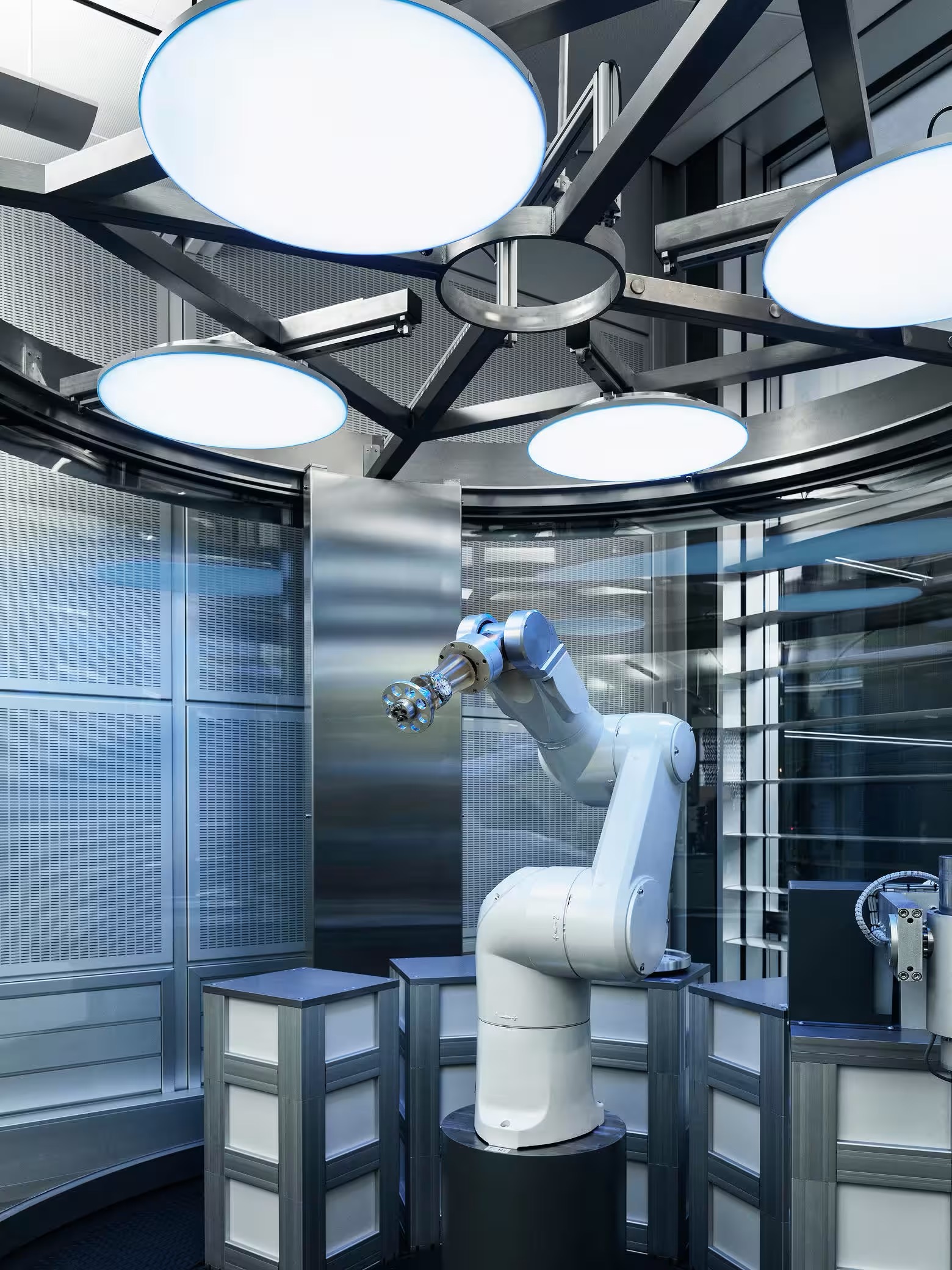
Rolex from the Inside. What Machines Truly Produce Its Watches?
Rolex, not surprisingly, is very keen to show case polishing, movement assembly, or a watchmaker bent over a workbench.
It's a beautiful sight and very catchy from a marketing perspective, but it almost never invites us to look deeper and reveal its industrial side. What happens on automatic lathes, machining centers, EDM machines, vacuum furnaces, PVD installations, transport robots, and production control software?
This is understandable because no high-end manufacture wants to admit to automation or disclose its machinery park. For Rolex, this is not only a production tool but also a part of its technological advantage, allowing for such a gigantic quantitative scale while maintaining quality.
The company protects information about suppliers, equipment models, and custom-developed solutions. Nevertheless, from official job offers, archived advertisements, patents, and factory reports, at least part of the brand's industrial background can be reconstructed.
This reveals a picture far more interesting than the marketing narrative of traditional craftsmanship, although some of that craftsmanship still exists, which I described in more detail here https://wowbook.pl/en/blog/the-ghost-factory-myth
Précitrame: a machine manufacturer closely associated with Rolex
The best-documented machine manufacturer used by Rolex is Précitrame Machines from Tramelan in the Bernese Jura.
The company builds specialized transfer centers designed for multi-operational machining of small and very precise parts. It sounds complicated, and indeed it is.
In the movement manufacture in Biel/Bienne, custom-made glazed modules for Rolex are used, where various operations are performed simultaneously: drilling, milling, turning, grinding, and finishing of mainplates, bridges, and other movement components.
However, these are not typical machine tools bought from a catalog. The modules were designed for Rolex's specific production organization, and several devices can be connected by a transport system into a single automatic line.
The relationship between the two companies goes beyond a typical manufacturer-client dynamic. When Précitrame's machine-building operations were spun off in 2001, Rolex acquired a majority stake in the new company. In practice, this meant taking control over one of the most important elements of its own production infrastructure, which has been a constant element of Rolex's strategy from the very beginning. As can be seen, this strategy is one of the foundations of the company's success.
Rolex thus not only became independent of parts manufacturers. It also began to secure access to the machines on which these parts are made.
Tornos and Citizen: microscopic parts produced in series
The second group consists of automatic lathes used for the production of small movement components: axles, pivots, screws, shafts, gear elements, and winding system parts.
Current recruitment advertisements for the Biel/Bienne facility directly mention Tornos SwissNano and Citizen R04 and R07 machines. The SwissNano was developed with watchmaking and micromechanics in mind. It is designed for fast, repetitive machining of parts whose dimensions and tolerances are measured in tenths or even hundredths of a millimeter.
Archived advertisements from Manufacture des Montres Rolex show that cooperation with these manufacturers has a longer history. In 2008, employees familiar with, among others, Tornos DECO 10, DECO Sigma 8, and Citizen Cincom M16-III, C16, and R04 were sought.
This does not mean that all these machines are still in operation, but it confirms the continuity of a certain production model; Rolex has been using Swiss and Japanese automatics of this type for years.
Bumotec, LIPEMEC, and machines whose models we do not know
An archived advertisement from Manufacture des Montres Rolex from 2008 also listed knowledge of Bumotec machines as an additional asset for so-called CNC setter positions. This involved five-axis milling and turning of components related to cases, bracelets, indices, and markings.
Rolex is also on the reference list of the French manufacturer LIPEMEC. The company specializes in precision grinding machines, pneumatic presses, and special machine tools.
Rolex also uses wire and sinker EDM machines. This is confirmed by both historical and contemporary recruitment advertisements. These machines are essential for producing extremely precise components and tooling, especially dies and molds. However, their manufacturer remains undisclosed to me.
NUM, Fanuc, and Siemens, or what controls Rolex machines
The machine tool itself is only half of the system. The other half is the numerical control responsible for axis movement, interpolation, spindle operation, tool correction, and communication with other elements of the line.
Rolex advertisements from 2007 and 2008 mentioned NUM and Fanuc systems used in CNC transfers, milling machines, and machining centers in Biel/Bienne. Newer job offers also confirm the presence of Fanuc and Siemens controls in the Fribourg facilities.
However, there is insufficient evidence to attribute specific Siemens Sinumerik or Heidenhain series to Rolex. Their presence is only technologically probable.
An interesting trace also appeared in building automation. A current Rolex job offer in Biel/Bienne mentions programming "PX and TRA" automatics managing air conditioning, lighting, blinds, and doors. Manufacturer documentation identifies these names as Siemens Desigo PX and Desigo TRA, i.e., Total Room Automation.
Machines that cannot be bought from a catalog
The most interesting part of Rolex's equipment, however, was custom-made according to specifications it developed itself.
This applies, among other things, to the production of the Parachrom hairspring. The niobium and zirconium alloy is prepared in a vacuum furnace using an electron beam. Industry reports describe the device as custom-developed and unique. Rolex does not disclose its designer.
The resulting material is then repeatedly drawn through successive dies and rolled into an extremely thin tape. Reports from Biel/Bienne mention the wire passing through about 50 successive drawing dies and dimensional control with accuracy measured in tenths of a micrometer.
Equipment developed for the company's needs also includes automatic movement oiling systems, electric screwdrivers with torque control, and under-table carousels where movements await subsequent assembly stages, protected from dust and accidental damage.
It is here that the true nature of Rolex production is best seen. Automation does not replace the watchmaker but takes over tasks where repeatability and precision are more important than individual manual work.
Silicon, ceramics, and thin-film technology
In Biel/Bienne, Rolex also conducts processes more characteristic of the semiconductor industry than traditional watchmaking.
Job offers confirm the existence of cleanroom infrastructure used for cleaning silicon substrates, thin-film deposition, photolithography, and etching. These processes are related to the development and production of silicon regulator components, including the Syloxi hairspring.
In Chêne-Bourg, there are devices for producing Cerachrom ceramic components. The process includes material forming, high-temperature sintering, surface treatment, and metallization of markings using PVD. Rolex officially admits to having purchased specialized equipment for this purpose but does not provide its manufacturers, and I have not yet discovered their names.
In the same facility, galvanic installations, coating equipment, and laser systems are used for dial production. Two different laser beams allow for matte and grainy surfaces and the creation of more complex decorations.
How Rolex verifies what it has produced
In the central laboratory in Plan-les-Ouates, a high-performance scanning electron microscope is in operation. It is used to examine gold, platinum, Oystersteel, and RLX titanium alloys and to detect defects invisible under a conventional optical microscope.
Rolex also confirms the use of complex devices specifically designed for testing wear, accelerated aging, and the resistance of cases and bracelets.
In the company's Centre de Mesures, 3D tactile measurement systems, optical devices, and profilometers for roughness testing are used. We know that inspection programming is done, among others, in the METROLOG environment, but we do not know the manufacturers of the coordinate measuring machines collaborating with it.
Rolex patents also describe an automated chronometric control station. The watch is positioned in various orientations by drives arranged on two axes, and cameras record the position of the hands relative to a precise time base. The images are then analyzed by software.
The patent does not yet prove that every production station looks exactly this way. However, it shows the direction in which control systems are developing: less acoustic evaluation, more optics, automation, and image analysis.
For diving watches, a hyperbaric chamber developed by COMEX is also used. It allows for tests at pressures corresponding to depths far exceeding the conditions in which the watch might find itself during normal use.
The factory beneath the factory
One of the most impressive pieces of equipment in Biel/Bienne is not a machine tool, but an automatic warehouse located beneath the production building.
The system includes over 46,000 storage locations, 14 aisles served by 14 stacker cranes, approximately 1.2 kilometers of conveyors, and 22 retrieval stations. Trays with parts move at speeds of up to three meters per second. Their path is managed by a routing system collaborating with approximately 60 PLCs, and the entire installation is monitored 24 hours a day.
In Plan-les-Ouates, a similar system operates with two twelve-meter silos and approximately 60,000 storage locations. Ordered components can reach the appropriate workstation within minutes.
Rolex confirms that all its main facilities use automatic, computerized storage and distribution systems. However, it is unknown who built them. In open sources, it has not been possible to confirm the involvement of Swisslog, Stöcklin, SSI Schäfer, TGW, Dematic, or Kardex.
Software is part of the machine
A modern factory cannot be described solely by a list of devices. Equally important is the software that connects design, machining, quality control, logistics, and production planning.
Current Rolex job offers confirm the use of PTC Creo for design, GibbsCAM for preparing machining programs, and METROLOG for programming measurements. Production and data flow are linked to MES systems from the FlexNet and DELMIA Apriso families, the SAP environment, and product lifecycle management systems.
Rolex also employs its own programmers working in Java, Python, C, and .NET, among others. Thus, it does not create all systems from scratch but independently develops integrations, production applications, and analytical tools. Précitrame, in turn, declares that it develops its machine interfaces internally.
The question of who writes the software for Rolex machines therefore does not have one simple answer, as some comes from control and machine tool manufacturers, some from industrial system suppliers, and some is developed within Rolex itself.
A Polish lead
A Polish lead also appears in this story. According to information I obtained, Rolex approached one of the Polish polytechnics with a query about the possibility of conducting specialized metrological tests of specific components. I was unable to officially confirm the details of this matter. It is also unknown whether it ended with a consultation or if the research was actually carried out. This should not be surprising, as similar industrial projects are usually covered by strict confidentiality agreements.
It is only known that it concerned small objects examined by optical methods, without interfering with their surface, using interference, focal differentiation, or confocal phenomena. Depending on the analyzed parameter, these methods allow working with resolutions from single nanometers to micrometers.
What could the inquiry have been about? One of the most probable leads is sapphire crystals for watches or material samples related to their production. Rolex manufactures almost all the most important components of its watches in its own facilities, but it does not grow synthetic sapphire, from which the crystals are made. This is one of the few areas where it remains dependent on external suppliers. Independent control of geometry and surface quality becomes all the more important: flatness, curvature, waviness, micro-roughness, polishing marks, micro-scratches, and other defects that could disqualify the component.
This is, of course, a hypothesis, not a confirmed subject of research. Rolex guards its secrets so effectively that even a Polish lead to its research facilities ends exactly where the NDA begins.
The most industrial of manufactures
Rolex does not produce watches solely with a file, a loupe, and the hands of an experienced watchmaker. Nor does it produce them on a single, fully automatic line.
It is a precisely designed combination of industrial scale, micromechanics, automation, in-house engineering, and manual labor. Automatic lathes produce thousands of identical axles and screws. Transfer modules machine mainplates and bridges. Robots deliver components. Vision and measurement systems control the results. Only between these processes does a human appear, performing tasks that a machine cannot perform equally well.
Rolex's most important advantage is therefore not a single machine tool or one mysterious process. It is the ability to combine hundreds of machines, IT systems, and manual workstations into a single controlled production organism.
And perhaps that is why the company is so reluctant to show it in its entirety.
P.S. What does Rolex not produce itself?
Rolex is considered one of the most comprehensive, integrated, and automated watch companies in the world. It melts its own gold alloys, produces cases, bracelets, dials, and movements, and even manufactures its own hairsprings. However, this does not mean complete self-sufficiency.
The most surprising exception is the hands. Rolex, like other well-known companies, does not produce them but uses the services of specialized Swiss companies Fiedler and Aiguilla. The first operates in Carouge near Geneva, the second in Biel/Bienne. The production of a single hand can require several or even dozens of operations, including blanking, forming the tube, grinding, polishing, electroplating, applying luminescent material, and surface inspection, which I discussed in more detail in the article https://wowbook.pl/en/blog/anatomy-of-a-watch-hand
The second exception is sapphire crystals. Rolex does not "grow" synthetic sapphire and relies on external suppliers for this. One of them is Stettler Sapphire, a company specializing in the processing of technical sapphire components. It also produced the 14.3 mm thick crystal used in the experimental Rolex Deepsea Challenge, prepared for the descent to the bottom of the Mariana Trench.
At least some lubricants also come from external sources. Technical documentation for Rolex movements mentions, among others, specialized oils and greases from Moebius.
The situation is probably similar for some gaskets, synthetic ruby jewels, and other seemingly secondary components.
This does not diminish the term "manufacture." Rather, it shows what modern luxury watch production is about. It's not about doing everything yourself at all costs, but about maintaining full control over the design, parameters, quality, and suppliers.
Even if some of the smallest elements are produced outside Rolex's walls.
Photo: Rolex SA / rolex.com