WoW Investigations
The Ghost Factory Myth: Why Your Rolex Isn't a Robot's Work?
The "robot factory" myth: A mathematical vivisection of Rolex production
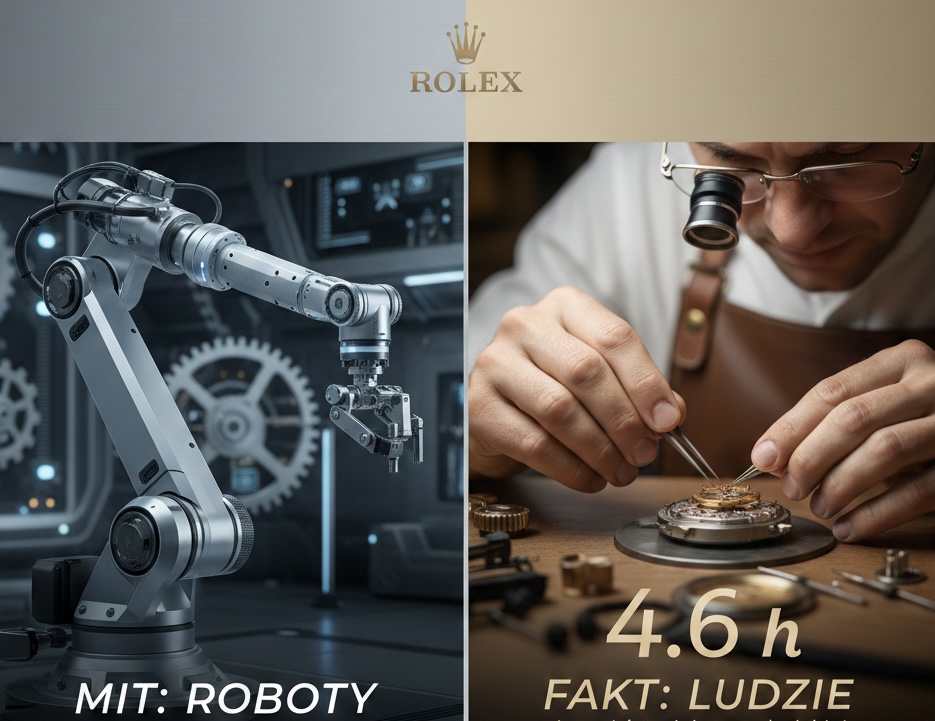
In collecting circles, as well as in the so-called average perception, a slightly malicious thesis circulates: "Rolex is not watchmaking, it's just automation, marketing, large-scale industrial production, brilliant logistics, and an army of robots."
It suggests that behind the doors of the Geneva factory – because it's not a manufacture, after all – you won't find a watchmaker with a characteristic loupe, but only gleaming arms of CNC machines and conveyor belts straight out of Tesla factories.
Of course, Rolex's production facilities are not a manufacture in the traditional sense we envision: traditional craftsmanship, long watchmaking tables by the windows, serious gentlemen and focused ladies, all sitting and creating watch movements with hand tools, diligently cutting bridge shapes with hairspring saws, and making winding stems with small lathes, pressing jewels with presses.
Of course, we will see (though probably not us, as it's hard to get in there) retinal scanners, and as beautifully described on Hodinkee, "logistics better than Walmart, vaults with a capacity of 12,000 cubic meters, connected by a network of rails totaling 1.5 kilometers, transporting over 2,800 trays of components per hour between 60,000 storage compartments and workshops upstairs," all straight out of sci-fi movies.
But not only that, because the truth is much more complex and, surprisingly for skeptics, profoundly different from the common perception, as well as the dehumanized image I deliberately presented at the outset.
Let's start by looking at the hard data, which sheds new light on what happens within the four pillars of the crown.
4.6 Hours – Mathematical Proof of Human Presence
Let's start with mathematics, because numbers have no prejudices. Industry analyses (Morgan Stanley, Vontobel) indicate that Rolex produces approximately 1.15–1.24 million watches annually. With a global workforce of around 15,500 people, of whom over 12,000 work in Switzerland, we can calculate the actual human labor input.
Assuming conservatively that approximately 3,250 (roughly 1/3 of the total) skilled specialists work directly in production, assembly, and quality control, the equation looks like this:
T=N*D*H/V
Where (T = average annual working time allocated per 1 manufactured watch)
* N = 3250 (production personnel)
* D = 220 (working days)
* H = 8 (working hours)
* V = 1,240,000 (watches per year)
The result? T is an average of 4.6 hours of direct human labor on each individual piece.
In a truly industrial world, where budget movements are assembled in seconds, these nearly 5 hours are a vast difference. This is the time for manually setting hands, regulating the balance spring, lubricating bearings, or multi-stage polishing of cases. A robot can cut a shape, but it's a human who gives it a "mirror finish."
Where Does the Camera End and the Eye Begin?
Rolex indeed possesses one of the most advanced automation systems in the industry, but it uses it where humans are simply... too weak or too imprecise. Below, I allow myself to list a few important and noteworthy facts:
* 904L Steel (Oystersteel): This steel is absurdly hard. Forming it requires 80-ton presses. Here, CNC machines are essential to ensure the repeatability of the "base." But once the case is ready, it goes to the polishing department, where a human hand feels microscopic irregularities and applies the final polish.
* Underground city of robots: In Plan-les-Ouates, a system of 14 logistics robots operates. But they don't build watches; they are assistants. Instead of making a watchmaker's assistant run around warehouses, a robot delivers a tray of parts in 10 minutes. Logistics automation serves to allow humans to focus on work at the bench, not on courier duties.
* Dials and indices: Here, technology loses to the biochemistry of the human eye. In Chêne-Bourg, each gold hour index is applied manually with tweezers and riveted from below. Why doesn't a robot do this? Because lacquered dials are too delicate. A robot does not yet possess the "feel" that would allow it to place an element without the risk of micro-scratches or damage.
Superlative Standard – The Double Quality Filter
Many brands boast about their COSC certification. For Rolex, this is only half of the tests, because after receiving the certificate from an independent institute, the watch returns to the manufacture, is fully assembled, and the second stage begins, with the final step being the so-called Visual Check. Under strong light and magnification, an employee looks for what a sensor won't catch, such as a minimal misalignment of the print on the dial or a speck of dust under the sapphire crystal.
Investment in Bulle – 2,000 Arguments Against Robotization
If Rolex planned complete robotization, why would it spend a billion francs on a new plant in Bulle? And why would it declare the employment of another 2,000 people there?
If the trend were solely to reduce the human factor, these numbers would be going down. Meanwhile, Rolex desperately needs hands to work, so much so that it is setting up temporary facilities in Romont to train staff even before the main factory walls are completed, which is scheduled for 2029.
My Verdict
Automation at Rolex is not about "saving on people." It's about eliminating errors where humans are fallible, so that watchmakers can dedicate their time to what is most important from the company's perspective: assembly, regulation, and aesthetics.
Your Rolex did not come out of a 3D printer. It passed through the hands of people who dedicated several hours of work to it, and the symbiosis of machine and human is simply an established level of balance between cost, quality, precision, and a certain kind of industrial art.
In conclusion, this is not a paean to Rolex, nor an attempt to glorify their business, but rather an answer to the question of whether the watches make themselves there.