WoW Investigations
Anatomy of a Watch Hand.
What you don't know about hands, or who stands above the dial of a Rolex, Patek, or Omega.
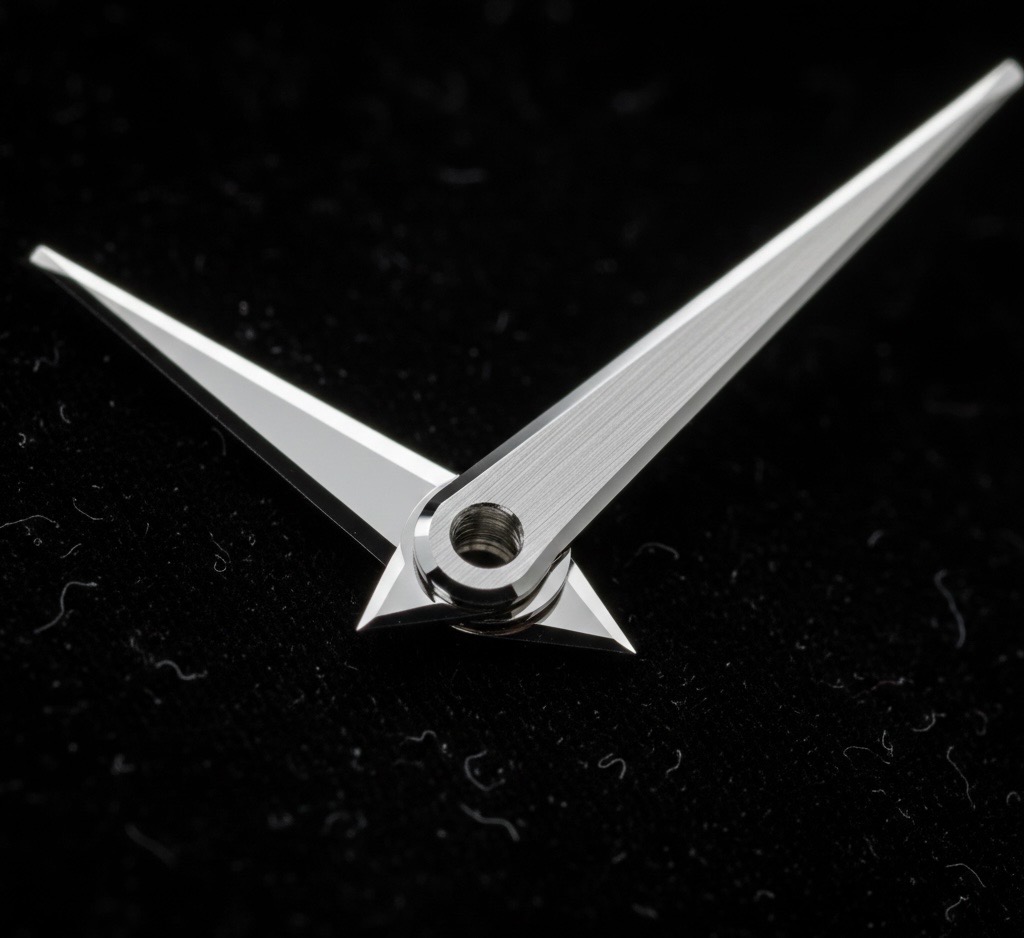
A silent oligopoly with very modest websites.
1. True Manufactures.
In the world of watches, we love to talk about manufactures. About "in-house," about 18th-century pedigrees, about their own gold foundries and balance bridge edges polished with boxwood. But we rarely ask a simpler question: who makes the hands?
These two, three (or more in some models) thin elements that actually tell the time are one of the most hermetic and at the same time most critical segments of the entire value chain. Without them, the whole narrative about centuries of the founder's family tradition loses its meaning, because the movement itself in the case would at best serve as a teaching aid in a watchmaker's workshop.
It turns out that even the biggest complications maestros like Patek Philippe, sales and recognition giants like Rolex, or lunar hegemons like Omega, do not make these, ironically, simple elements themselves.
What's more, only Seiko and Citizen, as well as Vostok, Raketa, and if we look at the group, Swatch Group, make their own hands.
If you look at the ideal manufacture that makes EVERYTHING itself (including hands, escapement with hairspring, glass, ruby jewels, lubricants, gaskets, dials, lume, and everything else), then perhaps only Seiko meets this definition. But that will be a separate article.
Returning to the hands, today the Swiss market for hand production is practically just a few companies: Fiedler SA, Universo SA, Aiguilla SA, Waeber HMS SA, and a few smaller entities operating on the fringes of the Jura arc. One hundred and fifty years ago, there were dozens of them. Today, it's an oligopoly with high barriers to entry.
For example, Fiedler has a total of about 170 employees, a small family business with an uninterrupted tradition of over 177 years, producing about 2.5 million hands annually. Bernese Aiguilla SA has a similar number of employees, producing 3.5 million annually, Weber from Neuchâtel is a small player, 60-80 people and less than a million in production, but Universo from Swatch Group is a giant, with 450 employees and over 10 million units produced annually.
However, this is not a romantic story about craftsmanship, but about full business control of the supply chain.
2. Consolidation as a survival strategy
A key moment occurred in 2000, when Swatch Group acquired Universo, the largest hand manufacturer in Europe. This was a purely strategic move, securing components for its own brands and simultaneously reducing dependence on external suppliers, as well as likely strengthening the barrier to entry for new players.
In practice, this meant that brands outside the group, including Rolex and Patek Philippe, had to rely even more heavily on independent manufacturers such as Fiedler or Aiguilla.
As a result, we have two parallel realities:
• a vertically integrated industrial giant (including Universo),
• independent, family-owned companies operating in the haute horlogerie segment.
3. The economics of a micro-element
A hand in a 50,000 CHF watch weighs fractions of a gram. But its production cost, with tolerances of 1 micron (one THOUSANDTH of a millimeter), is disproportionately high.
Estimated hand production (mid-segment) is <0.1 man-hours, but in the more luxurious segment (e.g., sports models of major brands), it's between 0.5–2 hours.
Now, haute horlogerie enters as a heavyweight, starting very seriously from several to several dozen hours of manual finishing.
We also have almost artistic, one-off projects, the sky is the limit, so it can be >100 hours of work.
At an assumed rate of ~45 CHF/h in watchmaking cantons, the labor alone for a set of hands in a high-end watch can cost more than the entire movement in an entry-level model.
This is why Rolex, despite its almost complete and highly automated production, still uses a specialized supplier, because building its own hand department with this scale of precision would mean years of investment and an uncertain return on investment.
3. Technology involves an almost unbelievable 40 operations on a piece of metal
The production of a luxury hand involves between 15 and 40 operations:
• blanking,
• stamping (companies like Aiguilla design and build their own presses to maintain accuracy, unattainable for "ordinary" market machines)
• skeletonizing (for such small elements, this is practically open-heart surgery),
• diamond polishing of edges (mirror shine),
• manual polishing,
• application of luminescent materials,
• visual inspection.
The most interesting thing, however, is what cannot be fully automated.
At Aiguilla, the process of placing hands into transport cards is done manually, as in the old days, with tweezers. Why? Because with a highly reflective surface, the vision system still loses to the human eye. Micro-scratches that kill the perception of quality in a 30,000 CHF watch are often only visible at a certain angle of light.
4. Scale versus craftsmanship
For comparison:
• Rolex produces approximately 1.2 million watches annually. The working time per piece is approximately 4.6 hours, in Omega 6 hours.
• Patek Philippe produces approximately 70,000 units annually, with hundreds of hours of work per watch in very complicated models (but 10-12 for simple ones).
In this model, the hands must be delivered "plug and play," meaning perfect, ready for assembly, without corrections.
Therefore, the hand supplier practically takes on part of the responsibility for the brand's reputation, although few know of its existence.
5. Digital silence
The websites of Fiedler or Aiguilla look like they stopped a decade ago. No aggressive marketing, no storytelling, no client names.
There are three reasons:
1. NDAs (full confidentiality) so brands cannot be named.
2. Protection of know-how; too detailed photos, boasting about technologies, etc., are a gift to the competition.
3. No need to acquire new clients; those who need to know, know. The market is closed.
6. The hand as a metaphor
The hand is a paradox of luxury:
• microscopic,
• expensive,
• invisible in marketing narratives, almost transparent
• absolutely functionally critical; most watches cannot function without it.
You can have your own gold foundry, your own alloy laboratory, your own CNC center. And still rely on a small company whose name the client will never see, and which is older than your famous manufacture.
In the world of watches, the most important elements often remain in the shadows. And perhaps that is why they have survived all crises, from the quartz crisis to the pandemic. Because they don't sell dreams, they don't build their position with marketing, brand ambassadors, or Formula 1 sponsorship. Instead, they sell a tolerance of one micron.