WoW Investigations
Watch mushroom picking
How not to mistake a watch for a marketing mushroom.
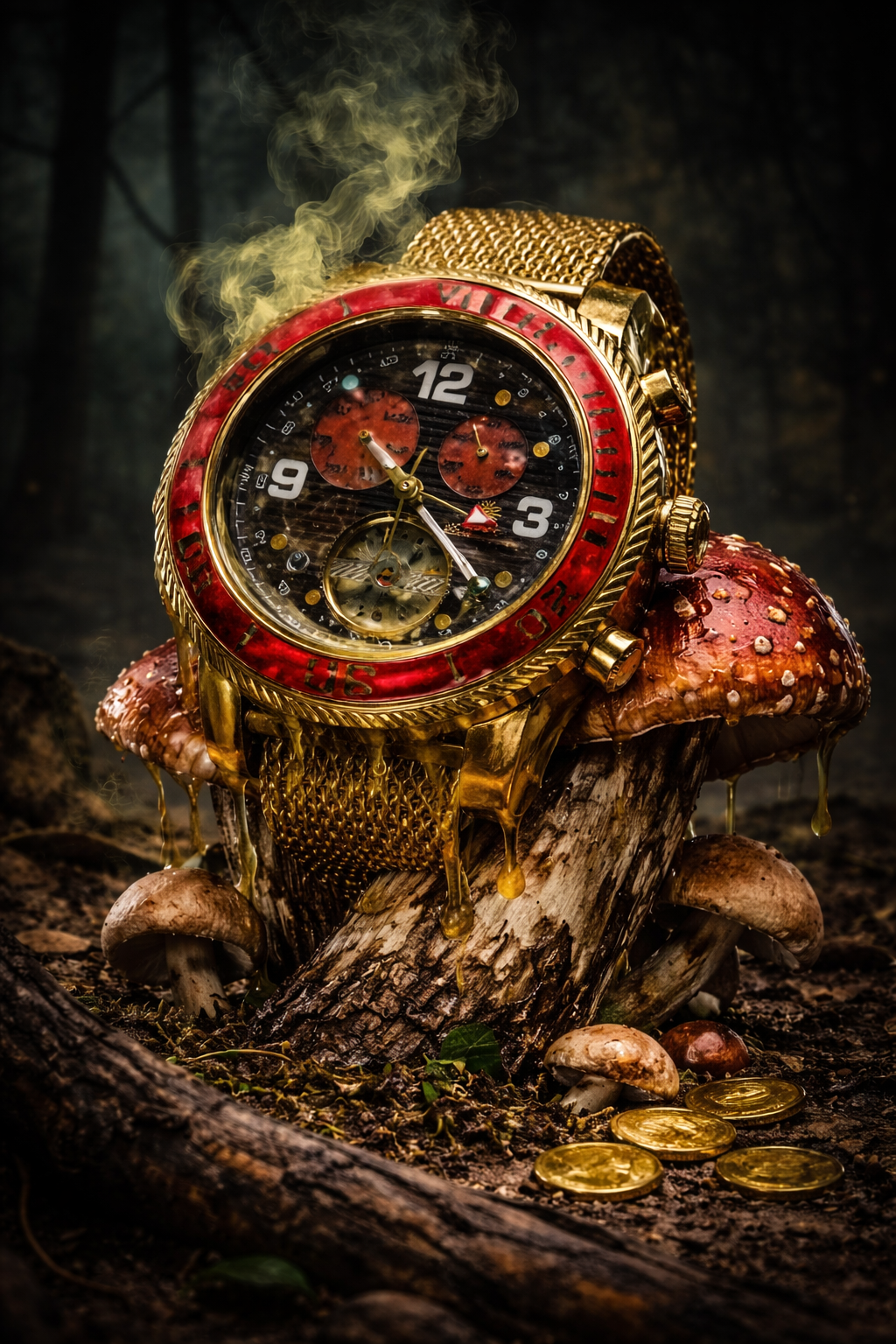
Mushroom watches
or watches that, like mushrooms, sprang up after a marketing rain
In the world of watches, there are brands that took decades to be born. First, there was a workshop, then a name, then technical solutions, customers, reputation, failures, triumphs, crises, and only at the very end, a legend.
And then there's the other type.
The type I personally can't stand.
Brands that don't so much emerge as they pop out of the ground. Suddenly and without roots. Without documented genealogy, but with a name that sounds as if the founder's great-great-grandfather polished bridges in the Black Forest in 1815, and the great-grandson still keeps old files and photos from the early days of Baselworld in a drawer.
These are what are often called mushroom watches or mushroom brands in the watch community. It's not an academic or legal term, but collector's slang. And a very apt one, because these brands really do behave like mushrooms: they grow quickly, love the dampness of marketing, the shade of e-commerce, and the fertile soil of customer ignorance.
Not every cheap watch is a mushroom brand, just as not every Chinese watch is. And not every watch with a European-sounding name immediately deserves this moniker. But there is a certain repeatable business model that can be recognized from afar.
Sometimes even by the foul smell of common trickery, which entices naive customers with its appearance, only to poison their minds and feed on the contents of their wallets.
Fortunately, the symptoms of poisoning usually pass quite quickly. The headache doesn't last forever; the emptiness in the pocket lingers longest. As a rule, however, the initial contamination induces a lasting immune response in the patient for the future.
How to recognize a mushroom watch
Most often, by the fact that everything looks a bit too good to be true from afar, and at the same time too vague to be easily verified.
Such a brand usually has several common characteristics.
First: the name
It sounds noble, European, preferably German, Swiss, or Italian. The name is supposed to work even before the customer sees the movement. It's meant to suggest tradition, even if there's nothing behind it but a branding department. Very often, some geographical appendage like London, Milano, Geneva, or another postcard from a marketer's imagination is added.
Second: the history
One that smells more of copywriting than of an archive. Somewhere, there's talk of "a return to old values," "traditional craftsmanship," "heritage," "passion passed down through generations." The problem begins when, after stripping away the marketing veneer, it turns out that this genealogy cannot be meaningfully reconstructed.
Third: the product
Composed of ready-made OEM components, usually from Asia, very often from China, but sold under a European narrative. The origin from China itself is no accusation, and that must be said honestly. The Chinese watch industry today can produce both mass-market junk and very solid, sometimes even ambitious, items. The problem only arises when a cheap Chinese product is sold as something it is not.
Fourth: mechanics as decoration
Skeleton, open heart, double balance, bizarre hands, flashy rotor, "tourbillon look," lots of visual attractions. All to make the watch appear more complicated than it actually is.
From afar, it's impressive. Up close, it can be a different story. The finishing is often machine-made, sometimes even tragic, as if someone, after a few YouTube tutorials, tried to replicate Lange & Söhne decorations with a file, bad intentions, and an excess of self-confidence. The rotor looks like it was cut from a tin can, the bridges resemble the handiwork of a student who only had technical drawing on Tuesdays, and the whole thing is more reminiscent of a fairground trinket than an exclusive boutique.
Fifth: the price
That is, an astronomical pseudo-retail price and a hellish promotion. So we have 399 euros, today 129, tomorrow 89, only now, last pieces, special offer, limited series number 1327 of 1999.
Real value? Often closer to what similar items cost on AliExpress, if, of course, one likes that style and level of technology.
Anyone who has ever been on vacation in Egypt or Turkey knows this negotiation model perfectly. This is not a market valuation. This is theater.
Sixth: secondary value
The most important thing. The secondary market is brutal and doesn't read advertising brochures. It usually only asks three questions: does the brand mean anything, can the product be serviced meaningfully, and does anyone other than the seller really want to buy it?
In the case of most mushroom watches, the answers can be painful.
Where do such brands come from?
For a very simple reason: this business model still works.
The modern market allows you to build a brand without a factory, without your own R&D, without history, and sometimes almost without a product in the classical sense. All it takes is a good name, ready-made OEM production, effective branding, aggressive performance marketing, and distribution through marketplaces, teleshopping, lifestyle stores, or networks that sell emotion, not horology.
This phenomenon is, in a sense, a cousin of the fashion watches market, about which I wrote in the article https://wowbook.pl/en/blog/fashion-watches-hit-or-miss. The difference is that a fashion watch usually states directly: I am a lifestyle accessory to a brand that operates, has been selling its products for years, and has a well-established brand in the public consciousness.
A mushroom watch wants to say something more.
And since it usually has nothing special to say, it starts to scream. And it tries to pass itself off as a watch with a pedigree.
Why "mushroom" and not just "cheap watch"?
Because cheapness is not the essence here. The essence is false genealogy.
You can make a cheap, honest watch. Citizen, Timex, Orient, Casio, and many microbrands have been showing this for years. You can also make an honest watch from China and communicate it directly, and that's no problem.
Mushroom begins where, instead of saying:
"here is a mass-produced fashion watch"
it says:
"here is a guardian of ancient values, an heir to tradition, an ambassador of craftsmanship."
In other words, a mushroom watch is not just a cheap watch. It's a cheap watch in the costume of pedigree. And sometimes also a classic example of balancing on a very thin line between clever marketing and outright misleading the customer.
Typical examples
This family includes brands of various types and calibers. Not all are equally toxic, not all are equally poor quality, but they operate according to a similar pattern.
Henry Bale London
This is almost a textbook case. The name sounds like a London chronometer gentleman, but in practice, we have a brand based on cheap Chinese production, aggressive discounts, showy skeletons, and an aesthetic designed more for a sales banner than for product longevity.
Raoul U. Braun
A great example of a brand that leverages the power of a name and associations. The mere coincidence with the legendary Braun of industrial design acts almost like a silent stowaway. Nothing needs to be said directly. It's enough for the customer to fill in the blanks. Mechanically, these are usually very cheap movements, and the product is built primarily around the prestigious sound of the name, not around horological value.
Carl von Zeyten
This is a more nuanced case. Because here we no longer have a purely ephemeral mushroom growing under a market leaf. The brand has real distribution and operates in normal retail. But the pattern remains similar: a created legend, a German costume, external movements, and paying primarily for the story.
Constantin Weisz
A very interesting example, because the very construction of the brand suggests old watchmaking art, although it's difficult to speak of a real historical master whose name would carry authentic heritage. This is almost a textbook case of "invented pedigree."
Important distinction: mushroom is not always junk
And this is the moment to be firm, because many texts here become too simplistic.
Not every mushroom watch is a technical disaster. Not every one has a terrible movement. Not every one will fall apart after a quarter.
Sometimes inside there's an NH35, a Miyota 8215, or some decent Chinese movement that will simply do its job. Sometimes the case is quite correct. Sometimes the watch will work for years.
The problem lies elsewhere.
Not in something being cheap.
Not in something being from China.
Not even in something being mass-produced.
The main problem is that the customer is sold a myth instead of an honest product definition. And along with it, a price that does not result from real value, but from marketing inflation.
Why it works so well
Because most people don't buy a watch the way an enthusiast does.
An enthusiast asks:
what movement,
what crystal,
what serviceability,
what history,
what secondary value.
The average customer more often asks:
is it pretty,
does it look expensive,
does the brand sound good,
is there a promotion,
will it make a good gift.
And there's nothing wrong with that. You just have to remember what happens when marketing starts to exploit this asymmetry of knowledge with full premeditation.
Because a mushroom brand doesn't sell time.
It often doesn't even sell a watch.
It sells a shortcut to prestige.
How to tell if something smells like a mushroom
The easiest way is to ask a few simple questions.
If, after visiting the brand's website, you find a legend about tradition faster than specific information about the movement, it's bad.
If the company's history sounds like a summary of a costume drama, but cannot be meaningfully substantiated by real sources, it's bad.
If everything is "limited edition," and at the same time there are dozens of models, it's bad.
If the catalog price seems absurd, and the product is almost always "on sale" at minus 70 percent or more, it's bad.
If the brand name sounds like it was generated by AI with the prompt: "make something between the Black Forest, Geneva, and a perfume bottle," that's also a bad sign.
Conclusion
Mushroom watches are not the greatest sin in the world. Much greater sins are fakes, Frankensteins, and all that beautiful pathology of "made-up" vintage.
But mushroom watches are a great case study because they teach one important thing:
not everything that looks like tradition has roots.
Sometimes it's just a product that grew after a rain of advertisements, fed with compost from stock stories, European-sounding names, and movements ordered from a catalog.
And with mushrooms, as you know, the problem is that from afar they can look very appetizing, but after consumption, they often produce quite peculiar symptoms.