Interviews
Vincent Calabrese
When convenience becomes the enemy of independence
Introduction
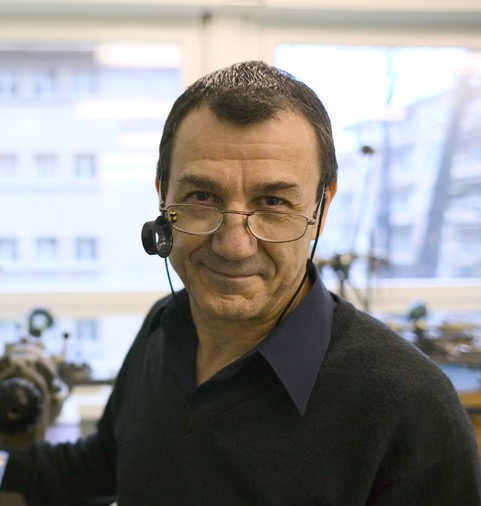
Vincent Calabrese was born in Naples in 1944. He came to Switzerland as a young man. There, without formal vocational training, being essentially self-taught, he deepened his knowledge, among other things, through courses at Patek Philippe and Rolex.
He worked as a watchmaker and restorer of old watches before deciding to go his own way.
In 1977, he presented a prototype movement with a linear caliber arranged in a straight line, visible through the case, at the Geneva International Inventors’ Show. René Bannwart, the founder of Corum, bought the patent and collaborated with Calabrese for the next three years on the project's development. In 1980, at the Basel fair, the watch went on sale as the Corum Golden Bridge. The movement was not hidden under the dial or treated as a technical element used to drive the hands. It became the main protagonist of the watch. In a world that for decades had primarily sold cases, dials, and brands, Calabrese proposed something opposite: the movement as content, not as a backdrop.
In 1985, together with Svend Andersen, he founded AHCI (Académie Horlogère des Créateurs Indépendants). This was not an organization intended to promote a specific aesthetic or new brands. Its goal was to create a space for watchmakers who wanted to act as authors of their own constructions, rather than anonymous executors of others' ideas. In times dominated by large industrial structures, this was an almost revolutionary idea.
Over the following decades, Calabrese developed his own constructions, promoted his invention of the carrousel escapement as an alternative to the tourbillon, designed movements for many brands, and consistently defended the watchmaker's right to independent thought. He also published an autobiographical book, "Le temps d’une vie," in which he describes both his own journey and the history of Swiss watchmaking.
Today, at over eighty years old, he remains professionally active. Under the Vincent Calabrese Hora Nova brand, he continues to design and sell his own watches, encompassing several collections: from technical constructions with unconventional time indications, through philosophical models referring to key moments of his career, to custom-made pieces. In a world where many pioneers of independent watchmaking have already passed into history, Vincent Calabrese remains an active participant in the discussion about what watchmaking is and what it should remain.
Photographs courtesy of Vincent Calabrese and Hora Nova.
WoW:
You founded AHCI in 1985, at a time when Swiss watchmaking was still feeling the effects of the quartz crisis. Looking back from today's perspective, was independence even considered in the terms we use today, or did concepts like authorship, creative freedom, and workshop sovereignty emerge later, with the evolution of the market and the language used to describe it?
Vincent Calabrese:
The crisis caused by the advent of quartz was a shock for watchmaking, which had become complacent and lived off its past achievements. At the same time, it stimulated creativity and gave new momentum to the watchmaking profession.
Thanks to this, watchmaking broke free from routine, and the watch became a world of refined mechanics through some artisan-watchmakers who began to think about it differently.
It was in this context, in 1977, that I decided to draw attention to all these artisans and bring them to the forefront of the watchmaking scene, whereas before they were merely anonymous "little hands," toiling in the shadows.
Paradoxically, the miracle of the quartz crisis was that it freed watchmaking from old patterns, unleashed creative forces, and broke conservative ways of thinking.
The quartz crisis became the foundation for the rebirth of mechanical watchmaking in the years that followed.
WoW:
At what point did you notice that the word "independent" began to mean something different than it did for you and the co-founders of AHCI?
Vincent Calabrese:
The word "independent" had its full meaning at the time of AHCI's founding in 1985.
Its meaning gradually began to wane when independent watchmakers started wanting to make a more comfortable living from their profession.
Then, at the turn of the nineties, commercial considerations began to dominate creative activity, and the concepts of profit and profitability came to the fore.
WoW:
Are there principles or values that you believe should never have been negotiated?
Vincent Calabrese:
Creativity and inventiveness require time, as well as the need to repeatedly revisit and refine one's work.
Hence the temptation to cut corners by using external production tools or specialized manufactures.
WoW:
Has the modern industry truly learned to look at the movement differently, or has it primarily changed the way it is communicated?
Vincent Calabrese:
For a long time, the fact that a watch is primarily a movement was ignored.
The Golden Bridge, enclosed in a sapphire case and showcasing its movement in all its glory, shook up people's thinking, who suddenly discovered the beating heart of a watch.
It was not only an evolution but also a revolution.
WoW:
Would you today admit a watchmaker supported by an investment fund, a creative director, and an extensive marketing structure to AHCI?
Vincent Calabrese:
The AHCI regulations state that only the watchmaker can be the creator of their watch.
No external entity – brand or manufacture – should interfere with their work.
It is rare for an investor, managing director, or marketing department not to be driven by financial considerations, productivity, or brand image.
It sometimes happened that a watchmaker presented a watch with a raw appearance, but with a movement that attracted all the attention.
Only connoisseurs can see its value and appreciate its ingenuity.
Only later can such a watch be aesthetically refined, retaining its movement, so that a wider audience can better understand and appreciate it.
A watch created in this way must first and foremost be a full expression of its creator's work.
Only then can it fall into the hands of brands or manufactures.
First, the watchmaker's work and competence.
WoW:
What does independence mean to you?
Vincent Calabrese:
Independence means freedom of thought, creation, and decision-making.
This sometimes requires the courage to go against established views and old patterns and to convince people who have been attached for decades, or even centuries, to outdated theories.
I myself had to fight for a long time to gain recognition for the idea of the Carrousel as an alternative to the tourbillon and to accept the obvious influence of gravity on the watch movement.
WoW:
Is there anything you, as the founder of AHCI, did not foresee?
Vincent Calabrese:
One can never sufficiently foresee human folly.
But this applies to all situations in life.
WoW:
What one warning would you leave for young watchmakers?
Vincent Calabrese:
Follow your own path.
Remain yourself, authentic, unwavering, and always keep your convictions fresh.
After the Conversation
Vincent Calabrese speaks sparingly. He doesn't build elaborate narratives, doesn't flirt with nostalgia, and doesn't try to convince anyone of his views. Answer number seven, the one about human stupidity, is the shortest in the entire interview and probably the most eloquent.
The most interesting aspect of this conversation, however, is that its main subject turns out not to be independence, but the moment when economics begins to replace creativity.
The contemporary industry is very keen to explain changes by the presence of investment funds, corporations, marketing departments, or market pressure. Calabrese, however, points to an earlier moment. According to him, the meaning of the word "independent" began to blur when independent watchmakers themselves started to strive for greater comfort and increased profitability in their operations.
This is an important distinction.
Calabrese nowhere claims that a watchmaker should be poor or that success is inappropriate. He does not contrast independence with wealth. He contrasts it with a situation where economics begins to set the boundaries of imagination. In his narrative, the problem does not arise when money enters watchmaking. The problem arises when money begins to dictate the direction of creativity.
This is precisely why he so often returns to the issue of authorship.
For Calabrese, a watch should not start with a brand, a marketing department, or market analysis. It should start with an idea. Only then can one think about its commercialization, aesthetic refinement, or production. In his answer regarding AHCI, he very clearly returns to this sequence: first the watchmaker's work and competence, then everything else.
This is perhaps the most important thing this interview opens up.
Over the past three decades, the industry has become accustomed to treating independence as a business category. Calabrese consistently refuses to accept such a definition. He doesn't talk about ownership structure, production volume, or the number of employees. For him, independence remains primarily the freedom of thought, creation, and decision-making. It is a state of mind, not a position in an organizational chart.
Equally interesting is his answer regarding the movement. When he talks about the Golden Bridge, he doesn't describe product success. He describes the moment when people first saw the "beating heart of a watch." In his eyes, the greatest revolution was not a new complication or new technology, but a change in the way the movement itself was perceived. Not as a hidden tool, but as the main content of the watch.
Finally, there is advice for young watchmakers: follow your own path.
It sounds trite. However, after reading the entire interview, it's hard to interpret it as a motivational slogan. It is preceded by stories of decades of disputes, of fighting against ingrained patterns of thought, and of the necessity to defend one's convictions against the opinion of the majority.
This is not motivational advice but a description of consequences.
Creative freedom, in Vincent Calabrese's understanding, is not a reward or a privilege. It is a commitment to bear the consequences of one's own decisions, even when the market offers an easier path.