Interviews
Denis Flageollet
What cannot be patented
Introduction
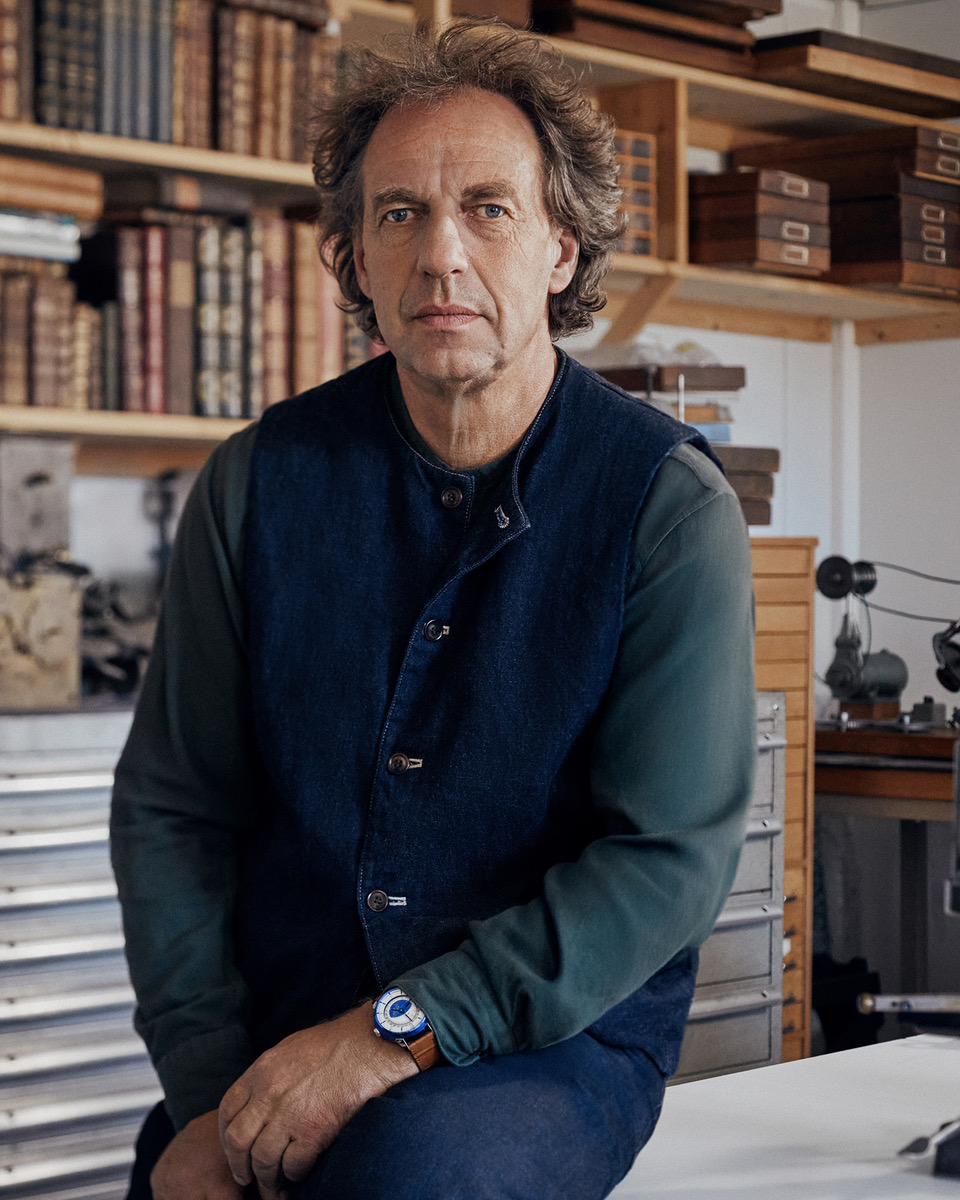
Denis Flageollet is one of those figures in contemporary watchmaking whose body of work cannot be confined to the history of a single brand. Before founding De Bethune with David Zanetta, he spent two decades restoring historical clocks and watches, developing movements for other companies, and helping to build one of the most fascinating technical environments to emerge during the formative years of modern independent watchmaking.
He comes from a family with deep roots in watchmaking. After completing a science-focused secondary education in France, he moved to Switzerland, where he studied watchmaking and micromechanics. He complemented his formal education with practical work on historical clocks at the museum in Le Locle. The restoration of old mechanisms became one of the foundations of his later way of thinking: before changing something, one must first understand why those who came before chose to construct it in precisely that way.
In 1982, he began working with Michel Parmigiani. He restored historical and complicated watches and was also involved in the development of an ultra-thin perpetual calendar for Breguet. A few years later, he established himself independently, restoring watches and creating unique pieces for collectors.
In 1989, he co-founded THA — Techniques Horlogères Appliquées — with François-Paul Journe, Dominique Mouret and Simon Bull. Other watchmakers later became associated with THA, among them Vianney Halter. Today, the name is most often invoked in connection with people who would later become important figures in independent watchmaking. For Flageollet, however, THA was no brief episode. For more than a decade, he was responsible for the technical side of the company, the organisation of its workshops and its research and development activities. Movements and complete watches were created there for other brands, alongside unique clocks and mechanical objects. De Bethune's official biography attributes more than 120 projects to this period; in our conversation, Flageollet himself speaks of eleven years of total commitment and of a team that eventually grew to more than thirty people.
After leaving THA, he used that experience to build something of his own and, as mentioned at the outset, founded De Bethune with David Zanetta in 2002. The idea was not to create yet another manufacture reproducing the aesthetics of historical watchmaking. Flageollet was interested in a different question: what could be done with the principles of classical watch mechanics when combined with contemporary knowledge of materials, physics and technology?
Over the following years, De Bethune became his laboratory. The manufacture developed 31 calibres and secured eight patents. It explored successive geometries for titanium and titanium-platinum balances, its own solutions for the hairspring, a silicon escape wheel, shock-protection systems and lightweight tourbillon constructions. One of its most recognisable innovations became the three-dimensional spherical moon-phase display. Titanium, meanwhile, ceased to serve merely as a lightweight structural material and became one of the defining elements of De Bethune's visual language.
Not every experiment resulted in a watch that would eventually appear in a catalogue. The Résonique project, developed from 2012 onwards, was an attempt to move beyond the limitations of the classical mechanical regulator. It did not achieve all of its intended objectives, and Flageollet makes no attempt today to portray it as an unqualified success. In this conversation, he explains that De Bethune took the project as far as the resources of a small team allowed and then decided to release it as open source. For him, an experiment that did not entirely succeed did not necessarily amount to wasted work.
He takes a similar view of inventions and patents. The mere fact that something can be constructed is not, in itself, sufficient reason to put it into a watch. Technology remains a tool, not an end in itself.
Today, De Bethune is in a very different position from the manufacture founded by Flageollet and Zanetta more than two decades ago. The 1916 Company is now its majority shareholder, but Flageollet has retained a stake in the business and remains its central point of reference in technical and creative matters. He continues to work on construction, materials and chronometry, but another theme is becoming increasingly prominent in his work: passing a way of thinking on to the next generation.
Perhaps the most far-reaching example is Mecavers. Flageollet does not regard it as a finished work, or even as something that belongs exclusively to him. He does not know whether he will live to complete it; its concept continues to evolve, and he sees the possibility of younger generations taking it over and developing it further not as a threat to his authorship, but as a natural continuation. In that sense, there is something of Gaudí and the Sagrada Família about it.
My own history with De Bethune does not begin with this interview either. In June 2014, the manufacture opened the official programme of the 10th Anniversary Annual Meeting of the Polish Club of Watch and Clock Enthusiasts in Warsaw, which I had the pleasure of presiding over at the time. Twelve years have passed, and today I return to De Bethune from an entirely different perspective — not to discuss another new release, but to ask the man behind its technical identity about the path that led him there.
Denis Flageollet began by studying and bringing back to life mechanisms left behind by those who came before him. He then spent years constructing for others, before creating a manufacture of his own. Today, he is increasingly concerned with another question: what of his knowledge and his way of working will remain for those who come next.
1. The boundary between restoration and creation
WoW:
Throughout your career you have restored some of the greatest masterpieces in horological history. Restoration often requires decisions that the original maker never documented.
Where, in your opinion, does faithful restoration end and the creation of a new work begin? Is there a point at which the restorer inevitably becomes a co-author?
Denis Flageollet:
Unlike an archaeological piece, where the priority is conservation and perhaps a visible restoration simply to convey what the original object looked like, watchmaking is far more complex. As in archaeology, we must understand the material without damaging its original treatments, but if we wish to restore the object's mechanical function, it often has to be restored entirely.
This raises the question of whether to preserve the object in its worn state without returning it to working order - often the museum's choice - or to bring it back to its original condition to appreciate its mechanical function and create an object that captures the imagination, as it did for its first owner. This is more often the collector's choice. In this case, and when the piece has suffered significant damage from time, we must put ourselves in the shoes of the object's creator. It is a fascinating exercise, but not a simple one. It requires extensive historical research, manufacturing knowledge, and intuition. It is an extraordinary experimental school. I hope I have prepared my research and studied the subject thoroughly enough during restoration not to have too often become a co-author, but inevitably, at some point, a choice must be made as close to one's own conscience as possible - a choice that is not necessarily the one the original creator would have made.
2. The most important lesson from THA
WoW:
Many conversations about THA focus on the remarkable projects and the people involved.
Looking back, what organisational principle or way of thinking that you developed during the THA years proved more valuable to De Bethune than any particular mechanism created there?
Denis Flageollet:
First, some context is needed. The watchmakers now known and credited as having participated in the THA adventure worked there for two to five years, and not full-time. THA is the first myth of independent watchmaking, so it's understandable that some who worked there for a time would want to highlight it. As for me, I took on technical responsibility and set up the production organisation from 1989 to 2001. This was therefore a total commitment of 11 years, creating calibres and watches for other brands, as well as unique pieces in clocks and mechanical art, all while building a team of over 30 people over the years. Before that, I had set up Michel Parmigiani's first production workshop. When I decided to leave THA following major disagreements, I had all the experience required to establish an independent manufacture and start from a blank page to create our own models.
The most important thing I took away from all these experiences is that nothing can be accomplished alone, and that you must know how to pass on your motivation to the team in order to produce the finest possible pieces. A manufacture must function as a single soul, not a multitude of egos, in order to give its very best.
3. Material or geometry?
WoW:
You have often said that everything begins with the material.
Yet many of your innovations are equally about geometry, mass distribution and the dynamic behaviour of a regulating organ.
In practice, which has proved the greater challenge throughout your career: the limitations of materials or the limitations of geometry itself?
Denis Flageollet:
In our physical world, everything begins with matter, and everything depends on matter - but we must not forget that matter is, in fact, only an arrangement of energy; it is 99.999% empty space. Once we understand and visualise this, we can see beyond matter and geometric composition, without of course forgetting that we remain subject to the laws of physics. The greatest challenge, then, is to physically translate what we perceive of the invisible. We must know how to transcribe the ineffable that comes to us from the great whole, while simultaneously accounting for the entirety of matter's reactions and the physical laws that accompany it. This inevitably leads to invention and innovation.
4. Résonique and the value of failure
WoW:
The Résonique project did not achieve all of its original objectives, yet it clearly influenced your later thinking about chronometry.
Looking back today, do you believe that the greatest advances in watchmaking more often emerge from unsuccessful experiments than from successful constructions?
Denis Flageollet:
The Resonique project came to me from a perception; we took it as far as our resources allowed. It would have required a dedicated team of at least five to six people to go further, which we did not have. We must remember that it took four centuries to achieve a properly functioning balance spring, and there are still improvements to be made. De Bethune therefore advanced as far as possible, and I decided to release it as open source, thinking the project could develop further over time. But I believe watchmaking is not yet ready for this kind of experiment - most major houses want to prove they invent everything from scratch, without building on others' research, even when it is offered freely.
This industry produces small objects and naturally confines itself to small ideas.
5. The durability of modern solutions
WoW:
Titanium, silicon and modern alloys have solved many traditional problems in watchmaking.
At the same time, their true long-term behaviour will only be fully understood after many decades of use.
Is there any solution currently used at De Bethune whose behaviour over the next fifty or one hundred years still remains, at least to some extent, an open question?
Denis Flageollet:
This is an essential question whenever a new material or technology is used. That is why we analyse materials, test them in all kinds of situations, artificially age them, and, if any concern remains, we design so that the component can easily be modified. Regarding silicon, for example, it could perhaps be replaced in our movements with standard-material components without a significant loss of reliability. I designed it this way precisely so that all our watches could be repaired by hand, by a craftsman.
6. Beauty versus practicality
WoW:
You have often emphasised that a watch should first be comfortable, readable and functional.
Is there a De Bethune watch that you still consider exceptionally beautiful, but which, with today's experience, no longer fully satisfies your own standards of practicality?
Denis Flageollet:
I have a DW1 that I wear from time to time. These Dream Watches are conceived in the spirit of "concept cars," seeking to go beyond conventional watches. The DW1 was the research laboratory between the DBS and the DB28 - an extreme watch in platinum, entirely monochrome, where the differentiation of elements is achieved solely through subtle differences in surface finishing. It is magnificent. I overlook its weight when worn and the fact that its legibility isn't perfect under all lighting angles. Its powerful presence erases these minor drawbacks.
7. Independence with a majority shareholder
WoW:
De Bethune remains one of the symbols of independent watchmaking, while today operating with the support of a majority investor.
Which decisions remain absolutely non-negotiable for you? In other words, what would you never agree to change, even if there were strong commercial reasons to do so?
Denis Flageollet:
It is the one who creates, who makes, who holds the knowledge, who decides -nothing is negotiable when it comes to the quality and reliability of our products. Our majority shareholders are indeed a support, because they are passionate about the brand and place complete trust in the team, but they are not, strictly speaking, investors. De Bethune has always developed organically and has never needed fresh capital. This is what makes it entirely independent, even in relation to its majority shareholders.
8. The ageing of your own creations
WoW:
As a restorer, the natural instinct is often to return an object as closely as possible to its original condition.
Yet a watch worn for twenty or thirty years also becomes a record of its owner's life.
Can you imagine a De Bethune watch that you would deliberately choose not to restore to factory condition because the traces left by time had become part of its identity?
Denis Flageollet:
I generally advise against restoring blued cases to a like-new finish; I find the patina they develop over time magnificent. Each case patinas differently depending on how it is worn - with its variations of blues and violets, it becomes a truly unique piece.
9. Legacy
WoW:
Imagine that, one hundred years from now, another watchmaker studies your work in the same way that you studied Breguet, Berthoud or Janvier.
If that person knew nothing about Denis Flageollet, what single principle would you hope they could still recognise simply by examining your watches?
Denis Flageollet:
I hope for nothing in particular. What is interesting about the work of the great watchmakers of the Enlightenment is not some singular trait - it is their body of work. It is the way they managed to transcend their own time and continue to make us dream, centuries later. I would give special mention to Janvier.
10. Patents and influence
WoW:
Several of your inventions have had a visible impact on contemporary watchmaking.
Which of your ideas do you believe has been most genuinely adopted by the industry? And has there ever been a moment when you consciously chose not to defend an invention too strictly because you preferred to see the idea live beyond De Bethune itself?
Denis Flageollet:
An amusing detail: I once found myself restoring a Patek Philippe grand complication pocket watch that had spent many years buried underground. It was entirely rusted, and disassembling the screws was an enormous ordeal. I swore to myself that I would find a way to solve this problem. When I designed the first DB2004 calibre, I worked extensively on the materials I would use. For the screws, I found a hardenable, easily polishable stainless steel. I thus managed to create screws capable of withstanding any conditions. At the time, we weren't set up to produce screws in series in-house. I approached a screw supplier who had to develop a new machining method to accommodate this change in material. In exchange, I authorised them to use this material for other clients as well.
At the time, it was common to find blued screws in watch movements. However, this new material does not blue. Within a very short time, blued screws disappeared from watch movements altogether — proof that my new material had been adopted across the entire watchmaking industry. There are other examples. I don't particularly seek this outcome, but I find it rather gratifying when others adopt my discoveries - it proves they are useful to the wider industry and that it was worth racking my brain over them.
The world and its different cultures fascinate me, but above all, so does nature itself. It is an inexhaustible source of inspiration for me. For as long as I can remember, whenever I have the chance, I’ve spent time in nature. It is, in a way, my invisible temple.
Having reimagined the play of light on the Côtes de Genève with the creation of the Côtes de Bethune, I wanted to capture the ever-changing spectacle of light on the surface of water. The random guilloché pattern was born of this contemplation: of the silvery glints shimmering across the waves of the sea or a lake, across expanses of water that come alive in the sunlight by day and beneath the moonlight by night.
This is the feeling I sought to convey when I designed the dial of the DB28 Starry Seas in 2022. I worked the guilloché in a deliberately irregular way to reinterpret the movement of the water. Since then, several brands seem to have adopted random guilloché.
11. Mecavers
WoW:
Mecavers appears to go far beyond the traditional idea of a timepiece. It feels almost like a project intended to outlive its creator.
Is there any part of Mecavers that you are consciously designing with the knowledge that someone else may ultimately complete it? And are you comfortable with the possibility that future generations may reinterpret some of your original intentions?
Denis Flageollet:
Mecavers is, for me, an object of transmission - it does not belong to me. I have no idea whether I will be able to finish it; its concept is in perpetual flux. It would be a pleasure for younger generations to take ownership of it and allow it to evolve.
12. Passing on a way of thinking
WoW:
Over the years you have passed your knowledge on to younger watchmakers and constructors.
How will you know that you have truly succeeded? Will it be when someone at De Bethune creates a solution that you yourself would never have imagined, yet you immediately recognise it as being entirely faithful to the spirit of the manufacture?
Denis Flageollet:
I already know I have succeeded, because it has already happened. The most important thing is to pass on one's passion for discovery - that is the finest legacy we can offer, and moreover, it is infinitely shareable.
13. THA revisited
WoW:
Looking back today, what was genuinely the most difficult challenge during the early years of THA?
Was it convincing clients, building trust, organising the team, or something entirely different that history rarely mentions?
Denis Flageollet:
Working day and night without having time to organise a strategy, and, unfortunately, without questioning the honesty of your partners - just making one exceptional piece after another.
14. The limits of innovation
WoW:
Throughout your career you have constantly expanded the possibilities of contemporary watchmaking.
Is there an invention that you consciously chose not to pursue because, although technically possible, you felt it would cross a boundary beyond which watchmaking would lose something essential?
Denis Flageollet:
More than ten years ago, we filed an important patent on the possibility of creating very large apertures [guichets]. I find a large aperture on a watch particularly vulgar - it is impossible to design a beautiful watch with very large apertures; there is no finesse in it. I therefore decided not to use this innovation.
After the Conversation
In Denis Flageollet’s case, the easiest way to sum up this interview would be to list his achievements: THA, De Bethune, 31 calibres, patents, new materials, balance systems, Résonique, Mecavers. Yet in my view, impressive as that list undoubtedly is, it tells us less about him than a few sentences that emerge between the technical details.
Above all, Flageollet does not treat watchmaking as a closed set of technical solutions that simply need to be executed with ever greater perfection. What interests him is testing the boundaries of what we already know and constantly searching for new possibilities. Sometimes this leads to a solution that can be patented and incorporated into a watch; at other times, it leads to an experiment such as Résonique, which he was unable to take as far as he had originally intended. For him, however, both belong to the same process.
That is perhaps one of the most interesting things about this conversation. In an industry capable of retrospectively rewriting almost every failure as an “important stage of development,” Flageollet simply says that something did not work. There were not enough people or resources, so the project was stopped. He later made it available to others. Even more striking is his explanation of why no one took it further: an industry that produces small objects too often confines itself to small ideas as well.
Equally revealing is his answer about a patent he decided not to use. You can invent something, solve a technical problem and legally protect the solution, only to conclude afterwards that the result would simply be ugly. In the world of luxury, where “innovation” has become one of the most overused words, there is something refreshing about that. An invention does not become valuable merely because it did not exist before.
There is another clear thread running through his answers. He began with restoration, trying to understand decisions made by people who have been dead for centuries. Today, he finds himself on the other side of that process. Increasingly, he is thinking not only about what can still be constructed, but also about what will happen to his own work afterwards.
That is why his answer about Mecavers strikes me as one of the most interesting passages in this conversation. “It does not belong to me,” he says directly about a project to which he has devoted years. He accepts that he may not complete it himself, and that those who eventually do may alter some of his original intentions. Even more striking is his answer to the question about passing on his own way of thinking: he already knows that he has succeeded, because it has already happened.
Perhaps this is where the two ends of Flageollet’s professional journey meet. As a young watchmaker, he tried to enter the minds of the old masters in order to bring their mechanisms back to life. Several decades later, he is himself leaving others not only watches and technical solutions, but also problems that he either did not have time to solve or deliberately chose not to resolve completely.
And perhaps that is a more interesting legacy than another patent.