Interviews
Cyrano Devanthey
Watchmaking without a Margin of Error
Introduction
Today, there are two parallel worlds in watchmaking.
The first is the world of technology, where precision is inherently coded, and repeatability stems from machines. The second is a world where precision still depends on human skill, the hand, concentration, and decisions made during work.
Oscillon belongs to the latter.
It is a project that consciously foregoes some modern tools, not because it is unaware of them, but because it wants to explore what can still be achieved without them. This is not a return to the past, but an experiment in self-imposed limitations.
In my conversation with Cyrano Devanthey, I was interested not in what the watch looks like, but in what the process looks like.
Where does an error occur, what happens when something goes wrong, and how much does one mistake cost?
Because in this work model, there is no room for "almost good."
Photos: Courtesy of Oscillon.
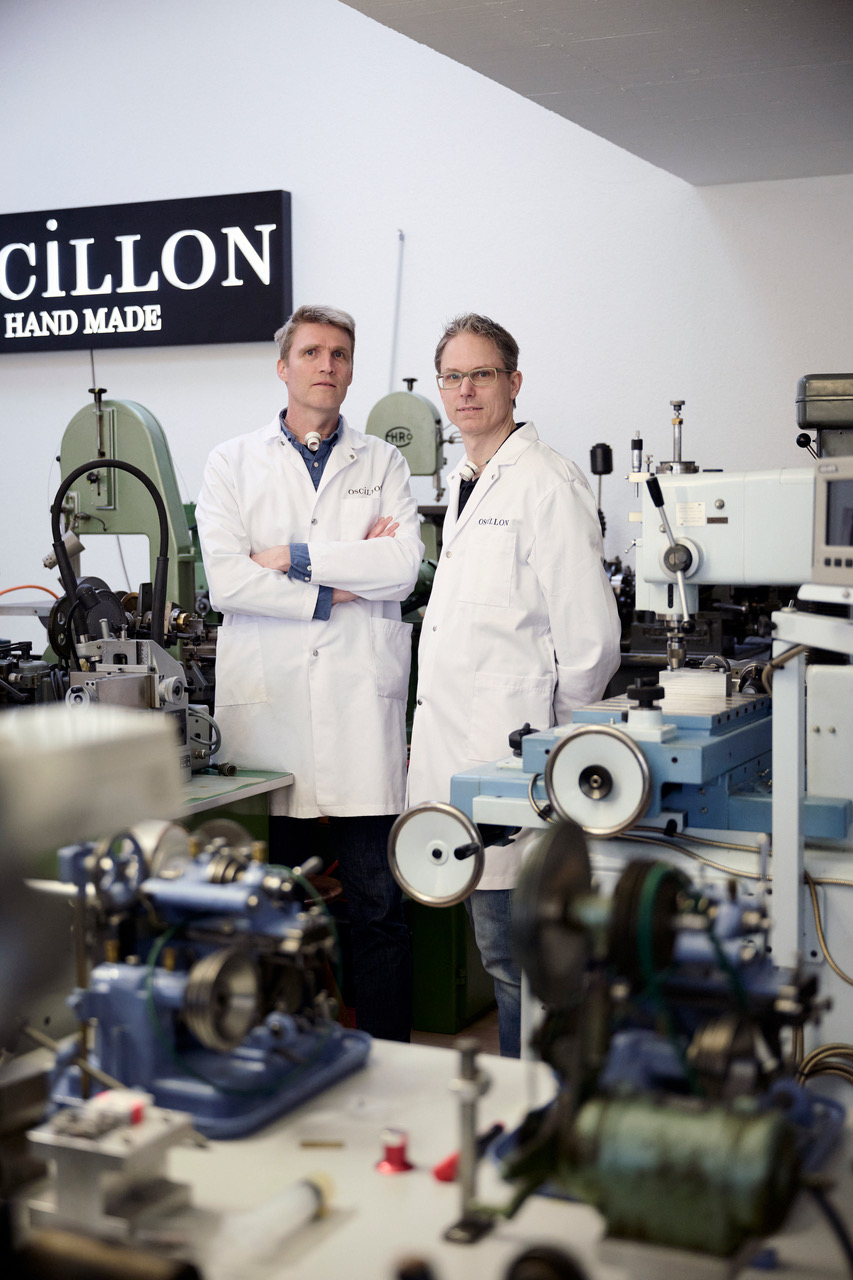
Cyrano Devanthey (right) and Dominique Buser.
WoW:
You often refer to a return to the 1950s.
Is there any aspect of modern metallurgy or tribology that you deliberately keep, even if it breaks the purity of that approach?
Cyrano Devanthey:
The 50’s are part of our inspiration for the design and movement architecture, as well as the manufacturing methods they had at their disposal at the time.
But we don’t close the eyes in front of modern technologies or knowledge.
We use CAD for the engineering of our timepieces with all the possibilities (for example FEM analysys) as well as modern alloys (decaflor, durnico etc.).
WoW:
Old machines like Schaublin or Hauser are often romanticized.
But they have no digital memory and no absolute repeatability.
How do you deal with tolerance stacking when every component is produced on machines that have their own character?
Cyrano Devanthey:
These machines are very precise, but the precision has to be retrieved by the person whom operates the machine.
Once the component is manufactured, we check the precision and geometry on the profile projector to make sure we are inside the tolerances and to avoid added errors and surprises during the assembly process.
WoW:
In Oscillon, geometry is not only designed but also constrained by the way it can be made.
Do you design the movement first, or do you design within the limits of the machines you actually use?
Cyrano Devanthey:
Already during the engineering process we have the manufacturing process and the available machines in mind.
This gives us the guidelines but also participates in the shape of the individual components and at the end of the whole watch.
WoW:
In an industrial process, cutting speed and cooling are controlled.
In your case, they depend on your hand, your rhythm, even your physical condition.
How much does your state on a given day influence the final component?
Cyrano Devanthey:
Not all manufacturing steps demand the same amount of concentration.
If we feel that today isn’t the right day to focus fully, we’ll just do something else that’s less demanding.
WoW:
Where is the point where traditional craftsmanship becomes unnecessary difficulty?
In other words, where do you draw the line between discipline and self imposed constraint?
Cyrano Devanthey:
Humans are lazy and always try to optimize and save time and energy.
We must limit ourselves by our philosophy.
The limits are reached when it comes to metallurgy or when highly specialized machinery is required for manufacturing.
For example, the blank of the hairspring, the mainspring, the sapphire crystals or the jewels.
WoW:
You have worked on extremely complex, high tech movements.
What is actually more difficult, designing a tourbillon in CAD, or achieving a perfect surface finish manually on a traditional lathe?
Cyrano Devanthey:
Both tasks demand different skills on different levels.
Sometimes it is more difficult to find the perfect engineering solution for a problem, sometimes it can take several days to find the perfect technique to achieve the nicest finish.
Most important on both subjects is to focus on the result and not give up.
WoW:
If two watches are made from the same plans, but entirely by hand, are they identical in your view?
Cyrano Devanthey:
There will always be minor differences between each of them.
This is the beauty of handcrafted items.
As each component is manufactured after the other there will always be minor differences, it’s like in nature, even on twins you will find small differences.
WoW:
Industrial movements aim for perfection under magnification.
Oscillon inevitably leaves traces of tools and process.
Do you see these marks as imperfections, or as part of the truth of the object?
Cyrano Devanthey:
We always aim for perfection in terms of manufacturing and finishing.
At some places we leave the original manufacturing marks as a hint of our manufacturing process.
This is like a signature of our philosophy and shows the truth of the process.
WoW:
If Oscillon produces only a handful of watches, how do you think about serviceability in 30 or 50 years?
Can another watchmaker repair your work without your tools and methods?
Cyrano Devanthey:
Actually we produce around five watches a year.
As we use only traditional methods and classic materials, there will always be a skilled watchmaker who can service our timepieces.
The same way a 200 year old pocket watch can still be serviced today.
At Oscillon we depend on the team, and the knowledge is transmitted to the younger generation.
Our goal is that Oscillon survives its initial creators.
WoW:
Modern watchmaking introduced materials and geometries that are not just difficult, but physically incompatible with traditional tools, such as silicon components, monobloc structures, or extremely thin profiles.
Do you see these as a different category of watchmaking, or as a direction that leaves the domain of what can be meaningfully made by hand?
Cyrano Devanthey:
This are the industry evolutions which is normal.
Every industry is always looking for improvements, cost savings, easier manufacturing etc.
Nothing is wrong with that.
Both philosophies ca co-exist.
It’s not because you can stream music you can’t enjoy a vinyl disk.
It all depends on your taste and how you want to explore your passion.
WoW:
What is something in modern watchmaking that cannot be recreated by hand, regardless of the watchmaker’s skill?
And on the opposite side, what is something that CNC can never achieve, regardless of precision?
Cyrano Devanthey:
There are modern manufacturing technologies like LIGA or the Silicon parts where there is no possibility to manufacture those components by hand (even if Anthony Randall made a cylindrical glass hairspring).
A nice beautiful hand polished rounded bevel (Anglage) can’t be achieved the same way with modern CNC technologies.
The modern technologies catch up, but there are still differences for the trained eye.
Our knowledgeable customers can spot and appreciate these differences.
WoW:
If you remove all narrative around Oscillon and leave only the object itself, what would still justify its existence?
Cyrano Devanthey:
Beside the manufacturing process and the limitation due to it, which is a big part of the value of the watch, our Oscillon timepieces are beautiful timeless wristwatches.
WoW:
In your answer about working with traditional machines, you mention checking tolerances after manufacturing.
What happens when something is slightly off?
Do you rework the component, or do you start again from scratch?
Cyrano Devanthey:
If the component can be reworked, we will do it.
But in most of the cases it wont be possible and we have to restart all over.
WoW:
You mentioned that on some days you choose less demanding tasks.
Are there specific operations in your process that you would never perform unless you feel completely focused?
Cyrano Devanthey:
Especially the tasks at the end of the process as we have already spent so much time to come to this point, that we will lose everything, if something goes wrong.
Also the drilling of the holes in the main-plate asks a lot of concentration as all the coordinates have to be correctly put on the machine in the X and Y axis and there are a lot of them.
If one hole is at the wrong place, the work of several days can be ruined.
After the Conversation
Oscillon is one of those brands that's easy to describe in a way that sounds great but means nothing.
Handmade, old machines, a return to roots. And just like that, you have ready-made Instagram content with the hashtag "craftsmanship," which a few thousand people like, and none of them will recognize the watch, but they might like the post.
That's why I was more interested in what happens in practice than the story itself. What happens when something goes wrong. And what it truly costs. Not in a financial sense, because that could be a separate and boring article, but in the sense of: what does it mean to start from scratch after several days of work.
So I asked about mistakes. And I got an answer I didn't expect, because subconsciously I anticipated a diplomatic "we try to avoid them" or "we have quality control procedures." Or something that sounds like craftsmanship but is just a well-dressed process.
Instead, I heard that if one hole is off, several days of work are ruined.
And that's the moment when it stops being a story about tradition and starts being a description of specific work, where one wrong move sets you back several days, with no "ctrl+z" combination and no beta version. There's no forgiveness and "we'll fix it in the next sprint."
Either it's good, or you start over.
In a world where most things can be optimized or have another iteration created, such an approach sounds like a real return to the past.
And perhaps that's why it was worth asking about.