Interviews
Sylvain Pinaud
Time is Part of the Product
Introduction
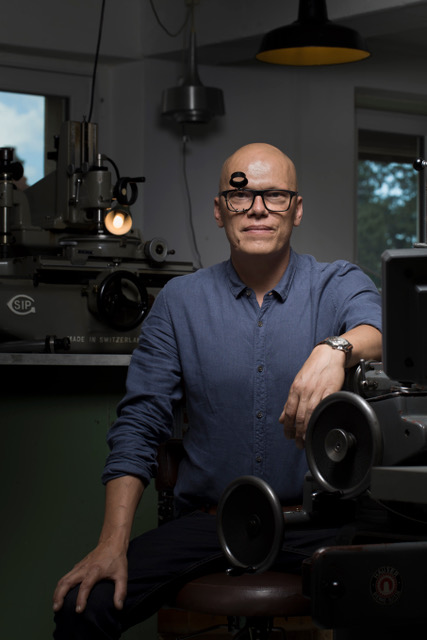
Sylvain Pinaud is not one of those independent watchmakers whose story begins with the idea of creating a brand of his own. Before his name appeared on a watch dial, he spent nearly two decades gaining experience across very different areas of watchmaking, from high complications to the restoration of historical movements.
The son of a watchmaker, he grew up around the workshop and later attended watchmaking school in Morteau, on the French side of the Jura. He worked for Franck Muller, where he encountered high complications, before joining Dominique Mouret’s workshop in Sainte-Croix, which specialised in the restoration of historical clocks. For several years, he worked on clocks and mechanisms by makers such as Abraham-Louis Breguet, Ferdinand Berthoud and Antide Janvier, learning to look not only at what they had made, but also at how they had thought.
That experience is important to understanding Pinaud. Restoration allows you to look inside a mechanism in a way that even the best textbook cannot provide. You can see the construction decisions made by past masters, the way they solved problems, their proportions, simplifications and, at times, their compromises. Sainte-Croix, a place associated for generations with watchmaking, precision mechanics and automata, became Pinaud’s place of work and remained so when he eventually began working under his own name.
His first watch of his own creation was the Chronographe Monopoussoir Artisanal, a project connected with the Meilleur Ouvrier de France competition, which earned him this prestigious French title. Pinaud constructed the watch himself, learning CAD design along the way, and presented it publicly at Baselworld in 2019. Technically, it was a success. Commercially, much less so. The watch attracted attention and admiration, but this did not immediately translate into orders.
The breakthrough came in 2022 with Origine. This time, instead of another complication, Pinaud created a watch displaying hours, minutes and seconds. Its apparent simplicity, however, was only the starting point. A large 13.2 mm balance was positioned on the dial side, while the architecture of the movement was shaped both by the demands of chronometry and by its distinctive asymmetrical composition. Origine earned Pinaud the Horological Revelation Prize at the Grand Prix d’Horlogerie de Genève. Just a few years after presenting his first watch, his name had become one of the most interesting in contemporary independent watchmaking.
The award itself, however, is less interesting than the path that led to it. Pinaud knows both contemporary watchmaking and constructions created long before CAD, CNC and today’s production models. Now he finds himself at yet another stage. His workshop is growing and, as he openly acknowledges in our conversation, he is no longer able to personally carry out one hundred percent of the work on every watch. He therefore faces a question that sooner or later confronts almost every successful independent watchmaker: how do you grow a workshop while retaining control over what leaves it?
That is why I do not ask Sylvain Pinaud about his next reference, its price or planned production numbers. I am more interested in what he considers a well-made watch today, why chronometry still matters so much to him at a time when more accurate timekeeping ceased long ago to require mechanical watchmaking, and what happens to a watchmaker’s work when his name begins to attract more customers than his own two hands can serve.
WoW:
In independent watchmaking, the aesthetic dimension of the movement is often emphasized.
You frequently speak about chronometry.
Is precision, for you, a matter of technical ambition, or a responsibility toward the owner of the watch?
Sylvain Pinaud:
For me, chronometry is both a technical ambition and a responsibility.
Since its origins, watchmaking has been a constant quest for precision. It is one of the fundamental reasons why mechanical timekeeping has evolved so much over the centuries. I believe that, as contemporary watchmakers, we have a responsibility to honour that heritage in our creations rather than considering precision as something secondary to aesthetics.
Technical ambition is what drives me to understand the mechanism as deeply as possible and to constantly look for ways to improve it. But once a watch leaves the workshop, it no longer belongs to me. Someone will live with it, wear it, and trust it to measure their time. I therefore feel a responsibility to deliver something that is not only beautiful, but fundamentally sound and precise.
I do not see precision as an isolated performance or simply as a number on a timing machine. It is part of the integrity of the watch, and in a way, a form of respect for the history of our craft.
WoW:
In your workshop, every watch passes through your hands from beginning to end.
What does full control over every stage of the process mean to you?
Is it purely a matter of quality, or does it also have a personal dimension?
Sylvain Pinaud:
Having control over the entire process is important to me because it preserves the coherence of the original idea.
A watch is not a collection of independent components. Its construction, finishing, proportions and adjustment all influence one another, so understanding the whole process is essential.
Today, as the workshop has grown, I can no longer personally work on 100% of every watch. But this also gives me the freedom to continue creating, designing and developing new mechanisms. I remain closely involved in every stage and keep control of the overall vision and standards.
For me, this is how I can continue to create while allowing the workshop to grow.
WoW:
What determines the pace of your work, your calendar, or the mechanism itself?
Sylvain Pinaud:
Ideally, the mechanism determines the pace.
Of course, there are deliveries, commitments and a calendar, but I try not to let them dictate the rhythm of the work. A mechanism has its own logic, and sometimes it requires more time than expected.
I would rather produce fewer watches and remain faithful to the way I believe they should be made than accelerate the process simply to meet a number. In independent watchmaking, time is also part of the product.
WoW:
Is there a moment in the process when you begin to hesitate?
At that point, what is more difficult, to refine something once more, or to decide that it is enough?
Sylvain Pinaud:
I probably attach too much importance to details and proportions.
For me, a creation rarely feels right immediately. I need time, and often many rounds of questioning and adjustments, before I can truly feel proud of it.
Sometimes the smallest detail can change the balance of an entire watch. I can spend a great deal of time looking at proportions, surfaces or the relationship between two components.
The difficult part is knowing when to stop. But for me, that time and those constant questions are an essential part of the creative process. I need to be convinced myself before I can feel that a creation is truly finished.
WoW:
Does the place where you work, Sainte-Croix, with its tradition of mechanical automata, influence the way you think about the construction and aesthetics of your watches?
Sylvain Pinaud:
Yes, very much so.
Sainte-Croix has a very particular relationship with mechanical objects. Before developing my own watches, I worked here restoring antique clocks, which had a strong influence on the way I approach mechanics.
Working on these historical pieces taught me a lot about traditional construction methods, the logic of mechanisms, and the importance of making something both functional and beautiful.
I think this heritage inevitably finds its way into my work today. For me, a movement should not only measure time; it should also be something you want to observe, understand and discover.
After the Conversation
What interested me most in Sylvain Pinaud’s answers was not what he says about handcraft, but what he does not try to pretend.
Pinaud openly admits that, as his workshop has grown, he is no longer able to personally carry out one hundred percent of the work on every watch. This may seem like a minor detail, but it touches on one of the more interesting questions facing contemporary independent watchmaking.
The market has grown very fond of the image of the solitary maker. A man bent over his workbench, designing, milling, polishing, regulating and assembling every watch with his own hands. It is an image that sells extremely well because it offers the perfect opposite of the industrial production associated with the major brands. Yet sooner or later, success brings with it a very mundane problem: a human being still has only two hands, and there are still only twenty-four hours in a day.
Pinaud does not try to hide this paradox. His answer is more pragmatic. He does not need to perform every operation himself, but he wants to understand the entire process and retain control over construction, finishing, proportions and regulation. Independence therefore ceases to mean solitude at the workbench. It begins to mean responsibility for the whole. And to me, that is a very honest position.
Even more interesting, however, is where Pinaud draws the line of that responsibility: precisely where the contemporary watch market often stops looking for it, namely accuracy.
The mechanical watch lost the competition for accurate timekeeping to quartz, smartphones and atomic clocks long ago. One could therefore argue that chronometry has become secondary in luxury watchmaking. If the customer is primarily buying design, history, craftsmanship and emotion, a few additional seconds of deviation per day will hardly change his life. Pinaud, however, reverses that logic.
Not because he believes that the mechanical watch will once again win the race for the most accurate measurement of time. Rather, he treats precision as an obligation arising from the very nature of the object. A watch may be beautiful, hand-finished and exceptionally rare, but it remains an instrument designed to measure time. If a watchmaker consciously abandons the pursuit of accuracy simply because the customer is buying something else, he is also abandoning part of his own craft.
This is why Pinaud’s statement that precision is part of the “integrity of the watch” is particularly powerful. It is not an extra, nor a figure to be quoted in press materials, but part of the integrity of the construction itself.
His answer about the pace of work follows a similar logic. Pinaud obviously has deadlines, clients and commitments. He does not work outside economic reality. Yet he makes a point that is important precisely because of its simplicity: if a mechanism requires more time, it should be given that time. It is better to make fewer watches than to accelerate the process simply to reach a planned number.
And this is perhaps where the most interesting contrast appears.
In industrial production, time is one of the costs. Every additional hour of work increases the cost of the product and reduces the efficiency of the process. For Pinaud, that same additional hour can become part of the product’s value. Not because “handmade” looks good in a catalogue, but because time allows the maker to look once again at a proportion, a surface, an adjustment or a detail that still does not feel quite right.
Pinaud himself puts it much more simply:
“In independent watchmaking, time is also part of the product.”
Perhaps this sentence captures the most important difference between a small workshop and the luxury industry. Not the number of CNC machines or the number of employees. Not even how many components are made by hand.
The difference begins at the moment when one has to decide whether the next hour of work is still a cost, or has already become value.
And then there is Sainte-Croix. Pinaud did not go there to build his own brand, but to work on historical clocks. By taking apart old constructions, he encountered solutions created in a world without computer simulations, five-axis machining centres or modern quality-control systems. What remains of that world is mechanics that, two centuries later, can still be opened, understood, repaired and brought back to life.
Perhaps that is why Pinaud’s final answer provides such a fitting conclusion to the conversation. A movement should not merely measure time. It should also be something one wants to observe, understand and discover.
There is no contradiction here between chronometry and aesthetics.
First, the mechanism has to make sense. Only then can it be beautiful.
That final thought is crucial to me. “First, the mechanism has to make sense. Only then can it be beautiful.” It is not a quote from Pinaud, but our conclusion from the conversation. And that is precisely why it works so well as its closing thought.