Interviews
Vianney Halter
The Man Who Showed That a Watch Can Tell a Story
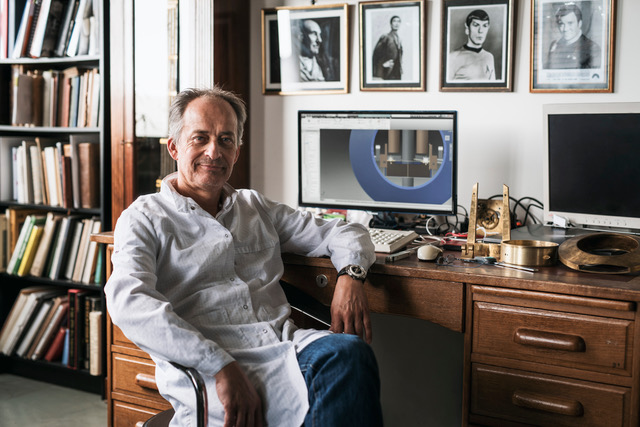
Introduction
Some watchmakers build flawless movements. Some create beautiful watches. And a rare few are able to change the way an entire industry thinks. Vianney Halter belongs to that last group.
He was born in France in 1963. As a teenager he entered the École d'Horlogerie de Paris, where he received a classical watchmaking education and gained his first professional experience restoring historic clocks and watches. It was there that he learned the craft in its most traditional form: patience, working metal by hand, and respect for the constructors who came before him.
The turning point came in the late 1980s, when François-Paul Journe invited him to Sainte-Croix. There he joined Techniques Horlogères Appliquées (THA), where he worked alongside Journe and Denis Flageollet. The atelier would become one of the most important laboratories of modern watchmaking. This was the setting in which some of the most complicated constructions of the era took shape, for houses such as Breguet and Cartier, while names like Jaquet Droz, Franck Muller and Audemars Piguet also drew on Halter's skills as a constructor. Though the THA name remained almost invisible to clients, its influence on the development of modern fine watchmaking is hard to overstate.
After leaving THA, Halter continued carrying out subcontracting work through his workshop, Janvier SA. At first, nothing suggested that he would go on to create watches under his own name. As he admits in this conversation, it was a decision of the heart, not a business plan.
In 1998 he presented the Antiqua, a watch that was a shock to some and a revelation to others. Its riveted, irregularly shaped case, its four separate perpetual-calendar displays recalling the portholes of a submarine, and its aesthetic drawn from nineteenth-century science fiction resembled nothing that had appeared before in the world of luxury watches. Today the Antiqua is regarded as one of the milestones of independent watchmaking, and its highest auction results have passed one million dollars.
I remember very well the first time I saw photographs of this watch, and back then I never imagined that one day I would have the honour of interviewing the man who created it.
His influence does not end there. In the years that followed, Halter created, among others, the Deep Space Tourbillon, a central triple-axis tourbillon suspended beneath a high sapphire dome, and then the Deep Space Resonance, one of the most original contemporary interpretations of the phenomenon of resonance in watchmaking. At the same time he collaborated with a range of brands, from Harry Winston to Louis Erard, Massena Lab and Behrens, proving that an independent creator can preserve his own identity even beyond the walls of his own atelier.
Yet it would be a mistake to reduce Vianney Halter to his technical achievements alone. For many collectors he has become the symbol of a creator for whom a watch was never a product, nor even an instrument for measuring time. His work draws on the literature of Jules Verne and H.G. Wells, on the aesthetics of the industrial revolution, and on visions of a future that might have arrived a hundred years ago.
In the conversation you are about to read, however, Halter says surprisingly little about mechanics. He speaks far more about freedom, independence, his disillusionment with the world of business, his collaborations with other creators, and about why, despite every difficulty, he has never regretted the decision to follow his own path. That is why this interview is not only a conversation about watches, but above all about a man who for more than thirty years has consistently proven that true independence begins where calculation ends.
WoW:
THA brought together remarkable personalities under one roof – François-Paul Journe, Denis Flageollet and yourself. Looking back today, what were the most important lessons you took from that period, and how did they influence the way you later built your own brand?
Vianney Halter:
Independence and freedom are the foundations of my life. With that background, making products (either in the watchmaking field or others) is a way of expression to me. I am kept fascinated by that, and that is what I discovered while working at THA’s.
⸻
WoW:
In the 1990s, you had the skills, contacts and experience to pursue a career within the largest Swiss manufactures or continue developing complex mechanisms for other brands. Instead, you chose the far more difficult and risky path of an independent creator. What led you to that decision, and was there ever a moment when you genuinely regretted it?
Vianney Halter:
During the 1990s I mostly used to work as a subcontractor. I mean, I was already creating things, but those creations were dedicated to brands.
Making watches bearing my name is complete chance; I was pushed this way through sheer luck. In other words, my heart made that choice, not my mind. And I never regretted it, as this allowed me to remain free.
⸻
WoW:
Independent watchmaking is often presented as the story of a solitary creator. Yet every important watch is the result of many hands and many minds. Do you think the industry gives enough recognition to the people whose names never appear on the dial or the movement?
Vianney Halter:
The business world is vile. Its only target is profit (exactly like Ferengi people!)
This will never change. In this context, the persons involved in the industrial making are not valued. They are hidden, although they contributed to the result. Obviously, this is not paying tribute to them.
⸻
WoW:
Antiqua became one of the most recognizable watches in the history of independent watchmaking. Looking at that project nearly thirty years later, what do you consider its greatest success, and what would you do differently today?
Vianney Halter:
The Antiqua is finally in tune with its time….30 years after its birth. At that time, people did not understand that it was a special piece, as it came out too early. Whereas today, the new generation is more curious, more open-minded and therefore more cultivated.
Thus I am not surprised that during a recent auction sale, the price of one Antiqua has risen over 1 million dollars.
I would make things exactly the same, otherwise the Antiqua would not become the iconic piece it is today 😉
⸻
WoW:
Looking back at your career, do you see yourself primarily as a watchmaker, a movement constructor, or a creator of concepts? What is the most important element of the watchmaking process for you?
Vianney Halter:
First, I am a watchmaker. Obviously, after a career in this world, I am also a constructor, a builder, a creator…and a dreamer.
A watchmaker must first master his/her craft and, for that, to practice for a long time of his/her life. BTW, most of the pretended independent watchmakers do not.
⸻
WoW:
Your watches have been described as instruments, machines, and storytelling objects. How do you personally define what it is that you create?
Vianney Halter:
I tend to think that my work can be compared with writing, painting, drawing or sculpting. I mean, it is only a channel/a way to tell a story. It is up to each one to find the meaning of it….
⸻
WoW:
Through collaborations with Louis Erard, Massena LAB and, most recently, Behrens, your design language has entered watches created in a very different economic and manufacturing environment from your own atelier. What convinced you that these collaborations were worth pursuing?
Vianney Halter:
Some projects and ideas that I had in mind came to birth thanks to those collaborations. Without them, they would not have appeared in the tangible world. Thus, collaborations allow me to do more things, and also, to make my work affordable to more people.
⸻
WoW:
Each of these collaborations seems to involve a different balance of creative responsibility. How do you decide what can be entrusted to a partner? Where does the line of compromise lie for you – what element of a project must remain unquestionably yours in order for you to put your name behind it?
Vianney Halter:
It is all about the human relationship between the parties. If it is smooth and trust based, I do not need that the elements I am supposed to bring are precisely defined. The crucial point is to agree regarding the technical difficulties and challenges, and to pool ideas to obtain a joint product.
Sometimes the result of the collaboration bears more VH elements than elements of the other party, sometimes it is the opposite.
⸻
WoW:
Over more than three decades, not everything can have gone according to plan. Which failure, setback or technical disappointment taught you the most, and how did it influence the projects that followed?
Vianney Halter:
The major disappointment I faced with is about administrative difficulties. I thought I would be able to develop within a system who would protect me. Unfortunately, it turned out to be a deficient system. After years, I observed that the Swiss administration is not designed to protect you.
As a compelling example, I registered several patents, in order to protect my inventions. For that, I did all that was required and I invested a significant amount of energy and work in Switzerland. Unfortunately, I realized that it is pointless. I naively thought that patents were designed to protect people, but the goal is to undermine them. It is a big disappointment.
As a result, I had to take action to work with States that respect work, innovation and creativity. Adapting to that kind of process requires a lot of energy, and therefore prevents you from spending it in the field that you excel. Thus I had to learn to avoid that kind of trap, to focus on what I love doing: being a watch maker.
⸻
WoW:
If you were twenty years old today and starting your journey in a world shaped by algorithms, social media and financial speculation, would you still choose watchmaking? And do you believe a young independent watchmaker could still build a career along a path similar to the one you followed?
Vianney Halter:
Indeed the contemporary world is shaped by new technologies and activities. Nevertheless, that does not necessarily cancel the previous ones. Human still enjoy hobbies that withstand time, and horology – at least the way I conceive it – is part of them.
As said, my target when making horology products is not to tell time, but is to tell stories, like sculptures and, by chance, eventually, those objects tell time.
By the way, where is the line/the frontier between a technical object and a piece of art? Does a same object stops being a piece of art just because it tells time…?
In this in mind, anyone who is passionate in her/his field, if she/he is strongly motivated, is able to give a try – provided her/his approach is sincere.
After the Conversation
The easiest way to tell the story of Vianney Halter is through the Antiqua, the Deep Space Tourbillon or the Deep Space Resonance. These are watches that have secured their place in the history of modern independent watchmaking and made his name one of the symbols of creative independence. The problem is that, looking only at the finished works, it is easy to miss the man who stands behind them.
This conversation shows a different side of Halter.
Not first and foremost the constructor of complicated movements, but a man who reduces almost every important decision in his life to a single idea: freedom.
He does not talk about planning a career, or about building a brand according to a business plan. Quite the opposite. He admits that the decision to make watches under his own name was not the result of cold calculation. As he puts it: “The heart made that choice, not the mind.”
That is telling. In a world that increasingly describes independent watchmaking in the language of investment, limited editions and auction records, Halter remains someone who still speaks the language of craft and of an inner need to create.
One of the most personal answers in the whole interview concerns not a watch, but patents, and his disappointment with a system that, as he sees it, works against creators rather than protecting them. It is a rarely raised subject in the world of haute horlogerie, where conversations usually centre on successes, and far less often on the institutions that are supposed to support them.
Equally interesting is his view of collaboration with other brands. He does not define it through the scope of responsibility or the division of authorship. What matters most turns out to be trust. Sometimes there is more of Vianney Halter in the finished piece, sometimes more of the partner. He does not try to weigh the two. What counts is the shared goal and a result that neither side could have achieved alone.
What stays with you most, though, is the answer that closes the conversation. Asked about the future of the profession, Halter does not begin to analyse the market or technology. Instead, he poses a question of his own:
“Where is the border between a technical object and a work of art? Does the same object stop being a work of art simply because it shows the time?”
That is, in fact, the best key to understanding his entire body of work.
Because Vianney Halter never set out to build the most accurate watches in the world. Nor did he try to build the most complicated or the most luxurious constructions merely to impress with a count of complications.
As he says himself: “When I make watches, my aim is not to tell the time, but to tell stories.”
Perhaps that is why his watches still feel like objects from an alternative history: a future imagined a hundred years ago, one that never became real, and yet still seems surprisingly close.