Interviews
Julien Vermeulen
The man who gave feathers a new meaning
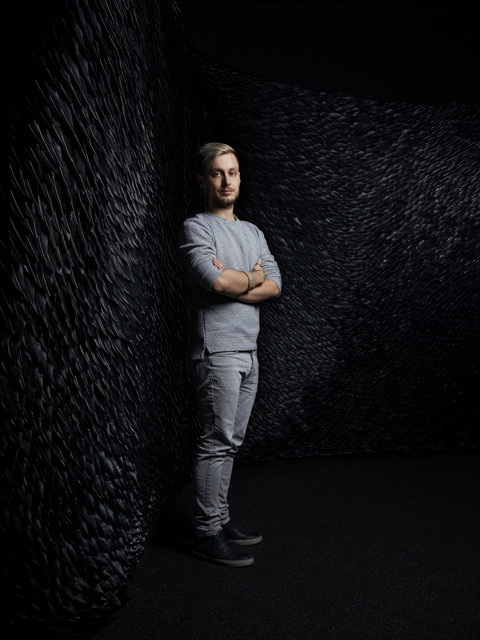
Introduction
Before his work entered the world of haute horlogerie, Julien Vermeulen had already earned acclaim within the French art and fine craft community. He is a plumassier, a specialist in featherwork whose roots lie in decorative workshops, theater, and Parisian haute couture houses. Yet, he never intended to limit himself to merely crafting ornaments.
Born in 1991, he discovered the art of featherwork during an internship with Jean Paul Gaultier. He studied fashion design at the École Duperré, trained in fine arts at the Sorbonne, and mastered craft techniques at Maison Lemarié, among others—a house tied to haute couture for decades. In 2014, at just 23 years old, he founded his own atelier, Maison Vermeulen.
Over time, he collaborated with houses such as Dior, Chanel, Louis Vuitton, Schiaparelli, Givenchy, and Cartier, while simultaneously developing his own artistic body of work. Feathers, traditionally used to adorn garments and hats, transform in his hands into paintings, sculptures, decorative panels, and installations. Cut, dyed, woven, and shaped, they alter texture and the way light reflects off them.
Among his key creations is Black Ocean, an installation created in 2017 for Paris’s Palais de Tokyo. Across an area of about twenty square meters, Vermeulen arranged more than twelve thousand individually trimmed turkey feathers coated in black ink. The piece was completed in just fifteen days, but required around a thousand hours of labor in total. A year later, it earned him the Prix Liliane Bettencourt pour l’Intelligence de la Main, an award celebrating mastery in fine crafts.
This was not his first success. In 2016, he received the Rising Talent award at Maison&Objet and the Grand Prix de la Création de la Ville de Paris in the fine craft category. Further accolades followed, and in 2022 he was awarded the title of Maître Artisan Plumassier. His work Black Gem was also acquired for the permanent collection of the Musée des Arts Décoratifs in Paris.
Gradually, Maison Vermeulen’s scope expanded beyond featherwork alone. Weaving, knitwear, developing new materials, and technological experimentation broadened the atelier’s horizons. In 2023, the Fondation Rémy Cointreau supported the workshop in acquiring a digitally controlled weaving loom—a telling detail in the career of a craftsman practicing one of France's most traditional specialties.
Today, Maison Vermeulen operates in Coutures, in the Maine-et-Loire department, and presents its creations through the Parisian gallery Maison Parisienne, among others. Julien Vermeulen’s portfolio encompasses collaborations with major fashion and high jewelry houses as well as bespoke pieces created for collectors. With Feathersnake, crafted for Vacheron Constantin, his art entered yet another realm: watchmaking.
Photos courtesy of Julien Vermeulen and the brand's official website
WoW:
For much of its history, the art of featherworking was tied to fashion, millinery, and haute couture. Today, you are introducing it into sculpture, design, and now also watchmaking. Do you believe that in order to preserve a traditional craft, one sometimes has to break away from its traditional applications?
Julien Vermeulen:
Definitely. A craft that remains frozen in its traditions would eventually simply disappear.
Craftsmanship is a living matter: it remains in contact with the spirit of the times, the sensibility, and the rhythm of its era. It must therefore constantly adapt, evolve, and seek new applications and new territories.
In my opinion, preserving artisan skills is not about endlessly replicating them in an unaltered form. On the contrary, one must understand their essence, the gestures, the knowledge of the material, and the quality requirements, and then allow them to continue living in a contemporary context.
Tradition is only truly preserved when it is able to evolve.
WoW:
When Vacheron Constantin approached you to work on the Feathersnake, what was your initial reaction: “it’s possible” or rather “feathers shouldn’t be forced to work on such a scale”?
Julien Vermeulen:
My first reaction was not really wondering whether it was possible or impossible. In fact, throughout almost the entire project, I worried about whether I would be able to bring it to completion.
I started from the lower part of the snake, and the further the work progressed, the more difficult it became: the curves grew sharper, the surfaces smaller, and the feather fragments finer and harder to control.
It was only after passing the eye area, practically near the end of the project, that I truly began to believe I would manage to finish this piece.
Until that point, uncertainty remained. That is also what made the execution so intense: I worked without knowing for sure at the outset whether the technique being developed would achieve the intended result.
WoW:
Did you feel at some point that it was no longer just about miniaturizing a traditional featherworking technique, but about inventing an entirely new method?
Julien Vermeulen:
Yes, absolutely.
Usually, one hand holds the feather and the other holds a tool. There is thus direct contact with the material: you feel it between your fingers, touch it, understand it almost physically.
In the Vacheron Constantin project, this relationship changed completely. At this scale, fingers become almost too large. The elements have to be manipulated using very fine tweezers, and then with a sequence of tools: a micro-scalpel to reshape the feather, a pinhead to bend it and give it a curve matching the volume of the snake, and later a micro-applicator to apply minimal amounts of adhesive.
At a certain point, the gesture becomes closer to marquetry, or even surgery, than to traditional featherwork.
The material remains the same, but the way of holding it, transforming it, and even looking at it changes completely. That was when I felt we were creating a new technical language grounded in an ancient craft.
WoW:
What was the most difficult aspect: radically scaling down the work, or subjecting such an unpredictable material to the constraints of a watch?
Julien Vermeulen:
The greatest challenge was definitely the scale: miniaturizing the material without losing what makes a feather remain a feather.
It was necessary to preserve its shape and structure, but also its reflections, depth, and that particular way it catches the light.
At such dimensions, the line is extremely fine: you move very quickly from a genuine feather barbule to something that is almost just dust.
The entire difficulty therefore lay in reducing without destroying. In preserving enough material for the eye to still recognize the feather, while simultaneously achieving a delicacy suited to the scale of the dial.
WoW:
Is the unpredictability of natural materials and the human hand becoming one of the last true forms of luxury?
Julien Vermeulen:
I do not fear technical or technological progress. To me, a tool is neither good nor bad in itself: it simply allows one to work more efficiently, more precisely, and sometimes to go further.
For instance, I don’t think there is any particular point today in making a watch screw entirely by hand if it brings no added value to the object. Entrusting this task to a machine capable of extraordinary precision allows us, on the contrary, to concentrate time, intelligence, and human skill where they truly matter: on the pursuit of complications, aesthetics, emotion, or a new form.
However, I am deeply convinced that true luxury lies in the care and attention devoted to the execution of an object.
It is not the absence of technology itself that makes something precious, but the sum of choices, time, exacting standards, and sensibility invested in its creation.
For me, luxury begins when we go beyond mere function and create an object genuinely imbued with beauty.
WoW:
How much of the 250 hours was spent on crafting the final piece, and how much on experimentation, failures, and discarded solutions?
Julien Vermeulen:
In reality, it is very difficult to separate the two, because Feathersnake was above all a research project.
The exploration, trials, errors, and the execution of the final piece constantly influenced one another.
The technique didn’t really exist prior to starting the project: it took shape gradually, alongside the difficulties encountered. Each successive section of the snake presented a different problem and forced a change in gesture, tool, or method of preparing the feather.
So I was learning as I worked.
A significant portion of those 250 hours belongs to a very empirical process in which the execution of the final piece and the research formed virtually a single whole.
WoW:
How were the roles divided during the creation of Feathersnake?
Julien Vermeulen:
Vacheron Constantin had already selected this caliber beforehand for a collection dedicated to the artistic crafts, precisely because it freed up as much space as possible on the dial and allowed the invited artists great freedom of expression.
So I was not involved in the choice of the movement itself.
Its architecture, however, offered a particularly interesting space to develop a true composition, almost a miniature work of art.
The horological constraints were already defined, but within them, vast room was left for artistic interpretation. The caliber did not attempt to visually dominate the whole; on the contrary, it created the conditions for the featured craft to become the main subject of the dial.
WoW:
Who is truly the author of the final piece: the manufacture, the guest artist, or both?
Julien Vermeulen:
To me, this is the true work of an artisan craftsperson, in the truest sense of the term.
The client, here Vacheron Constantin, arrived with an idea, an imaginative world, constraints, a schedule, and a specific intention. My role was to place my skills in the service of that intention and find the technical solutions to give it shape.
So I felt more like an artisan serving art than the author of the entire piece.
I am very proud of the result and of this collaboration, but I do not consider Feathersnake a work of which I am the author in the fullest sense of the word.
I was one of its interpreters—the one who possessed the technical expertise needed to translate the concept into physical matter.
And it is precisely this position that interests me in artistic craftsmanship: knowing how to step into the background enough so that an idea can become reality.
WoW:
Who owns the know-how developed during this process?
Julien Vermeulen:
Maison Vermeulen remains the sole owner of its know-how.
That is precisely why Vacheron Constantin approached us: because we possess a rare, specialized expertise.
This collaboration therefore did not mean transferring our know-how, but enriching it. It pushed us to expand our techniques in a new direction, to develop tools, gestures, and methods that, without this project, we probably would not have explored in the same way.
Today, this experience broadens our possibilities. It allows us to envision new applications for feathers, on different scales and across other objects, while remaining a natural continuation of Maison Vermeulen’s skills.
WoW:
How will such a dial age over thirty, fifty, or a hundred years?
Julien Vermeulen:
Feather is a material that seems extraordinarily fragile, but under proper conservation conditions, it can exhibit astonishing durability.
An anecdote that I find fascinating illustrates this well: in Tutankhamun’s tomb, discovered in 1922, several fans were found. One of them had preserved ostrich feathers after more than three thousand years.
This does not mean, of course, that a feather is indestructible. Like any organic material, it remains sensitive to insects, light, humidity, and storage conditions, among other factors. Other feathers found in that same tomb were, in fact, in much worse condition.
Yet the ability to endure several millennia shows that a properly protected feather is far more durable than its apparent lightness might suggest.
Inside a watch, it is situated, moreover, in an exceptionally well-protected environment, entirely different from a textile or a decorative object directly exposed to the surrounding elements.
WoW:
Will such a dial be restorable in fifty years?
Julien Vermeulen:
As long as I am professionally active, it will be possible to correct any changes and damage that might appear on this piece.
In fifty years, however, one must hope that I will have duly fulfilled my duty as an artisan: that I will have passed on my knowledge, and that it will have been transmitted further. This is how the art of featherworking has survived in France for over five hundred years.
One more thing must be made clear, however: even today, recreating an exactly identical piece would be impossible.
This stems from the very nature of the project. Each fragment of feather was hand-cut, one by one. Every single one is unique in terms of shape, size, curvature, and iridescence. Nature itself gave each feather a slightly different color.
If we were to make this snake again, we could recreate its character, composition, technique, and overall appearance, but we would never achieve a perfectly identical copy.
A new piece would necessarily be similar, but also entirely unique.
WoW:
How do you reconcile the rarity of the material, its traceability, ethical sourcing, and artistic needs?
Julien Vermeulen:
For this project, we needed a feather capable of creating spectacular reflections. Because the object is extremely small, a genuine explosion of color and light on a very compact scale was essential.
That is why we chose Himalayan monal feathers, whose iridescence is particularly intense.
We have long worked with a supplier specializing in rare feathers, who in turn maintains relationships with passionate breeders. The feathers used come from molting: they fall out naturally in aviaries and are then carefully gathered, one by one. No animal is killed to obtain these feathers.
This aspect is crucial for us. The revenue generated by breeding also helps maintain conservation programs for endangered species, supporting, among other things, captive breeding, reintroduction, and genetic exchange.
For me, the rarity of a material only holds value when accompanied by clear traceability of origin and ethical sourcing. I would reject a material, no matter how beautiful, if the way it was acquired conflicted with that requirement.
WoW:
Isn’t pitting hand craftsmanship against machines ultimately a false dichotomy?
Julien Vermeulen:
If a machine remains a tool guided by the human will to create beauty, I see no problem with it whatsoever.
It can allow for greater accuracy, repeatability, and sometimes greater ambition, thereby opening up new possibilities.
However, if the human hand achieves a better result than a machine, then in my view there should be no room for compromise.
True luxury is founded precisely on such an exacting standard: choosing at every stage the solution that yields the most appropriate, beautiful, and refined result, even if it demands more time or greater skill.
So I do not believe in systematically opposing the hand to the machine. The real question is which tool best serves the vision.
Yet when the hand contributes something irreplaceable, luxury must accept the time, complexity, and cost that come with it.
WoW:
Is high horology’s opening toward other disciplines a consequence of the growing difficulty in surprising audiences through mechanics alone?
Julien Vermeulen:
I think both phenomena are very closely linked.
The miniaturization and sophistication of movements continue to advance, partly thanks to new technologies and, increasingly, artificial intelligence. I am therefore convinced that watchmaking still has much to offer us on a purely mechanical level.
As for collaborating with artisans and artists from outside the industry, I see it as a natural continuation of what the decorative arts have always done.
Watchmaking has long drawn on engraving, enameling, gem-setting, and other artistic crafts. Today, it also welcomes wood, paper, embroidery, and feathers.
In my opinion, this is not a break with tradition, but rather an evolution of contemporary taste.
Techniques change, sensibilities evolve, but the principle remains the same: enriching the horological object by allowing mechanics to engage in dialogue with other forms of creation.
WoW:
If a private collector were to commission a Julien Vermeulen work integrated into a mechanical watch, would you accept such a project? And who ultimately needs whom more: feather art needing high horology, or vice versa?
Julien Vermeulen:
I did indeed receive similar proposals following the project's presentation in Venice.
But to be frank, I am not certain whether a private individual could independently provide all the conditions necessary to overcome the technical challenges that we tackled together with Vacheron Constantin to complete the Feathersnake.
For me to agree to undertake an endeavor of this scale again, the piece would have to be truly exceptional, and the project would need to grant me almost total creative freedom: a genuine blank slate, free of time, aesthetic, or financial constraints.
Only under those conditions could the project genuinely open up a new area of research, rather than simply attempting to replicate what has already been done.
As for whether feather art needs high horology or high horology needs feather art, I am not sure the question can be framed in those terms.
Both worlds complement each other remarkably well.
Watchmaking brings extraordinary standards of precision and durability, while feather art brings a material that is living, unpredictable, luminous, and evocative to the senses.
It is precisely from that encounter that something new is born.
WoW:
You mention the remarkable longevity of feathers kept under appropriate conditions, citing the fascinating example of feathers found in Tutankhamun’s tomb. However, I’d like to ask something more specific. During the development of the project, did Vacheron Constantin or Maison Vermeulen conduct dedicated aging tests on the entire dial assembly—including the feathers, adhesive, and base—for instance against temperature variations, humidity, or light exposure? If so, did any results surprise you?
Julien Vermeulen:
First and foremost, it must be remembered that Feathersnake is a unique piece, conceived more as an artistic endeavor than as a watchmaking project destined for commercial production. I believe Vacheron Constantin also regarded it as a form of patronage, an opportunity to explore the possibilities of a craft without having to impose standard industrial constraints upon it.
The pieces produced are fully functional, but indeed, no dedicated aging tests were conducted on the complete dial.
We therefore rely on our knowledge of the materials, their behavior, and our experience in preserving them, without being able to claim scientific test results regarding the long-term aging of this specific combination of materials.
WoW:
You mention that after presenting the project in Venice you received similar offers from private collectors, yet you doubt whether a single individual could provide all the necessary conditions to realize a project at the level of Feathersnake. That particularly intrigued me. What specifically did Vacheron Constantin’s infrastructure provide that a private collector, even one with substantial resources, could not easily supply? Was it primarily engineering expertise, prototyping and testing, dial integration into the watch, or other elements that the owner of a finished piece never gets to see?
Julien Vermeulen:
Vacheron Constantin contributed an immense amount to this project, particularly through the quality of dialogue we maintained throughout its realization. Whether in terms of tools, searching for technical solutions, or logistical and customs support, we were able to draw on enormous resources and expertise.
What seems especially crucial to me is the capacity to foster dialogue across very diverse professions around a single project, with each party contributing its own knowledge and solutions to the difficulties encountered.
That said, I am not familiar enough with the world of independent watchmaking to claim that a smaller workshop would be incapable of providing similar support. I prefer to remain cautious on that point. I am certain, however, that the collaboration with Vacheron Constantin was decisive for the success of this endeavor.
WoW:
In two of your responses, you said something that particularly caught my attention. On the one hand, you see no special value in making a component by hand merely because it is handmade, if a machine can produce it just as well or better. On the other hand, you believe that when the human hand brings something irreplaceable, true luxury must accept the time, complexity, and cost of such work. In that case, hasn’t the phrase “handcrafted” or “handmade,” so eagerly used by the luxury industry, sometimes become a marketing claim in and of itself? Does the real value of handcraftsmanship begin for you only when one can identify a tangible difference that a machine cannot achieve?
Julien Vermeulen:
Yes, absolutely. I believe the term “handmade” has at times become a somewhat facile marketing argument, almost an end in itself, whereas it should primarily express a distinctive relationship between the artisan and the material being shaped.
One must be able to feel that dialogue. In the work of the hand, there is an indescribable and unrepeatable kind of vibration, a sort of extra soul that a machine lacks, at least for now.
Take the example of guilloché in watchmaking. Machines can produce patterns of absolute perfection—in my view, almost too perfect. That is an achievement of computer programming and mechanical ingenuity that I do not dispute in the slightest. But it is not the same as hand-turned guilloché, where every single line testifies to an extraordinary mastery of gesture, the body, and its relationship with the material.
In craftsmanship, what interests me is not the mere fact that an object was made by hand, but what that hand brought to it. A machine can attain geometric perfection, whereas an artisan can attain a form of perfection perceptible to the senses. And it is perhaps precisely in that difference that the true value of handcraftsmanship lies for me.
After the Conversation
One of the most interesting answers came when I asked about the longevity of the Feathersnake dial. Julien Vermeulen admitted that the complete dial—including the feathers, adhesive, and substrate—had not undergone dedicated aging tests. Thus, we have no research data to predict how it will behave in ten or thirty years. At the same time, he explained that Vacheron Constantin had not planned to commercialize these models precisely because of these unknowns. Feathersnake should therefore be viewed primarily as an artistic and technical experiment, rather than a product prepared for commercial sale. The creator himself views the collaboration as a form of patronage, through which the craftsman was granted an opportunity to test the limits of his skills without the need to subordinate everything to an immediate commercial objective. He notes, however, that he is not privy to all the details of the manufacture's strategy or the future fate of these creations.
This is a significant distinction. Selling a collector a watch whose durability has not been verified is one thing; financing an experiment whose outcome does not need to immediately become a product is quite another. We do not know whether the feathers will retain their properties decades from now, or if such an intricate composition can ever be recreated. Vermeulen declares that as long as he practices his craft, he is capable of repairing it. Beyond that, much will depend on passing that knowledge down to future generations. Nonetheless, it does not change the fact that Vacheron Constantin chose to support an endeavor whose value does not need to be measured by the number of units sold. In the world of luxury watchmaking, where almost every story of craftsmanship ultimately leads back to a price list, this distinction is well worth recognizing.
This does not mean, of course, that an artistic experiment is exempt from questions of durability. Even a work of art enclosed within a watch case is subject to the passage of time. A movement can be cleaned, lubricated, repaired, and if necessary, some of its components can be remanufactured. In the case of a dial composed of hundreds of microscopic feather fragments, matters are far more complex. And that is precisely why Vermeulen's approach is so compelling: he makes no attempt to replace missing test data with empty assurances about the indestructibility of his creation.
Another intriguing subject is handcraft. The watch industry loves showing hands at work, flanked by files, tweezers, loupes, vintage machinery, and the faces of watchmakers absorbed in their craft. So much for marketing. In reality, we are far less frequently told which operations genuinely demand a human hand and which are executed manually primarily because they look good in a promotional film.
Vermeulen harbors no illusions. I particularly appreciate his honesty. He openly admits that the term "handmade" has at times become all too easy a marketing pitch, almost an end in itself. Nor does he see any point in crafting a component by hand if a machine can produce it just as well or better. He cites guilloché as an example: a machine can achieve nearly perfect geometric regularity, whereas a craftsman's work retains something that cannot be reduced to algorithmic precision. This is not about justifying imperfections, either. Hand guilloché also demands tremendous precision—it is simply achieved in an entirely different manner.
It is worth remembering who is speaking these words: a man whose professional reputation rests on exceptional manual skill, yet who does not hesitate to introduce digitally controlled equipment into his own atelier. He does not try to convince us that traditional methods are inherently superior. He is interested in the result.
With similar precision, Vermeulen describes his collaboration with Vacheron Constantin. He does not present himself as the author of the entire watch. He acknowledges that the manufacture provided the concept, defined the project parameters, and supplied technical and organizational resources. It assisted in developing tooling, finding solutions, logistics, and even matters as mundane and far removed from watchmaking as customs formalities. Maison Vermeulen was responsible for the specialized featherwork and developing the methods required to apply it on such a minute scale. The know-how developed in the atelier remained its own property.
This is rather refreshing in a world where the word "manufacture" can imply that everything, from the initial design sketch to the final polishing stroke, was created under a single roof. In reality, the most complex creations often require the collaboration of specialists whose names, as I have pointed out time and again, the client will never learn. In the case of Feathersnake, at least we know who was responsible for the feathers, and that takes nothing away from Vacheron Constantin's role.
In connection with Black Ocean, one of Vermeulen's most important works, a figure of around one thousand hours of labor is mentioned. Impressive. Yet one can also spend a thousand hours creating something utterly mediocre. Labor time alone is not a measure of an artwork's value.
This is worth keeping in mind, especially given that the industry has learned to sell not only objects, but also stories of how long it took to produce them—primarily to justify the price.