Interviews
Michel Navas i Enrico Barbasini
The best is yet to be created
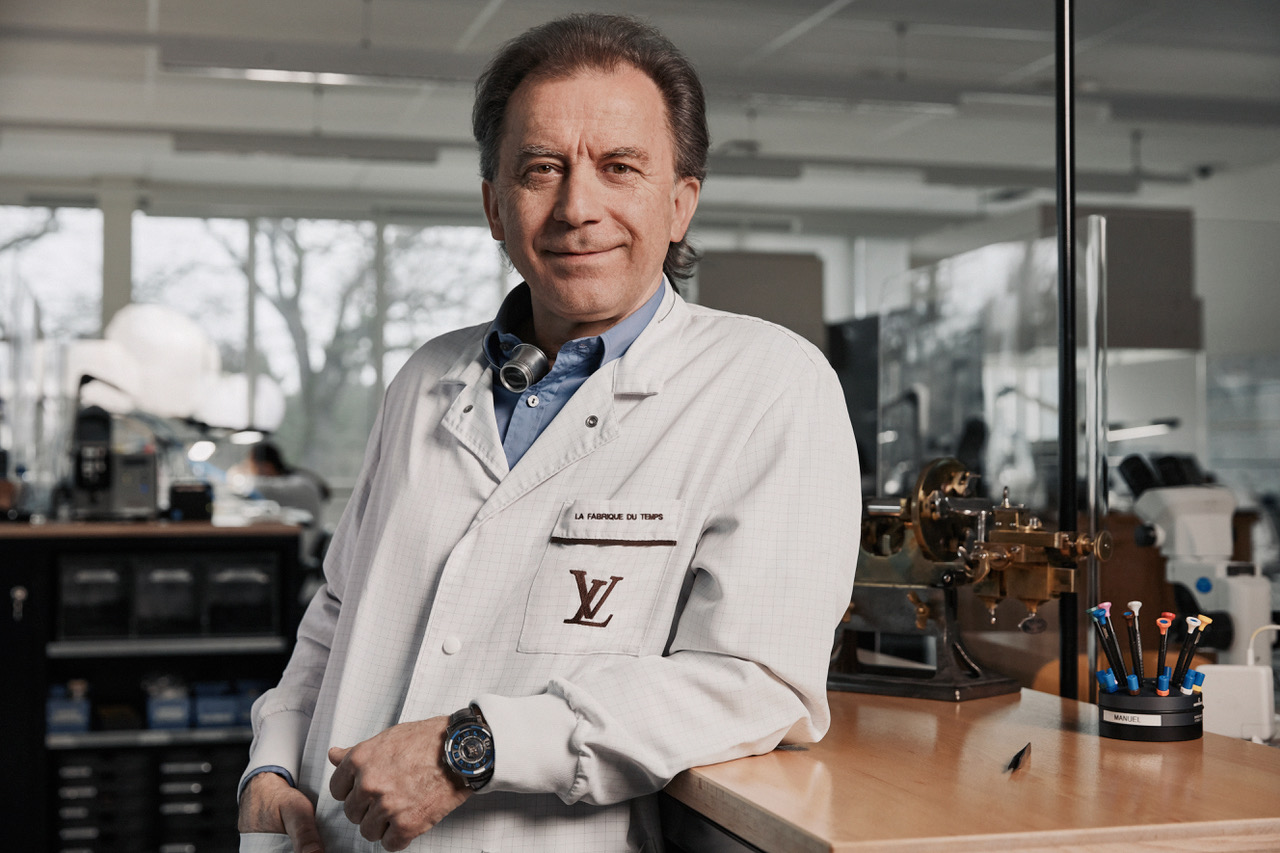
Introduction
In watchmaking, as I have often emphasised, the name on the dial does not always tell the whole truth about who actually created the watch.
Behind the designer, the brand or the owner of the manufacture, there are often people whom the client will never see, read about or perhaps even hear of. Constructors and watchmakers who turn an idea into a functioning mechanism. They are the ones who must make sure that the vision not only looks good on paper, but actually works, remains reliable and can ultimately be worn on the wrist.
Michel Navas and Enrico Barbasini belong to the most important representatives of this world.
Michel Navas grew up in a watchmaking family, entered Audemars Piguet in 1980 and later worked at Gérald Genta, Patek Philippe and Franck Muller. His career has taken him from the workbench to the development of some of the most technically ambitious movements of contemporary watchmaking.
Enrico Barbasini joined Gérald Genta after watchmaking school in 1979, entering a world of complications at a time when such opportunities were rare. Pierre-Michel Golay, one of the great technical minds behind Genta’s watches, played an important role in his early career. Barbasini would later also work at Patek Philippe and Franck Muller.
The two men met in Gérald Genta’s environment and became one of the most enduring creative and technical partnerships in modern watchmaking. Together they worked on Franck Muller’s complicated watches, co-founded BNB Concept in 2004 and then, in 2007, founded La Fabrique du Temps. Louis Vuitton acquired La Fabrique du Temps in 2011, and today the manufacture in Meyrin brings together movement development, cases, dials and métiers d’art for Louis Vuitton, Gérald Genta and Daniel Roth.
Their names appear behind constructions that have entered the history of contemporary watchmaking, although the names of designers and brands appearing on the dials usually became far more widely recognised.
From the beginning, one of the aims of my work has been to remind readers about precisely these people. I believe that constructors, watchmakers and movement creators are the true essence of watchmaking. That is why these are the people I look for, and why I am interested not only in the finished product, but also in everything that happens before a watch ever reaches the customer’s wrist.
A natural consequence of this approach is that, in this conversation, I was less interested in yet another story about a “passion for watches” or polished PR narratives. I wanted to understand where authorship really begins, how the relationship between a designer and a constructor actually works, what happens when an idea stops working at the prototype stage, how knowledge that cannot be written down on a technical drawing is passed on, and what “one watchmaker from A to Z” really means today in a manufacture employing around two hundred people.
The result is a conversation which, I hope, offers a glimpse deeper into a world usually hidden behind the brand name, advertising and the marketing message.
WoW:
For many years, you worked on watches that the public primarily associates with the names of designers or brands. Looking back, is there a watch from that period that makes you think: “People probably do not realise how much of this project actually came from us”?
Michel Navas & Enrico Barbasini:
As independent developers working for so many companies, we don’t have a specific watch in mind. Looking back, I think people often underestimate the work that takes place between an idea and a finished watch. A designer may imagine something extraordinary, but turning that vision into a reliable, wearable mechanical object requires a completely different kind of creativity.
Throughout our careers, we have worked on projects where the final watch became strongly associated with a particular designer or brand. We have always been comfortable with that. Our satisfaction comes from seeing an idea become reality, even if the watchmaker’s contribution is not immediately visible.
WoW:
Michel, in one interview you said that during your time with Franck Muller, you and Enrico developed many developments of his collection over a period of two or three years. Which specific watches or movements from that period would you identify as projects in which your contribution was particularly significant?
Michel Navas:
Our time with Franck Muller marked an important transition in our careers. We moved beyond working primarily at the bench and became much more involved in development. Over two or three years, we contributed to a very large part of the collection. Revolution 1, Revolution 2, Tourbillon, Double axis Tourbillon, Minute repeater, etc… But Crazy Hours is certainly one of the most recognizable examples of this period, but what mattered to us was not simply creating one signature model. It was learning how to translate Franck’s imagination into working mechanisms, repeatedly and across different types of watches.
Franck had a remarkable ability to think outside conventional watchmaking. Our role was to find the mechanical solutions that allowed those ideas to exist. It was an extremely stimulating period because it challenged us to think differently.
WoW:
Crazy Hours is now inseparably associated with Franck Muller, but contemporary accounts suggest that your role was to transform the original idea into a functioning mechanism. How was the work actually divided? What belonged to Muller’s original concept, and what had to be invented mechanically by you?
Enrico Barbasini:
The original idea came from Franck. He wanted a dial on which the numbers appeared to have been scattered randomly, breaking with the traditional order of the hours. The challenge was to make that apparent disorder work perfectly. Michel and I worked together to develop the mechanism that makes this possible. The watch uses a jumping-hour system: the minute hand follows its conventional path, while the hour hand jumps to the correct numeral at the appropriate moment.
The difficulty was not simply to make the hand jump. It was to ensure that the mechanism remained reliable, precise and suitable for everyday use. The concept was visually unconventional, but the underlying mechanics had to be completely dependable.
That is what made the collaboration interesting. Franck brought the creative disruption, and we worked on how to make it mechanically real.
WoW:
In 2013, you said that even eighteen people at La Fabrique du Temps already felt like quite a large organisation for the kind of atelier you had originally imagined. Today, around two hundred people work in Meyrin. What has changed in your understanding of scale? Where is the boundary between growth that gives watchmakers greater possibilities and growth that begins to distance the creators from the watch itself?
Michel Navas & Enrico Barbasini:
When we started, we imagined a relatively small atelier where everyone could work closely together. Today, La Fabrique du Temps Louis Vuitton has grown considerably, and naturally, the organisation is very different. But I don’t think the real question is the number of people. It is what that growth allows us to achieve without losing sight of what matters most: the watch itself.
Since Jean Arnault took the lead of Louis Vuitton’s watch division, we have particularly appreciated the importance placed on craftsmanship and on the people behind the watches. There is a genuine commitment to developing the Maison’s watchmaking capabilities, supporting ambitious projects and preserving the expertise that makes our work possible.
For us, that is essential. We have spent our careers building an approach to watchmaking based on technical excellence, creativity and close collaboration. We want to continue working in that spirit, even as the organisation grows.
Growth should give watchmakers more possibilities, not distance them from their craft. Our ambition is to have the resources to create exceptional watches while preserving the spirit of an atelier.
WoW:
The first Laurent Ferrier tourbillon movement was originally known as FBN 916.01, referring to Ferrier, Barbasini and Navas. How was the work actually divided between Laurent Ferrier, Christian Ferrier and yourselves? Which parts came from the Ferriers’ original concept, and which were developed technically within La Fabrique du Temps?
Michel Navas & Enrico Barbasini:
The FBN project was a collaboration built on complementary expertise. Laurent Ferrier brought his vision and experience in terms of casing, we brought our expertise undertaking our best developments and concepts, while Christian Ferrier started to be involved in the different projects. The question of authorship was extremely simple; Laurent Ferrier was the master of the casing and design meanwhile LFT mastered the best classical double hairspring tourbillon it could imagine.
With a project of this nature, it is important not to simplify the process by assigning every component to one individual. The original concept, the mechanical architecture, the development work and the refinement of the final movement are interconnected.
What matters is how those different contributions come together to produce a movement that works reliably and meets the intended standards of precision and finishing.
WoW:
You are often described as a perfectly complementary duo, but interviews rarely contain a concrete example of a genuine technical disagreement. Can you name one watch or one component for which you proposed two substantially different solutions? Which solution ultimately prevailed, and why?
Michel Navas & Enrico Barbasini:
When you work together for decades, technical discussions and differing perspectives are a natural part of the creative process. Rather than a dramatic disagreement over a single component, our work is a continuous dialogue where different technical paths are weighed against each other. One of us might lean towards a more direct, traditional mechanical solution, while the other pushes for a more complex architecture to achieve a specific aesthetic or functional result. Ultimately, the solution that always prevails is the one that best serves the reliability, performance, and integrity of the watch itself.
One example would be the LV Twin Chrono, which measures the time of two runners and indicates the time difference between them. We initially considered starting with a chronograph movement and adding the missing functions, but that proved far too complicated. We then hit upon the idea of using four separate movements: one to display the time, and three others dedicated to chronometry, an approach that made it much simpler to achieve the desired watch.
WoW:
And is there a project where, even today, one of you still believes that the other one’s solution was not the best possible choice?
Michel Navas/Enrico Barbasini:
I’m sure there are decisions we would revisit if we had the opportunity. When you work together for decades, you inevitably look back at certain choices and wonder whether another solution might have been better. But that is also the nature of watchmaking. At a particular moment, you make the best decision you can with the knowledge, means, skills, constraints and objectives you have. Years later, you may have a different perspective.
The interesting thing is that we can disagree about a technical decision without it affecting our relationship. We can challenge one another, defend our positions and then move forward together.
I would have to think about a specific example, because I wouldn’t want to name a project without giving the technical context that explains the decision.
WoW:
Official histories of manufactures naturally tend to concentrate on successful projects. Which movement or prototype taught you the most precisely because it did not work as you expected? Was there ever a project on which you spent months before finally deciding that it had to be abandoned?
Michel Navas & Enrico Barbasini:
Not every idea that looks convincing on paper becomes a good watch. Sometimes a mechanism works in principle but becomes too complicated, too fragile or too difficult to manufacture consistently. In other cases, the technical solution may work perfectly well, but it does not deliver the experience we originally imagined.
One of the most important lessons in development is knowing when to continue and when to stop. You can spend months trying to solve a problem, but at some point you have to ask whether the solution is genuinely improving the watch.
We have learned that persistence is essential, but so is the ability to question your own ideas. A failed prototype is not necessarily wasted work if it teaches you something that improves the next project.
WoW:
Pierre-Michel Golay appears repeatedly in the history of both of your careers, but he often remains in the shadow of Gérald Genta. Is there one specific construction principle, workshop rule or way of thinking that Golay taught you and that you still apply today?
Michel Navas & Enrico Barbasini:
Pierre-Michel Golay was an important figure in our professional lives, particularly during our years at Gérald Genta. He represented an extraordinary level of technical expertise and showed what could be achieved when a creative vision was supported by deep mechanical knowledge. One of the most important lessons we took from that environment was that there is no substitute for understanding a mechanism thoroughly. A complicated watch cannot be developed simply by assembling a series of clever ideas. Every component has to make sense within the overall construction.
There was also a strong culture of pushing the limits of what was possible, particularly with minute repeaters and ultra-thin complications. That combination of technical discipline and creative ambition has stayed with us throughout our careers.
WoW:
La Fabrique du Temps often emphasises the idea of “one watchmaker from A to Z”. In a manufacture of roughly two hundred people, what exactly does “A” mean today, and where is “Z”? Which stages are handled by specialised departments, and at what point does one watchmaker assume personal responsibility for an individual watch?
Michel Navas & Enrico Barbasini:
For us, the idea of making a watch from A to Z means understanding how every component contributes to the finished watch. At La Fabrique du Temps Louis Vuitton, we have specialists in different métiers, and their expertise is essential. But what we particularly value is the fact that Louis Vuitton has chosen to preserve an approach in which the watchmaker remains closely connected to the complete watch, rather than being responsible for only one isolated operation.
Jean Arnault has placed a strong emphasis on craftsmanship and on developing the manufacture’s capabilities internally. This allows us to bring more expertise together under one roof while preserving the individual responsibility that is so important in traditional watchmaking.
For us, the important thing is that each watchmaker understands the responsibility they carry. A watch is not simply a movement, a case and a dial assembled together. It is a complete object, and every decision affects the final result. We want to preserve that sense of personal involvement, where the watchmaker can recognise the finished watch as the result of their own expertise and commitment.
WoW:
A minute repeater can be documented in drawings, tolerances, materials and assembly procedures, but in the end someone still has to listen to it and decide whether it sounds right. How do you teach a younger watchmaker something that cannot be fully expressed in a drawing or measured by an instrument?
Michel Navas & Enrico Barbasini:
You can teach someone how a minute repeater works, how to assemble it, how to adjust it and how to measure certain aspects of its performance. But knowing whether a repeater sounds right requires something more.
You have to listen. You have to develop an ear for the clarity of the notes, their balance, their rhythm and the way the sound develops. Two watches can be technically functional but still sound very different. That knowledge is transmitted through experience. A younger watchmaker needs to listen to excellent examples, compare them, work alongside experienced colleagues and understand why certain adjustments change the result.
Eventually, you develop a kind of instinct. It is not magic; it comes from years of observation and practice. But it cannot be acquired from a drawing alone.
WoW:
Michel, in 2018 you spoke about your reluctance to use silicon partly from the perspective of long-term repairability. When you design a watch today, how consciously do you think about whether a watchmaker fifty or even one hundred years from now will still be able to reproduce, repair or understand its critical components?
Michel Navas:
When you work in traditional watchmaking, you are conscious that you are creating something that may outlive you. A mechanical watch should not simply be designed to work well when it leaves the manufacture. It should also be possible to understand, maintain and repair it over time. That influences the way we think about construction, materials and the accessibility of components. New technologies can offer interesting advantages, and we should never reject innovation automatically. But we must also consider what happens in the long term.
A component that performs exceptionally well today is not necessarily the best solution if it becomes impossible to service in the future. We have a responsibility to think beyond the launch date and even beyond our own careers.
Ultimately, longevity is part of the value of fine watchmaking. We want to create watches that can be passed on to another generation, with the possibility of being maintained and understood by the watchmakers who come after us.
WoW:
Over several decades, you have accumulated knowledge that cannot simply be acquired at watchmaking school. How do you know when the next generation is genuinely ready to take responsibility for the most complicated mechanisms produced by La Fabrique du Temps?
Michel Navas & Enrico Barbasini:
Readiness is not measured only by technical knowledge or by the number of years someone has spent at a workbench. It is also about judgement. A watchmaker must understand the mechanism, recognise when something is not right and know how to investigate the problem without creating another one. With highly complicated watches, small decisions can have consequences throughout the movement.
You also need patience, humility and the ability to ask questions. Someone who understands the limits of their own knowledge is often better prepared than someone who believes they already know everything.
The moment comes when you can trust that person not simply to follow a procedure, but to understand why they are doing something and to take responsibility for the result. Our responsibility is to pass on as much knowledge as possible, but also to give the next generation the opportunity to develop its own judgement.
WoW:
Gérald Genta was famously reluctant to repeat himself and was constantly looking forward. Today you are creating new watches bearing his name. Where do you personally draw the line between continuing his language and creating something that Gérald himself might never have done?
Michel Navas & Enrico Barbasini:
For us, the most important thing is to respect Gérald’s creative spirit rather than simply reproduce his designs. He was constantly looking forward, and he was never interested in repeating himself. That is an essential part of his legacy. We had the privilege of working with him, so we know how important creative freedom was to his approach. He could begin with a very strong artistic idea and challenge us to find a way to make it mechanically possible. That dialogue between creativity and technical expertise has always been at the heart of our work.
Today, we are fortunate to be able to continue that dialogue within La Fabrique du Temps Louis Vuitton. Working closely with Matthieu Hegi, the Artistic Director of gérald genta, allows us to bring together different perspectives. The design begins with a creative intention, and our role is to explore how that intention can be translated into a watch without compromising its technical integrity.
The Oursin collection is a particularly good example of this approach. Inspired by the sea urchin, an organic and unexpected form, it reflects Gérald Genta’s fascination with nature and his ability to find inspiration beyond traditional watch design. Its distinctive spherical case and bezel set with rounded elements reinterpret this original inspiration in a contemporary way, creating a strong visual identity while remaining true to the Maison’s unconventional spirit. It demonstrates how we can draw on the creative universe Gérald established without simply revisiting his historical designs.
What we particularly appreciate is the opportunity to pursue this approach while respecting the identity of Gérald Genta. There is a desire to preserve the spirit of the original creations, but also to give the Maison room to evolve. We are not simply reproducing historical designs; we are developing new creations that remain connected to the original creative philosophy. For us, the challenge is not to ask what Gérald would have done today, because we cannot answer that question for him. It is to preserve the curiosity, the audacity and the willingness to challenge conventions that made his work so distinctive. If we simply repeated what he had already done, we would be missing the point. The best tribute is to continue creating with the same freedom and ambition, while bringing our own experience and expertise to the process.
Gérald was very demanding in terms of design and elegance. He often wanted very small and very thin watches. We sometimes told him that the project couldn't be as thin as he wanted, but his standards were very high in terms of thinness.
WoW:
If you could create one more watch together without the constraints of a brand, collection, commercial target, cost or launch calendar, what horological problem would you still like to solve?
Michel Navas/Enrico Barbasini:
I think we would still want to solve a problem that has not yet been solved properly. We have spent our careers developing complicated watches, but complexity in itself has never been the objective. We are interested in finding new ways to display time, creating mechanisms that bring something genuinely different to the wearer, or making a complication simpler to understand and use without sacrificing its technical depth.
If there were no constraints, I suspect we would start with an idea that seems almost impossible and then spend our time trying to find a way to make it real. That is what has always motivated us. The ideal project would be something technically challenging but also beautiful, intuitive and reliable. Something that would make another watchmaker look at it and wonder how it had been done.
And, above all, it would be something that neither of us had created before. The best is yet to be created…
After the Conversation
In the watch industry, names and brands impress us.
Genta. Muller. Ferrier. Roth.
And that is natural. A name or a brand identifies the watch and is easier to remember than the entire story of how a mechanism came into existence. It can be placed on the dial, in a catalogue and in an auction description.
Yet the conversation with Navas and Barbasini reveals a different picture of contemporary watchmaking. Perhaps a less convenient one, but certainly a more interesting and more truthful one.
An idea or a sketch is not yet a watch.
Between the two lies an entire world of calculations, prototypes, compromises, failed solutions, technical disagreements, attempts to simplify mechanisms, hours of adjustment and knowledge that may never find its way into technical documentation.
In other words, perhaps the less spectacular, but arguably the most important part of the story.
Without this entire sequence of engineering, construction and execution, there would be no object of fascination that, for the sake of simplicity, we later call a watch.
Crazy Hours remained Franck Muller’s Crazy Hours. And rightly so, because the idea was his.
But it was Navas and Barbasini who had to answer the less romantic question:
How do you actually make it work?
Perhaps it is precisely in the difference between “imagining” something and “making it work” that one finds one of the most underestimated parts of watchmaking history.
And perhaps that is why the final sentence of this conversation sounds particularly appropriate.
Not: the best has already been created.
The best is yet to be created.