Interviews
Hugo Rittener
Mechanics that do not measure time
Introduction
Mechanical automatons are among the most extraordinary, yet least known, areas of contemporary horology. They do not measure time; their sole purpose is movement, gesture, and eliciting a reaction.
One of the creators who is reviving this almost forgotten field today is Hugo Rittener – a Swiss automaton constructor from the canton of Vaud, raised in La Praz, in the Jura landscape, between forests and the Vallée de Joux. His path was not obvious: he started as a polymechanic in heavy industry, worked on prototypes, and in watchmaking, before joining the workshop of François Junod in Sainte-Croix – one of the last places where the tradition of automatons is still alive.
Today, Rittener represents an approach that is rare even in the world of independent creators. He designs, constructs, and executes his objects almost entirely by himself, often being responsible for over 90% of the work, from the first sketch to the final assembly and finishing.
His latest project, Majordomus (Le Majordome), is an automaton composed of 1054 elements designed as a welcoming object. The mechanics are deliberately exposed, and the figure itself appears only upon activation. The movement lasts for several dozen seconds, after which the object returns to silence.
The creation of Le Majordome began with a prototype and a meeting with the first client, who was also an art patron, and decided to support the project even before it took its final form. The first piece, marked "0," became the beginning of a series planned for only ten pieces, spread over several years and customizable.
Each of these objects is made from materials typical of mechanics and horology, such as steel, brass, bronze, wood, and ruby jewels, with hand-finished decorations and inlay elements. Even the regulator of this movement can be part of the visual composition.
This approach – full control over the process, a limited number of pieces, and the deliberate exposure of the mechanics – places his work much closer to art than to classical horology.
The interview below is not a discussion about a product. It is a discussion about work, material, and the attempt to imbue sculpture and movement with something resembling life.
Photos by Nasinka, courtesy of Hugo Rittener
WoW:
Automata hold a very special place in the history of watchmaking. In the 18th century, they represented one of the most spectacular demonstrations of mechanical capabilities – one only needs to think of the works of Jaquet Droz.
When creating automata today, do you feel you are continuing this tradition or rather reinterpreting it?
Hugo Rittener:
I try to do both simultaneously: to continue the tradition through techniques acquired and passed down for centuries from artisan to artisan, while also developing this craft according to my aesthetic preferences and working methods, also utilizing some contemporary technologies.
I have a particular fondness for timeless objects, capable of fitting into various architectural environments.
I believe automata are not sufficiently known to the general public. They are almost forgotten objects, partly because they are very rare on the market, and in the second half of the 20th century, their production almost completely ceased in favor of digital technologies.
Today, automata belong more to the world of mechanical works of art and are mostly unique pieces.
I see a great future for them. The only limit is the artisan's creativity. The possibilities for collaboration with other professions are so vast that the field of possibilities is almost unimaginable.
I have always been full of admiration for the works of Jaquet Droz and the Rochat brothers. When you look at the conditions in which they worked, I think it took true genius, comparable to Leonardo da Vinci, to design and create such advanced and innovative objects.
WoW:
A significant part of your professional journey has been associated with collaborating with François Junod, one of the most important contemporary automata creators.
However, creating automata is not just about technical precision, but also a constant battle against friction, gravity, and the smallest mechanical imperfections.
What have you learned about the nature of failure while working on mechanisms that, despite correct design, "refused to come to life"?
Hugo Rittener:
Indeed, I have worked with François Junod and still partially collaborate with him.
The opportunity to participate in the transmission of knowledge that I have by his side, as well as with his collaborators, is almost unique in the world. It reminds me of certain Japanese traditions where craftsmanship is passed down from master to successor through generations.
As for failures, there have been many. For about fifteen years, I have been carrying out various mechanical projects. I think I have completed as many unsuccessful projects as successful ones.
In the case of mechanical automata, it has only been a few years since I have been able to lead a project from A to Z: from the first sketch to the final assembly, performing over 90% of the object myself in my workshop.
The skills that need to be acquired require an enormous amount of time.
The path is very long. It's a calling, a true vision of life. It's not a profession you do for a few years and then change direction.
It's an art that occupies all my days and often my weekends too: innovation, invention, pushing my own boundaries, developing new techniques, working with new materials.
Currently, I am also discovering the entire world of marketing and customer acquisition to make myself known and find my first clients and patrons.
This would allow me to live from my work and develop new projects.
It can be stressful, but at the same time, incredibly motivating.
WoW:
A watch measures time, a certain physical abstraction.
An automaton, however, attempts to imitate life through movement that the human brain instinctively recognizes as organic.
Is the construction of an automaton for you primarily an act of engineering, or rather an attempt to give the illusion of life to inanimate matter?
Hugo Rittener:
An automaton uses a watchmaking movement not to measure something, but to create poetry.
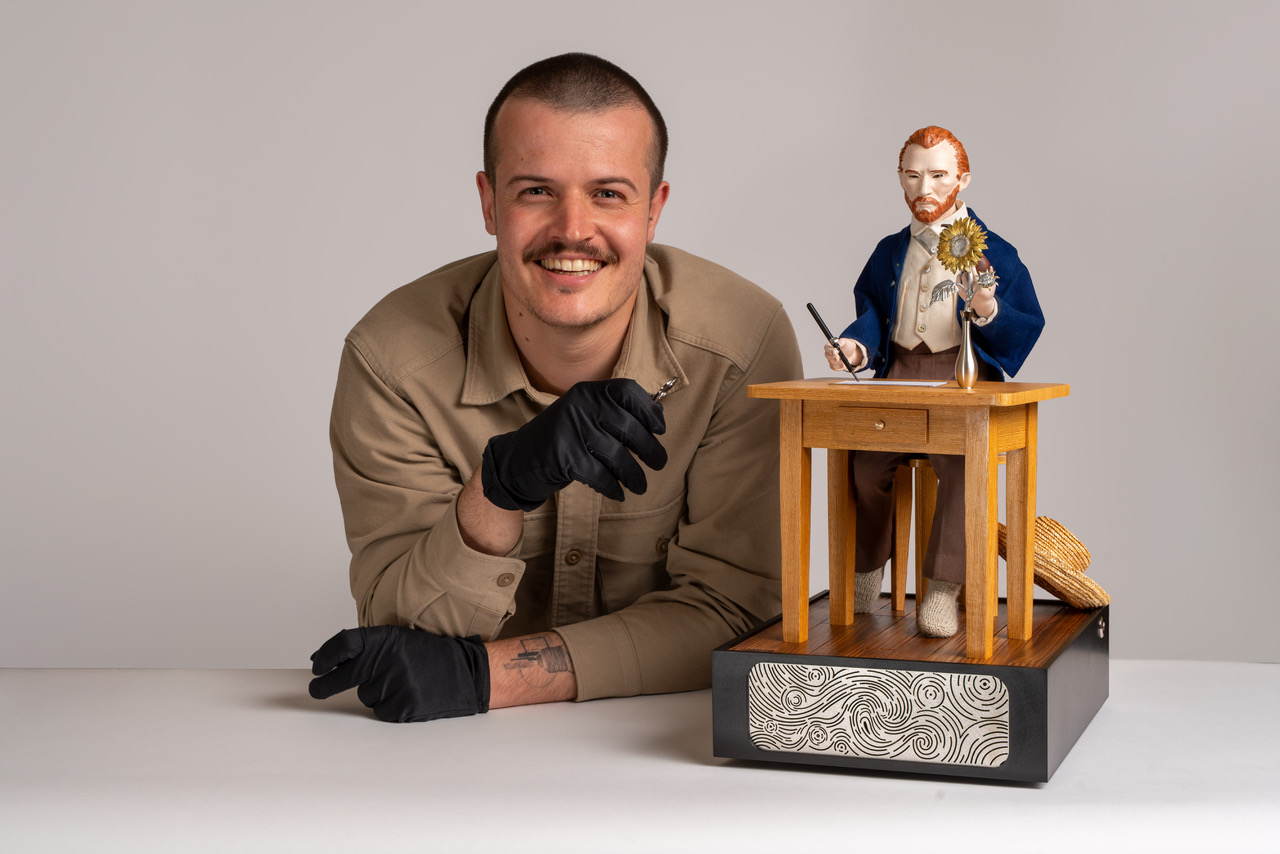
The first automata I created were inspired by the automata from Vichy from the early 20th century. Among other things, I created a small android depicting Vincent van Gogh, capable of faithfully reproducing the artist's signature.
These automata approach a certain realism, but that is not my main goal. I even believe that realism is not always the best way to create a poetic object. It can sometimes even evoke a certain unease.
The purpose of an artistic automaton is primarily to evoke emotions of wonder, often very close to those associated with childhood: through the object itself, its aesthetics, movement, and the element of surprise.
The most complex automata are not always the ones that move us the most. Sometimes it's small details that make the biggest difference.
For example, the sudden appearance of a character, as in the Majordome, makes the object particularly attractive.
WoW:
Your automaton Le Majordome depicts a butler greeting the observer.
Was the choice of this character a conscious reference to the tradition of historical automata, which often depicted figures performing everyday gestures?
Hugo Rittener:
Le Majordome is a very important stage in my life. It is the first automaton that entirely stems from my subconscious world and that distinguishes itself from previous artistic mechanical objects.
I dedicated several thousand hours to this project. The transition from idea to finished object is a very demanding process, especially when all stages are performed independently.
I wanted to create an object that would reflect me and be fully refined. My intention was to design an automaton where the mechanics are at the forefront.
I paid homage to the Rochat brothers and their bird snuff boxes, referencing their aesthetics, but at the same time reversing traditional codes: instead of showing the automaton and hiding the mechanics, I did the opposite. The automaton only appears when activated.
I also introduced walnut marquetry elements even into the mechanical parts. This visually "lightens" the mechanism and refers to my surroundings, the forests around my workshop, and a childhood spent working with wood with my father.
The butler's gesture was intended to be universal. A bow was a natural choice.
I worked to keep the object visually light despite its 1054 components. I imagine it placed against a wall, in a hotel lobby or a private space.
I plan to create a series of ten pieces over several years, with customization options. I also want to share the creation process with the client – from the first sketches to the installation. For me, the process is as important as the final result.
Since childhood, I dreamed of working this way: in a workshop, with a single object, while snow falls outside the window. The road was long, but today I am here.
WoW:
An automaton is a much more complex system than a classic watch movement: it combines micromechanics, sculpture, motion design, and staging.
Which element of the construction proves to be the most unpredictable after the entire mechanism is assembled?
Hugo Rittener:
Some things are predictable because I have tested them before or observed them in other mechanisms. However, there is always an element of the unknown when developing something new, which requires many trials. Managing mass transfer during movement is, in my opinion, one of the most difficult aspects to predict, especially when working with sculptures made from casting. It is a prestigious and durable material, but its weight can very quickly become critical.
Before delivering an automaton, I run it hundreds of times to guarantee its reliability over time. Most malfunctions occur within the first 500 cycles. The goal is to have no doubts whatsoever when the object is handed over to the owner.
Functional automata are rare today precisely because of their extreme complexity. Even the simplest automaton requires at least hundreds of hours of work, which by definition makes it an exclusive object.
WoW:
In watchmaking, we speak of "complications": calendars, chronographs, or repeaters. All, however, remain linked to time measurement.
Can an automaton be considered the "purest mechanical complication," since its sole purpose is movement?
Hugo Rittener:
I am a great enthusiast of watchmaking and I do not believe that one mechanism is "purer" than another. Our professions are very close, but they develop in parallel worlds. Sometimes these worlds meet, as in the case of some clocks with automata.
For example, I worked for over three years on the La Quête du Temps clock for Vacheron Constantin – a highly complicated clock where the automaton indicates hours and minutes on demand. I developed this automaton with a colleague in François Junod's workshop, in collaboration with several specialized workshops.
In these fields, mechanics become an artistic stage. Automata are perhaps more accessible: a child, a teacher, or a head of state often react to them in a similar way. Watchmaking is much more known and widespread today.
The great challenge for creators of artistic mechanics is therefore to bring this world closer to the general public. For several years, large watch and jewelry brands have started to take an interest in this craft. This is a very good thing, as it allows it to be more widely disseminated.
WoW:
In a watch, the mainspring's energy is released continuously, and the aim is usually to make the movement as quiet as possible.
An automaton, however, is different: it's a mechanical spectacle where movement is accompanied by sounds – the friction of gears, the clicks of pawls, or the sound of the mainspring being wound.
How do you design silence and sound in an automaton?
Is the sound of working metal a flaw for you, or an element of the "soundtrack" of this spectacle?Hugo Rittener:
The sounds of an automaton should only be useful sounds: pawls, releases, mechanisms necessary for its operation. They must be mastered and designed for this purpose.
In mechanics, parasitic sound is often a sign of premature wear. Of course, some sounds are part of the object's choreography, especially music. These are mechanical sounds deliberately introduced.
I once showed an automaton to a friend when I still needed to correct some unwanted sounds. However, he found them beautiful – they corresponded to the idea he had of an automaton. For him, if something is mechanical, it must make a sound. Meanwhile, the automata I create today do not generate any uncontrolled, parasitic sounds.
WoW:
Contemporary robotics speaks of the "uncanny valley" phenomenon, where something becomes almost human and begins to evoke unease.
In your automata, do you deliberately maintain a certain "mechanicality" of movement to remind the viewer that they are dealing with a machine, or do you strive for the most natural movement possible?
Hugo Rittener:
I don't try at all to make my automata realistic. I rather seek a certain form of authenticity.
Mechanics, in my opinion, have enormous poetic potential that is still largely untapped. The movement and life it can generate, especially when it is self-acting, without electricity or external force – are fascinating.
I find the emergence of a form of life in an object not intended for it beautiful. I have always been very sensitive to the "life" emanating from steam engines: the beauty of their construction, the sense of power, combined with an almost poetic lightness of movement. For me, there is nothing more beautiful than giving life to something that was not intended for it. Mechanics were never created to be beautiful or alive.
It is man, through art and the need for life, who created automata.
WoW:
We live in an era dominated by smart, connected, and multifunctional objects.
Automata, however, are by definition useless in a practical sense – their only function is movement and mechanical spectacle.
Is the creation of such objects in a way a form of resistance against modern technology?Hugo Rittener:
Yes, in a way, it is. It's not that I'm against novelty, but it simply doesn't suit my nature. I have always had the need to concretize my ideas, to touch things, to work with matter.
The Earth has so much to offer us that spending entire days in front of a screen seems to me to deprive oneself of this richness. We are fortunate to have a body capable of transforming matter and giving form to objects resulting from our imagination.
I feel incredibly privileged to have been born in Switzerland, at this time, surrounded by exceptional artisans. I want to live with concrete things.
And what could be more human than dedicating thousands of hours to creating objects that, on paper, seem useless, but gain meaning when one sees the wonder and curiosity they evoke?
WoW:
A mechanical watch was created to measure time.
An automaton, however, seems to tell a story through movement.
Can it be said that automata remind us that at the heart of watchmaking was primarily a fascination with mechanics itself?
Hugo Rittener:
I think this question essentially already contains the answer.
Watchmaking and automata have always developed hand in hand. This reflects the way humans function: on one hand, the curiosity to measure the immeasurable and try to understand the world; on the other, the desire to recreate what we do not yet fully understand, which is life.
After the Conversation
After this conversation, it's hard to escape one observation.
Automatons didn't return because the market needed them, but because there are still people who want to build them.
This is a very small group. In practice, a few names, a few workshops, and individual projects stretched over months and years. There's no talk of quick success or modern market acquisition here. Patience is inherent in this field from the very beginning – from learning, through construction, to sales.
I think that of the entire conversation with Hugo, the art of patience shines through the most.
When sending questions, one might expect safe and polished answers. Instead, I received something completely different.
Material that reveals the person, their way of thinking, and their attitude towards work. Without trying to "sell" anything. And that probably best reflects this area.
There is no scale or model here that can be easily replicated. Nor is there marketing that covers the entire process.
What remains is work. Hundreds of hours, errors, corrections, and repeated attempts, until the movement begins to function as it should.
In a world where most things are created quickly and in large numbers, such an approach is becoming increasingly rare.
And that's why automatons still make sense. Not just as a product, but as the result of a decision to do things that are harder than they need to be.
And as a choice for a very long-term perspective on the future.