Interviews
Emmanuel Bouchet
Mechanics begins with imagination
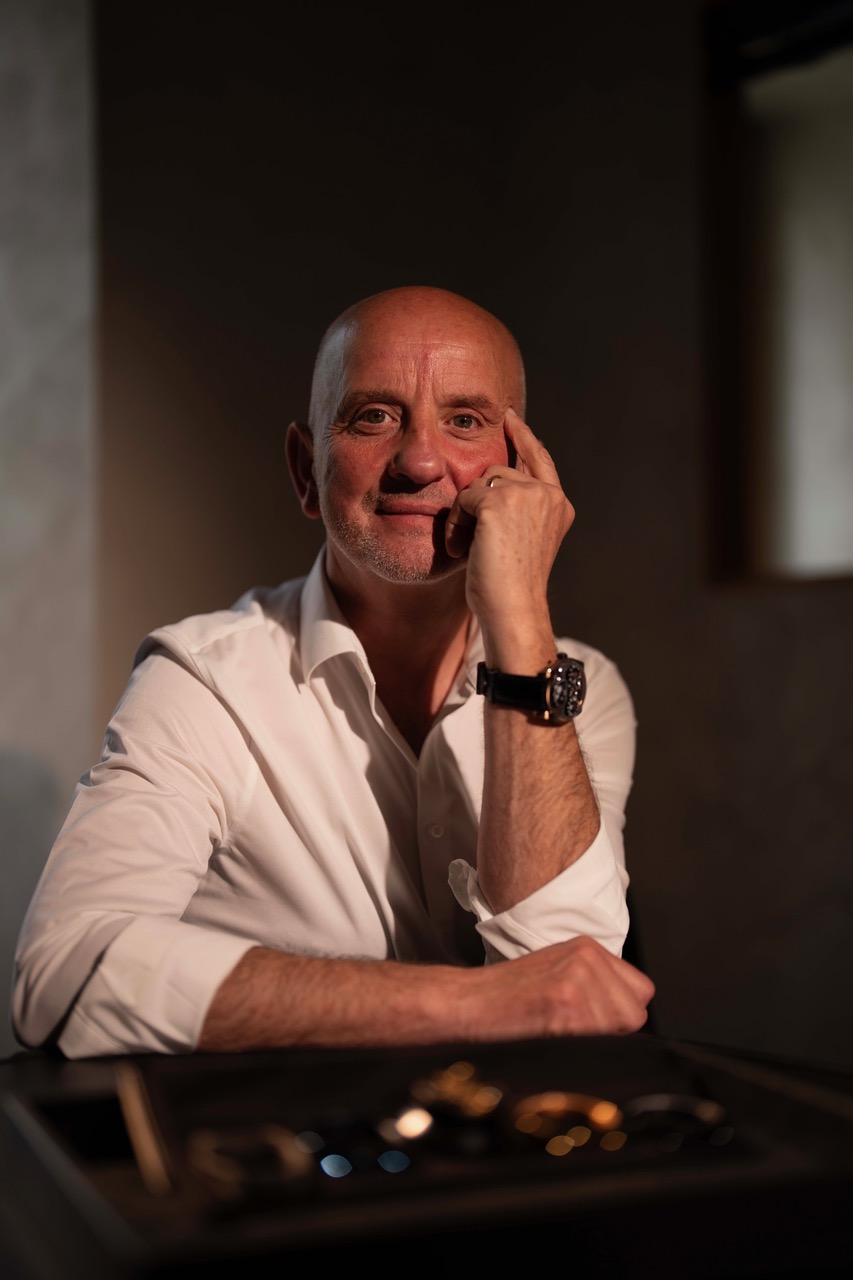
Introduction
Emmanuel Bouchet is not one of those watchmakers whose name regularly appears on the covers of catalogues or in advertising campaigns. And that is precisely what makes him so fascinating. For more than three decades, he has belonged to the small circle of movement constructors who have quietly shaped contemporary haute horlogerie while remaining largely invisible behind the brands for which they create.
He grew up in Charmauvillers, a small village in the French region of Franche-Comté, just a few kilometres from the Swiss border. His father was a watchmaker, and the family's restoration workshop became the place where he first learned not only the principles of mechanics, but also the patience, precision and respect for craftsmanship that would define his entire career. After graduating from the renowned Lycée Edgar Faure watchmaking school in Morteau, he officially joined the family workshop and later managed it himself before beginning his professional career in Switzerland.
Over the following years, Bouchet contributed to the development of complex movements for some of the industry's most prestigious names, including Jaeger-LeCoultre, Parmigiani Fleurier and Harry Winston. International recognition came with the presentation of the Harry Winston Opus 12 in 2012—one of the boldest creations in the history of the Opus series. It was far more than another complicated watch. It was a radical rethinking of how time could be displayed, proving that even in the twenty-first century mechanical watchmaking was still capable of surprising us with ideas that seemed almost impossible to realise.
In 2008, Bouchet co-founded Centagora, a company specialising in the engineering and development of advanced mechanical movements for the watch industry. A few years later, he entered a new chapter of his career by stepping out from behind the scenes to establish the brand bearing his own name. Introduced in 2014, Complication One was not only his first watch under the Emmanuel Bouchet signature, but also a manifesto of his philosophy as a constructor—a philosophy in which the architecture of a movement is every bit as important as its function. In the years that followed, he continued to expand the engineering activities now centred around MACLEF, designing movements and complications for external clients.
It is precisely this dual perspective that makes Emmanuel Bouchet such a compelling interview partner. Few movement constructors have experienced contemporary watchmaking from the viewpoints of major manufactures, an independent creator and the founder of their own brand. Perhaps that is why his reflections on innovation, the meaning of manufactureand Swiss Made, the limits of mechanical watchmaking and the responsibilities of a movement constructor carry such authority.
Our conversation quickly evolved beyond a discussion of individual watches. Instead, it became a dialogue about the responsibility of a constructor, about ideas that never make it beyond the drawing board, about the fine line between genuine innovation and marketing, and about why it is still worth designing new mechanical movements in a world that no longer needs mechanical watches simply to tell the time.
Reading this conversation, one cannot escape the feeling that Emmanuel Bouchet sees mechanics as far more than a technical discipline. For him, it is also an art form—one expressed not primarily through decoration, but through the idea itself. Through the architecture of a movement. Through the emotions experienced by its creator. And that is precisely why his answers are about far more than watches alone.
WoW:
Looking back at your journey from your father’s workshop to Opus 12 and your own creations, what is the most important lesson watchmaking has taught you? Not in a technical sense, but on a human level.
Emmanuel Bouchet:
My journey has taught me to always remember my origins, the moments that allowed me to grow, and the people who passionately and expertly taught me the watchmaking craft. Not a day goes by that I am not reminded of these values, these roots, and the memories of shared moments, whether joyful or more challenging.
WoW:
You have worked both on classical complications and on projects that attempted to look at time in a completely different way. Where does the greatest challenge lie today: in mastering the mechanical aspects of watchmaking, or in having the courage to abandon solutions that are proven, accepted by the market and simply work?
Emmanuel Bouchet:
I constantly imagine mechanical systems, picturing them in motion long before I even draw them. I have a lifelong desire to invent, innovate, and dream: my wish is that, once a project is finished, this sense of wonder will be shared with others. However, the return to reality can be harsh: developing complex mechanical systems takes time. It always takes a lot of courage for me to have to abandon so many ideas, at the risk of certain mechanical marvels never seeing the light of day. For me, the real challenge is also to always strive for innovation in the mechanical aspects and not limit myself to what has already been done.
WoW:
Opus 12 remains one of the most unusual watchmaking projects of this century. Was there ever a moment when you felt the idea had become too complex to be realised? If so, what allowed you to move beyond that point?
Emmanuel Bouchet:
The journey to create Opus 12 was both wonderful and challenging. I often compare it to that of a marathon runner who must focus on the finish line: you have to give your best at every moment, the thought of giving up crosses your mind, but the desire to succeed and push your limits allows you to cross the finish line. Since Opus 12, I have been striving to achieve that same level of emotion with my new watchmaking projects.
WoW:
What has to happen for a constructor to decide that it is worth creating something genuinely new? In other words, when do existing solutions stop being enough?
Emmanuel Bouchet:
I think we must always question the status quo and strive to go further, whether in terms of innovation or technology. Then, depending on the complexity of the idea and, above all, on the consideration of its legitimacy and value, we can decide whether or not to bring it to fruition.
WoW:
For most of your career, you have designed movements for others: Jaeger-LeCoultre, Parmigiani and Harry Winston among them. Does a constructor working within a large manufacture design differently from one who answers only to himself? What does that change of role do to the way a constructor thinks and works?
Emmanuel Bouchet:
I am first and foremost a watchmaker; however, my experiences within various watchmaking houses have led me to work on the development of watchmaking projects with the technical office (constructors), which has further solidified this aspect of my craft. Whether as a freelancer or as an employee of a manufacture, my motivation remains the same: I am always driven by my desire to develop reliable mechanical systems that meet the initial specifications. Large companies can provide access to developments that would require too many resources for a small manufacturer; however, I now have the freedom to work on projects that I have imagined, conceived myself.
WoW:
Many brands today speak about 'manufacture movements'. From the perspective of someone who has designed calibres from a blank sheet of paper, what does the term 'manufacture movement' truly mean today, and what is merely a marketing misuse of the expression?
Emmanuel Bouchet:
Creating a true in-house/manufacture caliber is a complex undertaking, demanding significant resources in terms of both cost and time. This decision must be carefully considered beforehand: the stakes and risks involved must be thoroughly examined before embarking on the project. Therefore, to minimize costs and reduce the risks associated with developing a genuine manufacture movement, many choose to use an existing caliber base and refine it to create their own. Unfortunately, some marketing materials distort customer perception, as they are often neither informed nor aware of these differences and what they represent. For our part, we design and we are not afraid to take risks, to create, and to manufacture. This topic is somewhat similar to that of Swiss Made.
WoW:
You wrote that the discussion about manufacture movements is, in some ways, similar to the debate surrounding 'Swiss Made'. I found that comparison particularly intriguing. Could you expand on what you meant?
Emmanuel Bouchet:
Indeed, for me, we're essentially talking about the same thing: I differentiate between an existing movement marked as Swiss-made and one developed and manufactured in Switzerland. I completely understand that some people prefer to look for sources outside Switzerland, but it's simply a matter of not indirectly misleading the customer. Our Emmanuel Bouchet timepieces are 100% Swiss-made, and it's not always easy for the customer to grasp the financial implications of this decision.
WoW:
Why does someone still decide to design a new mechanical calibre in 2026? What does working on mechanical watchmaking offer that cannot be achieved in any other way, in a world that no longer technically needs it?
Emmanuel Bouchet:
That's an excellent question indeed! For a long time now, mechanical watchmaking has ceased to be essential for telling time, but we have a duty to perpetuate the know-how, the tradition, and to preserve what human beings are still capable of producing in a handcrafted way, with their hands and their intelligence.
WoW:
Looking at the last twenty years of contemporary watchmaking, which achievements do you consider underrated by collectors, and which do you believe are overrated?
Emmanuel Bouchet:
For me, the art of watchmaking lies not only in the decoration but also, and above all, in the mechanical complexity. However, I've had the impression lately that watches focused primarily on traditional horological decoration, rather than mechanical innovation, are being promoted, and the marketing messages aren't always representative of reality. Personally, I find this regrettable and sad. It's very difficult, even for people with extensive watchmaking knowledge, to navigate this landscape.
WoW:
I noticed the recent announcement of the MC2130 calibre presented by MACLEF at EPHJ. Could you tell us a little more about the project and your personal involvement in its conception and development?
Emmanuel Bouchet:
MACLEF is indeed a company specializing in the development of timepieces with complications (from the movement to the finished product, according to the client's needs). I made the decision to create MACLEF, alongside my work with Emmanuel Bouchet, to meet a market demand, particularly from brands producing small series. Some of our clients were looking for a high-end micro-rotor movement, and their needs didn't necessarily align with what the most well-known caliber manufacturers could offer.
WoW:
In your answer about MACLEF, you mentioned developing movements for other brands according to their needs. For many years you have created movements that eventually carried the names of other companies. How do you feel about the fact that the brand usually remains in the spotlight, while the movement constructor's name often remains unknown to collectors?
Emmanuel Bouchet:
At MACLEF, we specialize in mechanical development and expertise. We always approach this work with the same drive to excel: whether or not the end customer is aware that we are also involved in the project doesn't change our commitment or passion. Brands finance a project that belongs to them, and I understand that it's perfectly normal to remain in the background if that's their preference. However, when brands advertise a manufacture movement that is, in reality, based on an existing design, I find this lack of transparency regrettable.
WoW:
You mentioned that many ideas eventually have to be abandoned. Is that usually because they prove technically impossible or insufficiently reliable, or because the market simply isn't ready to accept them?
Emmanuel Bouchet:
Launching a new mechanical system,development, manufacturing, validation to ensure reliability, and series production - requires a very substantial investment. We must therefore carefully consider in advance whether this mechanical system truly offers something new for the customer and/or for the watchmaking industry.
WoW:
Throughout our conversation you referred several times to innovation. Do you believe that truly groundbreaking innovations in classical mechanical watchmaking are still possible today, or will the future mainly consist of refining and perfecting the solutions we already have?
Emmanuel Bouchet:
New manufacturing sources (already present for some specific types of components) will develop in the coming years, and I believe this will inspire new developments. Preserving the expertise in the art of traditional watchmaking decoration is very important, but I am convinced that art must also be present in the mechanics: art is an emotion, a reflection on a creation that has moved the soul of its creator. And thanks to complex mechanical systems, these emotions can be translated. We must be inventive. For me, as long as the world will exist, inventive watchmaking mechanisms will continue to emerge. Personally, I find the following text very inspiring: Letter to Artists (April 4, 1999).
After the Conversation
What surprised me most about Emmanuel Bouchet was how rarely he spoke about his own achievements. That is quite remarkable for someone who created Opus 12 and has spent more than three decades developing movements for some of the most demanding names in fine watchmaking. Rather than talking about success, he speaks about responsibility—the responsibility of a constructor towards his own work, towards the brand, and above all towards the future owner of the watch.
In an industry where increasing attention is devoted to brand stories, emotions and carefully crafted narratives, Bouchet consistently brings the conversation back to mechanics. Not because he dismisses tradition or aesthetics. Quite the opposite. Several times he emphasises the importance of traditional hand-finishing and craftsmanship. At the same time, he reminds us that the true value of watchmaking does not end with decoration. If a beautifully finished movement is not supported by genuine engineering, the courage to develop new ideas and real technical value, it is difficult to speak of true innovation.
One part of our conversation particularly stayed with me: his reflections on the meaning of “manufacture” and “Swiss Made.” Bouchet does not criticise brands for using existing movement architectures or for sourcing components outside Switzerland. He understands the economic realities and compromises of modern watchmaking. What he asks for is something much simpler—transparency and honesty towards the customer. The real issue is not where a movement is made or how many of its components are produced in-house. The real issue is whether a brand’s communication faithfully reflects reality.
His perspective carries particular weight because it comes neither from a market commentator nor from a collector. It comes from someone who has experienced watchmaking from almost every possible angle: working for major manufactures, creating under his own name, and continuing to develop movements for other brands.
Perhaps the thought I will remember most is his understanding of art. For Bouchet, art does not begin with hand engraving or a perfectly polished bridge. It begins much earlier—the moment a constructor is able to imagine a mechanism that does not yet exist. A mechanism that first comes to life in the imagination, then on paper, and only finally on the wrist.
At the end of our conversation, Emmanuel Bouchet said that as long as the world exists, new watchmaking mechanisms will continue to emerge. After speaking with him, I could not help but feel that this was more than optimism about the future of mechanical watchmaking. It was also a quiet promise from someone who still intends to help shape that future.