Interviews
Jörg Hysek
Jörg Hysek. More than "the second Gérald Genta"
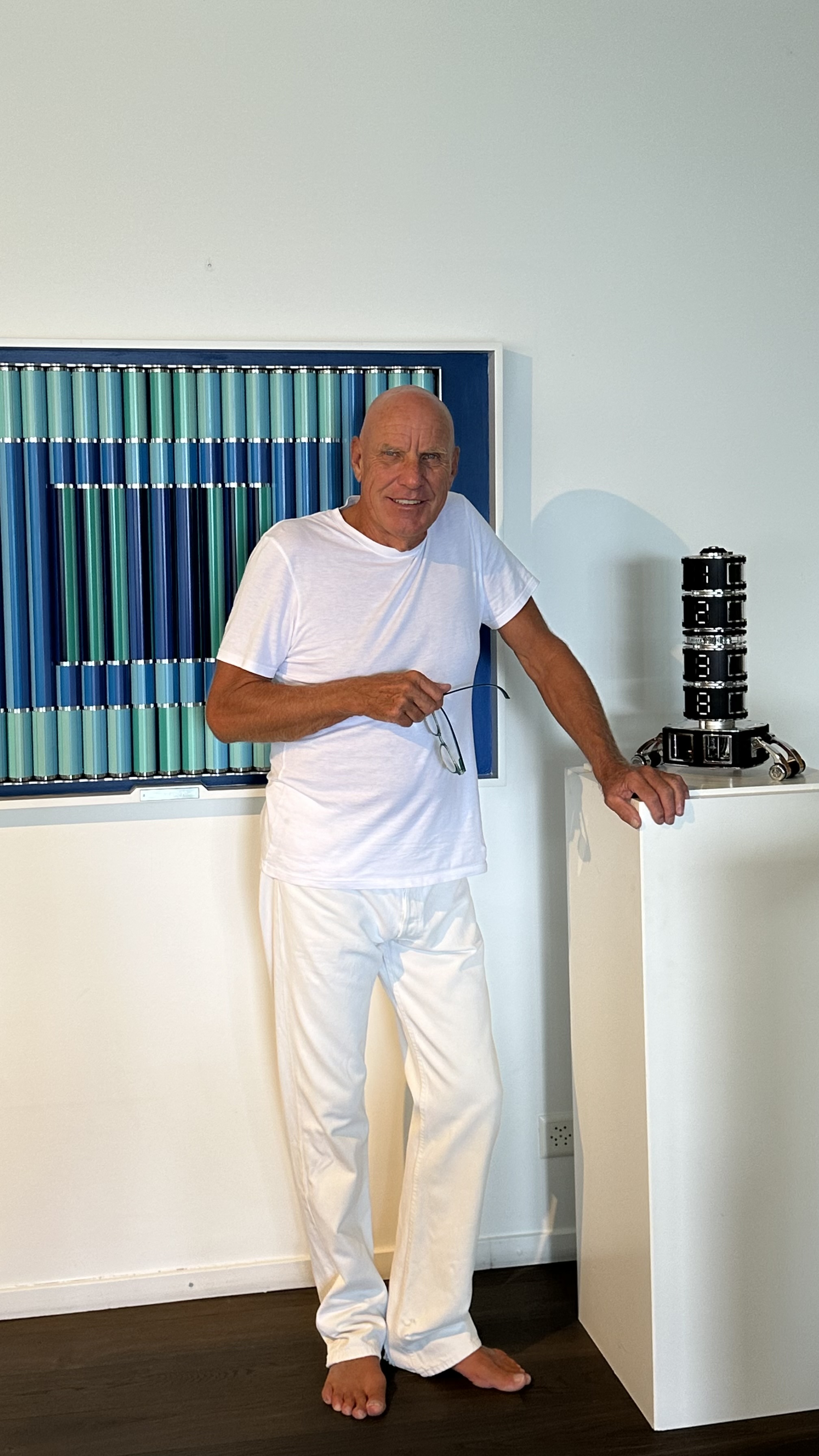
Introduction
One can know the Vacheron Constantin 222 and not know who designed it. One can recognize the Breguet Marine, TAG Heuer Kirium, or Seiko Arctura, without noticing that the same person is behind their form. This speaks volumes not only about Jörg Hysek but also about the entire watchmaking industry. It meticulously cultivates the names of manufactures, less frequently the constructors of movements, and unfortunately often forgets about the designers who gave watches their visible form.
Hysek's story is unique in this regard. The authorship of the Vacheron Constantin 222 was sometimes mistakenly attributed to Gérald Genta, although the design was created by Hysek, who was then only in his early twenties. He speaks about it himself without needing to build a legend. He brought a drawing to Vacheron Constantin, sold it for a few hundred francs, and did not participate in the further development of the design. This honest distinction between the design of the form and the work of the constructors does not diminish his contribution. On the contrary, it allows for a better understanding of how watches were truly created in times when most brands remained independent, and an external designer could simply arrange a meeting with their management and lay out his drawings on the table.
However, his career extends far beyond the 222. For Breguet, he created a sports watch with an integrated bracelet that was meant to retain all the brand's historical codes. For TAG Heuer, he designed models produced on a scale he initially underestimated himself. Five thousand pieces turned out not to be an annual plan, but a monthly one. With the Seiko Arctura, he learned what it means to take a bold concept from paper to production planned in hundreds of thousands of units.
This conversation was initially intended to be an interview about design, the most important projects, and the true authorship of the 222. However, it quickly became apparent that Hysek also has a natural talent for telling interesting stories, going far beyond the planned topics. Stories of a creator, but also an entrepreneur who repeatedly crossed the line between design and business risk.
There are almost cinematic situations in it. A Russian retailer is invited to evaluate the first HD3 drawings, and instead of an opinion, places an order for seven million Swiss francs and pays a forty percent advance. A few years later, the bankruptcy of BNB Concept instantly deprives HD3 of the ability to accept orders for the watches just presented. Even later, Hysek goes to a meeting where Richemont is to sign an agreement regarding Slyde, and on the way, receives a call informing him that the transaction has been canceled. To this day, he does not know the reason.
He does not try to present his own path as an uninterrupted series of successes. He talks about financing problems, the cessation of HD3's operations, and the bankruptcy of Slyde. When he mentions clients who could not be provided with service after the project's failure, he simply apologizes to them. In the world of luxury, where failures most often disappear under another layer of PR communication, such a response has greater value than a carefully prepared success story.
The interview is accompanied by drawings and photographs provided by Jörg. They are not merely illustrations. They show how an idea progressed from the first line to a finished object, and also how broad the scope of his work was: from watches for great manufactures, through designs for his own brands, to the digital experiment Slyde and mechanical art.
This is a conversation about watch design, but even more about independence, intuition, chance, and the price of taking risks. About a man whose work is known by far more people than know his name.
Beginnings and working methods
WoW:
Your first years in the watch industry were spent in Rolex's design department. This period remains relatively poorly documented. What kind of projects did you work on then, what did you learn in an enterprise of that scale, and have you kept any drawings or concepts from that time?
Jörg Hysek:
It was a particularly interesting period, during which one realizes that the hopes and ideas brought from school vanish within the first few days of work.
Because I have a very independent character, it was very difficult for me to adapt to a structure as rigorous and organized as Rolex, which is a true model in this regard.
In retrospect, this period was very beneficial to me. It taught me to better control my creative impulses, to organize them, and to understand that an idea alone is not enough. It must also fit into a specific framework, respond to concrete constraints, and maintain coherence.
And no, of course none of my concepts were adopted. Ultimately, this was consistent with the logic of the situation, as I was primarily there to learn, observe, and understand. That is precisely why this experience proved so important on my professional path.
WoW:
How did your work as an independent designer evolve later? Did brands provide you with precise guidelines, an already chosen movement, and production limitations, or did you more often propose a complete concept? What exactly did the documentation provided to the client include?Jörg Hysek:
At that time, the creative process in most watch companies was not organized at all. Almost all brands remained independent and did not belong to any group.
It was common practice for case, dial, and bracelet manufacturers to regularly visit brands and present their latest designs. New watches, then presented at the Basel fair, were often created by combining these various novelties.
During the same period, it was relatively easy for an independent designer, like myself, to arrange meetings with watch brand managers and present them with my latest concepts.
Designs were then shown as flat 2D drawings and sold for a few hundred francs. They were usually based on personal intuitions, without prior, specific guidelines.
The situation only began to change and gradually become organized from the 1980s onwards.
Projects for major brands
WoW:
How exactly did your work on the Breguet Marine collection proceed? What were the brand's expectations, and which elements do you consider your most important personal contribution to Breguet's contemporary stylistic language?
Jörg Hysek:
Breguet was a particularly beautiful story, especially in terms of human relations.
I met François Bedeta, who was then a shareholder and CIO of the company, at the Basel fair. He was an extremely likeable man, representing a style somewhat in the spirit of old France, completely opposite to mine. And it was this difference that brought us closer and made us fond of each other.
Breguet was then a somewhat forgotten and relatively little-known brand. However, it was beginning to revive thanks to very precisely targeted communication and François Bedeta's commitment. The collection drew inspiration mainly from the company's historical models: Breguet hands, guilloché dials, and other similar elements.
Shortly after our meeting in Basel, François contacted me to tell me about plans for the next fair. He then gave me very clear guidelines:
"Design a sports watch with an integrated bracelet for me, using all of Breguet's codes."
My research focused primarily on the bracelet. It had to be different from everything that already existed, and at the same time perfectly fit into the brand's world. Once I found the bracelet design, the case shape naturally imposed itself and did not cause much difficulty.
During the presentation of my drawings, François immediately accepted the design. So we began making a prototype, which was handled by Jacques Nawratil, an independent prototyper I had met while working at Rolex.
Success came immediately after the watch's presentation at the Basel fair. Breguet then had a tiny booth, almost hidden under the stairs, yet the new model immediately attracted attention.
It was the beginning of a very beautiful adventure, but above all, a collaboration and human relationship that left a very strong mark on me.
WoW:
For TAG Heuer, you designed, among others, the 6000 series and then the Kirium collection. These were watches intended for much larger-scale production than some of your other projects. How did you reconcile a distinctive visual identity with the requirements for cost, ergonomics, and repeatability of industrial production?
Jörg Hysek:
TAG Heuer was a truly beautiful story. And yet it began with a misunderstanding.
When presenting the project assumptions and negotiating my license fee for the 6000 model, we talked about a series of 5,000 units.
That was the production volume I used as a basis when working on the new design.
When the watch went into production, I cannot describe my astonishment when I realized that those 5,000 units did not mean annual production, but monthly!
As you can see, sometimes a misunderstanding can hide very beautiful surprises.
Therefore, in the case of Kirium, whose production volume was definitely larger, both the project assumptions and the negotiations regarding the license fee were already completely clear.
The process of creating and implementing this model into production went really smoothly.
WoW:
In the Seiko Arctura, MIM technology allowed for the creation of an asymmetrical case without a separate case back. How did this solution come about, and how did the collaboration with Seiko engineers proceed? Did the Japanese product development approach differ from working with Swiss manufactures?
Jörg Hysek:
Arctura, like most of my projects, is based on a beautiful story of human relations.
At that time, the Jean Lassale brand, known for creating the world's thinnest watch, was in a very difficult financial situation and had just been acquired by Seiko.
Jean Lassale had developed a particularly innovative caliber, whose wheels were not mounted on traditional axles, but on ball bearings. For its time, this was a true technical achievement.
The new director of Jean Lassale after the company's acquisition by Seiko was a Mr. Mouto, who came from Tokyo. He asked me to design a watch with a very distinctive identity that could set a new direction for the brand.
Thus, Thalassa for Jean Lassale was born, a project that contributed to changing the brand's commercial direction.
The success of this collaboration brought me very close to Mr. Mouto. Five years later, he became the General Manager for product at Seiko. So, quite naturally, he asked me to create a watch with a unique identity for the new Kinetic movement.
I drew inspiration for this project from the spirit of the Porsche 911 bodywork: taut lines, a sense of movement, and the desire to give the watch an almost automotive presence.
The model was accepted immediately after its presentation in Tokyo. However, the most difficult stage remained: obtaining approval from the management of Seiko's factories in Suwa.
To pass this stage, I needed enormous argumentative strength, persuasion, and energy.
Then, to supervise the watch's implementation into production, and above all to guarantee the preservation of its aesthetics down to the smallest detail, I had to travel between Switzerland and Tokyo every three months for almost two years.
But it was a wonderful experience, both humanly and technically!
It is even more impressive when you know that 650,000 units were planned for production in the first year.
This was a completely different scale. This project allowed me to discover what it truly means to take an idea born on a piece of paper all the way to industrial production on such a huge scale, without losing the spirit and identity of the original concept.
WoW:
Your first known designs were usually quite discreet and balanced. Over time, your stylistic language became more expressive, partly due to larger cases, frequent use of the numerals 1, 5, 7, and 11, visible structural elements, and profiled rubber straps integrated with the case. Were these solutions primarily driven by ergonomic and technical considerations, or did you also want to create an instantly recognizable visual language?Jörg Hysek:
You are talking here about watches created under the JORG HYSEK brand. I must tell you what was the impulse that led me to create my own brand.
At that time, I received a commission from Hermès to design a watch. While working on this project, I also came up with the idea of creating a writing instrument whose clip would not be attached to the pen itself, but directly to its leather case. In my opinion, this idea made enormous sense precisely for Hermès, due to its skills and the entire world associated with leather.
Despite my deep conviction in this concept, the project was ultimately not accepted. I must admit that this decision was incomprehensible to me. I was so convinced of the validity of this idea that I decided to launch it myself under my own name.
It was presented at the Basel fair in 1997 and was an immediate success. The reaction of the public and industry representatives confirmed my belief that I could go further and create a true world built around my own name.
That is why, a few years later, I presented the Kilada watch.
With this first watch project signed with my name, the most important aesthetic assumption was to radically differentiate myself from everything that existed at the time. I didn't just want to create another watch. I wanted to propose a model with its own, instantly recognizable identity.
WoW:
For many years, you also worked for brands that did not disclose the identity of external designers. Now that some old confidentiality agreements may have expired, can you name watches or collections you worked on where your involvement remains relatively little known or uncredited?Jörg Hysek:
Yes, there are quite a few, but they were often brands without a true identity and with very fluctuating marketing strategies.
A few examples: Beretta, Calcio, Courrèges, Damiani, H. Stern, Boss, Michel Jordi, and many others.
Vacheron Constantin 222
WoW:
Publications present different versions of the origin of the 222 project: from a spontaneous presentation of drawings to a specific order from Jacques Ketterer. Could you reconstruct the actual course of events? What significance did the earlier Vacheron Constantin 42001 model and the emergence of the Royal Oak and Nautilus have at that time?
Jörg Hysek:
Indeed, it was a spontaneous presentation. At that time, at the beginning of my activity as an independent designer, I sold my concepts in the form of flat drawings for a few hundred francs. Since the large watch groups did not yet exist, most brands remained independent, and it was relatively easy to arrange a meeting to present one's work.
That's how I met André Goy, who bought several design boards from me, including the one depicting the future 222.
The design was presented exclusively in a flat view. One must understand that a significant part of the subsequent work depended on the correct interpretation made by the prototyper working for Vacheron.
The emergence of the Royal Oak certainly influenced my work. At that time, my research and presented concepts largely focused on watches with integrated bracelets, which I considered a particularly interesting direction to develop.
WoW:
How did the transition from your first drawings to the final form of the 222 proceed? Which elements did you design personally, and which solutions were developed by Vacheron Constantin engineers and external partners, particularly Gay Frères? Were the caliber 1121, the monobloc case construction, and the intended water resistance of 120 meters specified at the beginning of the project?
Jörg Hysek:
It was at the very beginning of my career, and I was still very young. So I did not participate at all in the individual stages of implementing this watch into production.
At that time, I limited myself to selling my drawings. Only later did I begin to fully engage in all the stages necessary for the realization of my projects, from concept to finished product.
WoW:
For many years, the authorship of the 222 was attributed to Gérald Genta, and this information even appeared in a statement by a former president of Vacheron Constantin. When did you learn about this error, and how was the historical information later corrected? Did you ever discuss this watch with Gérald Genta?Jörg Hysek:
No, I never had the opportunity to discuss this with Gérald Genta. Unfortunately, I knew him very little. We met only a few times. The historical correction was made by Vacheron Constantin.
WoW:
Did Vacheron Constantin consult you on the 222 re-editions introduced in 2022 and 2025? How do you assess the changes made compared to the original construction, particularly the new movement, the sapphire case back, the different date position, the bracelet modifications, and the reduced water resistance?Jörg Hysek:
No, Vacheron Constantin did not consult me on the 222 re-editions, which I, of course, deeply regret!
The brand bearing your name and HD3
WoW:
The company bearing your name changed ownership in 2000, and you left it a few years later. How did this process look from your perspective, and what consequences did it have for your ability to use your own name and develop further projects? How do you currently perceive the Hysek brand?
Jörg Hysek:
This is a question that could be answered very extensively, but I prefer to keep my thoughts to myself!
WoW:
HD3 was created as a joint adventure of three designers: Valérie Ursenbacher, Fabrice Gonet, and yourself. How did you divide roles and the authorship of individual watches among yourselves? To what extent did other team members also influence projects officially attributed to only one designer?Jörg Hysek:
The original assumption was for each designer to create their own watch. Each project was, moreover, signed by its author, not by me.
Since we had already worked together for several years within my Hysek brand, we had developed a great mutual respect.
Each new concept was, of course, the subject of serious discussions and many conversations about aesthetics, but the final decision always belonged to the person whose signature appeared on the given project.
It was a wonderful experience based on trust, respect, and true creative freedom.
WoW:
In an earlier interview, you spoke very openly about the difficulties arising from HD3 being primarily a structure created by designers, dependent on external constructors and movement suppliers. What were the most important technical challenges resulting from such an organization, and how did the bankruptcy of BNB Concept affect the projects undertaken and the company's future direction?Jörg Hysek:
HD3 was an extraordinary adventure with enormous creative potential. Its main weakness, however, was that the company did not have its own engineering facilities in watchmaking, and therefore was dependent on external suppliers for the realization of its calibers.
BNB Concept, a young, very creative company that developed innovative calibers extremely efficiently, unfortunately went bankrupt in the spring of 2010, during the watch fair in Geneva.
For us, it was a real catastrophe. We were then presenting our new models, all of which were based on calibers developed by BNB Concept. So we found ourselves in a situation where we could not accept a single order.
The contrast with the previous year was enormous, because then we had a particularly rich order book. We presented our collections, among others, during the "Time Float" exhibition, organized on one of the CGN ships moored opposite the Richemond hotel.
Since we had already paid significant advances for the development of our calibers, we had too few funds left to recover and quickly find a solution.
Unfortunately, we had no choice but to cease operations.
WoW:
One of HD3's first large orders was supposed to come from a Russian retailer, although the team then only had a book of drawings, not finished watches. To what extent did the expectations of Russian collectors, and more broadly non-European markets, influence the sizes, materials, and very expressive character of HD3 projects? Or, on the contrary, did you try to maintain an approach completely independent of market tastes?Jörg Hysek:
Yes, that's true. It was a completely crazy story. Each designer completed their watch, which was initially presented in the form of a drawing.
We only wanted to show these designs to one of our Russian retailers, ask for his opinion, and find out if these models might appeal to Russian customers.
The meeting took place at the Hôtel de la Cigogne in Geneva. During the presentation, we expected to hear his impressions and comments on individual projects. To our great surprise, however, he did not give us his opinion. He immediately placed an order!
He ordered all models for a total amount of 7 million Swiss francs and paid an advance of 40 percent.
We came for an opinion, and left with an order for 7 million!
It was a meeting I will never forget.
Slyde
WoW:
Slyde was intended to combine digital technology with materials, craftsmanship, and presentation characteristic of a luxury watch. How did you define the potential customer, and how did you assess the market's readiness to accept such a product and its price level?
Jörg Hysek:
The original assumption for this product was primarily to use a new concept. One must remember that Slyde appeared several years before the Apple Watch.
I created a startup largely funded by an investment fund, whose task was to develop and implement this new concept. From the very beginning, it was assumed that the company would be sold after the product was completed, preferably to one of the large watch groups.
I primarily negotiated with the Richemont group, which was particularly interested in the technology developed as part of this project.
After many months of negotiations, a meeting was finally scheduled for the signing of the final agreement.
It was on the way to this meeting that I received a call informing me that the signing of the agreement had been canceled.
I never learned the true reason for this decision.
WoW:
In retrospect, how do you assess the results of the Slyde project? How many watches were ultimately produced and sold, which assumptions proved correct, and which needed to be changed? How were after-sales service, spare parts, and updates for customers handled after the company ceased operations?Jörg Hysek:
It was a beautiful experience that could truly succeed only if a partner from the watch industry with an extensive distribution network was found.
The investments needed in this area are enormous. A small distribution network, even operating in the luxury segment, does not allow for generating the funds necessary to finance research, development, and commercialization of such a product.
Despite these difficulties, we sold about 8,000 units in two years, which was quite a promising result.
Unfortunately, after Slyde's bankruptcy, we could not provide after-sales service. This was particularly regrettable for the customers who trusted us, and I apologize to them for that.
Mechanical art and heritage
WoW:
As part of the Dream Watch 6 project, you worked with Denis Flageollet and De Bethune, while other mechanical objects were created in collaboration with Robert Bray, among others. How does the transition from your artistic concept to a truly functional construction currently proceed, and how does this process differ from designing a wristwatch?
Jörg Hysek:
I would say it's primarily about the pleasure of creating other things. The creative act itself doesn't really change, but we allow ourselves more freedom.
For four years, I have been working on a huge project in the field of mechanical art, realized in collaboration with a major watch brand. It will be presented next spring, and then I will certainly have a lot to say about it.
For now, unfortunately, I cannot reveal anything more.
WoW:
The history of the 222 shows how important original drawings, correspondence, and documentation can be for preserving a project's history. What do you intend to do with your archive? Does it contain a project that you consider particularly important, but which remains currently unknown or has not been sufficiently appreciated?
Jörg Hysek:
I agree, and that is why, since the 1980s, I have gradually started archiving my drawings. All of them are organized and stored in a safe place.
Are there materials of particular importance among them? We will find out in the future.
After the Conversation
After this conversation, it's difficult to view Jörg solely through the lens of the Vacheron Constantin 222. It's a project that secured his lasting place in horological history, but at the same time, along with the Breguet Marine, it overshadowed a significant part of his body of work. The TAG Heuer 6000 and Kirium, Seiko Arctura, writing instruments, his own brand, HD3, and Slyde all showcase a designer capable of moving between a single drawing sold for a few hundred francs and production numbering in the hundreds of thousands of units.
Calling Hysek "the second Gérald Genta" seems both natural and a little unfair. Natural, because few designers have had a similar impact on the appearance of watches belonging to such different worlds: from Vacheron Constantin and Breguet, through TAG Heuer, to Seiko. Unfair, because it would once again define him through the name of another creator, whereas Hysek developed his own, easily recognizable formal language and left a mark far beyond one famous project.
Genta occupies a central place in the history of watch design, solidified by the Royal Oak, Nautilus, Ingenieur, and Bulgari-Bulgari. Hysek's body of work is more dispersed, and thus less well-narrated. Some of his designs functioned for years without the author's name, some were created for brands that later changed owners and strategies, and the company bearing his name began to develop without him. This does not change the fact that Hysek belongs to a very narrow group of people who not only designed successful watches but co-created the visual language of the entire industry.
Even more interesting than the list of models, however, is the story of the decisions that accompanied them.
Hysek does not try, years later, to arrange these events into a convenient narrative of inevitable success. He admits where his role ended, speaks of dependence on partners, lack of funds to save the company, and clients left without service.
However, this is not a closed story. Jörg Hysek continues to create, and for four years he has been working with a major watch brand on a monumental mechanical art project, which is to be unveiled next spring. Perhaps then another chapter of this conversation will begin, because I already feel it will be worth it.
If Gérald Genta remains the most famous watch designer of the 20th century, Jörg Hysek undoubtedly belongs to the narrow group of creators who were similarly able to give their own form to entire collections and change the visual language of great brands. Not as an imitator or "author of a single icon," but as an independent designer whose work is known by far more people than know his name.