Interviews
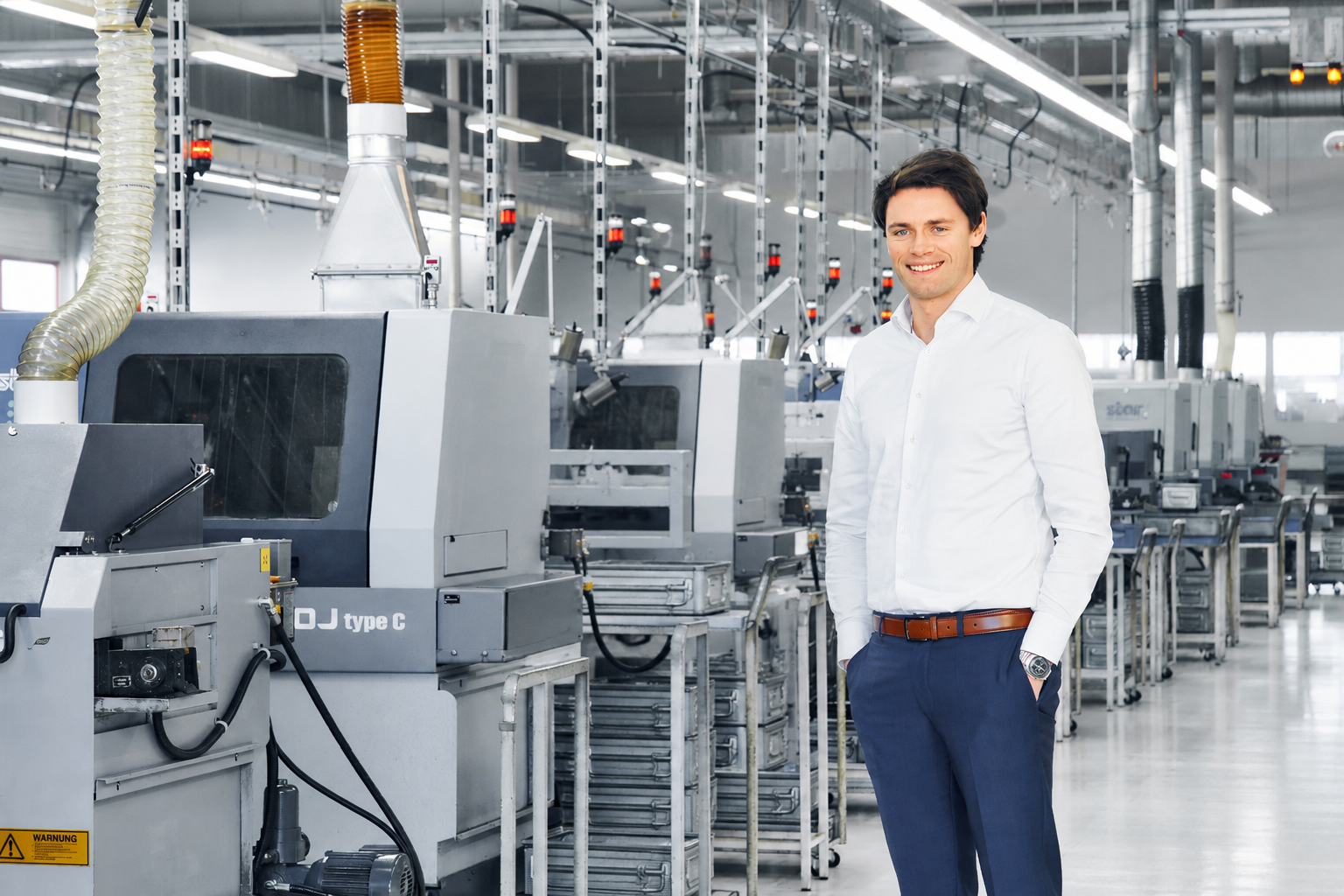
Dominik Hermle.
Industry and Craftsmanship Are Not Opposites
Introduction
Four Generations of Precision.
Hermle is among the last large family-owned businesses in Europe still designing and manufacturing mechanical clocks and movements on such a scale. Founded in 1922 in Gosheim, in the Swabian Alb, the company has remained in the hands of the Hermle family for over a century and today operates out of Reichenbach am Heuberg.
It is there that the vast majority of key movement components are made, from design, through the machining of plates, bridges, gears and gear trains, to assembly, regulation and final quality control. As Dominik Hermle points out, only a few highly specialized processes, such as certain surface finishes, are entrusted to outside partners. With nearly eighty CNC machines, the company has reached a level of vertical integration that, as he puts it, makes it practically the only clock manufacturer in the world operating with this degree of self-sufficiency.
But Hermle is far more than a clock manufacturer. The same precision that has driven the development of mechanical movements for generations is also applied to the production of components for some of the most demanding industries, including aerospace and medical technology. It is this industrial activity, running alongside clockmaking, that today provides the economic foundation to sustain and develop competencies that many companies can no longer afford to finance through mechanical clock production alone.
One of the most spectacular projects of recent years is the Tellurium Tourbillon, a piece that shows Hermle is not confined to classic series production. As Dominik Hermle himself acknowledges, projects like this are not merely demonstrations of the company’s technical capability, but also an important direction for its future, combining top-tier engineering with artisanal perfection and exceptional design.
Dominik Hermle, representing the fourth generation of the family running the company, is CEO of Hermle and a member of the Grand Prix d’Horlogerie de Genève (GPHG) Academy. He studied at the University of Tübingen and joined the family business after building professional experience outside it.
In this conversation, we deliberately did not focus on Hermle’s product catalogue. We were far more interested in what allows traditional clockmaking to survive economically today, where the line between industry and craftsmanship actually lies, and what it means to run a company more than a century old that operates simultaneously in the world of modern engineering and classical mechanics.
WoW: Before taking responsibility for the family business, you gained professional experience outside it, including in the fields of language, media and communication.
How did someone whose professional tool had long been the written and spoken word find his place in a world of metal, manufacturing tolerances and mechanics?
Dominik Hermle: At first glance, these seem like two very different worlds. In fact, my experience in language, media and communication made it easier for me to get started. After all, even in an industrial company, it’s all about listening, understanding complex relationships and bringing people together. Of course, I had to acquire the technical knowledge especially through discussions with our experienced colleagues. I spent a lot of time on the production floor and developed a great deal of respect for the expertise within the company. Today, I don’t see communication and technology as opposites, but as ideal complements. Technical excellence is the foundation of our success; good communication ensures that this leads to shared solutions and progress.
WoW:
Before taking responsibility for the family business, you gained professional experience outside it, including in the fields of language, media and communication.
How did someone whose professional tool had long been the written and spoken word find his place in a world of metal, manufacturing tolerances and mechanics?
Dominik Hermle:
At first glance, these seem like two very different worlds. In fact, my experience in language, media and communication made it easier for me to get started. After all, even in an industrial company, it’s all about listening, understanding complex relationships and bringing people together. Of course, I had to acquire the technical knowledge especially through discussions with our experienced colleagues. I spent a lot of time on the production floor and developed a great deal of respect for the expertise within the company. Today, I don’t see communication and technology as opposites, but as ideal complements. Technical excellence is the foundation of our success; good communication ensures that this leads to shared solutions and progress.
⸻
WoW:
Clock manufacturers exist not only through technology, but also through stories about heritage, craftsmanship and continuity across generations.
Does your experience in communication help you distinguish between the authentic history of a company and a narrative created for the market? Where do you see the line between honestly presenting tradition and idealising it?
Dominik Hermle:
My experience has taught me that good communication isn’t about making up stories, but about telling the right stories in a credible way. People can find out very quickly whether something is authentic or just well-staged. Hermle is over 104 years young. This shows that, for us, tradition is neither an end in itself nor a marketing tool, but rather the result of continuous work spanning generations. At the same time, a company wouldn’t remain successful for so long if it relied solely on its history. For me, the line between history and idealization is crossed when the past becomes more important than the future. A strong corporate history combines both: it provides direction while also fostering the courage to continue evolving.
⸻
WoW:
You did not begin your career directly at Hermle, but first gained experience outside the family company.
Did that distance make it easier to enter the business later, or did it make you more aware of rules and habits that people raised within the organisation may no longer notice?
Dominik Hermle:
Definitely. My time outside the family business broadened my perspective and allowed me to get to know other corporate cultures. It was incredibly valuable to see and experience everything from an employee’s perspective. I continue to benefit from that to this day. At the same time, I quickly realized that many of Hermle’s structures are in place for good reasons and are part of our success. An outside perspective helps us preserve what works and initiate changes where they make sense.
⸻
WoW:
In family businesses, succession is often presented as the moment when one generation hands over control to the next. In practice, it is probably a much more complex process.
How does this work at Hermle? Can responsibility truly be transferred on a particular day, or is succession a gradual process in which the boundaries between the experience of the previous generation and the independence of the next are constantly shifting?
Dominik Hermle:
Business succession cannot be reduced to a single day, it is a process. My father is at the company every day, knows the processes down to the last detail, and remains involved in many areas. I benefit enormously from his experience. At the same time, we engage in intensive discussions within the executive team and continue to develop decisions together. This creates a good mix of experience and new ideas. For me, that is precisely the strength of a family business: maintaining continuity while keeping an eye on the future.
⸻
WoW:
Hermle is associated above all with clocks and movements, but the company is also active in precision industrial manufacturing.
Does this broader industrial base make it possible to preserve clockmaking expertise that might be increasingly difficult to sustain as an independent activity? How important is the modern industrial side of the company to the survival of traditional mechanics?
Dominik Hermle:
Both business divisions benefit from each other. Our industrial precision manufacturing provides the economic foundation and brings state-of-the-art manufacturing expertise to the company. At the same time, through our clock business, we preserve the artisanal and engineering know-how that has been part of our identity for generations. Today, we are virtually the only clock manufacturer in the world with an exceptionally high degree of vertical integration. This enables us to develop and manufacture key components in-house—a decisive advantage for ensuring quality, precision, and expertise within the company over the long term. It is precisely this combination that sets Hermle apart. Without our industrial strength, it would be significantly more difficult to continue traditional mechanical craftsmanship in its current form. Conversely, the experience gained from over 100 years of precision craftsmanship continues to shape our standards for quality and accuracy in both business areas to this day.
⸻
WoW:
The mechanical clock is no longer necessary as a primary instrument for measuring time. At the same time, mechanical wristwatches have experienced a strong revival that domestic clocks have not enjoyed to the same extent.
Why, in your opinion, was the wristwatch able to become part of its owner’s identity, while the clock remained primarily an element of an interior? What could give the mechanical clock a renewed meaning today?
Dominik Hermle:
The wristwatch has the decisive advantage of being directly connected to its wearer. It is worn every day, accompanies its owner for years, and thus often becomes a personal memento or an expression of personality and style. A clock, on the other hand, occupies a different place. It is part of the room and less a part of one’s own identity. However, I see great potential especially in high-quality mechanical clocks: They are not merely timepieces, but fascinating objects brimming with craftsmanship, technology, and history. In an increasingly fast-paced and digital world, the mechanical clock can regain special significance as a deliberate counterpoint to the throwaway mentality. It stands for durability, precision, and the joy of owning something that can be passed down through generations.
⸻
WoW:
The clock and watch industry often speaks about craftsmanship, although modern production relies heavily on CNC machines, automation and repeatable industrial processes.
Where, for you, does industrial production end and craftsmanship begin? Should craftsmanship be defined by the way an object is made, the involvement of the human hand, the scale of production, or rather by the preservation of knowledge and responsibility for the final result?
Dominik Hermle:
For me, industrial manufacturing and craftsmanship are not mutually exclusive. Especially in modern precision manufacturing, highly sophisticated machines are an important tool for achieving the highest quality and reproducibility. What matters most, however, is how this tool is used and the expertise behind it. Craftsmanship does not necessarily mean that every part must be made exclusively by hand. Rather, it is reflected in the expertise of the people who master the processes, make decisions, and take responsibility for the result. At Hermle, we combine state-of-the-art manufacturing technologies with decades of accumulated know-how. The machine delivers the precision, people contribute their experience, understanding, and passion. For me, it is precisely this combination that defines true craftsmanship.
⸻
WoW:
In Poland, Krzysztof Płonka is an independent clockmaker who creates complex astronomical clocks and develops his own escapement concepts outside the structures of a large manufacturer.
What role do such creators play today? Are they a source of inspiration for the industry, guardians of knowledge and experimentation, or do they already operate in a completely different world from serial manufacturers?
Dominik Hermle:
Independent watchmakers play an important role because they preserve knowledge, push boundaries, and develop new ideas. They are an inspiration to the entire industry. We, too, are increasingly navigating this tension between mass production and customization. Through custom projects such as the Tellurium Tourbillon, we create highly personalized mechanical timepieces that combine our decades of expertise with our clients’ specific wishes. In this way, we blend industrial expertise with horological creativity.
⸻
WoW:
Across the luxury industry, an increasing part of a product’s value is created through language, history, provenance and brand narrative.
Is there a risk that, in the case of clocks, the story begins to overshadow the mechanical and material value of the object itself? How can a customer recognise that genuine expertise still stands behind a brand’s narrative?
Dominik Hermle:
A compelling story is important, but it must never replace substance. Quality, technical expertise, and the ability to truly master a product remain crucial. But with a timepiece like our Tellurium Tourbillon, it becomes clear that a mechanical watch can be so much more than just a timepiece. When people stand in front of it, they are often immediately captivated, not just by the technology, but because they are experiencing a work of art, precision, and passion.
A brand’s story is credible when it is underpinned by genuine expertise. At Hermle, this is embodied by over 100 years of experience, an exceptionally high degree of vertical integration, and the combination of craftsmanship and modern precision.
⸻
WoW:
If you could preserve only one thing for future generations, either the mechanical clocks themselves or the knowledge, tools and skills required to build them, which would you choose, and why?
Dominik Hermle:
I would choose the knowledge and skills that go into making mechanical timepieces. A timepiece is the result of experience, precision, and passion. If this knowledge is preserved, new mechanical masterpieces can continue to be created in the future. Clocks will always be part of my DNA. 😊
⸻
WoW:
You mention Hermle’s exceptionally high degree of vertical integration. Many manufacturers use this term, but often to describe very different realities.
Which key components of a mechanical clock are still entirely developed and manufactured in-house at Hermle today, and which processes have become economically or technically unreasonable to keep under one roof?
Dominik Hermle:
At Hermle, vertical integration is a core practice. We develop and manufacture in-house the components that are critical to the quality of our mechanical movements, including plates, bridges, gears, gear trains, and numerous other precision parts. With nearly 80 CNC machines, we have an exceptionally high level of vertical integration and are largely self-sufficient in this area. Assembly, adjustment, and final inspection are also carried out entirely in-house. We collaborate with experienced partners only for highly specialized processes, such as certain surface finishes.
⸻
WoW:
The Tellurium Tourbillon appears to go beyond traditional series production and almost enters the realm of mechanical art.
Do projects like this primarily demonstrate what Hermle is technically capable of, or do they represent a strategic direction in which highly individual mechanical clocks may become a more important part of the company’s future?
Dominik Hermle:
The Tellurium Tourbillon is far more than a technical masterpiece—it is a work of art. It combines the finest watchmaking craftsmanship, precise mechanics, and exceptional design, demonstrating what is possible with decades of experience, a high degree of in-house production, and artisanal perfection. For us, projects like this are far more than mere showcases of technology. They reflect our innovative strength and underscore Hermle’s commitment to creating exceptional mechanical timepieces. Highly customized and technically sophisticated timepieces will therefore remain an important part of our portfolio in the future.
⸻
WoW:
While reading your answers, I noticed that you consistently speak about quality, precision, knowledge and responsibility, while you almost never use the language of luxury or exclusivity, which is so common in today’s watch industry.
Do you think this reflects a specifically German approach to clockmaking and manufacturing, or is it simply your personal philosophy of what gives a mechanical timepiece its true value?
Dominik Hermle:
For us, the true value of a mechanical timepiece does not come from the concept of “luxury,” but from quality, precision, and craftsmanship. For us, exclusivity is the result of these values, not the goal. This approach is undoubtedly shaped by German engineering and is, at the same time, an integral part of Hermle’s philosophy.
After the Conversation
After my conversation with Dominik Hermle, I realized that finding the right lens through which to view the Hermle company is not as simple as it seems.
Like most watch enthusiasts, we tend to see, first and foremost, a manufacturer of mechanical clocks. Yet the conversation revealed something far more interesting, hidden beneath the layer where most observers’ attention usually stops. Hermle is not a company that sustains an industrial operation in order to be able to produce clocks. It is an engineering enterprise for which clockmaking remains one of the most demanding applications of competencies built over more than a century.
The difference seems subtle at first glance, but it completely changes how one looks at the company.
In contemporary clockmaking, craftsmanship is very often set against industrial production. CNC machines are said to strip objects of their soul, automation is treated as the opposite of tradition, and greater production scale is assumed to exclude authenticity. Dominik Hermle, however, never once accepted the problem framed in these terms.
For him, the machine remains nothing more than a tool. The value of a product is determined by the person behind it: their knowledge, experience, and responsibility for the final result.
This approach fits perfectly within the philosophy of German engineering, in which technology was never an end in itself, but a means to the highest quality and repeatability. Seen this way, a CNC machine does not replace the craftsman. It merely allows him to exercise his competence with a precision the human hand alone could never guarantee.
Something else struck me even more. Throughout the entire conversation, the word “luxury” was almost never used. Nor did the stories of exclusivity, prestige, or distinction so characteristic of today’s industry ever appear. In their place, the same concepts kept returning: quality, precision, responsibility, knowledge.
It was only toward the end of the conversation that Dominik Hermle said something which, in my view, best sums up not only his company’s philosophy, but also the difference between an engineering enterprise and a brand built primarily on marketing:
“For us, exclusivity is the result of these values, not the goal.”
That single sentence is worth reading twice, and worth pausing on: whether the word “luxury,” declined today in every possible case by this industry, has simply become too much.
In the world of luxury goods, exclusivity very often becomes the starting point. At Hermle, it seems to be merely the natural consequence of something far more fundamental: competencies developed and passed down through successive generations.
Perhaps that is exactly why this conversation turned out to be less a story about clocks, and more a conversation about what craftsmanship truly means today.
Perhaps, then, the future of mechanical clockmaking depends less on how much of it is still made by human hands, and more on whether there will still be people willing to take responsibility for every element of the mechanism being made, and to guarantee its execution, its precision, and the repeatability that translates into how well it ultimately works. In Hermle’s world, the answer to that question seems obvious.