Interviews
Stefan Kudoke
Independence, Craftsmanship, and the Courage to Say "No"
Introduction
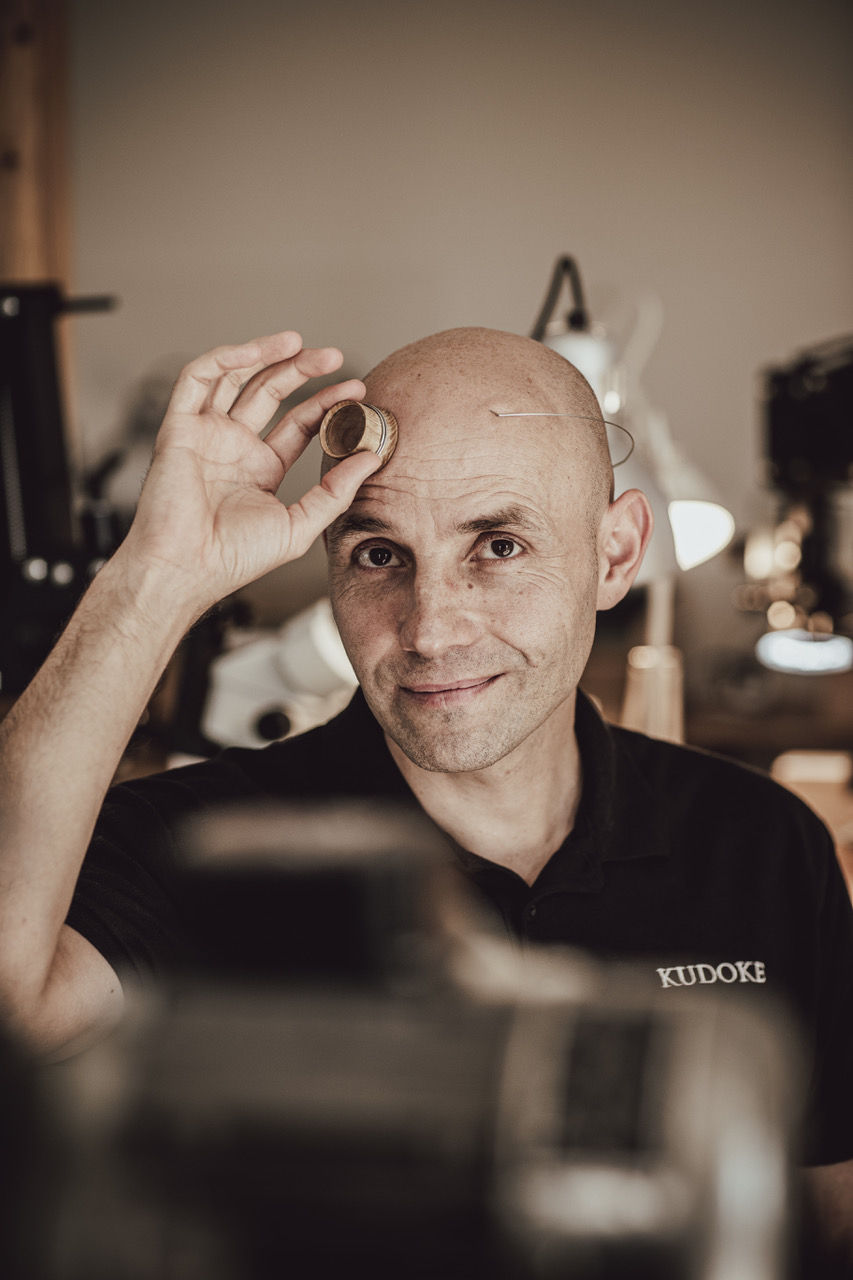
Stefan Kudoke has built his position quietly. Not through noise, but through consistency. Born in 1978 in Frankfurt an der Oder, he received his watchmaking education in Glashütte. He worked in the complications and prototypes department at Glashütte Original, and later in the service departments of Breguet, Blancpain and Omega in New York. He became a master watchmaker at the age of 22, exceptionally early in his professional path. Those years gave him technical discipline and a deep respect for quality. They also gave him a clear awareness of what he did not want to do in watchmaking.
He has worked as an independent watchmaker since 2004. He has been running the KUDOKE brand full-time since 2008. The goal was not to repeat the language of Glashütte under a new name. The goal was to create his own aesthetic world, one in which the influences of Saxon and English watchmaking, historical pocket watches, architecture, art and traditional hand engraving could meet.
KUDOKE remains a small, independent manufacture. Production scale is not the decisive factor here. What matters is personal responsibility for the design, finishing, assembly and final character of the watch. Kudoke emphasizes that independence does not mean making every screw by hand. It means preserving creative control over the concept, the movement architecture, the aesthetics, the quality and the direct craft contribution of one’s own hands.
In 2019, KUDOKE received the Grand Prix d’Horlogerie de Genève award in the Petite Aiguille category for the KUDOKE 2. Stefan Kudoke thereby became the first German independent watchmaker to be recognised by the GPHG. This success, however, did not fundamentally change his approach. Kudoke still speaks about watchmaking calmly: as work in which what matters is not only what we are able to do, but also what we consciously choose not to do.
In conversation with WoW – Watcher of Watches, Stefan Kudoke talks about his path from great brands to his own independence, about the line between collaboration and the loss of authorship, about consciously moving away from the dominant aesthetic of Glashütte, about hand craftsmanship, success after the GPHG, and about why true independence sometimes begins with the courage to say no.
WoW:
Looking back at your professional journey – from your earliest years learning the craft to building your own manufacture – what has remained unchanged in the way you approach your work and your life?
Stefan Kudoke:
Looking back, many things have changed – the size of the workshop, the complexity of the watches, and the responsibilities that come with running an independent manufacture. But at the core, my approach has remained the same.
From the beginning, I have been driven by craftsmanship, and the desire to create something meaningful with my own hands. I still believe that a watch should be more than a technical object; it should carry a human touch and tell a story.
One principle that has never changed is what I call the “golden rule”: treat others the way you would like to be treated yourself. This applies not only to customers, suppliers, and colleagues, but also to the watches we create. I always ask myself whether I would be happy to receive a watch made to the same standard. If not, it is not ready.
Building KUDOKE was never about becoming the biggest manufacturer. It was about preserving the freedom to create watches according to my own vision and values.
WoW:
For a period of time, you worked within some of the most prestigious structures of modern watchmaking. What did your years at brands such as Breguet, Blancpain and Omega teach you, and which of those experiences later proved most valuable when building your own company?
Stefan Kudoke:
Working for brands such as Breguet, Blancpain and Omega was a valuable experience because it allowed me to see different aspects of high-end watchmaking at a very high level. I learned the importance of precision, consistency, and maintaining quality standards across every detail of a watch.
At the same time, I gained insight into how successful watch companies are structured and how design, production, communication, and service must work together. As a young watchmaker, it was an excellent opportunity to learn from experienced people and understand what it takes to build a lasting brand.
Perhaps the most valuable lesson, however, was discovering what I wanted to do differently. Large organizations have many strengths, but I realized that I was happiest when I could work more directly, more personally, and with greater creative freedom.
When I founded KUDOKE, I combined the professionalism and discipline I had learned from these renowned brands with the independence and personal expression that have always been important to me. In many ways, my own manufacture is the result of both experiences coming together.
WoW:
Many people speak about independence, but very few live it for more than two decades. Has your perception of independence changed since founding your company in 2004? If so, in what way?
Stefan Kudoke:
When I founded KUDOKE in 2004, independence meant having the freedom to create watches according to my own ideas, without having to follow trends or corporate strategies.
Today, I see independence as a balance between freedom and responsibility. You are free to make your own decisions, but you are also responsible for every one of them – towards your team, your customers, and the future of the company.
What has not changed is that independence allows me to stay authentic. We don’t create watches to satisfy the market; we create the watches we truly believe in. Fortunately, there are collectors around the world who appreciate exactly that. I think this honest connection between watchmaker and collector is one of the greatest privileges of being independent.
WoW:
Before starting your business, you also studied economics, business and marketing. Has that knowledge influenced the way you design watches and movements? Have there been moments when business considerations suggested one direction while your watchmaking intuition suggested another?
Stefan Kudoke:
Studying business gave me a better understanding of how to build and manage a company, but it has never dictated how I design a watch.
Of course, there are moments when business considerations and creative ideas point in different directions. It would often be easier or more profitable to follow trends or develop products with broader market appeal. But I have learned that short-term success should never come at the expense of authenticity.
In the end, my watchmaking intuition usually has the final word. I believe collectors can sense when a watch is created from genuine passion rather than market analysis. The business knowledge helps me make sustainable decisions, but it serves the creative vision – not the other way around.
WoW:
Modern watchmaking relies on cooperation with suppliers, specialists and technological partners. Is there a line beyond which a watch ceases to be truly your own creation?
Stefan Kudoke:
I don’t believe independence means making every single component yourself. Modern watchmaking has always relied on specialists, and I have great respect for the expertise of our suppliers and partners.
For me, the decisive question is who has the creative responsibility. The concept, the movement architecture, the design, the finishing, and the final quality standards must reflect my own vision. At the same time, every watch must pass through our own hands. We assemble, decorate, engrave, regulate, and inspect each watch ourselves. That is the difference between being an independent watchmaker and simply being a designer.
A watch ceases to be your own creation when you stop making the essential decisions and no longer contribute your own craftsmanship. As long as the creative direction and the hands-on work remain yours, collaboration is not a compromise – it is part of good watchmaking.
WoW:
Most German watch brands build their identity around the visual language of Glashütte. You consciously chose a different path. Where did that decision come from, and what did you want to express through this alternative aesthetic language?
Stefan Kudoke:
I have great respect for the traditions of Glashütte and the remarkable watches that have been created there. But I never wanted to copy an existing style simply because it was expected of a German watchmaker.
From the very beginning, I wanted KUDOKE to have its own identity. My inspiration comes not only from Saxon watchmaking, but also from English watchmaking, historical pocket watches, architecture, art, and traditional hand engraving. I enjoy combining these influences in a way that feels authentic rather than following a single school of design.
I believe collectors are looking for character, not imitation. If someone sees a KUDOKE from across the room, I want them to recognize it immediately – not because it follows convention, but because it has its own personality.
WoW:
What is the most underappreciated aspect of genuine watchmaking today in the eyes of customers and collectors?
Stefan Kudoke:
I think one of the most underappreciated aspects is the amount of time, skill, and experience behind true hand craftsmanship. When people look at a finished watch, they often see the result – but not the countless hours of development, finishing, engraving, and refinement that made it possible.
That is one of the reasons why we regularly share videos from our workshop. Even a seemingly simple component, such as a hand, requires numerous individual operations before it is finished. Showing these processes helps people understand the craftsmanship that cannot be seen in the finished watch alone.
Another aspect is restraint. In genuine watchmaking, knowing what not to do is often just as important as knowing what you can do. Every detail should have a purpose, not simply attract attention.
Fortunately, I also see a positive development. More and more collectors are looking beyond specifications and marketing. They want to understand who made the watch, how it was created, and what values it represents. I believe that appreciation for authentic craftsmanship is growing, and that is very encouraging.
WoW:
Winning a Grand Prix d’Horlogerie de Genève award is often considered a defining moment in an independent watchmaker’s career. What changed after receiving that recognition, and what remained exactly the same?
Stefan Kudoke:
Receiving the GPHG award was, of course, a great honor and an important milestone for KUDOKE. It brought international recognition and introduced our work to many collectors who had never heard of us before.
The recognition also allowed us to grow, but only on our own terms. Over the years, we have expanded our team step by step, always at a pace that felt healthy and sustainable for us. We never wanted success to pressure us into growing faster than we believed was right.
What remained exactly the same was our independence. We continued to make our own decisions and stayed true to our philosophy of creating honest, handcrafted watches that reflect our own values. The GPHG gave us greater visibility, but it did not change who we are.
WoW:
Success brings visibility, demand and new opportunities. Is there a point at which success itself can become a threat to independence?
Stefan Kudoke:
Yes, I believe that success can become a challenge if it begins to dictate your decisions instead of supporting your vision.
Greater demand often creates pressure to grow faster, increase production, or follow market trends. Those opportunities can be tempting, but they can also lead you away from what made your work special in the first place.
For me, independence means having the courage to say “no” when necessary. We have consciously chosen to grow step by step, always at a pace that allows us to maintain our quality, our craftsmanship, and our close relationship with our collectors.
In the end, success should give you more freedom – not less. If it starts taking away your ability to make your own decisions, then it has become a threat to true independence.
WoW:
KUDOKE 5 appears to be one of the boldest projects in the history of your brand. Was the greater challenge inventing a new way of displaying time, or technically realising that concept without compromising reliability and chronometric performance?
Stefan Kudoke:
The KUDOKE 5 was the logical evolution of the KUDOKE 2. I wanted to reinterpret the iconic 24-hour display and give it an even stronger three-dimensional presence. The design idea came first – it was the starting point for the entire project.
Turning that idea into reality, however, became a technical challenge. The rotating disc is significantly larger than on the KUDOKE 2, which means it also has much greater inertia and requires more energy to drive. I did not want to sacrifice power reserve or chronometric performance simply to achieve a visual effect.
The solution was to integrate a ball bearing, which significantly reduced friction and minimized the loss of energy. In the end, the project became a combination of both worlds: a design-driven idea that could only succeed through a technical solution. For me, that is what good watchmaking is all about – where aesthetics and engineering develop hand in hand.
WoW:
What does contemporary watchmaking do significantly better today than it did twenty years ago? And what, in your opinion, has it lost along the way that was truly valuable?
Stefan Kudoke:
I think one of the greatest improvements over the past twenty years is the much closer relationship between watchmakers and collectors. Today, independent watchmakers can communicate directly with the people who wear and appreciate their watches. That creates meaningful conversations, lasting relationships, and often very personal timepieces that tell a story for both the collector and the maker. I see that as a real gift.
At the same time, I sometimes feel that the industry has become very fast-moving. Social media and constant product launches create pressure to always present something new. But good watchmaking takes time. Some ideas need years to mature, and true craftsmanship cannot be accelerated.
For me, the greatest challenge today is to preserve that patience. I would rather create one watch that I am truly proud of than several that simply satisfy the demand for novelty. I believe authenticity and lasting quality will always outlive trends.
WoW:
Your watches often contain deeply personal elements – symbols, details and hand-finished surfaces that carry traces of their creator. If someone were to discover one of your watches a hundred years from now, knowing nothing about Stefan Kudoke, what would you hope they could learn about the person who created it?
Stefan Kudoke:
I would hope they would recognize that this watch was not created by a company, but by people. That behind every engraving, every polished edge, and every design decision was someone who genuinely cared about what they were making.
I would also hope they could sense a certain curiosity and individuality. I have never tried to follow trends or create watches that appeal to everyone. Instead, I have always tried to create something honest that reflects my own personality and values.
If someone, a hundred years from now, were to hold one of my watches and think, “Whoever made this loved his craft and respected the people who would one day wear it,” then I believe I have achieved something worthwhile.
After the Conversation
After this conversation, one impression remains with me above all: Stefan Kudoke is not trying to convince anyone that he is independent. He simply speaks like someone who has lived for years with the consequences of that independence.
That is an important difference.
In the watch world, the word “independence” is often used rather lightly today. Sometimes it means small-scale production, sometimes not belonging to a large luxury group, and sometimes merely a good-sounding phrase in a catalogue. With Kudoke, it sounds different. Less romantic, perhaps, but more true. It is a daily practice of choice, not a declaration of rebellion. What to do and what not to do. When to grow and when to stop.
And most importantly, when to say no to a client, to the market, and sometimes probably also to oneself.
The most interesting thing is that in his answers there is no pose of the lonely genius locked in some kind of ivory tower, surrounded by files, bridges and angelic dust left after polishing the edges.
Kudoke speaks very soberly about cooperation, suppliers, specialists and technical partners. He does not pretend that an independent watchmaker must make every screw by hand in order to preserve the moral purity of the craft. He knows that contemporary watchmaking is a network of competences.
At the same time, however, he draws the line very precisely. A watch does not stop being truly yours when someone else makes a component. It stops being yours when you hand over the essential decisions to someone else: the concept, the architecture of the movement or the standard of finishing. The final responsibility.
This is perhaps one of the most honest definitions of independence that can be heard in the industry today.
The second strong theme is restraint. Kudoke says that in genuine watchmaking, knowing what not to do is just as important as knowing what we are capable of doing. That sentence should hang above the desks of many product departments, including those of much larger and much wealthier brands.
Because the contemporary watch market sometimes seems tired by its own need to make noise — noise driven by marketing.
More launches, more colours, more limited editions, and more “breakthrough” releases that, after two months, quietly disappear beneath the next layer of novelty.
Kudoke reminds us that a watch does not have to be inflated and shout in an advertisement in order to have character.
Paradoxically, this is precisely why his path is interesting. It is a story about refusing to copy one dominant language, not about escaping from tradition. A German watchmaker does not have to spend his entire life standing in the shadow of Glashütte, even if Glashütte remains one of the most important points of reference.
Kudoke is looking for his own alphabet: a little Saxon, a little English, a little from old pocket watches, a little from hand engraving and a little from personal sensitivity. The result is not a manifesto against tradition. It is rather an attempt to say that tradition only makes sense when it allows one to speak in one’s own voice.
Equally valuable is the way he speaks about success. The GPHG award could have become the beginning of acceleration, increased production, a stronger push into the market and the building of a larger sales machine. Kudoke describes it differently. Success should give more freedom, not less. If it starts dictating decisions, it ceases to be a reward and becomes a threat.
That sentence reaches far beyond watches.
It applies to every creative activity that begins with passion and then meets demand, expectations, pressure to grow and spreadsheets that have the strange ability to look perfectly reasonable even when they are quietly killing the meaning of the entire undertaking.
That is why, after speaking with Stefan Kudoke, what remains is not the image of a brand that wants to be bigger, louder or more spectacular. What remains is the image of a workshop that wants to preserve the right scale. A scale at which the watch still passes through human hands, and decisions do not dissolve into an impersonal structure.
The most beautiful thought, however, comes near the end of the conversation. Kudoke says that if someone were to find one of his watches a hundred years from now, he would want them to understand that it was not created by an anonymous company, but by people.
People who cared. People who were curious, attentive, respectful of the craft and of the future owner.
In an age in which luxury is increasingly confused with access to a brand rather than contact with someone’s work, this is a very simple and very powerful definition of the meaning of watchmaking.
A mechanical watch will never beat a phone today in terms of utility. It does not have to, because its value begins somewhere else: in the time devoted to the project, in the decisions that cannot be seen, in the details most people will never notice, and in that strange, slightly irrational hope that an object can carry something of the person who created it.
With Stefan Kudoke, independence begins with the courage to say “no”.
But it ends with something even more important: responsibility for what one says “yes” to.