Interviews
Paul Gerber
The master of the invisible space. A magician who doesn't need a stage!
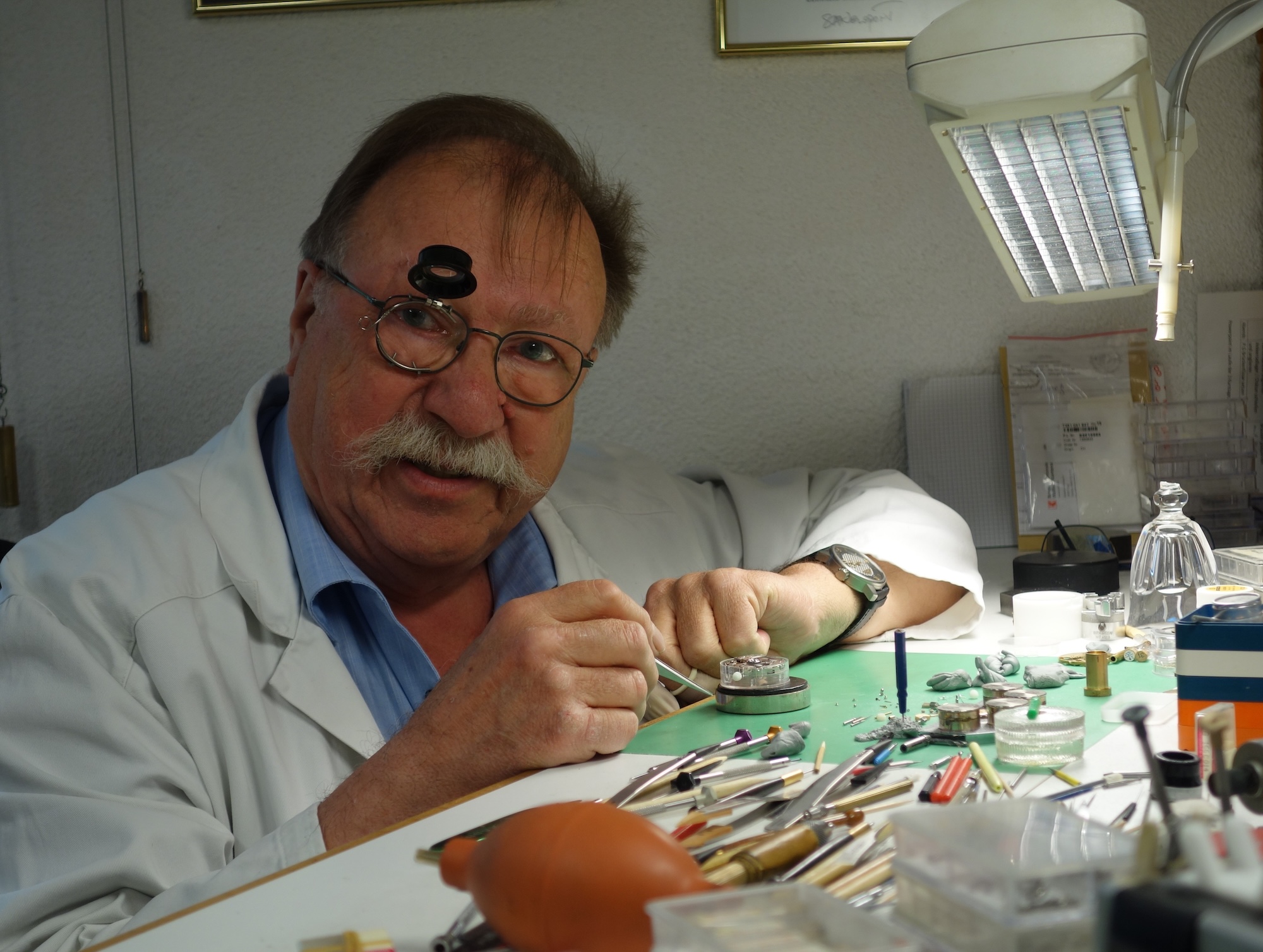
Introduction
Paul Gerber is one of those watchmakers whose work usually stems from an engineering problem, rather than a product idea.
For years, he has been developing his own movements in Zurich, working simultaneously on unique pieces and solutions intended for serial production. His achievements include both elaborate projects, such as Superbia Humanitatis, and precise structural interventions in existing calibers, for example, the integration of an alarm mechanism with a Valjoux 7750 for Fortis. His approach is also evident in the MIH Watch, whose annual calendar operates using only nine additional parts, and in the Retro Twin with a winding system based on two rotors and a retrograde seconds hand.
Several constant elements recur in his approach: maximum utilization of available space, integration of functions instead of modular addition of complications, and very clear criteria regarding tolerances, durability, and serviceability. Not every solution, even if functional, proceeds to the next stage. Some remain as unique pieces if they do not meet his own standards on a larger scale.
In addition to his own constructions, he has also worked for other brands, from small manufactures to larger companies. The authorship of solutions did not always appear on the dial.
This is a conversation about design decisions. About what remains, and what is consciously not put into production.
WoW:
In many of your constructions, one can observe a consistent approach to utilizing space, often without changing the dimensions of the movement.
When does miniaturization cease to be technical elegance for you and start to become a compromise?
Paul Gerber:
Technical elegance always comes first; harmony must be maintained.
WoW:
Many contemporary complications are created as modules mounted on existing calibers.
Do you believe a complication should be part of the design from the outset?
Paul Gerber:
Modules are not a solution for me. The integration of complications is always a particular challenge and, of course, requires significantly more work. More work in design, testing, and later in production. Ultimately, this can result in a very harmonious whole, and the final result gains significantly more value.
WoW:
Some of your solutions have only been produced in very small numbers or remained unique pieces.
Do you believe there are concepts that consciously should not go into series production, even if they are technically functional?
Paul Gerber:
Yes, sometimes it's solely about whether an idea can be mechanically realized. If so, the project is complete. The next step would be commercialization. This is not always necessary for me.
WoW:
In one of your projects, a monopusher controlled by the crown, you decided not to implement the solution, even though it worked.
Where do you draw the line for acceptable tolerance in the behavior of a movement?
Paul Gerber:
There are two reasons for this. The crown protruded, which didn't look aesthetically pleasing. The tolerances were very small; I had concerns about durability and servicing and didn't want to take the risk.
Meeting various criteria: flawless operation, durability, and the most service-friendly design possible. Everything must remain in proper proportion to the effort.
WoW:
The visual aspect of movements plays a large role today.
From what point does aesthetics begin to influence or limit the design?
Paul Gerber:
First the design, then the aesthetics. So far, I have always managed to find a good solution that maintains harmony.
WoW:
You work with both classic methods and modern tools, such as CNC.
Which elements of the movement do you consciously not entrust entirely to machines and why?
Paul Gerber:
I always use the machine that meets the criteria leading to the desired end result. For repeatability, CNC technology is a necessity. Then, manual work becomes essential. There are no components in my watches that are exclusively machined by CNC machines.
WoW:
You have also created movements for other brands, often without your name being directly attributed to the finished product.
How often, in your experience, do movements or key design solutions originate outside the brand that ultimately signs the watch?
Paul Gerber:
For twelve external brands, I realized smaller and larger projects up to the stage of readiness for series production. Some companies did not want my name to be mentioned. Others did mention my name, such as: Fabergé, MIH, Fortis, Sarcar, Perrelet, Ochs und Junior, and Uhrenkabinett-Wehrle. Smaller brands were happy to mention my name; larger companies did not want to.
WoW:
You mentioned very small tolerances and concerns about durability and servicing.
Can you give a specific example of a solution you abandoned precisely for these reasons?
Paul Gerber:
Caliber 33 with its own patented escapement is such an example. In this escapement, various angles had to be extremely precisely aligned with each other. This works very well in individual pieces, to the extent that I did it for myself. Despite great interest, I deliberately did not sell this escapement to a large company, because for series production it would have required significantly more rework. I preferred to dedicate that time to a new project.
WoW:
Your designs often show a clear focus on the possibility of disassembly and servicing.
Is serviceability an equal criterion to function for you, or do you see a different development trend in the industry?
Paul Gerber:
For me, servicing is very important. Design and servicing must harmonize. However, it is not always easy to meet this criterion. If I create a technical solution in a new, very simple way, not every watchmaker is able to perform the service because they are not familiar with this solution.
WoW:
In some projects, the biggest challenge is not the complication itself, but its integration within the entire movement.
Can you point to a specific project where this integration was the most difficult?
Paul Gerber:
Superbia Humanitatis is certainly a good example. The client wanted all the classic complications. The great challenge was to fit them all in and ensure their mutual interaction.
Another example is the alarm design I integrated into a Valjoux 7750 for Fortis. Both from the dial side and the movement side, I managed to completely integrate the required mechanism. This had a big impact on series production. There was no need to lengthen the base components, which meant large savings, and the movement became only slightly thicker.
WoW:
Which design decision was, in retrospect, the most difficult for you?
Paul Gerber:
Certainly Superbia Humanitatis. So many complications had to work both together and independently there.
After the Conversation
The most powerful moment of this conversation is not the declaration of style, but the example of caliber 33.
Gerber had a ready, patented escapement, and there was interest from a large company, yet he consciously decided not to sell the design. The reason was simple: the solution would require thorough re-engineering for serial production.
This is a decision where the constructor's time proves more valuable than commercialization scaling.
The second constant is the order of criteria. First, construction, then aesthetics. Function, durability, and serviceability are equally important decision criteria for him. In the case of a monopusher controlled by the crown, the problem was both aesthetics, with the protruding crown, and very tight tolerances, raising concerns about durability and service. The movement worked, but the risk was too great.
The theme of integration returns in the example of Superbia Humanitatis as the problem of accommodating many complications and their mutual interaction. It also returns with the alarm integrated with Valjoux 7750 for Fortis, where full integration on both sides of the movement allowed avoiding the lengthening of basic components.
A less obvious conclusion also emerges. The more proprietary and structurally simplified a solution is, the harder it is to service outside the author's workshop. Simplicity of geometry does not mean simplicity of service if the solution remains unique.
One principle recurs in his approach: if an idea can be mechanically realized, the design is complete. Commercialization remains a separate decision.