Interviews
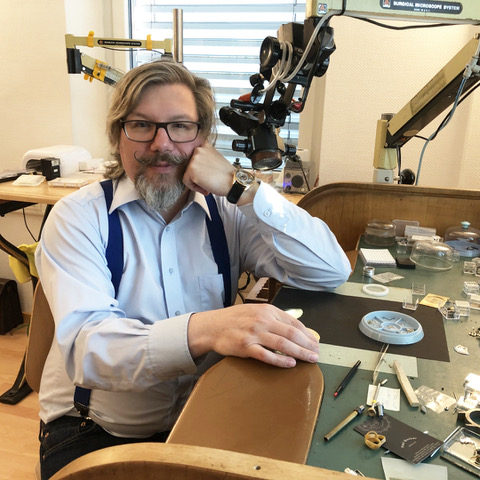
Andreas Strehler
I am a watchmaker, not a brand
Introduction
In watchmaking, there are creators who build brands and those who build movements. The names of the former are on the dials, while the latter are more likely found in design documents.
Andreas Strehler belongs to the select group who have successfully done both for years.
He is a Swiss watchmaker and constructor who has transitioned from restoring historical movements and working at Renaud & Papi to his own, fully independent activity. He was one of the youngest members of AHCI, and his name has long been a synonym in the industry for engineering precision, mechanical imagination, and a rare ability to simplify truly complex things.
Over the years, he has worked not only on watches bearing his own name but also on projects for other brands. Among the most significant examples are his collaboration with H. Moser & Cie. on the perpetual calendar, with Harry Winston on the Opus 7 project, with Maurice Lacroix on their own chronograph movement, and also with Maîtres du Temps. In parallel, he developed his own constructions, such as Papillon, Sauterelle, and a record-breakingly precise mechanical moon phase indicator.
It is precisely this dual perspective, as a creator of his own watches and a person who has co-created solutions for others for years, that makes him a unique interlocutor. Strehler looks at watchmaking not like a marketer, not like a brand manager, and not like a collector's storyteller, but like a constructor for whom energy, geometry, durability, and the meaning of mechanics are paramount.
That is why this conversation is so valuable, as it is not an interview about "novelties," "heritage," or "brand DNA." It is a conversation with a man who still thinks about the watch "from the inside out."
Photos courtesy of Andreas Strehler
WoW:
Do you believe there are still fundamental mechanical problems left to solve in watchmaking, or are we mostly refining and reinterpreting solutions that already exist?
Andreas Strehler:
Mechanical watchmaking is an anachronism in general. To be honest, technologically, mechanical watches have been outdated since the rise of microelectronics. 😉
We have been in an endless loop of the last stage of mechanical watchmaking for more than 50 years. That is the philosophical part.
Mechanical development is similar to other creations like music: the notes have been defined for centuries, but every day we can still create a new song.
Fundamental problems? In watchmaking, we create them all the time. There is no real need for challenges, except to surprise the customer.
Modern solutions in mass production may increase precision, but there is no sustainability. We are at the same level with industrial mechanical watches as we are with electronic watches: if a bad watchmaker makes a mistake, even the best watchmaker cannot repair it without replacing parts with original spare components.
This is not the case in traditional watchmaking: if a bad watchmaker bends something, a good watchmaker may correct it. The watch keeps its value because of its content, not because of spare parts availability.
WoW:
When you start a new project, does the process usually begin with a technical problem you want to solve, or with a concept for a mechanical function you want to realize?
Andreas Strehler:
A technical and aesthetic challenge. What it should do, what it should indicate, or how it should look.
WoW:
In the Sauterelle, you implemented a remontoir d’égalité. In a wristwatch, do you see such a mechanism primarily as a real improvement of isochronism, or more as a demonstration of mechanical purity?
Andreas Strehler:
It is a real improvement in timekeeping, which makes the watch technically attractive.
Normal watches are tested only fully wound and after 24 hours. Even a watch that runs three days or more is not checked further. Everything is defined by norms, and because otherwise the watch would fail.
With my remontoir, the watch delivers the same timekeeping over the full power reserve, and it even compensates for variations in power transmission that cannot be compensated by mechanisms like fusee and chain.
WoW:
Constant-force mechanisms stabilize the delivery of power but inevitably add complexity. Do you believe such systems will remain robust and serviceable after 20–30 years?
Andreas Strehler:
My mechanism is really robust. It follows the same mechanical principles used in watches for centuries: gears and a spring.
There are no weak points like silicon hairsprings or nanomechanics.
WoW:
How does the relationship between an independent constructor and the brand that ultimately brings the product to market usually work?
Andreas Strehler:
We are subcontractors. We help our clients to produce their products. They have the challenge of bringing them to market.
WoW:
Are there technical problems that are easier to solve in a small independent workshop than in a large manufacture?
Andreas Strehler:
Creativity in large companies may be lower because everyone wants to build a career and moves between positions or even companies.
There is almost nobody who knows more than what happened in the last five years.
WoW:
Where does elegant mechanical engineering end, and what might be called “mechanical baroque” begin?
Andreas Strehler:
Many customers just want the superlative, not the product.
WoW:
You created one of the most precise mechanical moon phase displays ever. Is this mainly an engineering exercise, or does it still have a practical purpose?
Andreas Strehler:
Watchmakers tend to repeat what previous creators have done without asking why.
In the case of my moon gear train, I simply created a gear train with reasonable gear sizes and as few components as possible.
So why repeat what has already been done, instead of creating something improved with the same level of technical complexity?
It has the same purpose as an imprecise moon phase indicator. It indicates the lunations - just more precisely. 😊
WoW:
Do you see silicon as a natural evolution of watchmaking technology, or as a shortcut?
Andreas Strehler:
Good for mass production, but not sustainable.
WoW:
If you were free to design a movement entirely from scratch, without commercial or marketing constraints, what problem would you want to solve?
Andreas Strehler:
What kind of question is that?
I always do what I want. I do not really care about marketing when I create a watch.
I am a watchmaker, not a brand!
After the Conversation
The conversation with Andreas Strehler is valuable not because it contains many impressive slogans. On the contrary, its strength lies in the fact that almost every sentence challenges the convenient narratives on which the modern watch industry builds its image.
Strehler doesn't speak like a brand. He doesn't even speak like a "master independent watchmaker" in the catalog version. He speaks like an engineer who looks at a watch from the inside and has no need to pretend that mechanics are today the answer to a real functional problem. When he states that mechanical watchmaking is an anachronism, he doesn't try to discredit it but rather restores its proper proportions.
This is precisely one of the most interesting paradoxes of this conversation. The more honestly Strehler talks about the limitations of a mechanical watch, the more clearly its true value becomes apparent. Not in the promise of progress, which supposedly is still ongoing, but in the quality of thought, the elegance of the construction, the ability to create solutions that don't have to exist, yet can still captivate.
His aversion to the appearance of innovation and to complicating for complication's sake resonates particularly strongly. To a world where the client increasingly expects not a product, but a superlative. This is a very apt observation, as it applies not only to watches but to all modern luxury. In many market segments, value is no longer built by the quality of the object itself, but by the intensity of the story surrounding it.
Strehler stands on the opposite side. He is interested in durability, repairability, the logic of the movement. Even his skepticism towards silicon or mass production doesn't stem from nostalgia, but from a very specific question: will what we create today still make sense in a few decades?
This is rare thinking in an industry that readily talks about heritage, but much less often asks itself whether contemporary constructions will themselves be worth inheriting someday.
This conversation also shows something else. That behind many words the industry likes to use, such as innovation, manufacture, or independence, lie very different things.
Strehler doesn't need to elaborate on or decorate these concepts. In a few simple answers, he shows that true watchmaking begins where marketing syntax ends.
And perhaps that's why this interview stays in the mind longer than many conversations with more media-savvy names. Because it doesn't talk about what the industry would like to hear about itself, but about what it truly is.