Interviews
Dominique Renaud
Has the mechanical watch already reached its limits?
Introduction
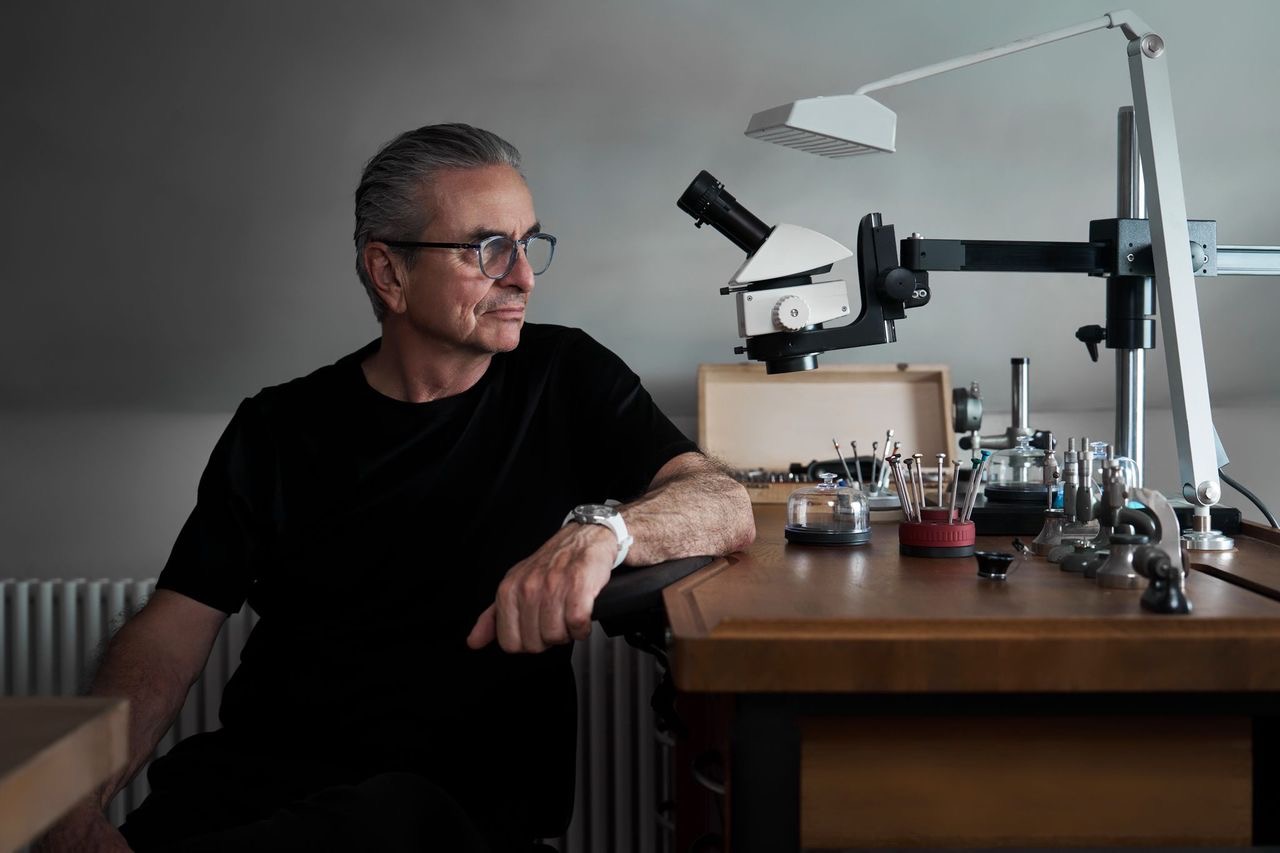
Dominique Renaud belongs to a select group of constructors who have genuinely influenced the development of contemporary watchmaking, while remaining outside the marketing narrative that so often dominates this industry.
As co-founder of Renaud & Papi, he participated in the 1990s in developing solutions that redefined the way grand complications were constructed. Collaborating with many prestigious manufactures, including on projects developed for Richard Mille, he was involved in creating movements that pushed boundaries in terms of both construction and the materials used.
After a period of extremely intense activity, he withdrew from the world of watchmaking for many years. However, his return was not a continuation of his previous path, but an attempt to challenge the very foundations of the mechanical watch. The Blade Resonator project, presented years later, was almost immediately recognized as one of the most radical attempts to depart from the classic architecture of the balance with a hairspring.
In an era when a watch increasingly becomes primarily a marketing product and an investment object, Dominique Renaud remains true to a completely different way of thinking. At the center of his interests are construction, energy management, and the physical limitations of the movement.
The conversation I had with Dominique Renaud does not concern specific models or the latest releases. It touches upon fundamental issues: the regulator, friction, energy, and the question of whether the mechanical watch has already reached the limits of its capabilities, or if it is only on the verge of redefining its own principles.
WoW:
Do you believe that the mechanical regulator, in its current form, represents a definitive architecture, or are we still in a transitional stage of the evolution of mechanical timekeeping?
Dominique Renaud:
The mechanical regulator we use today, meaning the balance and hairspring system, is one of the greatest inventions in the history of mechanics.
However, the history of technology teaches us one thing: no solution is definitive. What works perfectly today might tomorrow prove to be just a stage in a much broader evolution.
For me, the regulator remains an area of continuous exploration. For centuries, we have refined this system, but that doesn't mean we have reached the ultimate form of mechanical timekeeping.
WoW:
The Blade Resonator project was an attempt to challenge the classic balance.
Do you believe that the main limitation of new regulators today stems from the laws of physics and manufacturing constraints, or rather from the market's attachment to the traditional balance and hairspring architecture?
Dominique Renaud:
The Blade Resonator used in the DR01 model was born from an almost naive question: have we become prisoners of the balance and hairspring?
This system works excellently, but it also has significant physical limitations: friction, dependence on lubrication, and sensitivity to gravity.
The idea behind the Blade Resonator in the DR01 model was to explore a completely different approach, based on the elasticity of the material rather than the inertia of the balance.
In watchmaking, obstacles are not solely technical. They are also cultural. Sometimes we become too attached to solutions we know well.
WoW:
Does the least utilized area of a modern mechanical watch not remain energy management, i.e., its storage, transmission, and the stability of torque?
Dominique Renaud:
A mechanical watch is, above all, a miniature energy machine.
We store a small amount of energy in the mainspring, and the entire architecture of the movement is designed to transmit this energy as stably and efficiently as possible.
In this process, we lose vast amounts of energy due to friction, gearing, and the impulses of the escapement, i.e., the lift angles. In my opinion, it is precisely energy management—its storage, transmission, and stability—that remains the most important frontier in modern watchmaking today.
In the Renaud Tixier Monday watch, I worked on increasing the efficiency of the automatic winding mechanism with a micro-rotor. I utilized the space in its central part to connect it with a flywheel, which recovers energy from dynamic wrist movements.
The flywheel continues to rotate even after the micro-rotor stops, thereby assisting in further winding the mainspring.
WoW:
If you could eliminate one fundamental weakness of a mechanical watch: friction, the need for lubrication, the influence of gravity, or the lack of perfect isochronism, which would you choose?
Dominique Renaud:
If I could eliminate only one weakness of a mechanical watch, it would be friction.
Friction is the silent enemy of any mechanical construction. It consumes energy, necessitates lubricants, causes wear on components, and introduces instability.
The entire history of watchmaking is, in fact, a battle against this phenomenon. If friction could be radically reduced, a significant portion of the other problems would almost disappear on their own.
WoW:
What have you imparted to young constructors that they couldn't learn in a traditional watchmaking school?
Dominique Renaud:
What I try to impart to young constructors is not limited solely to technical knowledge.
Schools are very good at teaching how to build watches. However, they much less frequently teach how to question established principles.
Sometimes you have to learn to... unlearn.
I often tell them: never accept a solution just because it has existed for two centuries. Watchmaking is a living mechanical art. It evolves thanks to people who have the courage to ask simple questions and seek new paths.
WoW:
Do you believe there is still a true "Holy Grail" of mechanical watchmaking, a problem whose solution could completely change our understanding of timekeeping, or have we already reached the limits set by the laws of physics, and today we are left only with refining existing solutions?
Dominique Renaud:
After a period where I explored the possibilities of high frequencies and small amplitudes, with the DR Pulsion60 watch, I decided to move in a completely opposite direction: towards very low frequency combined with enormous amplitude. This might seem paradoxical, but such an approach reveals a completely different dimension of mechanics.
With a larger amplitude, based on the classic Swiss lever escapement, the lift angle during the impulse disturbs the total oscillation of the balance for a much shorter time, which in the Pulsion60 model exceeds 400 degrees.
Such a huge amplitude allows one to almost physically feel the movement of the oscillator. The balance becomes visible, alive. It operates at a frequency close to the rhythm of the human heart. After all, watchmaking should also stir emotions.
Perhaps the true Holy Grail of watchmaking is not solely about maintaining the highest precision, but rather about continuously creating new instruments that can express the passage of time through beauty and poetry.
In this artistic sense, I am deeply convinced that there is still much to discover.
After the Conversation
The conversation with Dominique Renaud aligns with a direction increasingly rare in contemporary horology. It doesn't concern the creation of new products, but rather the analysis of their limitations.
In his answers, the watch ceases to be a finished object and becomes an energy system, where energy losses resulting from friction, instability, and the method of its transmission play a crucial role. It is in these areas that Renaud perceives the true limits of modern mechanics.
At the same time, he challenges the approach of merely refining existing solutions. The constructions developed over two centuries of history are not an unchallengeable model for him, but a starting point. These are structures that must first be understood, but not necessarily accepted uncritically.
The central theme of this conversation becomes the ability to "unlearn." The capacity to question solutions that still work sufficiently well seems to be a prerequisite for true progress.
At the same time, Dominique Renaud's reflection is not limited solely to technical issues. In the final part of the conversation, another dimension emerges. Mechanics ceases to be merely a tool for time measurement and also becomes a way of expressing it.
In this view, horology does not appear as a closed and completed system. On the contrary, it remains a field still open, not only to new solutions, but above all to new questions.