Interviews
Thomas Prescher
Freedom Needs Discipline
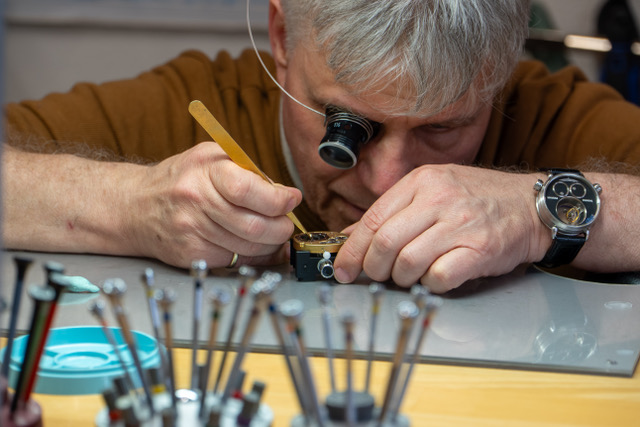
Introduction
Thomas Prescher belongs to a small circle of watchmakers who have not only left their mark on the history of contemporary independent watchmaking, but have also changed the way we think about what a mechanical wristwatch can be in the first place. He is one of those constructors who are not satisfied with refining existing solutions, but instead try to create ones that simply did not exist before. He built the world's first flying double axis tourbillon and the world's first flying triple axis tourbillon in a wristwatch. The solutions he developed in constant force, energy management and the miniaturization of moving constructions rank today among the most important achievements of contemporary haute horlogerie.
Although his watches are made in a small workshop in Ipsach, Switzerland, their significance reaches far beyond the scale of production. They are proof that even a single creator can push the boundaries of an entire discipline.
The road to this point, however, does not resemble the story of a typical Swiss watchmaker. Before Prescher ever sat down at the workbench, he served for six years as a naval officer, part of that time aboard a submarine. That experience taught him responsibility, planning and thinking about a mechanism as a system in which every element affects all the others.
Watchmaking came only later. First self-taught, through repairing old clocks and watches, studying books and working by trial and error. Then professional training at IWC Schaffhausen, where he gained the craft foundations of the profession. The years that followed brought work in the restoration of historical timepieces, among others at the renowned Gübelin.
Restoration became for him something far more than a job. It was a school of patience and humility, and a rare opportunity to study the solutions used by the greatest masters of past centuries. He would return to these lessons many times as the constructor of his own mechanisms. Before deciding to go his own way, he also headed production at Blancpain, coming to know the workings of a large Swiss manufacture from the inside.
In 2002 he opened his own workshop in Twann, Switzerland. The atelier later moved to its present location in Ipsach. He did not try to build a large manufacture or to compete on production volume with established brands. From the very beginning something entirely different interested him: constructing mechanisms that had previously seemed impossible to make in a wristwatch. The first years of his own practice brought creations that quickly passed into the history of contemporary watchmaking. First the double axistourbillon mentioned earlier, and shortly after the Tourbillon Trilogy, a set comprising single, double and triple axis tourbillons fitted with a constant force mechanism. The latter two were world premieres, and the flying triple axis tourbillon remains to this day a solution without precedent in a wristwatch.
Prescher did not stop at technical records. In the Tempusvivendi models he combined high complications with automata, the art of engraving and an individual narrative created together with the collector. The hour is indicated by a moving figure activated by the owner, so that the very reading of time becomes part of a mechanical spectacle.
He was a member of the Académie Horlogère des Créateurs Indépendants (AHCI) for many years, the organization that brings together the most distinguished independent creators of contemporary watchmaking. Over the years he has earned recognition from both collectors and the profession, remaining faithful to a way of working in which what matters most is the maker's personal responsibility for every stage of a watch coming into being, from the first sketch, through construction and the making of parts, to the final adjustment of the finished mechanism.
The conversation you are about to read, however, is not a catalogue of complications or a review of successive models. Multi-axis tourbillons are merely the starting point for a much broader discussion. We talk about the road from the navy to his own workshop, about arriving at knowledge on one's own, about the limits of mechanical watchmaking, about the economics of independence, and about a deliberate choice of a life in which the number of watches produced was never the most important measure of success.
1. From a naval officer to an independent creator
WoW:
Before starting your career in watchmaking, you served as a naval officer. The military world is often associated with discipline, hierarchy and operating within clearly defined rules.
Did this experience later become an advantage in your work as an independent watchmaker, or, on the contrary, was it something you partly had to move away from in order to create your own unconventional solutions?
Thomas Prescher:
Yes, the time in the Navy was later a big advantage for me.
In the Navy, and especially on a submarine, you learn discipline, responsibility and careful planning. You also learn that every part of a system has a function. A small mistake can create a much bigger problem somewhere else. This is very similar to complicated watchmaking.
When I construct a movement, I do not only look at one wheel or one mechanism. I must always look at the complete movement. I check the calculation, the tolerances, the energy and if different parts can have a collision. Everything must work together.
Of course, as an independent watchmaker I also had to learn to move away from some fixed rules. In the military there is a clear hierarchy and normally a clear procedure. When you create something new, there is often no procedure. Nobody can tell you what the correct solution is.
But I did not have to leave the discipline behind. I use this discipline to create unconventional solutions. Freedom gives me the possibility to start such a project. Discipline is then needed to finish it.
2. Learning without instructions
WoW:
Before beginning your formal watchmaking education, you spent a long time repairing old clocks and watches by yourself, learning from books as well as through trial and error.
Do you believe that this unusual path—first searching for solutions independently and only later receiving professional education—allowed you to achieve something that perhaps a traditional educational path from the very beginning would not have made possible?
Thomas Prescher:
I think this way of learning was very important for me.
Before my professional education, I bought old clocks and watches which were not working. I used books and technical articles, took the mechanisms apart and tried to make them work again. There was nobody next to me who could immediately give me the solution.
Of course, I made mistakes. But when you make a mistake yourself, you must understand why it happened. You cannot only follow the instruction of somebody else. You must look at the complete mechanism and find your own way step by step.
Later, the education at IWC gave me the professional knowledge, the correct working methods and the necessary precision. This was also very important. Self-learning alone is not enough if you want to make watches on a very high level.
For me, the combination was the important point. First, I learned to search for solutions independently. Later, I learned how to realize these solutions according to professional watchmaking standards.
Perhaps this also helped me not to accept too quickly when somebody said that something could not be done.
3. The purpose of great complications after the quartz revolution
WoW:
The quartz revolution meant that the mechanical watch lost its position as the most accurate and practical instrument for measuring time. However, instead of disappearing, it was reborn as an object of emotion, craftsmanship and creativity.
Do you think that the role of today’s great mechanical complications is still to solve specific technical problems, or rather to push the boundaries of what an independent watchmaker is able to design and create?
Thomas Prescher:
Today, nobody needs a mechanical watch only to know the exact time. A quartz watch, a telephone or another electronic instrument can do this very well and normally much more accurately.
For me, this does not make mechanical watchmaking less important. It gives mechanical watchmaking another purpose.
A great mechanical watch is a combination of engineering, handcraft and art. The mechanism must still solve real technical problems. It must manage energy, control friction and work reliably. Otherwise, it is only a nice object and not a serious watch.
But today we can also use these technical solutions to create emotion and to show something which was not possible before. A complication can make the movement of time visible. It can show the ideas of the watchmaker and the abilities of the people who manufactured and finished the parts.
The purpose is therefore not only to measure time. It is also to push the limits of what we can construct and manufacture.
For an independent watchmaker this freedom is very important. We can ask a question even when there is no commercial reason to ask it. Then we must find out if the answer can be made in metal and if it really works.
4. Why a multi-axis tourbillon?
WoW:
The classic tourbillon was created more than two centuries ago as a solution to the limitations of pocket watches, which spent most of their time in one position. A wristwatch works in completely different conditions, constantly changing its position.
What made you dedicate such an important part of your career specifically to the development of multi-axis tourbillons?
Thomas Prescher:
The tourbillon fascinated me already during my education. For my School Watch, I made a tourbillon. From this time, the subject kept me fascinated.
The traditional tourbillon was developed for a pocket watch. A pocket watch normally remains in upright positions in the vest of a gentleman. A wristwatch is different. The position changes all the time when the owner moves his arm.
The logical question for me was therefore what happens when the tourbillon also rotates around more than one axis.
The basic idea already existed in larger clock constructions, but it could not simply be made smaller and put into a wristwatch. The weight, energy, friction and shock resistance are completely different. A new construction was necessary.
I was also fascinated by the visual result. A multi-axis flying tourbillon is not only a technical mechanism. When the bridges around it are removed, it becomes a moving sculpture. You can see the regulating organ turning through different positions and moving freely in space.
This combination was very attractive for me: a real technical challenge together with a very strong visual result.
5. The greatest unsolved challenge
WoW:
A significant part of your work has been dedicated to issues such as energy management, constant force and overcoming the physical limitations of micromechanics.
Is there still a technical problem in mechanical watchmaking that you find particularly fascinating, but which has not yet been fully solved?
Thomas Prescher:
For me, one of the most important challenges is still the management of energy.
A mechanical watch only has a limited amount of energy. This energy comes from the mainspring and must operate the complete movement. Every wheel, lever and additional complication consumes part of it.
At the same time, the force of the mainspring is not completely equal from the beginning to the end of the power reserve. Friction is also not always the same. It can change because of position, lubrication, temperature, wear and very small differences between the parts.
A constant-force mechanism can improve the delivery of energy to the escapement. I have worked a lot with these systems. But every additional mechanism also needs energy and creates new friction, new tolerances and more parts which must be adjusted.
The perfect solution would give the balance exactly the energy it needs under all conditions. It should be small, reliable, efficient and possible to service after many years. This sounds simple, but these requirements often work against each other.
For me, this is still fascinating. The best solution is not always the one with the most parts. Very often, the most difficult work is to find a simpler solution which works better.
6. The mechanism that seemed impossible
WoW:
Your multi-axis flying tourbillons were among the projects that pushed the limits of miniaturization and the construction possibilities of wristwatches.
Looking back today, what was the greatest challenge in creating them: the concept itself, energy management, manufacturing the components, or perhaps something completely different that the owner will never notice when looking at the finished watch?
Thomas Prescher:
The first idea is normally not the most difficult part. You can have an idea and make a first drawing quite quickly. The difficult part is to make the complete construction work in a wristwatch.
In a multi-axis flying tourbillon, every component must be very light. At the same time, it must be strong enough and manufactured very precisely.
The weight distribution is extremely important. The different carriages are supported from only one side, and they rotate around different axes. A very small difference in the weight of one part can influence the complete mechanism.
Energy management was also a big challenge. The tourbillon needs enough energy to turn the carriages and operate the escapement. But if the components are too large or too heavy, the energy consumption becomes too high.
Then we have the normal use of a wristwatch. It receives shocks and is moved in all directions. A mechanism which works well on the table is not automatically ready to be worn on the wrist.
A lot of the real work is never visible to the owner. It is in the calculation of the wheels, the shape and weight of the components, the tolerances, the counterweights and the adjustment of the complete system.
The owner sees the tourbillon rotating very freely and easily. To make it look easy was a lot of work.
7. The watch closest to your philosophy
WoW:
You have created many extraordinary constructions, from retrograde displays to multi-axis tourbillons.
Which of your own watches do you consider the most important, not necessarily the most complicated one, but the one that best represents the way you think about watchmaking?
Thomas Prescher:
This is difficult because different watches show different parts of my work.
The Tourbillon Trilogy, and especially the Triple Axis Tourbillon, was certainly very important for my technical development. It showed what could be achieved with a multi-axis flying construction and constant force in a wristwatch.
But the Tempusvivendi is perhaps closer to my complete philosophy of watchmaking—to connect art, technical complexity and watchmaking.
The basic mechanism comes from traditional watchmaking. It uses retrograde indications and an animated figure. But every watch can be developed together with the future owner. The figure, the decoration, the engraving and the complete subject can become very personal.
In its normal position, the watch does not immediately show the time in the usual way. The owner activates the mechanism, and the figure moves its arms to indicate the hours and minutes. The mechanism therefore creates an interaction between the watch and its owner.
For me, this is important. A complication should not only be complicated. It should have a reason, tell a story and create emotion.
The tourbillons show my technical thinking. The Tempusvivendi combines technical construction, traditional handcraft, art and the personal wishes of the owner. This is very close to the way I understand independent watchmaking
8. Freedom versus building a larger company
WoW:
After experiencing the challenges of managing a larger team, you decided to follow a much more intimate model of work, almost entirely based on the personal involvement of the creator.
In a world where most companies naturally pursue growth, higher production and greater scale, you chose a different path.
Is complete creative freedom worth giving up the possibility of scale?
Thomas Prescher:
For me, creative freedom is worth more than producing a larger number of watches.
I have experienced working with bigger teams, including organizations of up to one hundred people. A larger company can produce more, and responsibilities can be distributed among more individuals. Of course, this has its advantages.
But a larger company also requires a constant flow of work. Employees must be paid, machines must be utilized and the entire organization has to keep running. More time is needed for planning, controlling and administration. The organization gradually becomes driven by operational needs rather than by art or philosophy.
At a certain point, the watchmaker can become more of a manager than a watchmaker.
I wanted to have enough time to work personally on the construction, development, manufacturing, finishing and adjustment of my watches. I also wanted to remain directly involved with the collectors.
In a small workshop, life is not always easier. When problems arise, there are fewer people to share the burden. Production is limited, and clients sometimes have to wait a long time.
But I can decide which project is important and how it should be realized. I do not have to make a watch simply because a production plan says we need another model.
For me, this freedom is extremely valuable. I do not want to make as many watches as possible. I want to make the watches which I believe should be made.
9. The economics of independence
WoW:
We often romantically view independent watchmakers as artists creating without limitations. However, even the most exceptional workshop must also function economically.
Today, what is the greater challenge for an independent creator: developing an extraordinary mechanism, or creating a business model that allows true independence to survive?
Thomas Prescher:
Both sides are difficult.
Developing an extraordinary mechanism can take several years. During this time, countless hours are spent on construction, calculations, technical drawings, programming, manufacturing and testing before a finished watch can finally be delivered.
But throughout this period, the workshop must continue to function. Salaries, materials, machines, tools and all the normal operating costs still have to be paid.
A technical problem is, in some ways, easier to understand. Either the mechanism works or it does not. Then you continue step by step until you find the reason.
The economic side is rarely so clear. Markets change, projects are delayed and clients can change their plans. A very small independent workshop does not have the same financial possibilities as a large brand.
For true independence, the business model must give the watchmaker enough time to create. Fixed costs must remain under control, and there must be collectors who understand that a special movement cannot be developed and manufactured within only a few months.
Restoration was very important for me, especially in the beginning. It helped finance my own projects while allowing me to study the work and solutions of the great watchmakers of the past.
The biggest danger is that the business which should make independence possible starts to control the creative work. Then you are economically independent on paper, but not independent in your decisions.
10. Legacy
WoW:
After more than two decades working as an independent creator, I would like to ask you not about the next watch, but about the longer perspective.
What would you like to remain as the most important part of your legacy: specific mechanisms and technical solutions, or rather a certain way of thinking about watchmaking?
Thomas Prescher:
Of course, I would be happy if my mechanisms remain an important part of watchmaking history.
The Double Axis and Triple Axis Tourbillons were projects which required many new solutions. The flying construction, the constant-force system, the energy management and the miniaturization were important steps in my work.
But I think a technical solution will always be developed further. Another watchmaker may take an idea, improve it and find a different solution. This is normal, and it is also how watchmaking continues.
For me, the way of thinking behind the mechanism is therefore perhaps more important.
We should respect traditional watchmaking and understand why the old masters created their constructions in a certain way. Restoration was an important school for me because I could study many different solutions from different periods.
But respecting tradition does not mean that we must repeat everything in exactly the same way.
After understanding the traditional solution, we should be allowed to ask whether another solution is possible.
I would like my work to show that discipline and imagination can work together. You need creativity to begin a project that looks impossible. Then you need careful planning, calculation, manufacturing and a great deal of patience to make it work.
Everything is done step by step. In the end, the mechanism must not only be unusual. It must be a serious watch.
Perhaps this way of thinking would be the most important legacy for me.
After the Conversation
The easiest thing is to reduce Thomas Prescher to a list of records. The first flying double axis tourbillon. The first flying triple axis tourbillon in a wristwatch. To this day the only flying one. All of it is true. The thing is that these very achievements say the least about the man we have just spoken with. If we stop at the records, we miss what is most interesting in this conversation: the way of thinking of a constructor who, after six years of service in the navy, chose a profession in which there is almost never a single correct answer.
Before we turn to his philosophy, though, it is worth placing Prescher honestly in his historical context. 2004 was an exceptional moment for contemporary watchmaking. Other constructors were working on the multi-axis tourbillon at almost the same time, among them Greubel Forsey, Jaeger-LeCoultre and Franck Muller. This was not, however, a race for priority, nor an attempt to solve exactly the same problem. Greubel Forsey treated multiple axes above all as an instrument of chronometry, a way to reduce positional errors still further. Prescher went another way. He did not treat the multi-axis tourbillonsolely as a means of improving chronometry. He was also interested in the experience of the observer: the way a person perceives the movement of the mechanism. A flying construction stripped of bridges lays bare the working of the whole system, but for him the visual effect never replaces constructional correctness.
This, in fact, comes through clearly in his answers. Prescher does not set technique against aesthetics. On the contrary. He repeatedly stresses that every complication should first solve a real constructional problem: manage energy, reduce friction, improve the reliability of the mechanism. Only once it meets these conditions can it also become a vehicle for beauty.With Prescher, aesthetics is never the point of departure. It is the consequence ofwell-solved mechanics.
The strongest part of the conversation, however, is not about tourbillons. It is about economics. Prescher is among the few makers of this class who speak about the economics of independence without any romanticizing. The restoration of antique timepieces financed his own projects for years and allowed him to develop solutions that at first had no commercial justification yet. It was also, for him, something more than a source of income, because it let him study the solutions of the old masters, to which he would later return in his own constructions. What strikes one even more, though, is his observation that a business built in order to secure creative freedom can, in time, begin to limit that very freedom. As he says, one can be economically independent on paper and at the same time lose the independence of one's own decisions. This is one of those remarks that reach far beyond the world of watches.
In essence, the whole conversation leads to a single paradox. A man shaped by an environment governed by procedures, hierarchy and precisely defined rules later chose a profession founded on the constant search for solutions that no one had worked out before. One might suppose that military discipline would become a constraint for a constructor. Prescher claims exactly the opposite. It is precisely discipline that allows bold ideas to be turned into working mechanisms.
This is best summed up by a sentence that came almost in passing: "Freedom gives me the possibility to start such a project. Discipline is thenneeded to finish it." It would be hard to find a better definition, not only of his own path, but also of that part of independent watchmaking which rests not on a marketing story about the freedom of the artist, but on the daily, painstaking work that leads to a finished mechanism.
And perhaps this is precisely why a conversation with Thomas Prescher turns out to be something far more than an interview about tourbillons. Almost everything has already been written about complications. Far more rarely does anyone speak about the price paid for the ability to construct solely according to one's own rules. Prescher does not try to build the myth of the lone genius around himself. Instead he shows that the greatest value of independence is not the ability to do anything, but responsibility for every decision taken. That is precisely why his watches remain something more than a display of technical possibility. They are the consequence of a way of thinking he describes in this conversation.