Interviews
Patrick Alexandre Ulm
Fourth chair for Charles Girardier
Introduction
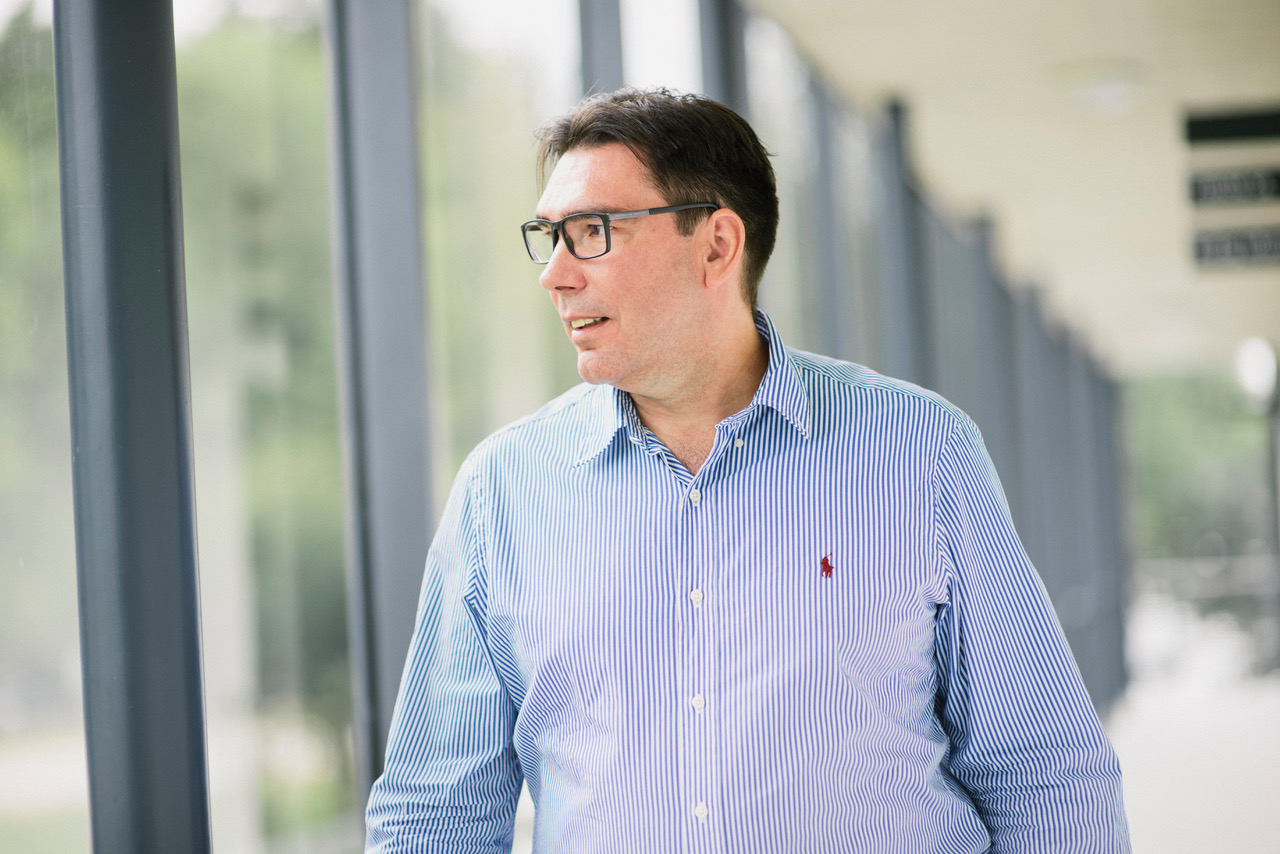
Patrick Alexandre Ulm is not a watchmaker. He did not attend watchmaking school, he did not grow up in a family connected to the profession, and for most of his professional life, he had nothing to do with the Swiss watch industry. His world was finance, private banking, and wealth management for affluent clients.
Watches remained a private passion. He was primarily interested in antique horology, he collected pocket watches, and he was fascinated by the people who, two hundred years ago, with simple tools, were able to create movements that are still astonishing today. However, nothing indicated that this interest would ever become his profession.
Until something happened that for most people is one of the most difficult moments in their professional life: he lost his job.
After years of a career in the financial world, Ulm suddenly faced the necessity of starting everything anew. His boss then told him two words: "Reinvent yourself."
It is easy today to cite this sentence as an impressive anecdote about entrepreneurship. It is much harder to remember the circumstances in which it was uttered. For Ulm, it did not mean an inspiring exercise in finding a new path. It meant the end of his previous career, the loss of professional security, and the need to answer a very specific question: what next?
He could have looked for another position in finance. He knew that world, he had experience and contacts, yet he chose something completely different.
What had until then been a private fascination with antique watches gradually became the beginning of a new professional life. Not as a watchmaker, because Ulm never tried to become one, but as an entrepreneur trying to build a watch brand practically from scratch.
This is how the modern history of Charles Girardier begins.
A few years later, there are watches, proprietary mechanical constructions, and a GPHG award. Looking at it from today's perspective, it's easy to construct a convenient success story. However, what is much more interesting is that at its beginning was not a business plan for the luxury watch market, but job loss and a man who was ultimately able to turn one of the most difficult moments of his life into the beginning of something completely new.
This is what I wanted to talk to him about.
WoW:
Before Charles Girardier appeared, what was the first watch that truly meant something to you? And what exactly fascinated you about watches before the idea of creating a brand came about?
Patrick Ulm:
My first experience with watchmaking wasn't a watch, but a sentence. My grandfather used to say: "All great watchmakers have their pocket watches in museums." As a child, I didn't quite understand what he meant. I understood it much later, standing in front of a museum display case.
I received my first watch at the age of twelve. It was a Tissot given to me by my godmother, an elderly lady whom I held in great respect. In a way, that watch still accompanies me. Around the same time, literature entered my life. First historical books, and later, when I was learning English, Agatha Christie's novels, which I adored. I didn't know then that this fascination with literature would lead me many years later to Charles Girardier.
Even before the idea of creating a brand emerged, I was fascinated by the genius of the master watchmakers of the Enlightenment era. People who, in Geneva workshops, using hand tools, participated in humanity's age-old quest to measure time.
I collected pocket watches long before discovering Charles Girardier. A pocket watch requires a certain gesture from a person: you have to take it out, open it, wind it with a key. It doesn't let you forget about it like a watch worn on the wrist. It was this physical relationship with the object, its rootedness in tradition, and the long history of humanity's relationship with time that always resonated with me.
For many years, I worked in private banking and family offices. Then came the financial crisis, and Yves Mirabaud, a partner at the bank and its CEO, told me something I've never forgotten. He said only two words in English: "Reinvent yourself."
At that moment, those weren't the words I wanted to hear. They meant I would have to change professions and lose my job. In hindsight, however, I see that they awakened the entrepreneur within me, who had been dormant somewhere. There was a need to find my own path, my true calling.
When I later discovered Agatha Christie's watch, I took it as a message, a calling. I understood that my mission was right here: to bring Charles Girardier back to life and once again find a place for his name in the world of independent haute horlogerie.
WoW:
In 2018, at Greenway, you saw a watch signed "Girardier l’aîné". What exactly did you see then? A beautiful old watch, or something that immediately struck you as a mystery?
Patrick Ulm:
I was in London on business at the time and escaped for a few days to Devon, to Greenway, Agatha Christie's former holiday home, which is now a museum. In her collection, among other pocket watches, there was an enameled piece signed "Girardier l’aîné". I didn't know that name.
What I saw was not primarily a beautiful old object. I saw a contradiction. Agatha Christie didn't collect random things. If that watch was there, there had to be a reason. And yet the name meant nothing to me, even though I had been collecting watches for years.
An enameler, a guillocheur, a master of time and mechanics of that caliber, signing his work so emphatically: "l’aîné", "the elder", like someone who wants to be recognized. And at the same time, complete silence around his name. Something wasn't right here.
It was this contradiction that kept me from forgetting him. A beautiful object can be admired and then you move on. A mystery, you take home to solve.
And... I'm still trying to solve it.
WoW:
When did the collector's curiosity turn into the decision: "I'm really going to do this"? What made you stop merely researching Girardier and decide to build a contemporary brand around his name?
Patrick Ulm:
I did what a collector does. I started searching. The Petit Palais in Paris, museums in Geneva, archives, auction catalogs. Gradually, this man became a kind of friend to me. He told me stories through his pocket watches, as if sending me timeless messages, each in the form of another watch.
Charles Girardier was born in Geneva in 1759. At the age of 21, he ran his own workshop. He was an excellent enameler and guillocheur, fascinated by automatons, and he constructed pocket watch movements. He died in 1839 without descendants.
With him, the name died out. There was no company, no heirs, no continuity. Only the pocket watches remained.
Later, I managed to buy original pieces. First, at an auction, a pocket watch with a painted hunting scene. Then I was offered a quarter repeater with Jacquemart automatons, dated 1815. To my knowledge, only two such pieces have survived.
Holding that object in my hand after two centuries and hearing it still working is something I find hard to describe. That's when my grandfather's words came back to me. The watches were indeed in museums. But Girardier's name was nowhere to be found anymore.
Coincidence? A challenge? Was it up to me to prove that this name deserved more than oblivion?
That's when I told myself: "I'm really going to do this."
But I want to make one point here. I never considered myself an heir. There is no Girardier lineage, and one can never speak of its continuation. I am a collector who rebuilt a name around existing evidence.
I see myself more as a guardian. A guardian of beautiful watchmaking and its creators, not an heir to its excellence. Our motto is Legacy of Excellence. I prefer to state this clearly, as it is stronger for me than suggesting a continuity that never existed.
WoW:
You are not a watchmaker and have never tried to pretend you are. How did a man from the world of finance convince the first specialists to take this project seriously? Who was the first to truly believe in you?
Patrick Ulm:
I am not a watchmaker, that's true, and I've never claimed to be. However, I came from a profession where you have to convince very demanding people to trust you for a long time, throughout your life.
I also had an advantage. I knew exactly what I wanted because I could hold 1815 pocket watches in my hands.
From the beginning, I established a principle that I never changed: to create contemporary watches that Monsieur Girardier could have created if he were alive today. Not reproductions. Not pastiche.
I call it the "fourth chair." When we sit at the table, the designer, the constructor, the artisan, and I, there is always one more chair for him.
I think it was this principle that convinced the first partners, because it simultaneously sets boundaries and makes demands.
The first person from the watchmaking world who truly believed in this was Cyrano Devanthey. We met during Time to Watches in Geneva and understood each other from the very first conversation.
And yes, people around me made it clear that I would most likely fail. It's hard, after all, to consider their arguments absurd. Trying to resurrect a name no one knows, and starting with a flying tourbillon, grand feu enamel, and an automaton, without one's own manufacture behind the project, looked unreasonable from the outside.
That only motivated me more.
I had a deep conviction that this was a calling, that fate demanded something from me, and that I had to do it. The people who tried to dissuade me didn't understand one thing: I didn't need to be reasonable. I needed to be an entrepreneur. This need was very strong in me since my youth. It was just waiting for the right project to manifest itself.
WoW:
The Signature Mystérieuse resembles a small mechanical theater. Where did this idea actually come from, and has contemporary haute horlogerie perhaps become too serious?
Patrick Ulm:
This idea comes directly from Girardier. His specialties were enamel, guilloché, and automatons. The 1815 quarter repeater doesn't just chime the time. Two gold-sculpted Jacquemarts strike bells before the owner's eyes. In his watches, the mechanics were not just precise. They were alive and capable of creating a spectacle.
So the question was: what would he do with this idea today?
I didn't want an automaton depicting human figures, because that would be a mere copy. So we took Girardier's very gesture and applied it to the simplest, yet most important thing in a watch: its signature.
Two letters, C and G, rotate around the same axis and only align at specific moments to form the logo. The signature appears and disappears, much like his own designation "l’aîné," which remains a mystery he took to his grave.
Has contemporary haute horlogerie become too serious? I don't want to lecture anyone. However, I see that in 18th-century Geneva, they were able to create incredibly precise watches that simultaneously brought a smile to the owner's face or allowed them to dream.
One does not exclude the other. Girardier is proof of that.
WoW:
How exactly is a Charles Girardier watch born today? What do you start with the next morning when an idea for a new collection emerges: a sketch, a historical watch, an emotion, or a conversation with the constructor?
Patrick Ulm:
The next morning, I don't start with a drawing or a movement. I start with a historical watch.
Each collection has originated from a specific borrowing from Girardier's work. The Signature Mystérieuse borrowed automatons from him. The Synchronaut adopted the azured date counter at six o'clock from a pocket watch signed "Girardier l’aîné". Plénitude took its form from a winding key. It was that key that shaped the crown.
Three collections. Three different borrowings. No copies.
Then comes the emotion I want to evoke. Only later, the mechanics that will make it a reality.
With Plénitude, it was about being able to see the watch's energy. I didn't want a small power reserve indicator tucked away in a corner of the dial. I wanted an indication placed on the north-south axis, from twelve to six o'clock, with the symmetry it deserves.
And with whom do I sit down first today? With Cyrano Devanthey and Dominique Buser in Buchs. They co-created and signed the calibers CG PL1 and PL2 with us.
And usually, they are the ones who tell me: "Patrick, that can't be done."
The most interesting thing, however, is what follows. In their mouths, "it can't be done" almost always means: "it can't be done that way." And it is the conversation that begins after those words that is often the moment when the watch truly becomes good.
WoW:
What was the most difficult technical problem you had to face? One that the future owner of the watch will probably never even notice.
Patrick Ulm:
There were actually two. And the owner will probably not see either of them.
The first concerned the Signature Mystérieuse "Fleur de Sel". I wanted a dial made using grand feu enamel technique with silver paillons, tiny cut elements arranged by hand and then embedded in the enamel.
This technique had practically died out. Eventually, near Lyon, we found an elderly lady who still operated one of the last machines used to punch out these elements. Without her, this dial would never have been created.
It makes one realize that haute horlogerie can sometimes depend on a single person and a single machine.
The second problem was the Volcano power reserve in Plénitude. We didn't want a simple, flat system based on a planetary gear. So we built a three-dimensional mechanism using a cone and an arm that tracks its position.
A wheel cooperating with the ratchet wheel rotates a screw. A truncated cone moves up along it during mainspring winding and descends as its tension decreases. The arm follows the surface of the cone and controls the hand.
The whole thing had to fit into a traditional construction with a bridge supported by pillars and a case with a thickness of 10.95 mm. We needed 3D printed models, prototypes, successive refinements, and patience.
I am also very keen for this cone to remain a central element of our story, because it cannot be patented. The only protection is to consistently talk about it in such a way that it eventually becomes inextricably linked to the name.
WoW:
What did you truly feel that evening when Charles Girardier received the GPHG award in 2020? Satisfaction, relief, disbelief, or perhaps, above all, the pressure to prove from that moment on that it wasn't a fluke?
Patrick Ulm:
For two months, I was in shock. I say this without exaggeration.
At first, there was, of course, joy, but above all, disbelief. Two years after resurrecting the name, to be on that stage in front of the entire industry...
However, another thought quickly emerged. I wouldn't call it pressure. Rather, responsibility.
This award was not mine. It belonged to Charles Girardier. I brought his name back to a hall where the best are awarded, 181 years after his death. From that moment on, it was necessary to ensure that this name found a permanent place there, and did not appear merely as a coincidence.
I also thought of my grandfather. He was no longer there to see it. But that evening, his sentence took on a whole new meaning for me.
Girardier's watches were in the museum.
And his name was once again on stage.
WoW:
Looking at the first, very striking Charles Girardier watches and the much calmer Plénitude, I get the impression that a big change has occurred. Has the watch changed, or has Patrick Ulm?
Patrick Ulm:
Both.
The first watches had to prove something. An unknown name, a first construction. We needed enamel, a tourbillon, an automaton, colors. We had to make people look.
It was meant to be a talking piece, as they say. And it worked.
But I knew that a brand is not built on surprise. It is built on the movement.
Plénitude is the moment when we stopped using other people's movements and started designing our own. When such a decision is made, the caliber becomes the main subject, and the dial must calm down and let it speak.
Appropriate proportions, 39.5 mm, a variable inertia balance beating at 3 Hz, chamfering performed with a cabron and diamanté, screw holes hand-finished.
Plénitude is perhaps less expressive and more horological. Yes. It is more self-assured.
And I have learned to be more silent.
Over time, I understood that in this profession, the object itself and the watchmakers are more convincing than a man talking about the tradition and DNA of Charles Girardier.
My job is to create the conditions for them to do so.
WoW:
If I were to walk into the workshops in Buchs with you today and observe the creation of Plénitude from start to finish, what exactly would I see? What is still done by hand, and where do you unhesitatingly use modern technology?
Patrick Ulm:
First and foremost, you would see that Buchs is no castle. It is a watchmaking center where several independent creators work, each on their own projects, but combining competencies when a specific problem requires it.
We came to Buchs for a specific reason: we wanted to develop our own movement. And because Cyrano Devanthey and Dominique Buser were there. Under their own brand, Oscillon, they build about five watches a year, entirely by hand. They co-created our calibers.
It might seem far from Geneva. Yet, for me, it is one of the most Genevan things about the entire brand.
In the 18th century, Geneva's strength was La Fabrique: a decentralized system of specialized, independent workshops dealing with engraving, enamel, guilloché, miniature painting, or movement construction. This system employed about five thousand people, roughly one-fifth of the city's inhabitants.
Girardier operated precisely in such an environment. He was a master who utilized the competencies of the workshops around him.
So we didn't leave Geneva. We recreated La Fabrique on our own scale. And the straps, by the way, are still hand-stitched in Geneva.
What specifically would you see in Buchs? Caliber design and prototyping. Assembly. Hand-finishing. 45-degree chamfering performed with a cabron, small wooden abrasive tools, using diamanté paste of increasingly finer grit. Hand-finishing of screw holes. Hand-polishing to a mirror finish of the winding wheel, click, and balance staff cap. The balance wheel weighted by the traditional method using eighteen screws of different masses instead of a laser.
A watchmaker from 1815 would recognize all of this immediately.
However, he would not recognize the 3D printed Volcano model lying on the table, the laser engraving of the name on the ratchet wheel, or the laser-made moon disc in the PL2.
We do not reject technology if it allows us to do something better.
In the end, each movement receives the CG Seal. This is our own commitment regarding precision, with a deviation of a few seconds per day, hand-finishing, and adherence to traditional methods.
WoW:
When you researched Girardier's historical watches, what surprised you the most about him? Did you discover anything that doesn't fit into today's rather solemn way of talking about old Genevan watchmaking?
Patrick Ulm:
What surprised me most was the freedom.
We imagine 18th-century Geneva as a austere, Calvinist place. Yet, we have a watchmaker placing gold-sculpted automatons on a quarter repeater, creating enameled hunting scenes, and, like other creators of his era, not shying away from much more intimate subjects intended for clients who knew exactly what they were buying.
This taught me two things.
Firstly, a watch at that time was as much an object of pleasure as it was a measuring instrument. It was shown to a friend in the salon also to see their surprise.
Secondly, these watchmakers worked for a very specific, personal clientele, fulfilling individual orders and maintaining full discretion. I find exactly the same among collectors today.
There remains the signature "l’aîné", even though we know of no younger Girardier. Perhaps a 21-year-old man tried in this way to appear more established than he actually was.
This humanized Girardier greatly in my eyes. He was not just a brilliant creator of enamel and mechanical amusements. He was also a young entrepreneur.
WoW:
Is there anyone who fundamentally changed your way of looking at a watch? Someone thanks to whom you stopped seeing it solely through the eyes of a collector?
Patrick Ulm:
There are two such people, on two different levels.
The first is Olivier Müller, former CEO of Laurent Ferrier, who was my mentor for three years. He taught me something that a man from finance cannot know: in this world, a watch is not finished when it leaves the workshop. It is only finished when it finds its collector.
He also made me realize that, paradoxically, I already knew this part of the job. In private banking and family offices, you work with people who expect discretion, an individual relationship, and trust built over years.
A collector is no different in this regard. He loves the watch as a collectible item, but at the same time perceives it as an asset with a place in his wealth. He wants to be treated individually, not as a market segment. These are the same demands transferred to a different world.
The second such experience was working in Buchs with Cyrano Devanthey and Dominique Buser.
Thanks to them, I learned to read a movement as one reads a text. To understand why a bridge has a certain shape, why a variable inertia balance requires more time during regulation but later maintains parameters better, why a specific finish is done by hand and not by laser.
I used to admire a watch.
Today, I understand it.
It's not the same thing.
WoW:
Finally, I'll give you complete freedom. Is there a story related to Charles Girardier that no one ever asks you about, but that you would like to tell?
Patrick Ulm:
The story no one asks me about is that Charles Girardier began for me like a detective novel. I say this as a man who read his first Agatha Christie at the age of twelve.
All her stories begin similarly: there's a deceased person, a closed circle of people, and a detail that doesn't fit anything.
In 2018, in her own home in Greenway, I found all three elements.
The deceased was a Genevan master watchmaker who passed away in 1839. The closed circle was the small world of 18th-century Geneva, where all important people were well-documented. And the detail that didn't fit was the signature "Girardier l’aîné" on a watch beautiful enough for Agatha Christie to keep in her collection, but signed with the name of a man about whom no one in the industry could tell me anything.
An artisan of this caliber doesn't just disappear. Either the world forgot about him, or someone made sure he was forgotten. I wanted to know which of these possibilities was true.
So I did what Poirot does.
I wasn't looking for the man. I was looking for evidence.
First, proof of death. And not just that he died, but how completely he vanished. In the archives after 1839, nothing extends the existence of the name. There is no son at the watchmaker's bench, no widow continuing the workshop, no successor who bought the stock and the right to the signature, as happened with many Genevan names.
Charles Girardier died without descendants, and with him, his name died. Completely.
For someone conducting an investigation, this is an extremely strange lead. A man signing himself "l’aîné", "the elder", leaves no younger person.
Older than whom?
Than no one.
To this day, there is no definitive answer, and I have stopped needing one. It's a mystery he took to his grave. And it belongs to him.
Later, proof of life emerged.
A man who left no descendants left something more reliable: objects that we can date, whose signature we can verify, and which we can study.
A painted enamel hunting scene bought at auction, the first Girardier I held in my hands. Then an 1815 quarter repeater with two gold-sculpted Jacquemarts striking bells. To my knowledge, only two such watches have survived.
These are proofs à rebours. Not proof that a crime was committed, but that a man of extraordinary talent existed.
You cannot fake the chamfering of a two-hundred-year-old bridge. You cannot fake enamel that has retained its color since Napoleon's time.
When I hold this repeater and hear it still chiming the quarters, I am not looking at an antique. I am reading a testimony signed by a witness who can no longer be questioned.
It tells me that he was an enameler, a guillocheur, a movement constructor, and a man convinced that a watch should surprise the person holding it.
That was enough to open the case.
And later, and this is something no classic detective novel allows, the investigation changed direction.
In Christie, when we find out who the deceased was, the book ends.
Here, when I found out who Girardier was, the real question arose:
Where is he now?
I found him in Buchs. Not his spirit. His method.
In the 18th century, Girardier operated within La Fabrique, a decentralized Genevan system of specialized, independent workshops, where each master utilized the competencies of the people working around him.
What Cyrano Devanthey, Dominique Buser, and I built in Aargau is a modern version of this system: separate watchmakers, each with their own projects, combining knowledge when a specific problem requires it.
When we sit down to design a caliber, there is always a fourth chair at the table.
His chair.
The winding key of one of his pocket watches became the inspiration for the Plénitude crown. His love for mechanics that do not hide their operation is reflected in the Volcano cone rising beneath the dial.
This is not a tribute.
This is a trace. One that an investigator follows.
And there remains the final piece of evidence. The one we create ourselves.
Each Plénitude movement receives the CG Seal: our own commitment regarding precision, hand-finishing, and respect for traditional methods.
I see it as the signature that Girardier can no longer place on a watch.
He signed his works "l’aîné" and left no younger hand to take over that signature.
The Seal is that younger hand.
Every caliber that receives it becomes another piece of evidence added to a case that will never be closed. Evidence, renewed watch after watch, that the man who died without heirs in 1839 remains present in the oldest Genevan way of creating watches.
Agatha Christie kept her watch in a display case.
I like to think that she had already solved this mystery herself and simply left a clue in a place where a twelve-year-old reader was one day to find it.
After the Conversation
I began preparing questions with a certain reservation, but not towards Patrick Ulm himself, but towards a phenomenon that the contemporary watch market knows all too well.
This business model, where an old name and a long-defunct brand are sought out primarily to announce a grand return and continuation centuries later, thereby legitimizing a well- and sufficiently dignified-looking founding year on the dial.
An archival watch, a few historical dates, a suitably crafted narrative about heritage, and the word "heritage," which in the luxury industry has been declined through all cases, provide fuel for a marketing story designed to sell a watch effectively.
We have seen many such returns, perhaps too many, and certainly not all of them had more than a trademark behind the historical name.
After my conversation with Ulm, however, I see the case of Charles Girardier differently.
Not because he managed to prove some uninterrupted continuity. On the contrary. One of the things I value most in his answers is the fact that he himself does not pretend this continuity exists. Girardier died in 1839. He left no descendants, and the former business ceased to exist. The contemporary company is therefore a new venture, and that honestly sets the starting point.
What Ulm did next is more interesting.
Initially, he used the most obvious language for a young brand trying to attract attention. Tourbillon, enamel, automatic, color. He himself calls the first watch a "talking piece." It was meant to make people look, and the GPHG 2020 award definitely confirmed that they did.
However, building a watch that the industry talks about for a while and building a watchmaking company are two completely different things. And Ulm himself says one sentence that probably best describes the change:
"A brand is not built on surprise. It is built on the movement."
Plénitude is a consequence of this thinking and does not try to outdo the first Charles Girardier in the number of complications. It is smaller, calmer, and much less demonstrative. The most important things happen within the movement itself and in how Ulm understands its creation.
He does not try to convince us that one day he became a watchmaker. He lists names. Cyrano Devanthey. Dominique Buser. Olivier Müller. He talks about what he learned from them and what he himself was unable to do.
This is a rare trait in the luxury world, where brands are extremely eager to say "we created," and much less often explain who exactly the people hidden in that "we" were. Very often, these people, as I have written many times, remain deeply in the shadows.
Ulm does not treat the collaboration of specialized watchmakers as something to be hidden to maintain the illusion of a self-sufficient manufacture. He reverses this logic and compares the modern model to the old Genevan La Fabrique, a system of independent workshops where individual competencies met in a single watch.
One can debate how far this analogy can be taken. But the idea itself is more interesting than another story about "full vertical integration."
There is also Ulm as a person.
A banker to whom someone at some point says: "Reinvent yourself." A collector of old watches goes to Agatha Christie's house and finds a name he doesn't know. He starts digging through archives. He buys the first watch. Then the second. At some point, instead of continuing to collect them, he decides to spend money on trying to build something of his own.
One can call it entrepreneurship or obsession. Both are probably needed to do it well and succeed.
He convinced me most when he stopped talking about Girardier and started talking about himself. I asked if, between the first, spectacular Charles Girardier and the much calmer Plénitude, it was the watch that changed, or Patrick Ulm.
He replied: "Both," and then added: "I learned to be more silent."
Initially, he had to tell the world who Charles Girardier was.
Today, he is trying to create a situation where he will no longer have to tell so much, because the watch itself is meant to do it for him.
And perhaps this is where the answer to the question of the symbolic fourth chair lies.
It is not occupied by the spirit of a man who died in 1839. There is no mystical continuity between the old workshop and the modern company.
Rather, it is occupied by a commitment that Ulm imposed on himself: before making another watch, he must be able to answer the question of why the man whose name he places on the dial would have done something in precisely this way.
This is, of course, still the interpretation of a person living in the 21st century, but there is a fundamental difference between using history as decoration and allowing history to impose demands on a project.
After this conversation, I have the impression that Patrick Ulm is trying to do just that.