Interviews
Patrick Freiburghaus
EMERA: Watchmaking or Narrative?
Introduction
There are brands that build their position on the movement. There are those that rely on history. And finally, there are those that start by creating a story and only then seek technical justification for it.
EMERA belongs to this third group.
It's a project where two approaches meet, represented by the real watchmaking expertise of Cyrano Devanthey and the very distinctive vision of Patrick Freiburghaus. The problem is that these are not equivalent orders, because after the first answers, it's clear that the weight of this brand does not lie in the movement's construction, but in the way it is narrated.
Therefore, this conversation is not a classic interview about watches, and it's not about complications, parameters, or its place in the industry hierarchy. What's interesting is how a brand aspiring to the world of haute horlogerie is built today, where technique becomes a means, not an end.
Some answers are specific, while others somewhat skirt the questions. But in this relationship between what is said and what remains unsaid, one can best see what EMERA truly is.
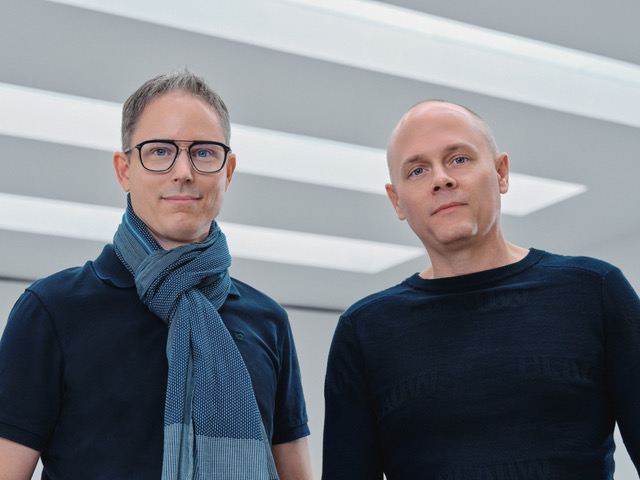
Pictured: Cyrano Devanthey - watchmaker, co-founder, and technical architect of EMERA, and my interlocutor Patrick Freiburghaus - designer, co-founder, and creative director of EMERA
Photos: EMERA
WoW:
Looking at EMERA, I have the impression that it is a brand built as much on narrative as on watchmaking itself. Would you agree with that, or do you see it differently?
Patrick Freiburghaus:
Yes, watchmaking is a true means of expression, but above all a foundation: it is thanks to it that we can go further. The aim is to tell a story that goes beyond the traditional codes of haute horlogerie and to create a new, deeply personal universe.
A timepiece is an intimate object. It speaks about the person who wears it, it accompanies them daily, very closely. It is a concentration of technology, craftsmanship, and passion, but also something deeper that is hard to define.
It has a soul. It is a witness to time. What could be more precious than time.
WoW:
If we remove all the language around “future”, “AI”, or “universe” — what remains as the pure watchmaking value of EMERA?
Patrick Freiburghaus:
Paradoxically, everything comes back to the human. The future fascinates as much as it unsettles, and it is already here. In the face of this, our reference points evolve, our relationships with others are redefined, and our priorities shift.
EMERA is not an answer, but a gateway to the essential: creativity, as the most intimate expression of the individual.
WoW:
Many young brands use the term “in-house” today. In your case, what is genuinely developed and produced internally, and what is the result of external collaboration?
Patrick Freiburghaus:
We develop everything in-house. I am responsible for the vision and design of the models. Cyrano handles engineering and assembly, and Quentin Hoerdt, who joined us later, enriches the project with a fresh perspective and advanced 3D expertise.
The rest is entrusted to our partners, all based in Switzerland and recognized for their very high level of expertise in haute horlogerie. Beyond skills, what deeply unites us is EMERA — and the friendship between the people behind the project.
WoW:
What in the MRA movement would you consider a real contribution to contemporary horology, rather than a well-executed interpretation of existing solutions?
Patrick Freiburghaus:
An anecdote fairly well sums up our approach. One of our watches was recently involved in an unexpected accident: it fell to the ground from its owner’s hands. The impact, estimated at several thousand Gs, had no negative effect on the tourbillon. This, in itself, is a form of validation.
We chose to start with the fundamentals: reliability, stability, longevity. After more than 25 years each in watchmaking, we have seen movements that are conceptually remarkable, but sometimes restrictive in everyday use.
Our intention is therefore to build on perfectly mastered foundations before expanding further.
There are many developments to come. We are moving forward carefully, taking the time needed to bring our vision to life.
WoW:
Why did EMERA choose to build around a tourbillon — was it primarily an engineering decision or a communication one?
Patrick Freiburghaus:
The choice of the tourbillon came naturally. Although it has been revisited many times, this does not take away from its beauty. Coming from high jewelry, I see the watch above all as a piece of jewelry, where technique and poetry meet.
The intention is not to create something entirely new, but to reinterpret an iconic complication, bringing a new sensibility and a distinctive signature.
WoW:
To what extent is EMERA a project driven by Cyrano Devanthey, and to what extent is it a brand-driven concept?
Patrick Freiburghaus:
Cyrano and I have very different watchmaking references and personalities, which might seem contradictory. But it is precisely this difference that creates a very balanced and unique partnership. He gives me the freedom to develop my creative vision, and in return, I fully take into account his technical expertise in our decisions.
This complementarity allows EMERA to combine creative boldness with watchmaking rigor.
WoW:
Would you describe EMERA primarily as a watch, or as a designed object that happens to contain a mechanical movement?
Patrick Freiburghaus:
EMERA is above all an artistic signature. Cyrano brings his expertise, but EMERA is neither a traditional watch brand nor a designer brand: it is an object carrying a singular vision. Technique matters, of course, but it is only a means; the message goes far beyond, as today we master almost everything on a technical level.
WoW:
Your production is extremely limited. Is that mainly a reflection of actual manufacturing capacity, or a deliberate strategy to create exclusivity?
Patrick Freiburghaus:
It is neither a strategy nor a lack of capacity, but a vital need to offer our clients the assurance of being unique. Beyond that, we want to fully explore our creative power by proposing a rich universe with strong creative propositions.
WoW:
How do you justify EMERA’s pricing in the context of brands with decades of proven technical heritage?
Patrick Freiburghaus:
With more than 25 years of watchmaking experience each, we hope to claim a certain level of expertise. EMERA’s pricing position is a deliberate choice that gives us a form of freedom.
WoW:
Who is the real client of EMERA, a collector of watchmaking, or a collector of ideas and objects?
Patrick Freiburghaus:
Our community is primarily made up of opinion leaders from all backgrounds. Our clients are above all individuals who appreciate our products and the vision we propose. The first reaction is emotional, analysis comes afterward; we immediately know if a product resonates with us, intuitively. We do not seek to convince, but to reach those who already resonate with our universe.
WoW:
What in EMERA today is still an ambition or a promise, rather than a fully achieved reality?
Patrick Freiburghaus:
EMERA means “sunrise” in ancient Greek and embodies for us a clear and luminous vision. The name imposed itself naturally and reflects above all the creative path we wish to share through our watches.
WoW:
If EMERA were judged purely on its movement without design and without narrative, where do you think it would stand today?
Patrick Freiburghaus:
That is an excellent question. If EMERA were judged solely on its movement, I would say it would stand at the same level as it does today. We do not seek to accumulate complications for justification: technical mastery is there, but always in service of our vision. Haute horlogerie is not a sprint; it is a long-distance race, a pace we respect with patience and rigor. I would like to thank everyone who trusts us. For us, each watch is above all an emotion worn on the wrist, an object that tells a story—our story.
WoW:
You mention that everything is developed in-house, but also that parts of the process are entrusted to partners.
Could you clarify more precisely which elements of the movement are designed and produced internally, and which involve external partners?
Patrick Freiburghaus:
All development is carried out in-house by Cyrano. Machining is entrusted to expert partners, while assembly and quality control take place within our workshops, ensuring consistency and the highest level of execution.
WoW:
You refer to reliability and stability as key priorities.
From a technical standpoint, what specific construction choices in MRA contribute to that compared to existing solutions?
Patrick Freiburghaus:
We use classic materials with a proven track record over centuries, combined with state-of-the-art engineering tools. The entire watch and movement are designed in CAD, with key components optimized through FEM simulations.
In parallel, complete movements undergo long-term real-world testing to validate performance beyond simulation.
WoW:
You describe the tourbillon as a reinterpretation rather than something entirely new.
What makes your interpretation technically or structurally distinct?
Patrick Freiburghaus:
Our tourbillon is crafted from Grade 5 titanium, combining lightness and strength. Operating at 4 Hz — a relatively high frequency for a tourbillon — it enhances precision and stability.
Based on the flying tourbillon principle introduced by Alfred Helwig, it is supported by a ceramic ball bearing to improve durability and reduce friction.
WoW:
You describe EMERA as an artistic signature.
Where do you personally draw the line between a watchmaking project and a design-driven object?
Patrick Freiburghaus:
That’s an essential question. The distinction, to me, lies in the pursuit of a new visual language rather than a process driven purely by technical performance. Design is not only about function or aesthetics — it is about intention.
Unlike traditional approaches, which respond to multiple constraints, this process is deeply personal. The brand is not something I serve — it is an extension of who I am.
While watchmaking inherently demands both technical and aesthetic excellence, technique serves a vision rather than defines it. I am not a watchmaker by training; my pursuit is fundamentally artistic, rooted in emotion — in the powerful, almost instinctive connection we feel when an object truly resonates.
Technical and aesthetic aspects are handled with care, but they are means, not ends. Our ambition is to create a new signature by exploring uncharted creative territory.
WoW:
If you had to define in one sentence what EMERA brings to watchmaking beyond aesthetics and narrative, what would it be?
Patrick Freiburghaus:
Beyond luxury
After the Conversation
This conversation might not have happened at all.
Initially, I had mixed feelings about engaging in it. From the first contact, the EMERA project uses language that could easily lean towards narrative rather than concrete facts. On the other hand, from the very beginning, I made it clear that I was not interested in marketing answers.
What ultimately convinced me was not the brand, but the attitude of the interviewee. The speed of response, openness to more difficult questions, and willingness to engage in this conversation on challenging terms – that was enough for me.
The rest is in the answers.
EMERA does not try to compete with traditional watchmaking in its classic sense. It does not build its identity around groundbreaking technical solutions or attempt to redefine mechanics. Instead, it consciously shifts the center of gravity from construction to interpretation, and from function to meaning.
The most interesting thing is that my interlocutor directly states that EMERA is an "artistic signature." Technique here is a means, not an end, and the tourbillon is not an attempt to push boundaries, but a reinterpretation of a known motif. This is an honest declaration, though rarely seen in an industry that usually tries to package every decision in the language of innovation.
At the same time, only in the second part of the conversation does another layer emerge, showing the production structure, the approach to design, and the engineering tools. And although this is a step towards greater precision, at the level of specific solutions, the answers remain rather general than operational.
What emerges from these answers, however, is more interesting than the declarations themselves. We are dealing with a model in which the brand controls the design, architecture, and final effect, while the physical production of components is distributed within a specialized supply chain. This is not an exception, but the modus operandi of this entire segment of the industry.
In other words, value is not created by who cuts the mainplate or produces the gear, but by who designs the system, makes the construction decisions, and is responsible for the final result. And it is at this level that the answers regarding "in-house" should be read.
And here the proper dynamic emerges, because if a watch primarily becomes a carrier of vision, the question is no longer "how is it built," but "what does it actually represent?"
EMERA answers this unequivocally: emotion, individuality, a personal language of form.
Whether that is enough, everyone must judge for themselves.