Interviews
Rexhep Rexhepi
Creating what you truly want to create.
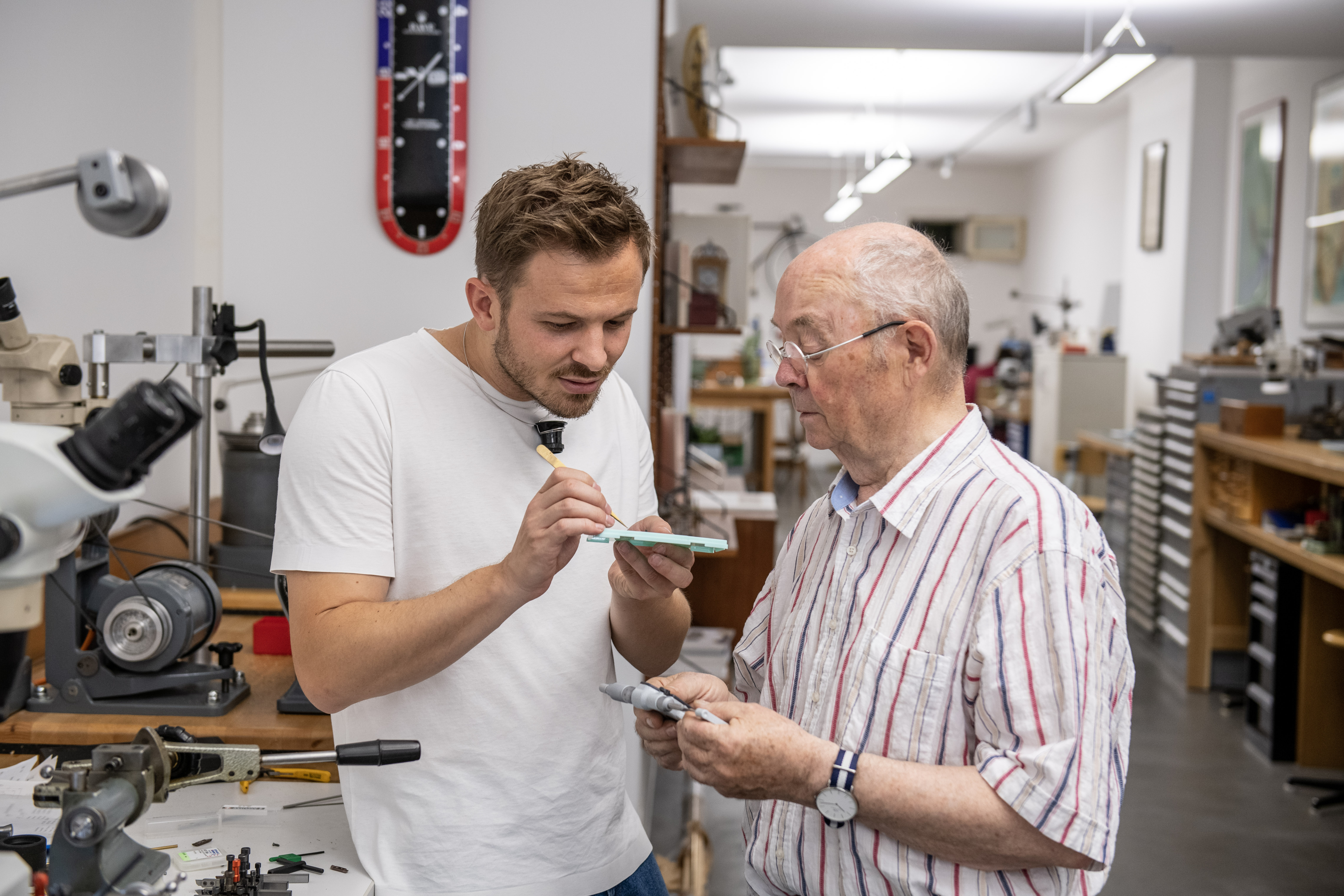
Introduction
Rexhep Rexhepi was born in 1987 in Kosovo. He arrived in Geneva as a child in the late 1990s, joining his father, who had already been working in Switzerland for several years. It was there that he discovered watchmaking, which quickly became his career.
He trained at Patek Philippe, where he spent around five years. He then worked at BNB Concept, a manufacture specializing in grand complications, where, despite his young age, he was entrusted with leading the team responsible for their assembly. The next stage was a position with F.P. Journe, where he was in charge of assembling complicated movements.
In 2012, at just 25, he founded Akrivia. A year later, he presented his first watch, the AK-01, with a tourbillon and a single-button chronograph. It was a bold debut that did not bring immediate success. He waited more than two years for his first client. Even so, he steadily developed the AK series, introducing roughly one new caliber per year, all the way to the AK-06.
The breakthrough came in 2018 with the launch of the first watch signed with his own name, the Chronomètre Contemporain. That same year, the model won the Grand Prix d'Horlogerie de Genève for best men's watch. Four years later, the Chronomètre Contemporain II repeated that success. In just a few years, Rexhep Rexhepi went from a young independent watchmaker to one of the most important names in contemporary independent watchmaking.
Today he runs several workshops in the historic heart of Geneva, has created eight in-house calibers, has twice won the Grand Prix d'Horlogerie de Genève, and collectors wait years for his watches. Pieces bearing his name reach prices in the hundreds of thousands of dollars at auction. It is hard to believe that just over a decade ago he struggled to find his first client.
From 2019 until his death in 2025, Jean-Pierre Hagmann was associated with his workshop. He was one of the most accomplished case makers of recent decades, having previously worked with Patek Philippe and Audemars Piguet, among others.
In this conversation we are not asking about new releases or the length of waiting lists. We are interested in the decisions behind the success. We ask which collectors he consciously stopped making watches for, where the sensible limit of in-house integration lies, and whether there is a point at which an independent maker begins to fear that he himself is becoming an institution.
1. From Akrivia to Rexhep Rexhepi
WoW:
The shift from the early Akrivia models to the Chronomètre Contemporain was not only a change of design language, but almost a change of audience.
Was the move toward a more classical language a natural artistic evolution, or also a conscious decision about which collectors you no longer wanted to make watches for?
Rexhep Rexhepi:
I can only be grateful to the collectors who have been with me throughout this entire journey.
My goal was simply to follow my own inspiration and create what I truly wanted to create.
I started with something completely different, and perhaps one day I will return to that approach. We'll see.
What mattered most to me was avoiding creative constraints and keeping the freedom to explore what genuinely fascinates me.
If I had been guided by collectors' expectations at the very beginning, I probably would not have continued the AK series.
The first models, like the AK-01, did not succeed right away, but I believed in this direction and developed it consistently.
By the time we reached the AK-06, people gradually began to understand what I was trying to create. That, in turn, gave me the freedom to evolve toward something more contemporary.
2. The Case as Watchmaking Architecture
WoW:
Your work with Jean-Pierre Hagmann meant that the case began to play a much larger role in the identity of your watches.
Do you think contemporary watchmaking too often treats the case as merely a housing for the movement, rather than as a distinct element of the watch's architecture?
Rexhep Rexhepi:
It was not really a collaboration.
I was fortunate that Jean-Pierre Hagmann worked in my workshop for six years and shared his invaluable knowledge as a master case maker with me and my team.
The case is the first part of a watch that people see and touch, which is why it plays a fundamental role in how the whole watch is perceived.
Historically, watchmaking has been strongly tied to certain conventions.
In art, you can allow yourself complete freedom, whereas in watchmaking tradition often suggests that a watch should be round and keep certain proportions.
For a long time there were only a handful of case makers, which inevitably led to similarities in their designs.
Today we have far greater possibilities and far more creative freedom.
Being able to design our own cases lets us express ourselves more fully and create something truly personal.
For me, it is simply another way of expressing my own vision and creating exactly what I believe is right.
3. The Weight of a Classical Language
WoW:
In your chronograph the visual language is extremely classical, while the expectations placed on it are entirely contemporary.
Was there an element of this watch where the weight of the classical form forced you into a harder decision than a freer, more modern approach would have?
Rexhep Rexhepi:
As I mentioned earlier, the challenge was to create something different while still being understandable and familiar to the audience.
I wanted the watch to feel like a real instrument, yet to have a modern character.
Some elements are very classical, like the graduated hands or the enamel dial.
Others introduce contrast and modernity, like the sapphire counters and the architecture of the movement.
I simply wanted to create a chronograph that would age beautifully over time.
I wanted to be sure that thirty years from now people would still wear this watch with the same pleasure and appreciation, watching it mature.
4. The Outside View
WoW:
Your path into watchmaking developed outside the traditional Geneva context.
Do you think this lets you see things that remain invisible to those raised entirely within that system?
Rexhep Rexhepi:
Yes, definitely.
I think it gave me a different perspective.
Interestingly, I had the chance to know both worlds.
I went through the traditional Geneva watchmaking path and worked in institutions like Patek Philippe, but at the same time I grew up in Kosovo.
That combination shaped the way I see the world, and probably gave me a different sensibility and a different point of view.
5. The Limits of the Workshop
WoW:
Step by step, you have built a highly integrated workshop covering the production of movements, cases, dials, and many other parts.
Is there still a component or process that you consciously choose not to bring in-house?
And what does that choice say about where, in your view, the sensible limit of the workshop lies?
Rexhep Rexhepi:
There are still a few components and processes that we consciously do not bring in-house, simply because at this stage it would not be justified.
At the same time, such decisions are never final.
The workshop is constantly evolving, and what is not relevant today may become so tomorrow.
The point is not to integrate everything, but to integrate what genuinely supports our vision and the quality of our work.
6. Handwork Without the Mythology
WoW:
The notion of "handmade" is used very freely in contemporary watchmaking today.
If you had to name the one stage where handwork matters most, and whose absence would most diminish the quality of the final result, which would it be?
Rexhep Rexhepi:
For me, handwork only makes sense when it brings something genuinely valuable to the watch.
I see little point in making every single part by hand just to be able to say it was made by hand.
What matters is whether the work adds to the beauty, the character, or the design of the object itself.
So the real question is not: how much was made by hand?
The real question is: where does handwork actually make sense and let you create something that cannot be achieved any other way?
7. From Independence to Institution
WoW:
You started out as a young, independent, and in a sense rebellious watchmaker.
Today your name is one of the most important reference points in contemporary independent watchmaking.
Is there a point at which an independent watchmaker begins to fear that he himself is becoming an institution?
Rexhep Rexhepi:
Following my dreams and realizing my own vision as a watchmaker is my only goal.
I don't think I will ever start to see myself in terms of an institution.
As long as I am driven by the same passion and the same freedom that motivated me at the beginning, I will keep following the same path.
After the Conversation
What stands out in Rexhepi's answers is the absence of grandstanding. Asked about independence, the limits of the workshop, or the weight of his own success, he keeps returning to the same thing: he wants to make the watches he himself considers right. It doesn't sound like evasion. It sounds more like a principle that resurfaces consistently, present in almost every answer.
This is clearest in his approach to handwork. Rexhepi does not defend craft as a value in itself. He asks a simpler question: does the manual work actually add something to the object? If it does not affect its character, beauty, or quality, it loses its justification. That is a rare position in a world that often uses the word "handmade" as a marketing tool.
He speaks about integration in the same way. He does not treat it as an objective in itself, but as a tool serving quality and the realization of his vision. This is an approach free of ideology, governed by function rather than prestige. Today, all key processes are carried out entirely in-house, even if the decision to integrate them was always driven by function rather than by the pursuit of prestige.One of the most interesting answers comes from the question about Jean-Pierre Hagmann. Rexhepi immediately corrects the word "collaboration" that I had used. He emphasizes that Hagmann worked in his workshop for six years, passing his knowledge on to him and the whole team. It was not a marketing alliance of two recognizable names, but a process of transferring experience that cannot be replaced by machines or documentation. After Hagmann's death in 2025, the workshop remained, but above all the knowledge remained.
What emerges from the whole conversation is the portrait of a maker who does not treat his current position as a destination. The first AK models barely sold. Only with the AK-06 did the market begin to understand the direction he had chosen. That patience, present from the very start of his path, seems far rarer today than any mechanical complication.