Interviews
Svend Andersen
Before Independence Became a Category
Introduction
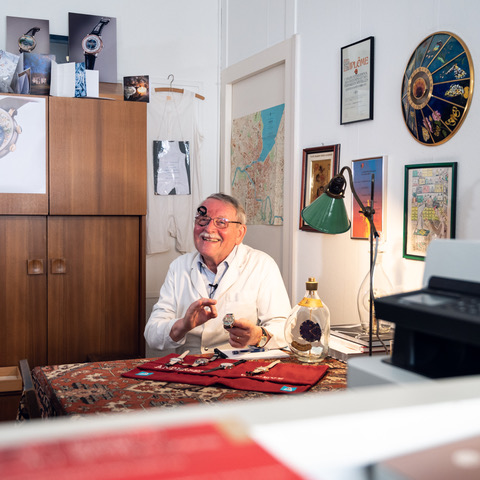
Svend Andersen was born in 1942 in Baekken, a small village in Denmark.
After school, he wanted to begin an apprenticeship at a company producing precision marine instruments, but the local chamber of commerce advised his father against the decision, warning that the business might not survive the year. Instead, Andersen began a four-year watchmaking apprenticeship with a local watchmaker in Padborg, near the German border, and then continued his studies at the Royal Institute of Technology in Copenhagen.
In 1963, at the age of twenty-one, he moved to Switzerland.
What followed was several years at Gübelin. First in Lucerne, then from 1965 in Geneva, where he worked in after-sales service. His knowledge of several languages quickly made him a valuable point of contact with clients. After hours, he pursued his own projects.
In 1969, at the age of twenty-seven, he created the object that would define the rest of his professional life.
He built a watch placed inside a glass bottle, assembled through a neck just eighteen millimetres in diameter, using tools of his own construction. The work took five months.
The Bottle Clock, shown at the Montres et Bijoux fair in Geneva, became a sensation. The watch community began to speak of Andersen as the “watchmaker of the impossible”.
That was when Patek Philippe took notice. When Andersen came to sign his contract, he was welcomed in person by Henri Stern, the manufacture’s then-president. Andersen was twenty-seven at the time, and Stern had been running the manufacture for a decade.
Andersen spent the next nine years at Patek Philippe. He worked on the most advanced projects of the complications atelier, including an encounter with the World Time constructions based on Louis Cottier’s designs. Working in the same environment at that time were also Roger Dubuis and Max Berny.
In 1979, he left.
The moment was particular. The quartz crisis was undermining the economic case for mechanical watchmaking, and many watchmakers of his generation were choosing safer career paths.
Andersen did the opposite.
He set up his own atelier on Quai du Seujet in Geneva, in the historic quarter of the old Genevan cabinotiers. He had watched the building rise earlier, from the window of his own desk at Patek Philippe, on the other side of the Rhône river.
The first commissions involved reconstructing pocket watch cases for Patek Philippe/Louis Audemars movements that had lost their original housings, most often during the Second World War.
Individual collector commissions soon followed, and these in time became one of the foundations of the atelier.
Five years later, together with Vincent Calabrese, he co-founded the AHCI, the Académie Horlogère des Créateurs Indépendants.
Today, independent watchmaking is a distinct market segment. In the mid-1980s, its future was not yet obvious.
Over the following decades, Andersen built, under his own name, a series of objects that have entered the history of contemporary watchmaking: the smallest calendar watch, the thinnest wrist-worn World Time, a perpetual calendar programmed for four hundred years, the most complex wrist-worn automaton of its time, and the first wrist-worn rattrapante chronograph with a World Time function.
In parallel, he made watches for specific people.
More than one hundred piece unique projects came into being, for collectors who arrived not for a finished watch, but with an idea of their own.
In 2015, he handed the brand over to Pierre-Alexandre Aeschlimann, calling the process not a sale, but a transition.
He remained present. He visits the atelier, talks with the team and comments on projects, but no longer designs new models.
In the conversation that is about to begin, there is no language of the contemporary industry, no story of vision. There is no building of personal legend, and no particular need to explain his own decisions.
Asked about the future, he responds with a question about God and Donald Trump.
Asked about independence, he tells a story about collectors.
Asked about the people who came out of his workshop, he says that he too once learned from others.
This interviewee does not make the reader’s work easy. But he certainly forces one to think.
Second part
Pierre-Alexandre Aeschlimann - After the founder
If the first part of this conversation tells the story of a man who created his own way of practising watchmaking, the second concerns a far more practical question.
What happens next.
In 2015, Svend Andersen handed the brand over to Pierre-Alexandre Aeschlimann.
An engineer by training, a graduate of EPFL. For years involved in advisory work and transactions in the watch industry, in the field of mergers and acquisitions. An advisor to investment groups and private clients investing in watchmaking, and a board member of several watch brands.
He did not arrive as a constructor or as a student of Andersen.
This is an important detail.
Because this story does not begin with a succession plan or with a family handover of a workshop. It begins with someone from the outside, who took over a brand built around a single person.
From that moment, his role was not to recreate Andersen.
It was to answer a far more difficult question: how to change a brand built around a single person so that, after the change, it is still itself.
And that is why the word “legacy” almost never appears in Pierre-Alexandre’s answers.
Other words do.
Team.
Product.
Collectors.
Time.
Part I · Svend Andersen
WoW:
You left Patek Philippe in 1979, at a moment when the quartz crisis was seriously questioning the future of mechanical watchmaking. Looking back, was this decision driven by conviction, or by a sense that the direction of the industry was no longer yours?
Svend Andersen:
Since the 70’s I have been recognised worldwide by collectors as the “watchmaker of the impossible” because of my bottle clocks. I was also one of the founders of Chronometrofilia, the first watch collectors’ club that included among others Beyer Zürich. These two roles provided me with a comprehensive understanding of the evolution of the watch market during the quartz crisis. My decision to leave PP was driven by a strong demand from collectors to re-make or design pocket watch cases for movements that had lost their original gold cases, mostly during WWII. The prospect of designing new pieces and enhancing existing mechanisms appealed to my inquisitive and creative nature. So, alongside Mr Perret, a renowned case maker, I embarked on this new journey.
WoW:
Your atelier in Geneva became, over the years, a place through which watchmakers such as Franck Muller, Felix Baumgartner or Kari Voutilainen passed. Did you see your role as consciously transmitting independence to a next generation, or was it something that happened naturally around your work?
Svend Andersen:
Before setting up my own workshop, I also learned from others. I completed a four-year watchmaking apprenticeship at Ur Mager Hansen in Pradborg, Denmark, followed by six months study at the Royal Technical Institute in Copenhagen. My first position was at the Glauser’s shop in Brig, Switzerland, where I was myself well advised by two experienced watchmakers. I was therefore later very happy to share my own experience with the new generation. I would describe it more as a share of knowledge, since they introduced me to new techniques, too.
WoW:
You co-founded AHCI in 1985 in a world where independence was a real risk, not a category. Today, the term is used much more broadly, sometimes also as a narrative. Do you feel that something essential in its meaning has been lost along the way, or has it simply evolved?
Svend Andersen:
The greatest artists are mostly independent. I think the evolution of today’s watch market must be viewed through the eyes of collectors, who are more and more having access to so many details/stories etc. Independent watchmakers are popular at the moment because they can establish an authentic and direct relationship with clients. It started for me in the 80’s with Italian collectors coming to me and asking to make their unique timepieces.
WoW:
The Secular Perpetual Calendar accounts for a correction that will only be required in the year 2100. How do you see the responsibility of creating a mechanism whose proper functioning depends on the knowledge and care of future generations of watchmakers? In your conversations with clients, is there an awareness that they are acquiring a watch whose correctness they will never be able to verify themselves?
Svend Andersen:
As God created humans, did he “program” Trump would be the president of the USA today?
WoW:
For many years, your work was based almost entirely on unique pieces and direct relationships with clients. Today, the brand also operates through small series and more defined collections. Do you see this as a natural evolution, or as a compromise necessary for the brand to continue?
Svend Andersen:
We follow the client’s demands. We are still making many custom-made timepieces through our collections. Collectors’ tastes have changed; 20 years ago, a watch collection was all about “must-have” models or brands. Today, it’s more about individual tastes.
WoW:
Pierre-Alexandre often speaks about preserving the DNA of Andersen. Where, in your view, is the boundary of change · what in this brand is absolutely non-negotiable, regardless of market expectations?
Svend Andersen:
Making watches that are built to last. We don’t follow trends. We always listen to our clients’ wishes.
WoW:
In 2015, you transferred the brand to Pierre-Alexandre Aeschlimann, describing it as a “transition”. What was the key condition for you to feel that the brand could continue beyond your direct involvement?
Svend Andersen:
I am now retired but I am visiting the team every week. I am not involved in the construction and development of new models any more but the team is sharing with me on the current projects. I can still give good advices they take into consideration.
WoW:
After more than four decades at the bench, what do you consider to be truly yours in watchmaking · not in terms of ownership, but in terms of what you have given to the craft that would not otherwise have existed?
Svend Andersen:
6 world records in horology:
• bottle clock
• smallest calendar watch
• thinnest world time wristwatch
• 400 programmed perpetual calendar wristwatch
• mostly animated automaton on a wristwatch at the time
• first split seconds chronograph worldtime
I have also co-founded the AHCI. I did this in 1985. I don’t know many people who would have had the belief to do it at that time.
⸻
Part II
Pierre-Alexandre Aeschlimann
WoW:
When you took over the brand, what was the greater challenge: understanding Svend Andersen’s vision, or adapting it to the realities of today’s market?
Pierre-Alexandre Aeschlimann:
The history of the brand is beautiful and “truly” rooted into high end watchmaking; not marketing.
Since 1980 any kind of complications have been developed and put into Unique Pieces or made in very limited edition Series. From Minute repeater, Perpetual Calender to Secular Perpetual Calender, worldtimer’s to worldtimer’s with minute repeater or worldtimer’s with alarm clock or worldtimer’s with retrogarde hours etc.
Between 2004 and 2015 ANDERSEN Genève was mostly dedicated its work to Unique Pieces. Not any new collection and a retail network of quality but missing novelties and enjoying tremendous margins!
In 2015 when I took over my main challenge was to put back the brand “on the map” and the first thing I did was closing all relations with distributors and retailers.
Then I introduced the Tempus Terrae, a new Worltimer that I developed with three outstanding ANDERSEN Genève collectors.
The market didn’t get this watch in 2015 and its demand is booming today… things take time.
WoW:
In which areas has leading the brand required decisions that might have been difficult or not obvious from the perspective of its founder, and were there moments where you had to consciously choose between fidelity to his approach and the necessity of evolving the brand?
Pierre-Alexandre Aeschlimann:
I believe everything went very smoothly.
At the beginning Svend was still involved with development and watchmaking.
For a few years, not any more and I am working with the team that I have built.
I can develop anything with this team.
It is made of fantastic people all passionate by watchmaking and highly skilled.
WoW:
Svend Andersen has spent more than four decades at the bench. You are now leading the brand he created. How do you define your responsibility towards someone who is still present, and still observing?
Pierre-Alexandre Aeschlimann:
Some ANDERSEN Genève timepieces from the 1990’s may be a bit “petite” but they are still beautiful and wearable.
My main responsibility is to develop and make watches that will make its owner happy and that will last over time.
They must be beautiful in 10/20/50 years.
ANDERSEN Genève has never been following trends and we never will.
From watchlovers to watchlovers.
After the Conversation
Andersen speaks sparingly, but concretely. There is something in his answers that, at first glance, may seem like evasion.
Yet after reading the whole conversation, it is hard to escape the impression that Andersen feels no need to explain his own world any more than he considers necessary.
Three moments of this conversation strike me as particularly interesting.
The first is the answer about the Secular Perpetual Calendar. The question concerned responsibility for a mechanism whose operation extends beyond the life of its maker. One might have expected an answer about precision, durability or duty towards future generations of watchmakers.
Andersen answers differently: “If God created people, did He ‘program’ that Donald Trump would become President of the United States today?”
The sentence is initially surprising, since it sounds like a change of subject or some kind of joke. But if one really thinks about it, it is in fact an excellent answer to the question of the limits of a maker’s responsibility.
One can create something and design the rules by which it works. One can try to anticipate as much as possible, but one cannot take responsibility for everything that happens afterwards.
The second moment concerns the answer about the AHCI and independence.
Asked whether the notion of independence has been diluted over time, Andersen does not answer directly, but speaks about collectors.
This is characteristic, because in his telling, independence does not begin with a maker’s declaration, but with a concrete situation. A client arrives with an idea that no one else wants, or is able, to bring to life.
For Andersen, independence is not an idea, but a relationship.
The third moment comes at the end.
Asked about his own legacy, Andersen does not speak of the brand, of aesthetics or of philosophy. He lists records, and each of these objects required a construction decision that no one before him had made.
At the very end comes one more, very important sentence about the AHCI: “I don’t know many people who would have had the faith, at that time, to do it.”
In my view, this was not faith in a trend or in a market. It was faith that if the work has meaning, someone, sooner or later, will find it and recognise it.
Two voices, one brand
There is one more, and very important, thing that comes through in the closing of the conversation with Pierre-Alexandre.
It concerns what Andersen Genève really is.
Andersen built a company that for years operated almost outside the logic of the contemporary market. It was not built on novelty, on scale or on growth, but on relationships and on the conviction that if a good enough watch comes into being, it will, sooner or later, find its owner.
Pierre-Alexandre does not describe his task as protecting that world from change. He describes it differently. He speaks of putting the brand back on the map, of closing the distribution network, of building the team, of designing new models. In that entire answer, he never once speaks of revolution. He speaks of time.
The most surprising thing in this conversation is not that Andersen handed the brand over, but that both men, despite an entirely different language, are speaking about something very similar.
Andersen speaks of collectors, Pierre-Alexandre of owners. Andersen speaks of work, Pierre-Alexandre of watches that should be beautiful fifty years from now.
And it is precisely here that the two parts of this story meet. Not in aesthetics, not in the business model, not in the succession, but in a very simple assumption: a good watch does not age along with fashion.