Interviews
Jessica i Maarten Pieters
Atelier Pieters. Half a century of experience, four watches per series a year
Introduction
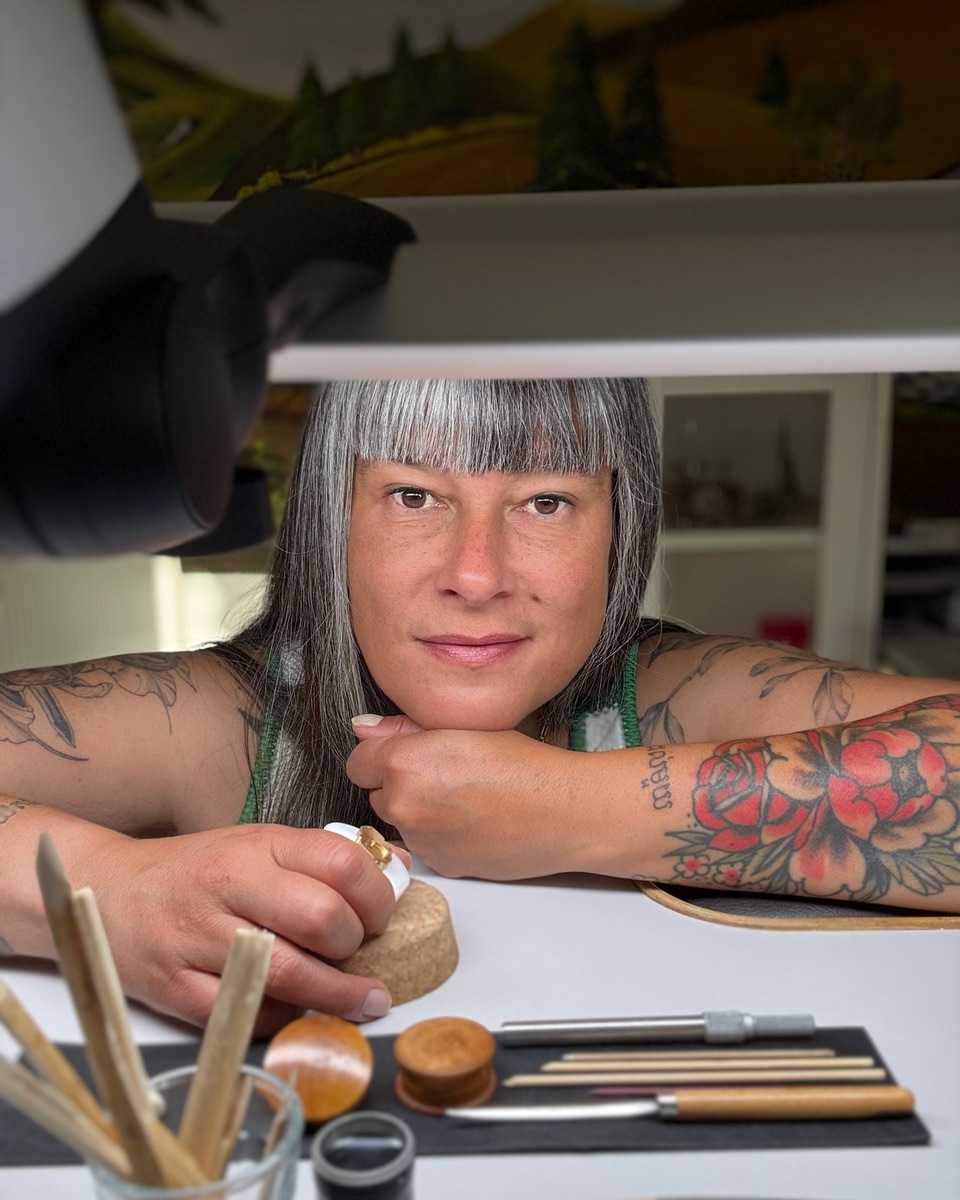
In recent years, new names have appeared with some regularity in the world of independent watchmaking. Some belong to young movement designers, others to specialists leaving major manufactures. The story of Jessica and Maarten Pieters, however, is rather different. When they presented their first watch under their own name in 2026, they had more than half a century of combined experience in watchmaking, spanning design, production, servicing and the training of successive generations of watchmakers.
Maarten Pieters, who is Dutch, worked in Sainte-Croix, Switzerland, in the mid-1990s, alongside figures including Vianney Halter and Denis Flageollet at the celebrated THA. He took part in complex projects, among them the Breguet Sympathique. He later joined Omega, where he worked on the Central Tourbillon and its chronometer certification. For the following fifteen years, he headed WOSTEP, one of the world's most important watchmaking education institutions.
Jessica Pieters, originally from Australia, built her experience in watch servicing and watchmaker training in Australia, the United States and Switzerland. She was associated with WOSTEP and later worked with Maarten to establish a watchmaking school in Cambodia.
Today they have established their own manufacture, Atelier Pieters, in Les Hauts-Geneveys. Their debut Atelier 1 is a platinum tourbillon watch with their own movement, offered in a limited series of 16 pieces at CHF 148,500 excluding VAT. The series comprises eight pieces in each of two colourways.
It was precisely the unusual breadth of their experience, from working with pioneers of modern independent watchmaking, through major manufactures, to educating future watchmakers, that prompted me to invite them for an interview. I have always tried to seek out voices that matter rather than marketing fluff. The founding of Atelier Pieters offered an opportunity to look more closely at two people who spent decades helping to shape the world of watchmaking before deciding to put their own name on a watch.
WoW:
Maarten, Sainte-Croix in the mid-1990s was home to an extraordinary concentration of watchmaking talent, including Vianney Halter, Denis Flageollet and the people behind THA. Today, we tend to look back on that period as a formative chapter in modern independent watchmaking. What was everyday life in those workshops actually like? Do you remember a project, a technical experiment or an incident that has never been widely discussed but captures the reality of that period?
Maarten Pieters:
First of all it was a privilege to have worked in this little town of Sainte-Croix, already from a historical point of view. It was for me the first time that I encountered the form of mechanical art (if I may say so), then of-course to work with extraordinary people as you have mentioned. This was a huge learning curve for me. The projects I don’t know even where to start, from small series to unique pieces, each of them was a joy to work on. In the time with Janvier SA (Vianny Halter and Nicolas Court) the machinery park was very conventional (lathes, pantographs, pointing machines and other small manually driven machines) it was so cool just making stuff. THA was already more a mixture of conventional and more modern machinery (CNC – cutting edge at that time) but both were so interesting, I have learned so much.
The projects in Janvier SA were more an artisanal approach, smaller numbers of units but with the highest attention to detail (meaning each piece was essentially unique). At THA there was already a more streamlined process with clear defined time lines and production (this approach was driven by Denis), also the operations where set out in different departments. However, both companies were able to make extraordinary timepieces and objects, so for me personally it was a privilege to work with two very different approaches.
In THA I was working on watches, pocket watches and clocks (well they were technically clocks but I have to say they were more unique time / art pieces), here I worked along side Pierre-André Grimm, this man was a genius and very humble and precise….from him I got so much knowledge and especially learned to work in a clean and organised manner (still today I can attribute my work attitude to him). Projects like the mystery clocks for Cartier, Van Cleef & Arpels or the famous Symphatique clocks of Breguet, these were all absolutely gorgeous projects that I had the pleasure to work on.
Working on the Chronograph mono-pusher project was a great experience due that we had to work with another company department (Laboratoire - Dubois in La Chaux-de Fonds) so our competence/work was measured by an external company. I liked that because we had to reflect on the way of not only the beauty of such an object but especially on the functionality of the product over time…. very interesting.
The time period in Sainte-Crois was exceptional… such a wonderfull time. But it was like there was something in the water - that epoch and a little later in general was impressive for the rejuvenation of real watchmaking and micromechanics in Switzerland – coming out of the quartz crisis my friends and peers were all doing crazy stuff or honing their skills and preparing to do so – the Grönefelds, McGonigle, Forsey, to name a few outside of Sanite-Croix - so many people who believed in specialised watchamaking who would later build some of the most beautiful products and biggest names of independent watchmaking today.
WoW:
You had the unusual opportunity to encounter the Breguet Sympathique clocks at different stages of their lives, first during your years in Sainte-Croix and later through servicing and restoration at Omega. Looking back, what proved to be the greatest strength or weakness of these remarkable mechanisms? Did working on them years later change your opinion of any of their original technical solutions?
Maarten Pieters:
Well the Breguet Sympathique Clocks, yes indeed they have followed me a bit around, like a magnet, from Sainte-Croix to Omega and even to the time I was in WOSTEP for after sales service. Anyway, the clocks and the combination with the watch (Tourbillon or minute-repeater) was like a marriage (somewhere a love and hate relationship in the most beautiful way). Both timepieces (the clock & the watch) were exceptionally precise, so this was also a challenge on his own, there was no room for error and the final client had to be very well informed of how the to pieces were inteneded to work together to avoid damaging them (which was not alway the case and led to many issues).
The most delicate part was the balance wheel axle as-well the detent escapement, especially in transport. Talking about strengths and weakness, I have to say this; the project was complex so it need special attention…. they are not usual objects…….I don’t think that you are walking around with a painting of a great artist to show your friend… they are put in rooms with their specific conditions… the same should be so with these timepieces.
The construction was quite robust but they were certainly delicate and fine adjustments could only be carried out by specialists and people who really knew the objects. Somewhere you got more and more experience to build or to service the clocks what helped in the end only to a better systematical and more ensured approach… like everything else, however I remembered that in the time (Swatch Group) we had a meeting to reflect on an shock absorber system, here I met Vianny Halter again but I have no Idea what happened at the end with the Idea. But one thing is for sure I can write a book about them.
WoW:
At Omega, you worked on the Central Tourbillon during a period when its chronometric performance was being developed further. What were the actual technical challenges involved in achieving COSC certification? Was the greatest difficulty related to the construction itself, its adjustment, or the requirements imposed by the manufacturer? And what was your personal involvement in that process?
Maarten Pieters:
The Central Tourbillon was constructed by Maurice Grimm (not to confuse with Pierre-André Grimm who I worked with in THA, they are not family related) in the beginning of the 90’s (1994), P33 was the project name, the construction of the watch was taken from a more industrial viewpoint, so once again this was for me very interesting working experience with great people, and another complete different viewpoint than those I worked with in Sainte-Croix.
When I joined Omega and became responsible for the project, I saw that the existing construction was performing very well in time-keeping and was wondering if it would be possible to push it for chronometer certification. With the project manager and the technical department I was given the responsibilty to investigate the possibility of achieving the COSC certification. At this time I had the great pleasure to work with Maurice Grimm (already retired, at this time he was in his 70’s). I had to understand his construction inside out to understand how we could systematically achieve the stringent testing procuderes of COSC. During our work we made around 28 (small) modifications from the gear-train until the tourbillon cage (different curve of the Breguet (Phillips) overcoil (if I remember correctly it went from 82 to 80 for the overcoil). This was a pivotal experience for me in my life, as he shared so much with me in such detail, I will always be grateful.
The certification process of the Omega was a collaboration between Omega, ETA and Nivarox to fulfil the requirement of the testing procedure given by COSC. So my involment was directly with different Swatch Group companes gathering production information, adjusting the watch or components accordingly and making the prototype for submiting to COSC. This took about 2 years and if I can remember correctly I think in 2002 Omega announced publicly that their OMEGA Central Tourbillon was Chronometer Certified.
It was not the first time that a tourbillon was certified by COSC, but it was the first time that a Tourbillon with an automatic selfwinding system was COSC certified. Absolutely amazing project and it was a wonderful time being at OMEGA.
WoW:
Jessica, you have spent years repairing watches and training watchmakers in different countries. Have you ever encountered a watch from a respected manufacturer whose construction made servicing unnecessarily difficult? What, in your opinion, had its designers overlooked?
Jessica Pieters:
Watchmakers tend to have many opinions about design and construction, like spectators at a football game who could’ve made the shot and won the game…everyone can do it better…
Personally, the main disconnect that I had was that although I was working mostly on mid-level to high-end brands, on pieces that could conceivably outlast their owners and their children after them, the brands never seemed to see the value in ongoing service relationships. After-sales service always seemed to be viewed more as an inevitable inconvenience that occurs following a sale rather than the oppurtunity to build lasting relatinships and loyalty.
As I always worked for independent workshops where we, the watchmakers accompanied each client directly through their service needs, I guess I was more directly connected to that customer relationship and how valuable it is in terms of brand appreciation than the companies themselves in Switzerland.
Outside of that, repair lead times in Switzerland were always long and rarely with any tangible explanation, spare parts availability was a challenge and also delivery times of said parts, at times we found ourselves advising customers to avoid certain brands solely due to the poor after-sales service support they would receive. None of the brands seemed to be able to agree on standard workshop equipment, you could find your workshop needed four different pressure testing machines just to satisfy each brand and then even that would change with a new responsible of after-sales service.
Admittedly, now many brands have since realigned their focus on maintaing customer relationships but that is only a recent evolution.
For me, no matter the perceived financial value of the piece, the customers were almost always emotionally connected to the timepiece that they had cared enough about to service and maintain, I always found that trust from them a privilige but I also a found a certain beauty in that lifetime of a piece that extends far beyond its production.
WoW:
Jessica, in my interview with Rebecca Struthers, she spoke openly about the difficulties she faced early in her career, when some people questioned her competence simply because she was a woman working in watchmaking. You began your career in Australia more than twenty years ago and have since worked in Switzerland, the United States and Cambodia. Did you encounter similar attitudes or prejudices? And looking at the industry today, do you believe things have genuinely changed for women who want to become watchmakers?
Jessica Pieters:
Unfortunately yes, there were difficult moments, particularily as a young woman in watchmaking. Either I was not considered a real watchmaker or I was somewhat of an oddity – for example being referenced in articles only because I was a woman and not based on my level of skill or accomplishments in my trade.
On the otherhand, I have been extrememly fortunate for the many mentors who took their time to teach me and guide me throughout my career and these were all men - so either I somehow chanced on the rare golden few or the confrontations that I had due to being a woman were unfortunate and outside the norm.
Within the Western world I think it has always been the most challenging, experiences within Australia, the United States and Switzerland - I could share some stories but times have also changed, and so has the conversation about the types of lives that women should/can lead, particularily in male dominated industries. Contrary to what you may think, during my work within China and Cambodia I found I was judged purely on my competence and what I brought to the table and never for the fact that I was a woman.
As I’ve matured I find I have faced less and less resistance or perhaps I just don’t take it personally anymore due to the self confidence of maturity, maybe I am now taken more seriously as a watchmaker because I have stuck with it and continued – I don’t really know. I certainly think that the journey for either a man or a woman is just as challenging in most countries now due to the lack of access to watchmaking training in general, I no longer think the gender bias is such an issue as it was twenty years ago.
WoW:
Maarten, you directed WOSTEP for fifteen years, while Jessica was also closely involved in its international training network. During that period, did you see the industry's demand shifting away from watchmakers capable of manufacturing components towards technicians primarily trained to replace them? Was there a particular experience or decision that made this change especially clear to you?
Maarten Pieters:
The primary mission of the WOSTEP Foundation (created in 2006 from the initial association created in 1966) was to ensure training for the after sales service of Swiss made products. All the current members of the Foundation are producing their products in an industrial manner. As production technoloiges have evolved, the cost of replacement components has significantly reduced and it makes more sense for industrialised products to just replace rather than repair. Also many modern materials used now mean components must be replaced i.e plastics, silicon and so on. Anyway, it is normal that the member brands of the WOSTEP Foundation would impose their needs more and more to influence the types of training availbale at WOSTEP – this was seen particularily in the modulisation of the training programs into shorter reduced programs – encasing program, service technician program, the writing was on the wall for how the “industry” viewed which watchmaking skills they needed and wanted to focus on.
The main challenge was the devaluation of the necessary skills in the trade, to reduce the required skill set necessary to work on products - for the majority of mass produced products, yes, you don’t need the full set of traditional watchmaking skills however, we come back to the mission - it notes all Swiss made products, which we have seen a marked increase in complex watches on the market. Also, the philosophy that within education, I guess due to the training that we both had, our experience and the products that we worked on, we always believed that in education everyone deserves to learn the complete picture, not only the limited amount of information that you might need for a particular job during a particular moment in time, things change. The skills needed today might not match those that are needed tomorrow and if they are lost how will they be found back (the skills)?
Something that the industry has never seemed to grasp is what it actually takes to be a watchmaker, even in customer service – for most of us, it is a passion not just a job and it stays ultimately human.
WoW:
In 2016, WOSTEP presented the W-02 prototype, a school watch featuring a two-minute tourbillon. Yet the project was never fully realised. What actually happened to it? Was the obstacle financial, educational, technical or something else entirely? And does the original prototype still exist?
Maarten Pieters:
Yes, in 2016 for the 50th anniversary, WOSTEP presented the prototype of the W-02, an evolution born from its predecessor the W-01 in the 3’000hour training program (the most complete training program at WOSTEP at that time). The prototype N°0000 was actually COSC certified. It was a beautiful training concept – the course was filled in a second but sadly the program was cancelled by the board of the Foundation and the previewed participants were all devastated.
We imagine that the orginal prototype still exists at WOSTEP. In the end, the project was not in line with what the board of the WOSTEP Foundation wanted to focus on for WOSTEP - at that time, so it was cancelled, simple as that. Maybe one day it will come back.
WoW:
In 2018, you both left WOSTEP after many years closely associated with the institution. What ultimately led you to make that decision? Was it primarily the desire to return to independent work, or were there also differences of opinion about the direction of watchmaking education?
Jessica and Maarten Pieters:
In very broad terms, over a number of years it was becoming increasingly evident that the training that the industry wanted did not align with our values. Like everything in this modern world – more consumable, faster, shorter etc...that is not the way we see our craft.
Although the side of the craft that we are focussed on now is not needed in high volume around the world for after sales service - in a way it is because products are becoming more and more complicated, many someones out there will be needed to service them around the world.
Industry is industry, as they moved towards a more mass produced and deskilled view of our craft (contrary to what is said in their marketing campaigns) we wanted to go back to our roots. It was time, there was a certain frustration not only for us but also for the board because the way that they wanted to drive the Foundation didn’t not correspond with our vision of the technical training needs worldwide. Where we were holding onto a sense of safeguarding craftsmanship and savoir-faire they were not (or at least in the same way) – so it was time for us to go.
For Maarten in particular, after 15 years at WOSTEP it was also time to pursue something new or rather reconnect to his past, away from the corporate side of the industry and back to the side that held so much significance for him – real knowledge sharing, making and so on. For Jessica also, the industrial side of watchmaking, although not without its challenges was less inspiring.
WoW:
Jessica, you helped establish a watchmaking school in Phnom Penh virtually from scratch. Is there a particular student whose progress surprised you or whose story has stayed with you? Do you know what became of the first graduates, and whether any of them are now working professionally as watchmakers?
Jessica Pieters:
Yes, we built it literally from the ground up – from the bricks and mortar building to white boards to highly specialised epquipment to instilling the culture of watchmaking – not only technical. We had to build a school and a curriculum however, it would have never been the success that it was without students. The students who had the courage to place their trust in us, two unknown foreigners talking about watchmaking and to learn a trade quite unconventional in their region.
All the students impressed me. Each and every one of them were pioneers, following their dreams into a little known profession, without any garuntee of employment afterwards. The trust that they placed in us and the way that they adapted to an enitirely new culture was so inspirational that today as we have started our brand, part of our energy comes from them – they took the chance to follow their dreams, now we take the time and the chance to follow ours.
Most of the graduates have continued with watchmaking, some are working overseas – Australia, United States, Middle East. Others have started their own businesses servicing watches and trading watches in Cambodia, and two are working in customer service for brands within Camdodia.
WoW:
In 2022, twenty-five ASEAN Lotus Tourbillon watches were produced for the ASEAN summit. Public statements at the time presented them as an achievement of Cambodian watchmaking, whereas later accounts described substantial manufacturing and assembly work carried out in Switzerland. Could you explain the actual division of work between your workshop and the school in Phnom Penh? Which operations were performed by the Cambodian students or graduates themselves, and did the public presentation accurately reflect their contribution?
Jessica and Maarten Pieters:
Aside from the strap, which was made by Delugs in Singapore, all elements for the ASEAN watch were manufactured and finished in Switzerland, including the hands, dials and case.
The movements were assembled, adjusted and tested in our workshop in Les Hauts-Geneveys.
The final encasing work was carried out at the school in Cambodia by Maarten Pieters and then instructor Stéphane Monard.
The students were fully trained on our tourbillon calibre but they did not participate in the assembly of the ASEAN pieces. It would have been unreasonable at that early stage in their technical careers to prepare such complex pieces for end clients.
WoW:
After so many years working on other people's watches and movements, you introduced a watch bearing your own name only in 2026. Why did you wait so long? And when you look at Atelier 1, which particular technical solution or construction detail do you regard as your most genuinely original contribution, rather than an evolution of something you had previously learned or worked on?
Jessica and Maarten Pieters:
Somewhere taking our time now to make time had to wait until we felt that we had truly contributed enough to perpetuating the craft that we have both dedicated our lives to and also finding the time – we have always been busy with many things.
It also took a moment to realise that through doing Atelier Pieters the way we envision as a shared experience in horology and not only a singular transaction, that we could continue what we were doing previously, only in a new format and to a different audience. For example, our clients receive regular (every few days) updates as we are building their pieces, including explanations on what we are doing and why – the thread of education continues and they appreciate being able to be so connected as their piece takes shape whilst they learn more and more about our craft and what actually happens behind the scenes.
In as much as a modern composer composes from notes to write an orginal score, he does not lay claim on developing the scale and neither do we. We are the sum of what we have learned, what we have taught and what we have worked hard to build into our hands - competence etc... of course, as makers we feel that Atelier 1 is entirely orginal as it is our own design, calibre and due to the manner of making we are built into each surface but we definitely also see the beauty in the legacy it represents. Watchmaking craft itself cannot be owned just as music notes cannot, and in terms of a product it always relies on the composer, in this case us, to bring the elements together to express something in their own way.
We always placed so much value on the skills and craftsmanship that have been passed down to all of us in watchmaking, almost like caretakers, I guess that is why education resonated with us so deeply and was the focus of our careers thus far. We wanted to launch Atelier Pieters in order to create our own avenue for fully exploiting the hard earned skills and deeply ingrained philosophy of two shared lifetimes celebrating horology.
Lastly, Atelier Pieters is entirely self-funded, we also needed to ensure that we were at a time in our lives where we could support oursleves during the two years or so that it has taken to create the brand, the prototype and purchase all the elements such as the platinum cases and so on…it is a significant investment to begin a brand and it represents our entire household income, therefore we also had to wait for it to be financially viable for us to take that sort of risk – however calculated.
WoW:
Atelier Pieters promises a lifetime service commitment for its watches. Given your extensive experience in restoration and watchmaking education, you know better than most how difficult it can become to maintain complicated mechanisms decades after their original makers have retired. What are you putting in place today to ensure that an Atelier 1 can still be properly serviced fifty years from now, even by a watchmaker who has never met either of you?
Jessica and Maarten Pieters:
Of course we cannot promise a lifetime service commitment outside things that are not under our control, our service commitment is for the lifetime of our company, we could not reasonably conceive to know the developments of the future in terms of technology etc..when we are no longer around.
We do however, have a plan for the future of Atelier Pieters, our son is joining us in 2027 (he is also a watchmaker with a talent for making like his father) and we will do everything that we can so that the brand will survive for generations to come.
Also, the construction of Atelier 1 itself has been done so so that we could make our components using manually driven conventional machines. We did not employ the use of any unsual materials or complex case constructions, meaning that everything could be remade over the generations that we would expect our product to last.
We designed the piece with service in mind, just due to our backgrounds, we don’t use any unusual thread sizes or strange dimensions, meaning that any specialsed watchmaker with the means of making could repair the piece long after we are gone.
That being said, we intentionally limit our production to four pieces a year so that we may also produce addditional components in view of service in the future and of course hands, dial casing elements have all been procured in numbers anticipating future needs of our clients and of course providing timely service for our clientelle.
After the Conversation
The debut of a new watch brand with a single model priced at more than CHF 148,000 inevitably raises questions, both about the justification for that price and the business rationale behind such a venture. The independent watchmaking market has accustomed us to high prices, small production runs and claims of hand craftsmanship. Yet a tourbillon, a platinum case and beautifully finished bridges are no longer enough, in themselves, to make a new creation exceptional, let alone commercially successful.
In the case of Atelier Pieters, the people behind the project seem more important than the technical specifications alone. Maarten and Jessica are not trying to establish credibility solely on the strength of their first watch. Their professional histories can be traced through specific institutions, projects and achievements that have left their mark on modern watchmaking.
Atelier Pieters is entering a market in which an ever-growing number of independent makers compete for the attention of wealthy collectors. The price of its debut model immediately places the brand among producers from whom buyers expect not only outstanding workmanship, but also a distinctive design identity, reliability and lasting collectability.
Four watches a year are, on the one hand, a consequence of the chosen production methods and, on the other, a very demanding business model. At such a small scale, every customer matters, while maintaining a workshop, service capability and continuity of production requires considerably more than watchmaking skill.
Their approach to independence is also interesting. The Pieters openly acknowledge working with specialist suppliers, without trying to present collaboration as a weakness. In an industry where the term 'in-house' is often overused, as I have frequently pointed out, this attitude deserves recognition and makes the brand worth rooting for. The value of a watch is not determined simply by whether every component was made under one roof, but by its quality, appearance and the responsibility taken for the finished product, including the maintenance of healthy relationships with customers.
What I find most convincing, therefore, is their attitude towards the future of their watches. Designing a movement so that replacement parts can still be made decades from now using traditional machinery is not a particularly spectacular solution. It does not lend itself to a catchy advertising slogan. It does, however, require an understanding that the true value of a mechanical watch does not end at the moment of sale.
Will Atelier Pieters succeed? It is far too early to answer. Its first model still has to prove itself in practice, and the new manufacture must earn collectors' trust. One thing, however, is difficult to deny the Pieters: unlike many newcomers, they do not first have to prove that they know how to be watchmakers. They have to prove that they can build a brand of their own.