Interviews
Kari Voutilainen
About craftsmanship that doesn't need marketing to prove its worth
Introduction
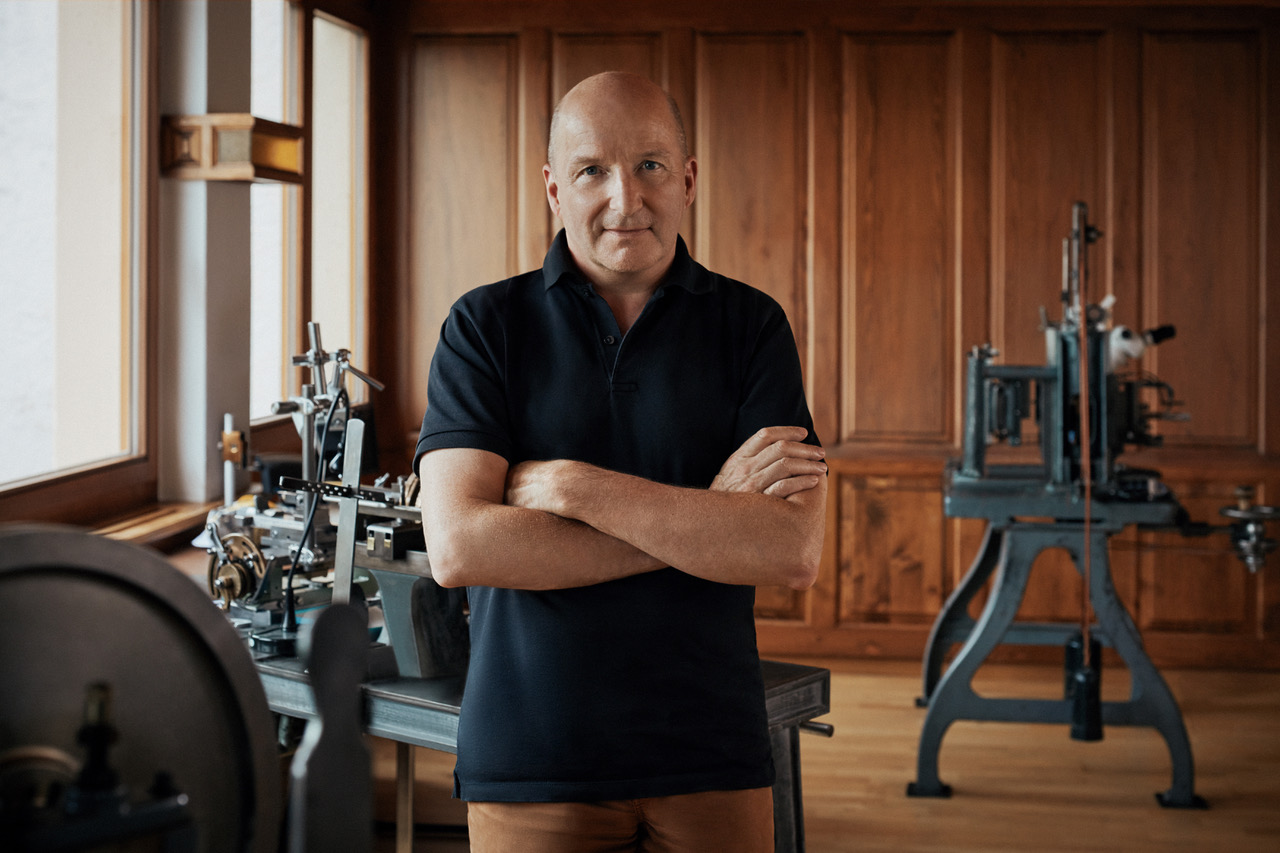
Kari Voutilainen belongs to a very narrow circle of contemporary watchmakers whose name functions not only as a brand but as the actual signature of a craftsman. In his workshop in Môtiers, only a few dozen watches are produced annually, and each is the result of work where precision meets the patient, almost meditative craftsmanship of hand finishing.
We had the opportunity to experience this personally in 2018, when Kari Voutilainen was a guest at the annual meeting of the Watch and Clock Enthusiasts Club. He literally dominated the room, not in a spectacular or flashy way, but with calm, authenticity, and extraordinary passion. This humble creator proved to be a master whose works can literally take your breath away.
This was not a typical presentation in the style of marketing industry conferences. Voutilainen prepared a series of photographs showing the most important stages of his journey from his early years working on repairing unusual watches, through the period when he himself taught young watchmakers, up to the moment he started his own production.
In a world where watches are increasingly becoming investment assets, and marketing can drown out the product itself, Voutilainen represents an almost anachronistic approach: a watch should primarily be a well-built movement and a harmonious technical object. I discuss such independence, craftsmanship, and what is truly beginning to worry him in modern watchmaking with him.
Kari Voutilainen in numbers
Annual production: only 50–70 watches
Year of manufacture establishment: 2002, location: Môtiers, Switzerland
Team: approx. 45 people
Multiple winner of the Grand Prix d’Horlogerie de Genève, member of the prestigious AHCI.
Specialty: hand finishing of movements and traditional guilloché dials on historical machines.
Photo: Piotr Stokłosa / Kari Voutilainen
WoW: When demand begins to exceed what one person can realistically produce, does the watchmaker still fully control his own path -or does the market gradually begin to shape it?
In our case, the market does not influence our future plans or our products. Our production is intentionally limited, and as an independent structure, we are not accountable to external investors or market pressures. This allows us to remain fully in control of our direction and to make decisions based solely on our own vision and standards.
WoW: At what point does “hand-made” risk becoming more of a narrative than a reality? Where do you personally draw that line?
In today’s world, we must take advantage of high-end watchmaking standards. In our workshop, “hand-made” is a daily reality. We produce ébauches with the highest possible precision, carry out all hand-decorations, and assemble each timepiece by hand to create truly beautiful watches.
WoW: Does artisanal and hand-finished technical perfection still carry the same meaning when a watch is increasingly treated as an investment asset?
We create our watches as works of art, without thinking of them as investment assets.
WoW: Is there something in contemporary watchmaking that genuinely concerns you?
Yes, what concerns me in contemporary watchmaking is the increasingly commercial approach of some new brands, which prioritize communication over the product. They lack a clear strategy and do not ensure the continuity of their work, which I believe is essential.
WoW: If you could stop one current trend in modern watchmaking, what would it be?
I would put a stop to watches created from templates that aren’t finished to their fullest potential. Moreover, there are very few truly innovative pieces these days.
WoW: When you finish a watch, how do you personally know that it is truly “right”?
I know a watch is “right” when every detail, from the movement’s precision to the hand-finishing of each component, meets the highest standards. It is when the piece feels complete, technically perfect, aesthetically balanced, and imbued with the sense of care and intention that defines our work. A harmonious appearance is what truly makes the difference.
After the Conversation
Kari Voutilainen's statements are interesting not only because they come from one of the world's most esteemed independent watchmakers, but primarily because they reveal certain phenomena that have defined the contemporary watchmaking market for years.
On one hand, we have an environment that increasingly treats watches as investment assets, financial instruments, or status symbols. On the other, a small group of workshops that still try to maintain a traditional craft model, where a watch is created slowly, in limited numbers, and without succumbing to the logic of production scaling.
Voutilainen belongs precisely to this second category. His answers are calm, devoid of rhetorical ostentation, but they contain a clear diagnosis, somewhat tinged with understandable nostalgia, that more and more brands are selling communication, and fewer are selling actual products. Marketing is becoming louder than mechanics. I fundamentally share both this view and this nostalgia, as I consider marketing an obvious necessary element of modernity, but I also perceive its excessive saturation and dominance.
And when marketing dominates beauty, admiration ceases.
The paradox is that in the world of watches, which historically was a world of engineering, narrative increasingly matters more than construction.
Therefore, the statement about watches created according to a template and not brought to a full level of finish sounds like a subtle but very clear criticism of a part of the contemporary luxury market.
In a workshop like the one in Môtiers, time still flows differently. There, a watch is still primarily a beautiful technical object, and only then a story told around it.