Interviews
Marco Lang
A Healthy Balance Between Freedom and Control.
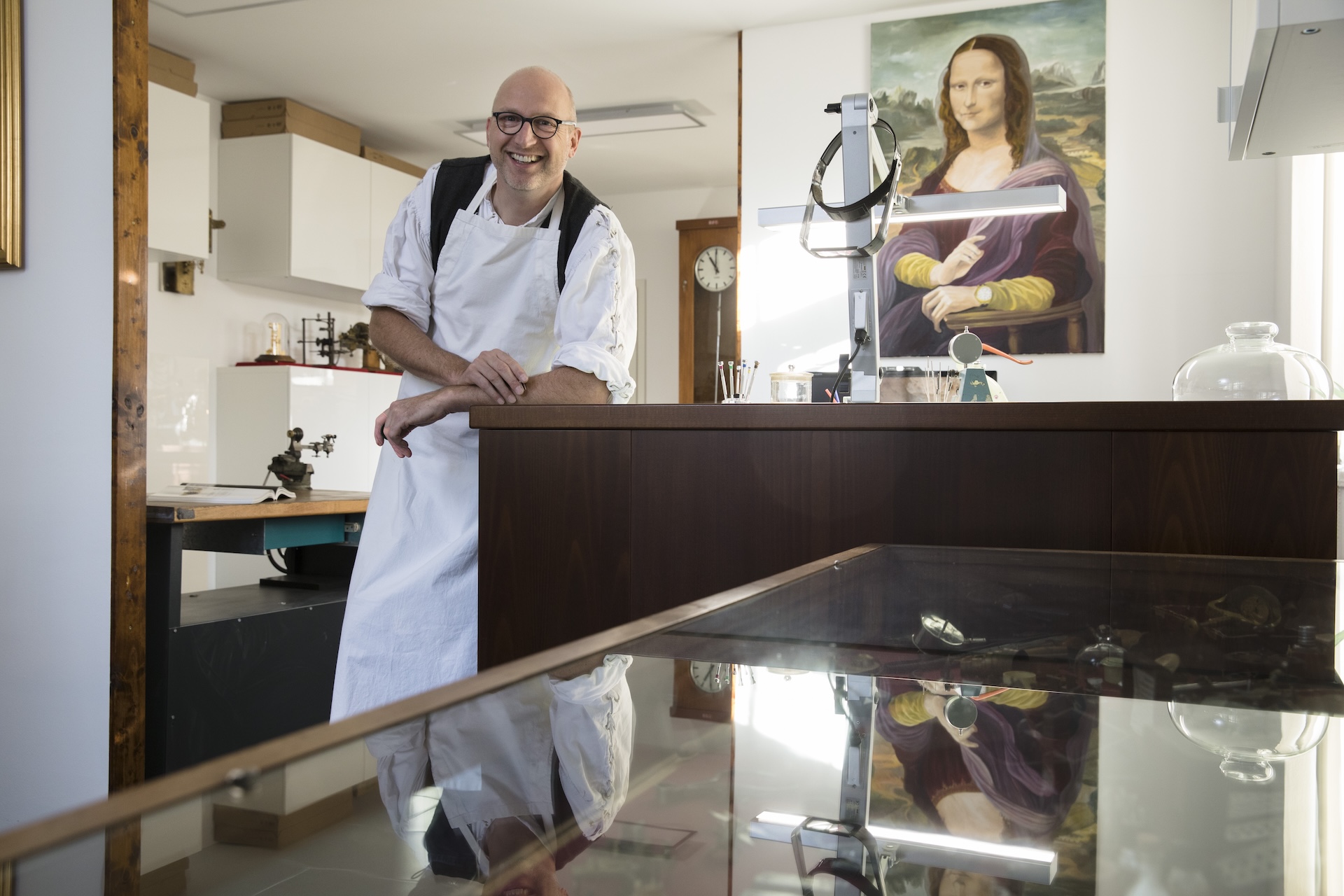
Introduction
Marco Lang created one of the most recognizable brands in contemporary independent Saxon watchmaking, although his path to his current position was far from typical.
He comes from a multi-generational watchmaking family originating from Thuringia. He grew up in East Germany and, as a child, moved with his family to Dresden. Later, he studied in Glashütte and worked on precision pendulum clocks and the restoration of historical movements.
In 2001, together with Mirko Heyne, he co-founded Lang & Heyne, a brand that over the following years became one of the most important symbols of contemporary Saxon haute horlogerie.
It was there that he created designs that cemented his position as a creator with a very distinct approach to movement architecture, symmetry, and traditional hand finishing.
In the following years, Lang & Heyne developed more and more dynamically, and the brand gradually transitioned from a small atelier to a more expanded structure. Marco Lang sold his shares in the company, and a few years later decided to leave the company, which still bears his name today.
Today, he works almost independently again in Dresden, creating projects under his own name. His current activity focuses primarily on two very different constructions.
The first is the "Zweigesicht-1," a proprietary watch based on the idea of alternately exposing two sides. Both allow the time to be read, but do so in completely different ways: one through a classic dial, the other through the visible movement. It is in this model that Lang also used an unusual mechanical shock indicator, which registers the forces acting on the watch and shows the owner how carefully or carelessly they handle their piece during daily use.
The second, much more experimental project is "Seven Spheres," a construction balancing on the border of watchmaking and kinetic art. The central element of the design is a multi-axis, moving system of rings with the balance wheel placed in the center, more resembling a mechanical moving object than a classic wristwatch.
We talked not only about watches, but also about growth, independence, design authorship, and the boundary between craftsmanship and business structure.
WoW:
The Zweigesicht-1 shows both sides of the watch as equally important.
Is this primarily a technical solution, or also a comment on how the industry presents watches almost exclusively from the dial side?
Marco Lang:
The idea for the "Zweigesicht" model came about because many collectors found the movements, even of my earlier models from the Lang & Heyne era, so beautiful that they would have preferred to see them as the front of the watch. For me, as a watchmaker, however, precise time reading and a large dial were still very important. So I found a compromise. Depending on their mood, the customer can decide which side they want to wear.
⸻
WoW:
Would today's system in Glashütte still be able to train watchmakers who work like you, or rather specialists for clearly defined roles within a structure?
Marco Lang:
There are definitely young watchmakers today who, firstly, have the courage to develop their own creations, and secondly, the opportunities to acquire the education that allows them to do so.
Independent watchmaking is currently in a very good position. Many collectors today appreciate the idealistic approach, in contrast to the more commercial approach of large manufactures.
I feel very comfortable in this community myself and am happy to be a part of it.
⸻
WoW:
You founded Lang & Heyne and later left the company.
Was this a conscious step, or the result of a model that no longer worked for you personally?
Marco Lang:
Founding and developing Lang & Heyne was a fantastic period. I was able to work with many interesting people. The fact that Lang & Heyne still successfully produces watches based on my ideas and designs also makes me happy.
But everything has its right time in different phases of life. The more Lang & Heyne grew, the greater the organizational effort became. I really enjoyed managing and leading a great team. But I missed sitting at the watchmaker's bench and physically shaping my watches with my own hands.
It is precisely this focus on what is most important to me that I have today as a "one-man manufacture." I value this very much, and the processes – from the idea for a watch to the finished parts – run wonderfully quickly and efficiently today.
⸻
WoW:
You often speak of freedom as the foundation of your current work.
At the same time, it looks like a pursuit of maximum control over every detail. Does freedom mean more independence or complete control for you?
Marco Lang:
A very interesting question. Yes, when it comes to control... I like to be able to set the direction. However, it is also important not to lose the ability to doubt oneself and to know that there are many ways to solve a problem. Conversations with colleagues often help a lot.
But of course, today more than ever, I enjoy freedom understood as independence. Both in terms of watchmaking decisions and financially.
⸻
WoW:
Was there a specific moment when you realized that as an entrepreneur, you were no longer a watchmaker?
Marco Lang:
Oops, no. I have always felt and still feel primarily an entrepreneur. And I am convinced that today, as an entrepreneur, I am more successful than ever before. Both in an idealistic and business sense.
Creating and producing watches and micro-mechanics is simply what I do best.
I try to achieve a sustainable balance for myself between watchmaking work at the workbench and organizational and sales tasks.
Leaving Lang & Heyne was an important step in building my further career.
Most often, an entrepreneur's success is measured by the size of the company created. I measure success by achieving the goal of making a particularly masterfully executed watch that I can hand over to a customer. Thanks to the respect and kindness of collectors, I can support my family very well.
⸻
WoW:
Your current work is often described as very personal.
How many people are actually involved in the creation of a watch bearing your name?
Marco Lang:
Haha, yes, probably fewer than in a commercial manufacture. In my small workshop, I work almost like a hermit. Only occasionally do I appear in public at an event or in an interview like this one.
Nevertheless, many people accompany my professional journey. First and foremost, my collectors and customers. But also friends and family participate in the creation process of my watches.
Of course, I also receive some support from colleagues who help me with the production of raw parts.
⸻
WoW:
Your shock indicator shows how the watch is handled.
Does it show the limitations of the watch or the limitations of our modern approach to mechanical objects?
Marco Lang:
In the vast majority of cases, customers handle watches with extreme care and have great respect for mechanics. Nevertheless, they very much like to receive feedback from the shock indicator on how dynamically they use the watch.
I calibrated the movement so that the hands reach maximum deflection when the watch falls from a height of 15 cm onto cushioned wood. Fortunately, this happens very rarely during normal wear.
⸻
WoW:
You publish CAD data of your designs.
If someone were to build a technically better watch than yours based on them, would that be a success or a failure?
Marco Lang:
That would be great! Competition inspires!
The idea behind the publication was to give other interested parties some inspiration and support for their own projects.
I receive overwhelmingly positive feedback from watchmakers and other "makers." In two years, designs from my site have been downloaded over 100,000 times from all over the world.
I would love to publish my earlier designs as well, but they belong to the current owner of Lang & Heyne.
⸻
WoW:
Seven Spheres moves on the border between a watch and a kinetic object.
Are you still building watches, or something beyond classical horology?
Marco Lang:
In "Seven Spheres," I was most fascinated by the movement of the nested ring system with the balance in the middle. In this sense, the term "kinetic art" is appropriate.
The highest level of precise timekeeping can probably be achieved with a simple three-hand watch with a large balance wheel.
However, this is not my general philosophy, but applies exclusively to the current project. The next one may already have a completely different watchmaking focus. And here we come back to freedom of choice. We'll see what I feel like doing then.
⸻
WoW:
Your current model is based on extremely small production and very high prices.
Is this a conscious choice, or a consequence of the type of watchmaking you practice?
Marco Lang:
With all the artistic and watchmaking approach, I calculate my watches like a regular machine builder.
The true market value is only determined by collectors and customers; on the secondary market, my watches achieve significantly higher prices.
The prices for customers therefore result from the value of the materials, the costs of purchasing raw parts, and the time it takes me to make the watch, with the latter factor, of course, having the greatest impact.
The fact that many tools and auxiliary devices are designed and manufactured is also often overlooked.
Overall, the "Seven Spheres" project is the most demanding project I have ever created. This results in the small number of pieces, the price, and the long waiting time.
WoW:
In one of your previous answers, you wrote that despite your current way of working, you still consider yourself primarily an entrepreneur. This is interesting, as many independent watchmakers describe company growth as a loss of freedom.
Has your definition of entrepreneurial success changed?
Marco Lang:
Ha, yes, when you think about it, it sounds a bit contradictory... an entrepreneurial hermit!! ☺
So let's say half and half. By "hermit," I mean that sometimes I work in isolation for a long time, completely focused at the workbench. That's my form of meditation.
But when I talk about entrepreneurial success, I am completely serious. At Lang & Heyne, I experienced both ups and downs. From the moment L&H was sold, a course for intensive growth was set. The enormous expansion of the team, high consultant fees, expensive new machines, and many other things could not be covered by sales growth.
Although today, as a "two-hand manufacture," I naturally achieve lower turnover, my cost block has fallen to an absolute minimum, which has a very positive effect on the revenue-to-cost ratio.
Added to this is less stress and greater life happiness. I take great pleasure in efficient work processes.
⸻
WoW:
Your comment that earlier designs now belong to the owner of Lang & Heyne also made me think a lot.
Has this experience changed your view on authorship in watchmaking? At what point does a design cease to be "yours" – legally and personally?
Marco Lang:
Personally, my watches will always remain my children…
But I made the decision myself, firstly to sell the company, and secondly to leave it five years later.
So there's no reason to shed tears. The way it is now is great.
As long as the watchmaking quality at L&H still meets my standards, we will be able to coexist very well and be proud of what the other side does.
Our customer base partially overlaps – many of my collectors also buy contemporary L&H watches.
⸻
WoW:
With "Seven Spheres," you talk a lot about movement and dynamics, and at the same time, you claim that the highest precision is provided by a rather simple three-hand watch.
How do you personally deal with this tension? Do you consciously choose the direction of the project at the beginning, or does it only reveal itself during the work?
Marco Lang:
You just have to be honest. The more complicated the movement, the more prone it is to problems. And yet, it is fascinating to push technical boundaries.
As I already wrote, with each project, I prioritize anew – and yes, this happens even before construction begins. Whether the project should be more artistic, more technically complex, or maximally precise.
But I make these decisions completely intuitively, solely for my own pleasure. This is precisely what the independent scene is about. Decisions are emotional, not made based on calculations and marketing analyses, as in commercial manufactures.
I worked the same way back in the L&H days. And not without resistance after 2013. All the marketing consultants and "strategists" above me were against creating the "Georg" model with a square case. But I got my way. And to this day, it is the most successful L&H model.
However, with the next project, it might look completely different.
After the Conversation
After this conversation, what turned out to be most surprising was something entirely different from the mechanics themselves.
Marco Lang does not give the impression of a man tired of the industry or disappointed by success. On the contrary, he speaks about his current work with great calmness, detachment, and at times a very characteristic sense of humor. He even half-jokingly refers to himself as an "entrepreneurial hermit."
This is an interesting contrast to the rather common myth in the world of independent watchmaking of the solitary creator fighting against the system. With Lang, there is neither the pose of a romantic outsider nor the need to build a legend around himself as the "last true master." Instead, something much more interesting emerges: a very conscious attempt to find balance between creation, work, private life, and ordinary human tranquility.
This resonated particularly strongly when he described long hours at the watchmaker's bench as his own form of meditation. In his answers, mechanics very often cease to be merely a technique and become a way of concentration, a rhythm of work, and a means of organizing one's own life.
Interestingly, Lang speaks about business without the typical industry pathos. He openly admits that the company's growth meant increasing costs, an increasingly complicated structure, and less and less direct contact with the creative process itself. However, there is no bitterness in this. Rather, there is the impression of a man who simply understands his own priorities better today than he did a dozen years ago.
Perhaps that is why this interview ultimately turned out to be less a conversation about watches and more about a very contemporary question: how to work intensely, ambitiously, and creatively, without losing oneself in the process.