WoW Investigations
Why Rolex Had to Kill Carl F. Bucherer
This was supposed to be Jörg Bucherer's dream manufacture. Instead, it became one of the most expensive vanity projects in the history of modern watchmaking.
Jörg's Project (Carl F. Bucherer, 1888–2025)
How 137 years of history lost to Excel.
Friday, February 7, 2025. Employees of the manufacture in Lengnau arrive at work in the morning. Someone calls an emergency meeting, and a brief announcement is made: it's over.
No press conference, no official statement, no farewell collection. A brand with 137 years of history is shut down in a manner more akin to the soulless liquidation of an unprofitable bank branch than the demise of a manufacture producing its own movements with a peripheral rotor winding system.
This is the end of a project that, under the noble guise of "haute horlogerie," was never purely a business venture, but rather the owner's dream of watches bearing his own name on the dial. An expensive toy, an ego-driven cherry on top of a business distribution cake.
Chronicle of a Death Foretold.
Two Different Businesses Under One Name
To understand this forced capitulation, one must first separate two worlds that operated for years under a single banner, misleading even industry observers.
Bucherer AG is a retail empire. Carl Friedrich Bucherer opened a watch and jewelry store in Lucerne in 1888. In 1924, his son Ernst entered into a strategic distribution agreement with Hans Wilsdorf, the founder of Rolex.
This alliance proved to be a goldmine. Over the next century, Bucherer grew into the world's largest watch retailer, acquiring the Kurz and Swiss Lion chains, the British The Watch Gallery, and in 2018, the American giant Tourneau. The result? Over 100 luxury boutiques worldwide and revenues exceeding 1.8 billion Swiss francs.
Carl F. Bucherer (CFB), the watch manufacturing brand, is a completely different story. Before 2001, products bearing this name functioned as a so-called house brand – somewhat like souvenir watches sold mainly in their own stores, which the collector's market was not particularly enthusiastic about.
Jörg G. Bucherer, representing the third generation of the family, decided to change this and in 2001, in a way, re-established it as an independent manufacture with ambitions to challenge the best.
As I wrote at the beginning, this was a purely ambitious project, permanently subsidized by the enormous profits of the retail chain. In its 24 years of existence, CFB never once broke even, let alone recouped its investments or showed any future prospects.
Technology That Shouldn't Have Worked (and the Paradox of Its Implementation)
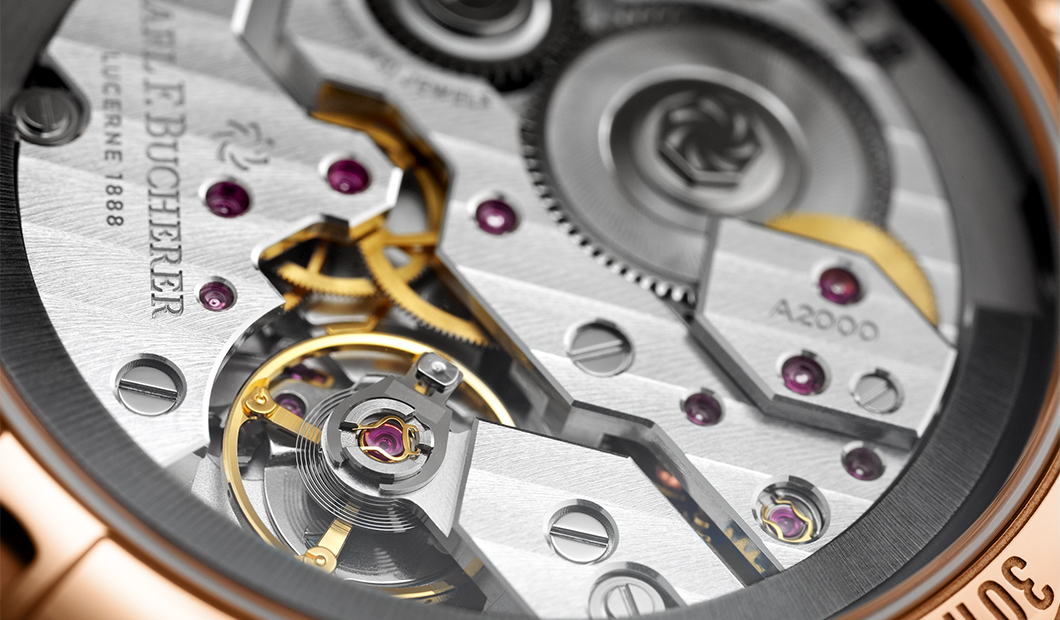
In 2007, CFB acquired the prestigious but struggling workshop Téchniques Horlogères Appliquées (THA) in Sainte-Croix. A year later, engineers from Lengnau presented the caliber CFB A1000, which was in fact the world's first serially produced movement with an automatic peripheral winding system.
This was not a marketing gimmick. A peripheral winding system, where the rotor rotates on special rails at the edges of the movement instead of on a central bearing, unfortunately has fundamental design limitations. It is characterized by drastically lower torque, is susceptible to shocks, and is difficult to seal. Paul Gosteli's patent from 1957 was attempted by Patek Philippe engineers in the 1960s (as caliber 350). They ultimately failed, and the solution proved too capricious and unreliable.
CFB solved this problem using ceramic ball bearings, a tungsten winding ring, and patented gear geometry. Their winding system worked flawlessly.
Moreover, the brand went further: in 2018, the caliber CFB T3000 combined a peripheral rotor with a tourbillon, and in 2021, the caliber MR3000 added a minute repeater to this. The result was a watch with three interesting solutions: a minute repeater, a tourbillon, and a peripheral winding system.
So where was the mistake? In a certain design paradox.
In the world of haute horlogerie, a peripheral winding system is used to drastically slim down the movement and create ultra-flat dress watches (as Bulgari does with its Octo Finissimo line or Audemars Piguet).
Meanwhile, CFB packed these flat, truly beautiful, and in a way ingenious movements into powerful, bulky cases with a thickness appropriate for divers (like the Patravi TravelTec or ScubaTec lines).
The customer thus received subtle, beautiful, and quite expensive technology enclosed in a sporty and completely unsuitable "armor."
It's like putting a beautiful and sporty-sounding naturally aspirated V10 engine from a Lamborghini Gallardo into a Unimog, and at an absurdly disproportionate price.
In such a price segment, the customer doesn't buy abstract gear geometry. They buy prestige, coherent design, and a legend. And CFB had neither design nor legend, not to mention prestige out of pity.
The Arithmetic of Defeat
In its best years, the brand produced approximately 25,000 – 27,000 watches annually, generating a paper revenue of 80–100 million CHF. However, accumulated losses over a quarter-century are estimated at over 250 million francs.
There were three reasons for this catastrophe:
1. R&D Costs: Maintaining an advanced development department, acquiring the THA manufacture, and opening a new facility in 2016 were investment outlays tailored for a brand selling 100,000 watches annually, focused on growth and expansion.
CFB generated a fraction of that volume, existed mainly due to its own distribution network, and had neither the vision nor the message to multiply sales and, consequently, production.
2. Pathological Distribution: Sales relied on the internal ecosystem of Bucherer boutiques. CFB watches were often offered as part of a "tied sale" or with powerful discounts for loyal customers buying other, desirable brands. This destroyed CFB's position in the secondary market. A Patravi chronograph landing on auction portals with an 80% discount from its list price is not luxury but a desperate sell-off.
3. Lack of Identity: Tudor in the same segment has the powerful myth of Rolex and the brilliant Black Bay line. Omega has the moon landing and James Bond. Breitling is aviation.
CFB only had a peripheral rotor and an association with a chain of jewelry stores.
Pax Rolexiana, or Corporate Diplomacy
In August 2023, Rolex shocked the world by announcing the acquisition of the Bucherer AG group. However, closely following Rolex's past actions, a consistently implemented policy of buying out suppliers and partners was evident.
This decision caused an industry earthquake, and shares of competing network Watches of Switzerland temporarily lost almost 30% of their value in one day, leading to the immediate evaporation of well over half a billion dollars in market capitalization.
Rolex's motivation was simple: to gain control over a global distribution network (over 100 boutiques) and secure the Rolex Certified Pre-Owned program. The Carl F. Bucherer watch brand was merely ballast in this equation from the start.
Jörg G. Bucherer, having no direct heirs, preferred to hand over the family empire to a long-standing partner rather than to soulless private equity funds. He signed the agreement in August 2023 and died in November at the age of 87. He did not live to see the brutal end of his life's project.
After the acquisition, Rolex's management, led by Nicolas Brunschwig, conducted a cold audit, the result of which was obvious, but the decision was delayed for 15 months due to certain industry geopolitics.
Bucherer boutiques are key sales channels for Rolex's competitors: brands from Richemont groups (Cartier, IWC), Swatch Group (Omega, Longines), or LVMH (TAG Heuer). If Rolex decided to revive CFB and pump millions into it, it would create an internal, favored-on-the-shelves competitor.
To create it, on the one hand, would require enormous capital, operational, marketing, and time commitment, and on the other hand, it would harm the sales business conducted on other brands as well as trade relations.
The liquidation of CFB in February 2025 was therefore as much an act of corporate diplomacy as it was a business calculation, and Rolex sent a clear signal to competitors: "We bought the retail chain to secure retail, not to compete with you with our subsidized manufacture. Bucherer will remain neutral."
Meaning, business as usual.
The Real Prize: Brain Drain and Manpower in Times of Crisis
What remains of Jörg's project? Approximately 70 high-class watchmakers and engineers from Lengnau received immediate offers to join Rolex's production structures, including the new billion-franc mega-factory for movements being built in Bulle.
In an era of drastic, structural shortages of skilled labor in Switzerland, acquiring a compact, cohesive, and experienced team capable of assembling the most complex complications is a gigantic, free injection of valuable human capital for Rolex.
The boutiques previously dedicated to CFB were thus smoothly taken over for the display of Tudor and Rolex, and the patents went into a drawer in Geneva.
Will we ever see a peripheral rotor in an ultra-flat Rolex Perpetual 1908 or Tudor line? Unlikely, but defensively blocking this technology from competitors is also a value in itself for Rolex.
A Lesson from Lengnau
The closure of Carl F. Bucherer is a textbook, brutal proof of what the modern luxury goods market is all about.
The CHF 3,000 – 15,000 segment does not forgive a lack of roots in pop culture. Consumers in this price range do not buy engineering rigor but rather a kind of social legitimacy. They want their surroundings to immediately recognize the status manifested by the watch on their wrist.
CFB had unique engineering but failed to translate it into a magnetic narrative. In modern luxury, engineering without a story is merely a cost, not a value. And a romantic, ambitious project financed by an external holding has exactly the same shelf life as its founder's life or the depletion of funds, whichever comes first.
The machines in Lengnau have stopped, the ceramic ball bearings have gone into storage in Geneva. Rolex, in its old habit, has not issued any official press release on the matter.
The empire simply moved on.
Photos: official brand website and foundation.