WoW Investigations
Who really makes our watch dials.
Silent consolidation of the Swiss dial makers market
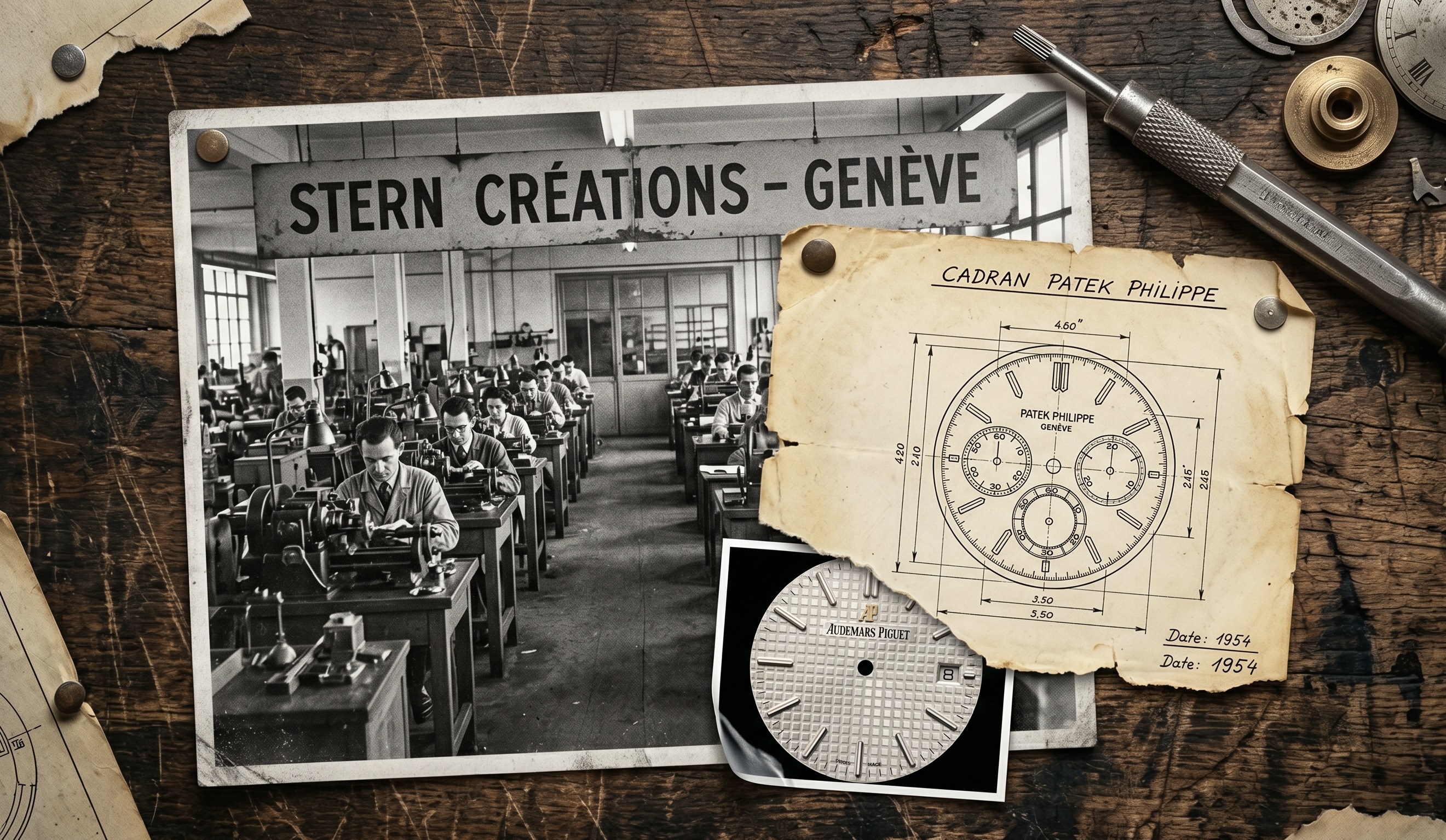
Every watch owner looks at the dial daily, but almost no one considers who truly produces it.
Relatively recently, somewhere between 2000 and 2012, amidst various watch events, fairs, and launches, a great yet invisible shift quietly occurred in the market.
The four largest watch groups and Patek Philippe systematically acquired the most important independent dial manufacturers. The operation proceeded discreetly, without major headlines, and within a decade, it changed the supply architecture in Haute Horlogerie.
A brand that wants a grand feu enamel dial today will likely buy it from Donzé Cadrans, owned by Ulysse Nardin.
A brand that wants a universal dial on an industrial scale will go to ArteCad, which belongs to LVMH.
A brand that wants top-class hand guilloché used to look to Metalem, as long as it was possible; today, probably not, because Metalem was quietly acquired by Chopard.
This doesn't seem like a coincidence, nor is it "just" a nicely sounding phenomenon described in business as so-called vertical integration. This was an acquisition of bottlenecks, without which it's impossible to make a premium watch. This applies to rare competencies like grand feu enamel or hand guilloché, as well as industrial dial finishing technologies (lacquering, electroplating, screen printing, pad printing, or index application), which account for most of the premium segment's production.
What happened · chronology of acquisitions
2000 · Richemont acquires Stern Créations.
Stern Créations, a cornerstone of the luxury dial market since 1898, and a long-time supplier to Patek Philippe, Vacheron Constantin, A. Lange & Söhne, and many others, came under the control of the group on June 27, 2000. The announcement assured that Stern would remain a profit center and continue to serve clients outside Richemont. In practice, the story ended differently, which I will return to.
2000 · Rolex acquires Beyeler. Under the leadership of Patrick Heiniger, Rolex pursued an integration strategy, and Beyeler, a long-time dial supplier, joined Genex (1998, cases), Gay Frères (1998, bracelets), Boninchi (2003, crowns), and finally Manufacture des Montres Rolex SA, acquired from the Borer family in 2004 for a billion francs. Thus, Rolex closed its supply chain.
2000 · TAG Heuer acquires ArteCad. The first stage of a longer process. ArteCad from Tramelan, founded in 1885 as Kohli, came under the wing of TAG Heuer.
2002 · Swatch Group acquires Rubattel & Weyermann. On April 23, 2002, the group acquired 100% of the shares of the dial manufacturer from La Chaux-de-Fonds, operating since 1890. The company then employed about 80 people, and the previous owner, Michel Theurillat, remained in his position to ensure continuity of supply for premium segment clients, including those outside the Swatch Group. After moving to a new building in 2015, Rubattel & Weyermann revised most processes and became the main supplier of dials for Breguet, Blancpain, Omega, and other brands within the group.
2004/2006 · Patek Philippe acquires Flückiger & Fils. On November 8, 2004, Patek Philippe acquired the 70-person company from Saint-Imier from the Flückiger family, who could no longer afford the necessary investments. A new company, Cadrans Flückiger SA, was formed, which moved to a newly built factory in the La Clef industrial zone in 2006. The workforce grew from 54 to about 100 people. Forty percent of production went to Patek Philippe, sixty percent to other brands, including Audemars Piguet and Chopard.
2011 · Ulysse Nardin acquires Donzé Cadrans. On September 1, 2011, Francine and Michel Vermot, who ran the company after their father-in-law Francis Donzé, sold all capital to Ulysse Nardin. Donzé Cadrans, one of literally a few remaining grand feu enameling workshops in Switzerland, came under the manufacture's umbrella.
Three years later, in 2014, Ulysse Nardin joined Kering, and in 2022, Kering announced the sale of the entire Sowind group (Ulysse Nardin and Girard-Perregaux) to management led by Patrick Pruniaux. Donzé Cadrans today operates within the independent Sowind Group structure, outside the large conglomerates, though still under the umbrella of a watch brand and not entirely independently.
2011 · LVMH acquires 100% of ArteCad. On November 10, 2011, the group finalized the acquisition initiated by TAG Heuer in 2000. ArteCad then employed 215 people and produced over 350,000 dials annually. It served TAG Heuer, Hublot, Zenith, and other external clients. In March 2012, LVMH also acquired Léman Cadran.
Within a decade, the independent supplier market shrunk to a handful. Singer in La Chaux-de-Fonds, Metalem in Le Locle (until it, too, was discreetly acquired by Chopard), Cador on the German-Swiss border. The rest are now owned by groups.
WoW Interpretation
Firstly, vertical integration was not a response to crisis. It was a response to narratives about crisis. Groups did not buy suppliers because there was a shortage of dials. They bought them because owning such a manufacturer gives control.
A brand that says "our dial is made in our manufacture" extracts premium value from that. A brand that buys a dial from a neighbor extracts much less. The difference is mainly communicative and not always technical, but ultimately always about margin.
Donzé Cadrans still makes dials for Patek Philippe, Hermès, Cartier, Czapek, Louis Erard.
Stern, as long as it existed, still made dials for almost everyone. The dials didn't disappear; the ability to boast that the dial was bought from an independent specialist did.
Secondly, operational independence is a legal fiction. Each acquisition was announced with assurances that the company "would maintain independence" and "continue to serve external clients," so Donzé still supplies Czapek and Girard-Perregaux. Cadrans Flückiger still makes dials for AP. ArteCad still has clients outside LVMH.
This is true, and yet not the whole truth. Production priorities, schedules, access to prototypes, exchange of know-how, all of this naturally revolves around the owner. An external client gets what's left over or what the group's strategy allows. And sometimes, they get nothing at all. Stern Créations was dissolved in 2016. After 118 years, Richemont decided it no longer needed the company, and 118 years of expertise formally disappeared as an independent entity, and in practice, was dispersed and absorbed by the system. "What was thrown away there, my God, my God," sighed former Stern employees in 2019 interviews with industry press. This is the price of independence under an umbrella.
Thirdly, independent creators are today clients of the competition. Philippe Dufour bought dials from Metalem until it was acquired by Chopard.
F.P. Journe, MB&F, Czapek, Andersen Genève, every independent watchmaker working at the Haute Horlogerie level orders dials from suppliers belonging to Swatch Group, Richemont, LVMH, Sowind, or Patek Philippe, and this is not a comfortable position. A supplier-competitor has insight into prototypes, deadlines, and technical solutions. If the owning group decides that serving external clients is no longer a priority, the independent creator is left with nothing. Stern in 2016 is therefore a warning, not an anomaly.
Fourthly, the Audemars Piguet case is exceptionally well-documented. The brand, which since 1972 had commissioned the guilloché of Royal Oak dials from an artisan linked to the Stern system, found itself in an uncomfortable position as a client whose supplier was part of the competition after Richemont acquired Stern.
AP decided to rebuild the competence in-house. Forty-year-old guilloché machines were brought from Canada and the United States, where they had previously gone from deserted European workshops. The machines were rebuilt, which took almost a year, and put into production around 2012. Today, Petite and Grande Tapisserie dials are made in Le Brassus on pantograph machines, while Méga Tapisserie for the Royal Oak Offshore are stamped, not guillochéd. This move had symbolic significance beyond costs. AP did this in an exceptionally visible and well-documented way, while other brands that also rebuilt their own competencies in this area did so more quietly and with less fanfare.
Fifthly, for microbrands, the market opened up, but in a completely different place. Swiss consolidation left a vacuum in the external segment, which Asian factories, mainly in Shenzhen and Hong Kong, began to fill. This is a real change. A Western microbrand with a budget of tens of thousands of francs per series today does not have access to Donzé or Flückiger, but it does have access to Asian factories that have evolved from copying to designing their own. Atelier Wen with hand guilloché performed by master Cheng, Behrens with experimental design, these are symptoms of a new geography of supply.
"Swiss made" on the dial does not always mean that the dial was made in Switzerland in the way the client imagines.
The paradox is that the more brands talk about "manufacture" today, the more their supply chain is shared.
Market Conclusion
The consolidation of "cadraniers" between 2000 and 2012 was the quietest and most effective strategic operation in the modern history of watchmaking. Five main entities (Swatch Group, Richemont, LVMH, Sowind, Patek Philippe) plus Rolex now control almost all the most important Swiss workshops producing premium dials.
Independent creators, therefore, unfortunately operate in conditions of dependence on the competition. Consumers receive dials of consistently high quality, but the marketing narrative around them, especially the story of "manufacture integration," deviates from the actual topography of production. Most often, it's the same workshop, the same people, the same machine. Only the logo on the watch is different.
April 2026:
The latest piece of the puzzle, the discreet acquisition of Metalem by Chopard, slowly comes to light with the launch of the L.U.C 1860 Lucent Steel in 2026. SJX Watches, aBlogtoWatch, and timekeepers.club confirm that the company, which for years was a symbolic cornerstone of independent craftsmanship (it's where Philippe Dufour ordered dials for Simplicity), is now owned by Chopard. The operation fits the pattern from 2000-2012, just a dozen years later and even more quietly.
Supplementary Summary:
The Donzé Cadrans Case: Although both companies belong to Sowind, their "independence" is a unique strategic export product. If UN were to close Donzé exclusively for itself, it would lose the prestige of being a "guardian of tradition" for the entire industry. By allowing them to work for Patek Philippe or Czapek, UN, and de facto Sowind, earns not only money but also legitimacy in the world of Haute Horlogerie.
Integration vs. Innovation: The risk I must mention is homogenization. When ArteCad (LVMH) produces dials for TAG Heuer and Hublot, despite different designs, the technological processes (e.g., Super-LumiNova application or electroplating) become identical. This leads to a "corporate look" for dials, which independents (like Moser or Akrivia) try to break by seeking niche artisans outside the mainstream.
Voutilainen and Comblémine (2014): Kari Voutilainen, seeing the acquisition of suppliers by groups as described above, made the heroic decision to acquire a majority stake in the dial factory Comblémine SA. This was a defensive move by an independent watchmaker that secured access to high-quality dials for other small brands (e.g., Grönefeld) and is currently the only real counterbalance to the "Big Five."
It is obvious that production priorities belong to the owner. But there is another aspect, namely IP (intellectual property) transfer. When an independent brand (e.g., MB&F) orders a prototype from a supplier belonging to Richemont, it risks not only delays but also a "leak of ideas." Even with strict agreements, engineers working on a dial for a small brand today might be designing a solution for Vacheron Constantin tomorrow. The groups therefore bought not only factories but also the innovation radar of the entire market.