WoW Investigations
90% of watchmakers in Poland do not service and cannot verify the authenticity of, for example, a Rolex – what does the market really look like?
Why most watchmakers in Poland shouldn't service or verify a Rolex? An analysis of the market, competencies, and workshop realities without myths and simplifications.
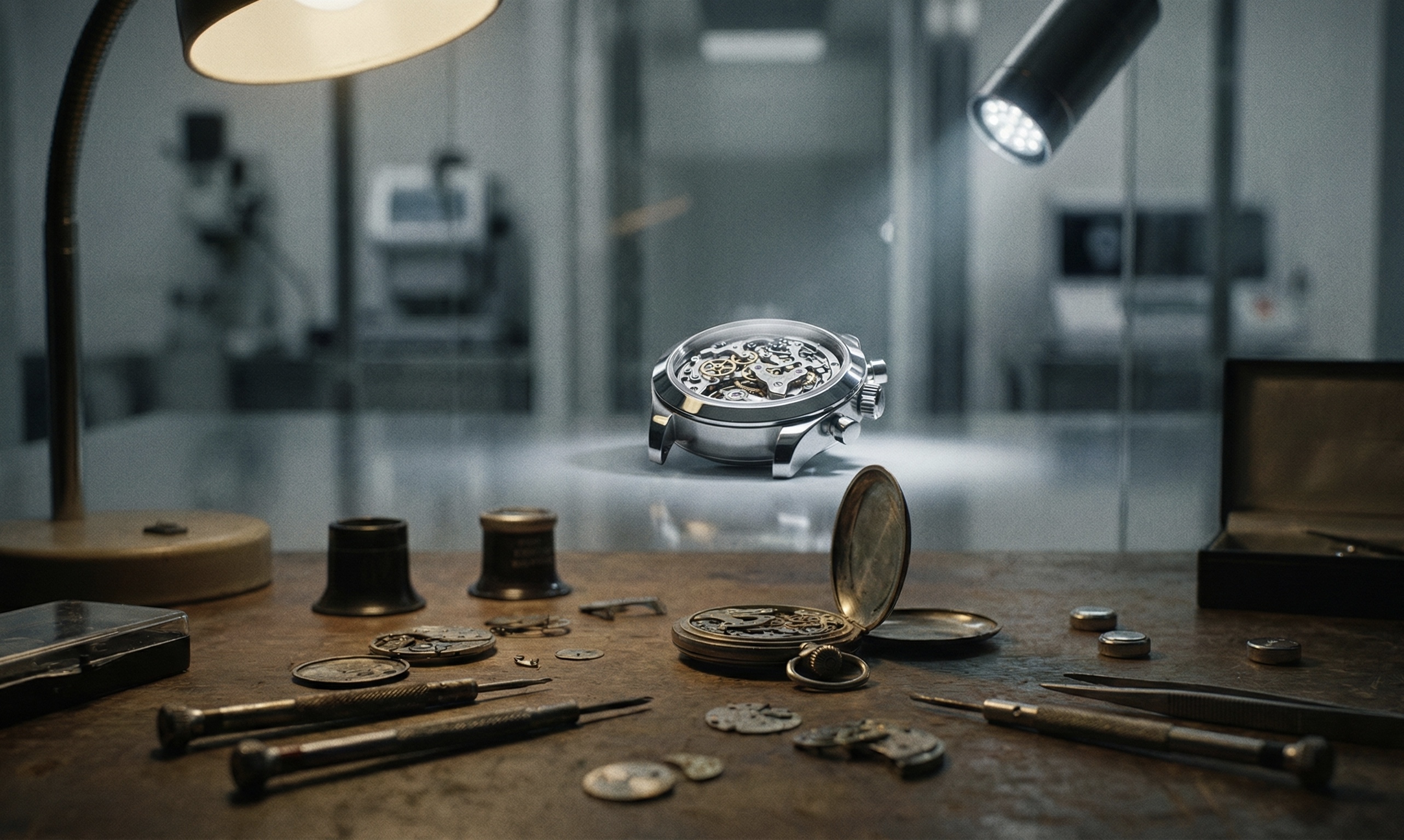
This title sounds like a provocation, and to some extent, it is.
But not towards watchmakers, rather towards our perceptions of who a "watchmaker" is in Poland today and what we can realistically expect from them.
This text was not written to offend, stigmatize, or corner anyone with the label of a bungler. Quite the opposite. It is an attempt to organize a reality that we all see but rarely name directly. A reality I often encounter on forums or discussion groups where we seek help or originality verification, and then the sacramental "go to a watchmaker" is uttered.
And this is where the problems begin, as the Polish watchmaking service market is deeply polarized today, so if we don't understand this, we will continue to make the same mistakes, both as customers and collectors.
Two worlds under one sign.
Let's start with the basics. In Poland, under the sign "Watchmaker," two completely different worlds are hidden, which have almost nothing in common beyond the name of the profession and a relatively narrow range of overlapping services.
The first world is luxurious, closed, sterile
This is the world of brands like Rolex, IWC, Omega, or Patek Philippe.
A world of authorizations, certificates, procedures, specialized tools, closed databases, and a "zero access" policy for outsiders, as well as strict regulation of spare parts.
In Poland, there are a dozen or so such points. Mainly Warsaw and the largest cities. Often within jewelry chains like W. Kruk, which has a central Rolex service center at Plac Trzech Krzyży, or Swatch Group with an Omega or Longines service center on Marynarska Street, or several historical partners, as well as companies like Wrzeciono Czasu, which are acquiring new service authorizations.
There are also unauthorized workshops where we can find excellent specialists from both older and younger generations, those few true masters, whom I describe in more detail in a dedicated chapter of the book.
But this is not a market; it is an enclave.
The second world is common, local, real
This is the world of thousands of points in tenements, in pavilions, often in smaller shopping malls, and sometimes in a workshop next to a house.
This is the world of batteries, straps, Vostoks, Delbanas, Atlantics, Zarias, as well as old watches of brands widely available in former communist countries.
A world that actually serves the majority of Poles, and this world accounts for ninety percent or even more.
Where does this mythical number come from?
Not from contempt but from mathematics, as there are an estimated 1500–2500 points in Poland that offer watchmaking services in any form, such as battery replacements, bent spring bars, broken straps, or crystal polishing.
Points genuinely capable of professional service for watches of the class of Omega, Jaeger-LeCoultre, Rolex, or Patek Philippe number perhaps a few dozen in total, counting the best independent specialists very optimistically.
Even if we round up, we are still talking about 95% of the market that does not have access to parts, documentation, tools, training, or knowledge, because they have never seen a disassembled genuine Rolex on a watchmaker's bench.
This is not my opinion; it is the market structure.
"But he is a watchmaker!"
Yes. And that's exactly why he will perfectly repair a Vostok, but he shouldn't touch something he knows absolutely nothing about.
Here we come to a fundamental misunderstanding, because, unfortunately, the watchmaker in Poland is a profession shaped by the realities of the PRL (Polish People's Republic), the availability of watches for repair and parts, but also family sentiments and the brutal economics of a small workshop.
It is a profession that was never designed for Haute Horlogerie, because for many years such a concept existed only in foreign press, and additionally, a huge educational gap and oppressive policies led to what we have today.
Education, where the chasm begins
The Polish watchmaker training system (MEP.04), in accordance with the Regulation of the Minister of National Education of May 16, 2019, teaches basic mechanics, classic escapements, relatively simple adjustments, and working on tolerant mechanisms. This is sufficient to service old Delbanas or revive Vostoks, and possibly cope with classic ETAs.
But this has nothing to do with the level of knowledge required by manufactures.
For comparison, the global standard is WOSTEP, which involves approximately 3000 hours of intensive, full-time study in Switzerland. The cost? Tens of thousands of francs. Language? English or French. Access? Extremely limited. For a watchmaker from a small town in Poland, this is an insurmountable barrier.
Economics, or why batteries win over passion
Now, the most important thing: money.
Battery replacement takes 5–10 minutes and costs, for example, 25–50 PLN (I'm talking about the price in a smaller city) and poses minimal risk, generating steady traffic.
A full mechanical service is several hours of work and several hundred zlotys, plus high risk or customer complaints if something goes wrong. If someone runs a small workshop, pays ZUS (social security), rent, taxes, and their clients are older people with watches from many years ago or younger people with CK or Boss watches with cheap quartz movements, the choice is obvious, or rather, there is no choice.
That's why the Polish watchmaker didn't "degenerate" into just batteries. He adapted to survive.
Vostok, Delbana, Atlantic is local competence
And here we come to a paradox.
The same watchmakers who shouldn't touch a Rolex are a valuable resource and guardians of technical memory, as well as often masters of improvisation and renovation. Old Soviet mechanisms, "Polish" Swiss watches from Pewex, family heirlooms – this is where the Polish watchmaker is at home.
This knowledge is passed down by hand, not by certificate.
The most dangerous area: "I'll check if it's original"
If I had to point to one area where this gap is most dangerous, it is authenticity verification.
Modern fakes can be so good that neither a layman nor an average watchmaker stands a chance. What's more, often an experienced forum, blog, or group regular will recognize a simple fake more quickly, as they are familiar with it from hundreds of hours of reading online posts, than a watchmaker with many years of experience but severely limited to a few simple watches from the communist era.
Let's also remember that even experienced collectors sometimes make mistakes. And without access to manufacturer databases, numbers, documentation, microscopes, or knowledge of micro-details, a so-called "quick glance" is an illusion of competence.
And here, unfortunately, forum stories, for example from the Watch and Clock Lovers Club, as well as from other forums and my personal experiences, are merciless.
Verdict (without emotion)
No, 90% of Polish watchmakers don't know about Rolex and Patek.
Yes, this is normal, and no, it's not their fault.
The problem begins when the client doesn't understand this, users start giving advice based on so-called common sense, and the watchmaker is afraid to say "no" and admit to a perfectly justified lack of knowledge in this area. Because then the risk zone begins.
One last sentence
For a Rolex owner, 90% of "Watchmaker" signs in Poland are potentially dangerous territory.
Again, for the owner of an old Delbana, these same places are the last line of defense for memory.
And until we learn to distinguish these worlds, we will continue to live in the watchmaking myth of a single profession that has long ceased to be homogeneous.
Finally, anecdotally, on the forums, we have an old watchmaker, Mr. Władysław, who often writes such tearful nonsense that it hurts to read, including stories about an Omega factory in China (sic!) from whose lines both originals and fakes for other markets come off. He often comments on obvious fakes, saying that they are probably originals and similar nonsense, so may God protect you from such a verifier.
Recently, I was dealing with a very interesting historical model, a Rolex Daytona Paul Newman 6239 from the 70s, and it was verified by some watchmaker from Lublin who, after waving it next to his ear (I remind you that it has a Valjoux 72 manual-wind movement) and not hearing the balance wheel working, stated that it was a Chinese battery-powered fake! A watch worth several hundred thousand zlotys!
And with this optimistic note, I leave you to ponder whether it's worth verifying authenticity with a "watchmaker."