WoW Investigations
The vintage market: passion, prestige, and… a minefield
Vintage market pitfalls, auction house manipulations, criminal scandals, and a million-dollar Daytona exposed as a quartz fake
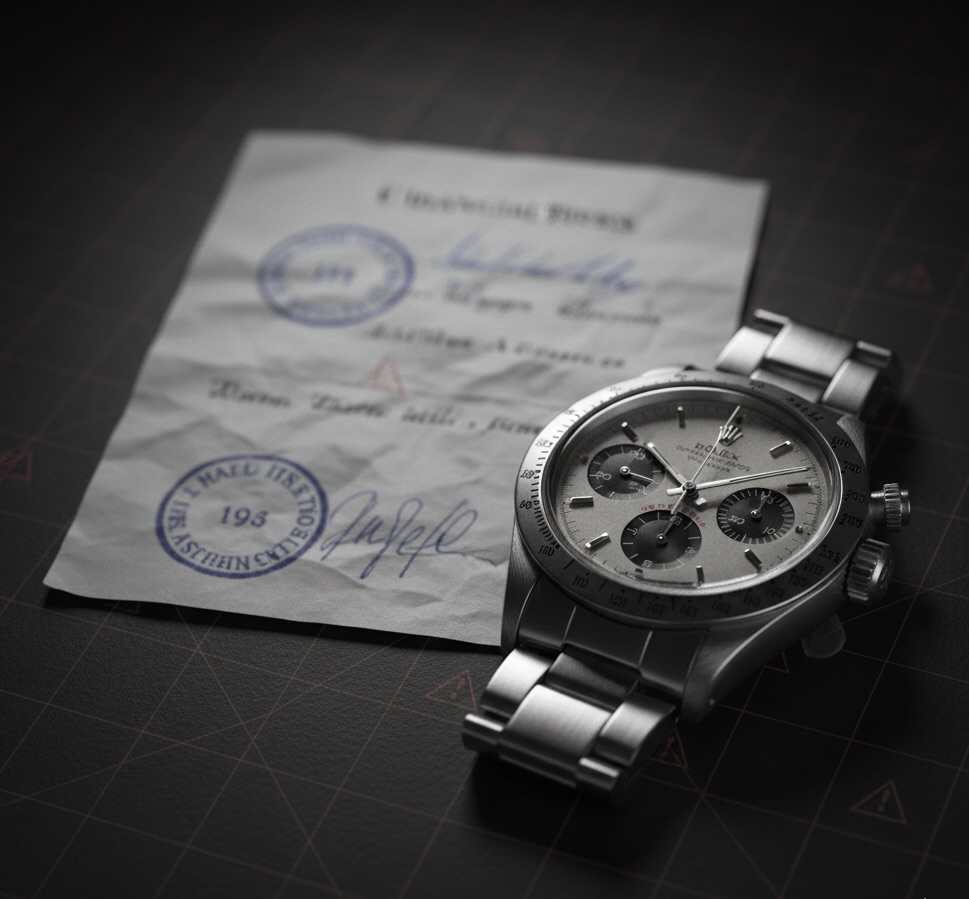
Vintage watches attract like a magnet, and not just with the promise of history, famous people or great actors associated with them, or discontinued movements, but also with the prices they fetch at auctions and often their systematically increasing value, because they won't make any more of them.
And at the same time, it's a market where the story can be more expensive than the precious metal, and the difference between an "original" and a "fabricated legend" can come down to a single inscription on the dial. Literally.
So if you think that, for example, a service document from the manufacturer or an auction certificate is some kind of armor against risk, I have bad news. Or rather, two stories in which Rolex and Omega have already shown that this "armor" has holes.
Why vintage is so tempting today
In the classic world of luxury, new items are sold through prestige, design, or perfect, handcrafted execution. Vintage is sold through sentiments, such as:
"this will never come back"
"this was made differently, meaning better"
"this is from a time when the brand had a soul"
The problem is that the market very quickly learned to produce this meaning as well. And when meaning can be produced and profited from, the temptation immediately arises, resulting in an industry of modifications, "rescuing" specimens, assembling hybrids, and adding stories, often by reprinting on the dial.
Of course, nothing is explicitly black and white, and not every restored watch is a fraud. But this is a gray area where honesty, reliability, and standards end where the possibility of making big money begins.
The illusion of security: "Since the manufacturer's service saw and repaired/restored it, it's OK"
In theory, everything sounds logical; after all, the manufacturer has archives, know-how, procedures, parts, catalogs, a system, craftsmen, and everything imaginable. Who, if not the manufacturer, can flawlessly identify a fake or a modification? In practice, therefore, by customers, sellers, and buyers, a service document is often treated as a certificate, even though it is not.
The service center does what it is called to do: inspect, appraise, and plan work. It does not always conduct a "legal process" of authenticity. And the market turns this into something else, attaching and selling this appraisal as proof of the watch's authenticity.
And here we touch upon the crux of the problem, as service documents become a kind of prop in the theater of credibility, and this prop is often unfortunately used for conscious deception or unconscious manipulation.
Example number 1: Rolex, Daytona, and "paper that shouldn't have acted as a certificate"
Last year, there was a lot of talk about cases described by Perezcope, concerning instances where Rolex's "Atelier de Restauration" accepted Daytona specimens for restoration... which, to put it mildly, were problematic.
Paul Newman "Oyster Sotto" Ref. 6263 (Sotheby's, May 2024)
This is a league where the market breathes through a straw; we have a watch of which there are only about 30 pieces, and every detail of it "weighs" more than a gold bar.
The watch was finally sold for only 254,000 CHF because it turned out that the "Oyster" print on the dial was added later. Previously, Rolex itself analyzed it for over 3 months and issued a restoration appraisal of 19,500 CHF, without any warning signal, without a word that we had a painted dial. The question is whether they didn't notice it, or if they didn't care, the amount for the repair was important. The seller, however, attached this document to the auction, which bidders understood as confirmation that this historic and sought-after watch was fully original.
This is not a minor mistake. At this level, "Oyster" is not just an inscription but real value.
Daytona Ref. 6240 (Sotheby's, May 2025)
Sold for 241,300 CHF, as the dial was supposedly inconsistent (with Ref. 6263 from the 1970s) and had a fake "Daytona" print on it. Additionally, in the restoration document, Rolex provided an incorrect year of production (1968 instead of 1966).
In a world where vintage means money, an incorrect vintage is not a typo but a mechanism for inflating "historicity" and price.
Ref. 6265 with fake engravings
A watch with the same case number but in a different configuration was already in the experts' database. Despite this, Rolex appraised the restoration at 17,000 CHF without any reservations.
Here we come to an uncomfortable question: did the service look at the history of the piece at all, or only at the list of works and parts and the amount for which they could sell their service?
CPO and "certainty" that turned out to be marketing
Rolex introduced CPO (Certified Pre-Owned), a program for buying back watches, which are then restored, checked, and serviced, and then sold with a box, documents, authenticity confirmation, and certificate for a suitably high price. What could be better for the customer?
Well, in Zurich, a Sea-Dweller Ref. 1665 with a completely fake dial was offered as a "certain" watch from the CPO program. It was withdrawn only after intervention from collectors.
If even in a "Certified" structure such an obvious "Frankenstein" can pass, it's worth stating directly that this entire CPO system is a risk reduction system, not its elimination, and we do not have 100% certainty.
The conclusion is that service documents from Rolex are no guarantee of authenticity, but the market loves to pretend they are because it works on buyers.
Example number 2 - Omega and a Speedmaster for 3.3 million CHF, or when a museum buys a "Frankenstein"
If someone is looking for the argument "this doesn't concern me, I'm careful," then this story is shock therapy.
In 2021, Omega was supposed to pay approximately 3.3 million CHF for a supposedly historic Speedmaster CK2915-1 (1957). After the purchase, it turned out to be a "Frankenstein" with a fabricated history, and an investigation revealed that even Omega employees were involved in the scheme, and the case ultimately went to court.
A big fraud, that's the conclusion.
What is really sold on the vintage market
In theory, it's known to be a watch, but in practice, it's a whole package - watch + narrative + aura + "evidence" + seller's authority.
In the most toxic cases, the mechanism is simple: we have a pretty good base watch.
"polished" elements (dial, print, engraving)
we have a fabricated story or some "half-truths"
and we have papers (correspondence, service appraisal as "legitimization")
and a price premium appears, which an enthusiast, deceived by all this evidence, is willing to pay.
That's why vintage can be a minefield, and these mines are not hidden in the ground, but in the stories.
A real-life story: when Facebook "knows better," and a watchmaker confuses a rotor with quartz
Finally, I will tell you about a very interesting case that I personally encountered.
A few months ago, on one of the large watch groups, someone posted photos of an old Rolex Daytona Paul Newman. Without history or documents, and without "certain papers." A few rather poor photos and the question: "What do you think about it?"
Comments, as usual, went to extremes:
"fake, you can see it right away"
"Frankenstein, give up"
"I'll buy it, I'll give 100k and take it"
"selling? what's the price?"
Fortunately, the owner was warned not to do anything under the influence of emotions, and especially not to sell in a hurry. Common sense advice: "Don't buy someone else's bargain, don't enter negotiations just because someone in the comments sounds confident and wants to buy tomorrow, and don't listen to amateur advice."
The owner did something seemingly sensible: he went to a watchmaker in a large provincial city. The diagnosis was quick and categorical: "Chinese fake on batteries."
The argument? The watchmaker shook the watch and concluded that since "nothing could be heard," it was probably quartz. The thing is, the Valjoux 72 doesn't have a rotor, so there's nothing to hear working. It wasn't bad will. It was certainty based on ignorance (more on why most watchmakers can't identify fakes, I wrote here https://wowbook.pl/blog/90-zegarmistrzow-w-polsce-nie-serwisuje-rolexa-jak-naprawde-wyglada-rynek )
Ultimately, the watch went to enthusiasts who managed to reach specialists in the global vintage Rolex market. These specialists don't judge "by ear" or "by eye," but rely on archives, detailed comparisons, and facts. Interestingly, even Rolex headquarters and the vintage restoration department replied that they could only issue a restoration appraisal. For about 10,000 PLN.
The final result was unequivocal: it was a fully original, historic Paul Newman worth well over a million Polish zlotys.
This story is important because it shows the second mine of the vintage market, where not only fakes pass for originals, but there are also originals that people can "kill" with one wrong diagnosis.
Conclusions for collectors: how not to pay for a legend that is just well-written
1) Treat "paper" as a clue, not a verdict
A service document says: "we saw this and appraised the work," but it absolutely does not automatically confirm that "this is a 100% original and historically accurate piece."
2) Separate three things - authenticity, consistency, originality
Authenticity, meaning whether it's not a fake at all.
Consistency, whether the parts match the reference of a given model, production period, the movement is complete, the case back, dial, crown, and bracelet come from that model.
Originality - whether it's "as it left the manufacture," or "improved" along the way, e.g., by adding an inscription to the dial or replacing parts, bezel, pushers.
The market likes to conflate these concepts into one word: "original."
The most expensive mines are dials and engravings
Because they create value, and sometimes one detail changes the price range by significant amounts.
Build a verification process, not faith in "reputation"
Reputation is important, but it's not a quality control system. The system is an independent opinion (someone who doesn't profit from the transaction but knows their stuff), comparison with databases and archives, consistency of history, and analysis of elements for a specific vintage (not "by eye").
Sometimes the psychological element is important: does the whole story "add up"?
A market rule always worth remembering: "the more money, the greater the motivation for manipulation"
This sounds trivial, but in vintage, it's brutally true.
Punchline
The vintage market is fascinating but also merciless.
The examples of Rolex and Omega don't say "don't buy vintage," but buy vintage like a person who knows that on the table lies not just a watch, but a game of trust.
Because in this world, it's easiest to confuse a legend with a well-crafted story, and you can pay a very high price for it. So, control is the highest form of trust, as the "classic" said.
I invite you