WoW Investigations
Valentine's Day, diamonds, and a drill. About "iced out" watches without romantic illusions
Is aftermarket diamond-setting a declaration of love and individuality, or financial self-destruction? A technical and market analysis of the "iced out" phenomenon.
Valentine's Day is a specific moment in the calendar, and this year we have a peculiar "Bermuda Triangle": Fat Thursday, Friday the 13th, and Valentine's Day.
Emotions are rising faster than the price of flowers, and common sense is often hung up with the coat in the restaurant's cloakroom before a special dinner.
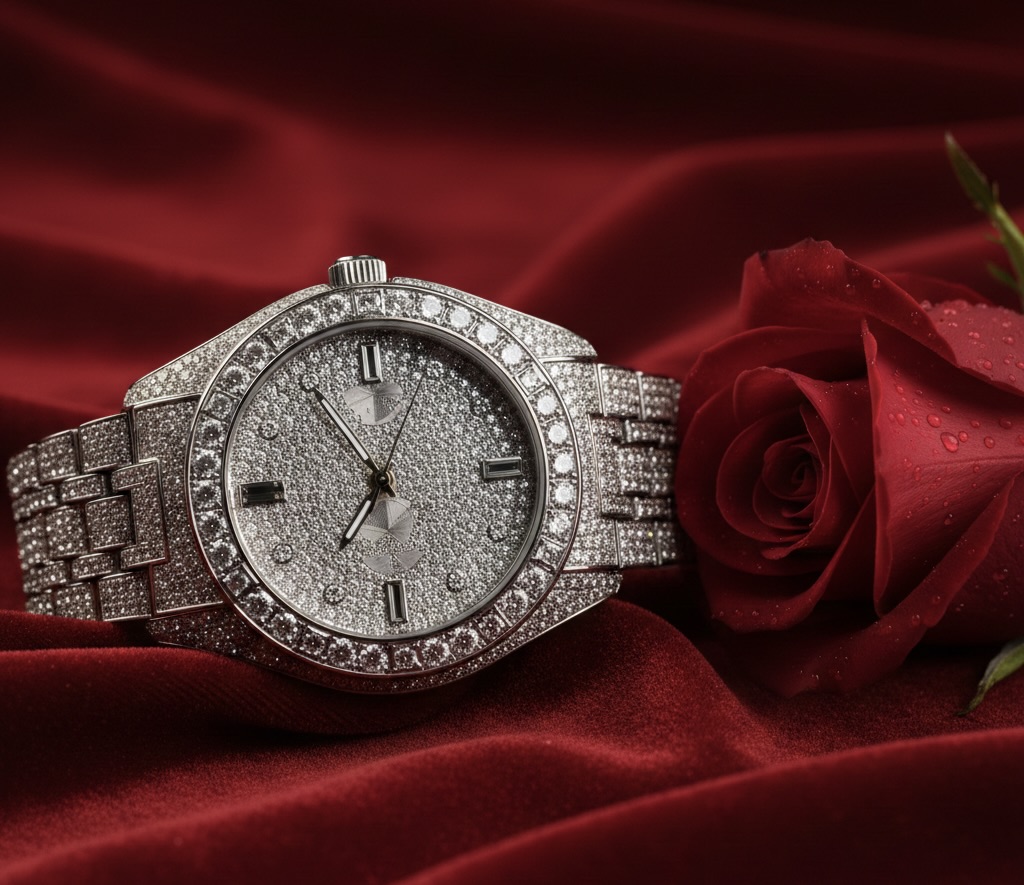
It is precisely at this time that I address the topic of watches known as "iced out," meaning heavily diamond-encrusted, sparkling like a Las Vegas concert stage, and visible from across the room. These watches often appear in sales groups, discussion forums, and countless watch listings online and offline.
The idea itself is not new, as jewelry has accompanied watches for decades, and jewelry watches themselves, not just for women, are an increasingly common part of most companies' portfolios, not only those associated with jewelry manufacturing. The problem, however, begins when someone takes a watch that was never meant to be jewelry and decides to make it so.
What "Adding Diamonds" Really Means
In the marketing space, it looks innocent. "Personalization." "Unique." "Individual design"—there are many more or less blunt terms for such modifications. Aftermarket is one of them. In reality, it means drilling into the case, lugs, bezel, sometimes even the dial. Removing material that was designed for specific stresses, tolerances, and water resistance parameters.
Factory models set with stones are created differently. The case is designed from scratch for stone setting. Wall thickness, mounting method, tolerances, spaces for appropriate seals, the behavior of the watch as a whole (case, movement, crystal, crown, etc.) during temperature changes, rapid cooling (e.g., during bathing)—all of this is foreseen, calculated, checked, and tested. Not to mention that the precious stones used to create such a watch are also selected for clarity, color, cut, and all necessary characteristics, so that the final effect is not only visually but also technically superior. In the case of modifications, we are interfering with a finished product, an interference that is not only structurally unprepared but often also materially or executively flawed.
And this is not a matter of taste, style, or finesse, but simply a matter of physics.
Weakened structure, micro-cracks, loss of water resistance. A diving watch can cease to be a diving watch. In practice, it often ceases to be a functional watch at all, becoming such a delicate object that it must be treated almost like porcelain. There can be numerous problems resulting from such modifications, and the aforementioned lack of water resistance is just one of them.
Warranty, or the Moment of Collision with Reality
The second stage is service. Top-tier brands do not discuss modifications made by third parties. Modification means loss of warranty and, in many cases, even refusal of service at an authorized center.
Sometimes, the manufacturer agrees to accept the watch on the condition that it is restored to its factory state. This means replacing the case, bezel, and dial. The cost of such an operation can be higher than the market value of the modified watch itself.
The romantic vision begins to crumble here somewhat.
The Most Expensive Element – Emotion
The most interesting part, however, begins when attempting to sell.
The secondary market is brutal and devoid of sentiment. Collectors look for originality and a condition as close to factory as possible. A modified piece is no longer treated as "collectible." It becomes a modified product, and the buyer looks for a bargain price, a discount for unauthorized interference, for a lack of appropriate quality, an unknown status of the stones used, potential problems, and future difficulties in resale. On many Facebook groups dedicated to a particular brand, the sale of such modifications is prohibited by the rules, considered something between a fake and a Frankenstein.
Here, a mechanism operates that can be called double depreciation. Firstly, the watch loses value as an original. Secondly, the cost of modification practically does not translate into the selling price. The jeweler's labor has no value, and, for example, diamonds are valued as raw material, not as a retail project.
As a result, someone can spend tens of thousands on a modification and recover only a small part of it. The difference between the amount invested and the amount recovered can be painful.
Why Does It Still Exist?
Because for some, a watch is not just a watch; for some, it's a time-measuring instrument and a piece of engineering history, and for others, an investment. For still others, it's a styling element and a status symbol.
In certain circles, subtlety is a flaw. Shine matters. Visibility. Immediate effect. In such a world, a watch must glow from afar and show that it was expensive. It must be a signal. And from this perspective, "iced out" fulfills its function.
The problem is that these orders are often mixed. Someone buys a watch as a supposed investment, and then modifies it in a way that has nothing to do with investment. It's a bit like buying a classic car with the intention of increasing its value, and then turning it into a tuning project. You can. But then you shouldn't be surprised that the classic car market reacts, to put it mildly, coldly.
Valentine's Advice, Without Pathos
If someone truly wants to give a watch with stones, there are two sensible paths.
First: buy a factory-set diamond watch. Such watches are designed as a whole and operate within a specific market logic.
Second: buy an already modified piece on the secondary market, much cheaper than the cost of its creation. In this case, the first owner paid for the emotions, and the next buyer gets the visual effect without a financial disaster in sight.
The most expensive option is to buy a healthy, original watch and subject it to drilling, because time can be merciless to illusions.