WoW Investigations
Two Faces of Venezianico
Venezianico is trying to do something most microbrands don't even start.
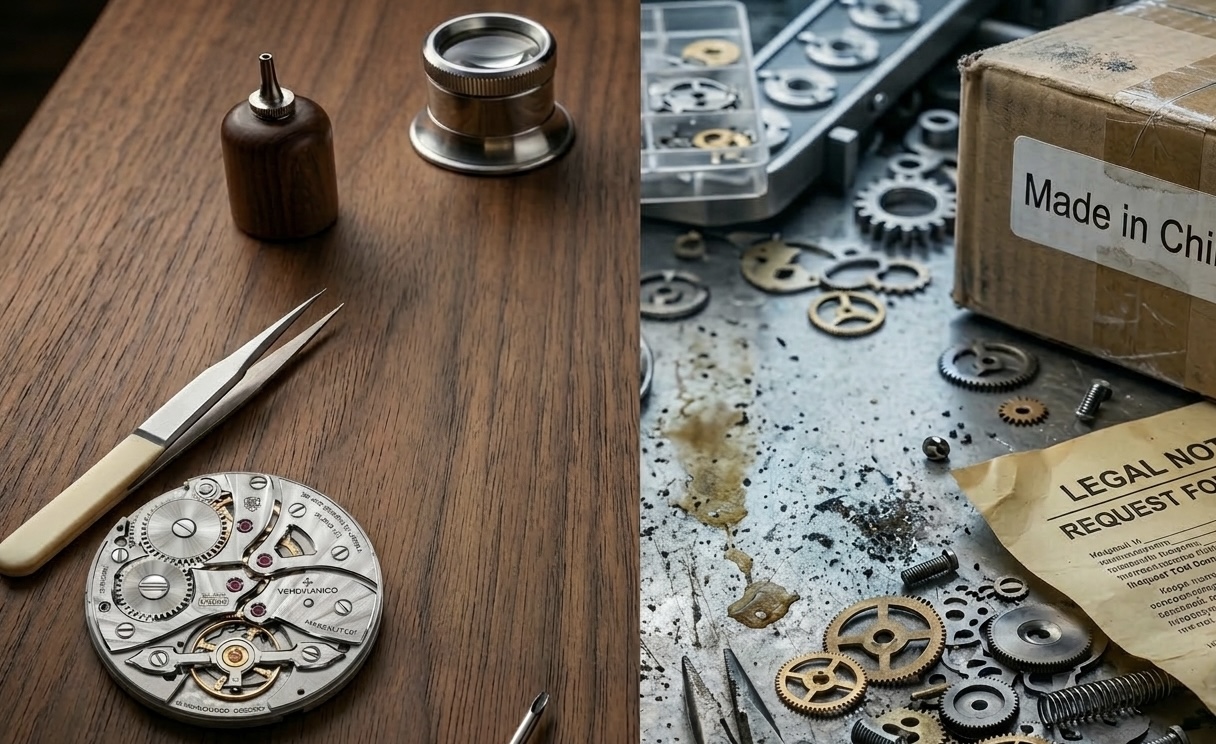
An Italian microbrand that first told us a beautiful story, then had to prove it
Today, there are two ways to build a watch brand. The first is old, slow, and expensive. First, the product is created, then the reputation, and finally, stories are built upon that foundation.
The second is contemporary, because let's face it, it's much easier to do it this way today, in a world of global orders, technology, excellent marketing opportunities, and social media. So, first, the story and everything that comes with it are created, and the product then has to catch up.
Venezianico is a textbook example of this second path, which started as Meccaniche Veneziane.
First, an image is created
At first, everything aligned. Beautiful Venice, wonderful architecture, and with it, materials, model names, and a cohesive aesthetic.
There was no accident here; this entire, very consciously built visual code was good and worked. So, among dozens of microbrands that assemble watches from a catalog of parts and try to sell them with the slogan "value for money," Venezianico did something more difficult from the start: it also sold context.
This worked because modern customers rarely buy just an object anymore; they desire meaning, atmosphere, and belonging. In this sense, Venezianico very quickly learned something that many manufacturers never understand: design sells, but the surrounding narrative sells faster.
But the whole problem arises when the product doesn't keep up.
The moment reality started to creak, overshadowing the ticking.
Early models, those from the Meccaniche Veneziane era, were exactly what the first products of well-told brands often are.
They were visually attractive and reasonably priced. And unfortunately, structurally… compromised.
The choice of Seiko NH35 or NH34 movements was logical. It provided reliability and cost control but imposed something that no marketing can hide: case thickness. And here, the first real problem with user perception emerged.
Watches that visually referenced classic, light elegance often turned out to be too bulky on the wrist. A thickness of 12–14 mm is not a drama in a diver, but in a watch aspiring to elegance, it starts to be.
The second and much more important level of the brand's problem is credibility
However, the next stage proved much more difficult, because with increasing sales and popularity, repetitive signals from users began to appear:
uneven quality control
problems with finishing details
weaker bracelets
assembly inaccuracies
in extreme reports: dirt or traces of carelessness inside the watches
These were not audit reports, but rather customer voices expressed online, in forums, and other information exchange platforms. But in the world of watches, it is precisely from these that reputation is built.
And on top of that, another element emerged, often more important than quality itself: the perception of authenticity.
People rightly asked how a brand so heavily reliant on "Italianness," craftsmanship, and architecture simultaneously uses a typical industry model of global sourcing, meaning components produced in Asia and assembled in a broader supply chain.
And again, this is nothing extraordinary, but when a customer starts to feel that the story and reality are not entirely congruent, they begin to feel cheated.
Kickstarter and the first test of trust
The biggest controversies arose during crowdfunding campaigns, when promises regarding specific movements clashed with the realities of availability and production changes. In some cases, customers received different solutions than they expected, and there were also delays and communication problems.
This is a moment that ends very similarly for many brands: rapid growth, immature processes, and ultimately, a loss of control over customer relations.
In the case of Venezianico, another, more disturbing thread emerged.
Narrative control
Reports began circulating in the community from some creators and reviewers who claimed to have experienced pressure from the brand regarding the publication of negative reviews, and this pressure was extremely strong, ranging from requests to remove materials to legal communications.
These are not widely documented cases that ended in court proceedings, but they are recurring signals.
Fighting with lawsuits as an attempt to create control over one's PR? Seriously, in the 21st century?
Rebranding, is it a name change or a stage change?
In 2022, Meccaniche Veneziane disappears, and Venezianico appears in its place.
The official justification is a rational blah, blah, blah: a simpler name, better international communication, and a new stage of development. Every corporation talks like that to people.
But in the context of previous events, this rebranding takes on additional meaning, and I perceive it not just as an "escape" but rather as a system reset.
In practice, such decisions rarely have a single reason.
It's usually simultaneously:
streamlining communication
preparing for higher positioning
and closing a difficult stage
The moment the product starts to speak with its own authentic voice
The most important question today is no longer whether the brand had problems, because we know it did and we know what they were.
What's important to me is what it did next, and next comes the V5000.
This is no longer just some marketing declaration of "we have our own movement," but a concrete answer to previous limitations, problems, and expectations.
The caliber was created in collaboration with the Swiss company OISA, a renowned specialist in movement design and industrialization. This is not a classic "in-house" in the sense of historical manufactures. But it's also not an off-the-shelf movement from a catalog.
It's an intermediate model, increasingly common in the modern industry, meaning a movement designed for the brand with the support of external technological facilities.
But we have a very nice movement that is 3.5 mm thick, so suddenly the problem that was previously systemic, disappears.
The Redentore Utopia has a 38 mm diameter, 8.9 mm thickness, and for the first time, it offers something that was previously missing: proportions that align with the narrative.
The initial market experiences with the new movement are particularly important here, as any fully proprietary caliber introduced to the market naturally raises concerns about "teething problems" and real serviceability in the long run. In the case of the V5000 / V5001, at least at the current stage, there are no signals of systemic design issues. Owners of the first examples indicate stable adherence to the declared accuracy of ±3 seconds per day and very good, repeatable performance of the movement in daily use.
Also significant is the operational model adopted by the brand, where final regulation and calibration take place exclusively in-house, under the direct supervision of an experienced watchmaker. This approach limits scale but simultaneously significantly reduces the quality risk typical for the first series of new movements.
At this stage, therefore, we can speak of a successful debut of the construction, although as always with new calibers, the ultimate verification will only come with the passage of time and the first full service cycles.
Is this credibility yet?
Perhaps not fully, but this is the first moment where it can be said that the product is starting to catch up with the narrative, and that is crucial for such brands.
Because up to a certain point, the customer buys the story, but sooner or later, they start buying consistency.
What the Venezianico case truly tells us
This is not a story about a good or bad brand, but an interesting case study of how watch brands are created today.
First, we have:
rapid desire building
strong aesthetics
effective marketing
direct sales
Then:
operational problems
disrupted customer relations
questions about quality and authenticity
And finally:
an attempt to organize everything
raising the product level
and rebuilding credibility
The fairest summary
Venezianico is neither a great breakthrough nor an empty shell; it is a brand that has mastered the art of telling its story and had to learn something more difficult: how to make the product truly worthy of that story.
And this is a process that is still ongoing and worth observing.
I myself have sympathetic feelings towards the brand; I like Venice, I like its atmosphere and references to the city's heritage, and I really like Venezianico's designs. I'm waiting for models in a 36mm case based on the new movement, which I also like. So I'm rooting for them and sincerely wish that this difficult initial period never repeats itself.