WoW Investigations
Time is Money, or the Coin Watch
Watches made from real coins are exciting, dangerous, and incredibly delicate.
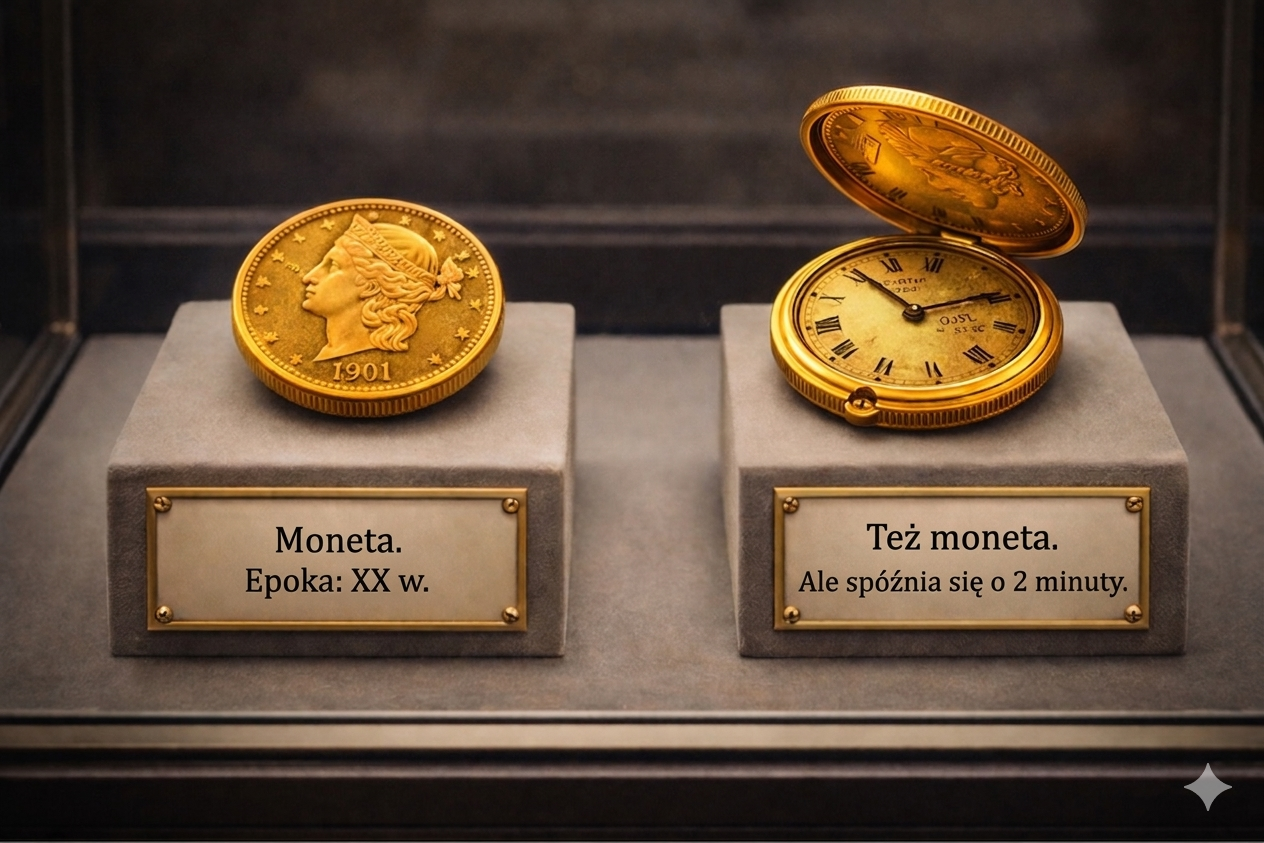
THE COIN WATCH: HOW TO ENCLOSE TIME IN MONEY
There's a moment at every auction when a particular lot silences the room for a moment. Not because the price is high, but because someone asks: wait, is that a watch or a coin?
The answer is: both. And that's exactly what we're discussing in this article.
A coin watch is one of those objects that defies simple classification. It's not jewelry in the classic sense, it's not a pure time-measuring instrument, nor is it a numismatic item, although it starts as a coin and ends as a coin, at least externally. Between these two states, someone spent weeks at the workbench, doing things that, from a coin collector's perspective, border on vandalism, and from a watchmaker's perspective, are the pinnacle of craftsmanship.
Often, it's not just one coin, but two, as one becomes the case, and the other provides the obverse or reverse from which a perfectly fitted lid is crafted. The greatest artistry lies not only in hollowing out the interior but in separating and rejoining the surfaces so precisely that, once closed, the cutting line is practically invisible.
Attempts to combine a watch with a coin appeared earlier, in the 19th century, but it was only the era of ultra-thin calibers after World War II that made the coin watch more than a curiosity or a jeweler's whim.
It started with thickness
To understand why coin watches exist at all, one must go back to the 1950s and one specific problem: how to fit a functioning mechanical movement into a space that is 2 millimeters thick.
A twenty-dollar gold coin, the famous Double Eagle, is about 2.4 millimeters thick. This is the entire challenge, and the movement, dial, hands, crystal, hinge, and locking system must fit into what remains after hollowing out the coin's interior.
In 1957, Piaget introduced the caliber 9P, exactly 2 millimeters thick. 89 parts and a 36-hour power reserve. This was the moment when coin watches ceased to be a concept and became a product. Three years later, the 12P appeared, now automatic, with a 24-karat gold micro-rotor, 2.3 millimeters thick. Vacheron Constantin went even further, presenting the caliber 1003, 1.64 millimeters thick, still one of the thinnest mass-produced movements in the world.
To be clear about what this means in practice: a human hair is about 70 micrometers thick. The difference between the Piaget caliber and the Vacheron Constantin caliber is 360 micrometers, or less than five hairs. At this level of precision, traditional assembly methods cease to work, lubricants are too viscous, and the mainspring barrel must be supported only from one side because there is no room for another bridge on the other.
Two paths: hide or display
Once you have a movement that fits inside a coin, the question arises: what will you do with it?
In practice, coin watches developed in two directions: as a secret watch that pretends to be a coin, and as a coin watch that doesn't hide the coin but rather displays it.
Patek Philippe answered: you will hide it completely. The series of references 800–809, produced from the 1950s to the 1980s, are watches that look like coins from the outside. No traces of intervention, no crown protruding from the side, no crystal. Only pressing a hidden button on the milled edge opens the lid and reveals the dial. It is estimated that a total of about 200 examples of all coin references were created over seven decades.
Corum answered differently: it will be so intriguing that you will show it. The 1964 Coin Watch model did not have a hinged lid, and the movement sat in a hollowed-out Double Eagle; the dial was visible, and the watch functioned as a watch. Less secret but more utilitarian. And as it turned out, more American.
The Corum Coin Watch was associated with the American political and business establishment, and examples of this line also appeared on the wrists of several US presidents, from Lyndon Johnson to George H.W. Bush. The Double Eagle coin symbolized the former power of the dollar, from the days of the gold standard, and the Swiss movement inside added European sophistication to this symbol. It was a watch that was perfectly suited as a diplomatic gift, combining the symbol of statehood, gold, and precision.
Although the American Double Eagle dominated the imagination, brands also used other coins, from Mexican 50 pesos to Swiss 100 francs.
A legal issue everyone ignores
There is one aspect of coin watches that is rarely discussed directly, and which is particularly interesting in the American context.
18 U.S. Code § 331 prohibits the alteration of circulating coins; it is a felony and carries a specific penalty.
Fortunately for the watch manufacturers, who are acting in good faith, the key word "fraudulent" also appears there, which is an important distinction.
Altering a coin into a watch is not intended to imitate legal tender, but to create a luxury item. In practice, brands used coins withdrawn from circulation or treated as a carrier of bullion value, not real currency. Formally, the issue touched upon a violation of the law, but practically, this threat was successfully averted.
What's happening with prices
The coin watch market is too small to describe with a separate index. In practice, its prices depend on four things: the brand, the coin used, the condition, and the originality of the construction.
Therefore, a Patek Philippe coin watch today functions more as a hybrid of a rare Patek and a collectible object than as a regular vintage model, while Corum remains relatively accessible.
Reference 802 in good condition fetches around 30–50 thousand dollars at auction, but everything also depends on time and circumstances.
Ref. 803 with an 1895 coin was auctioned in Hong Kong in 2025 for 217,600 HKD, which is about 24,000 euros, while, for example, a Piaget with a Mexican Centenario 50 pesos is around 3–5 thousand euros for an example in decent condition.
Vintage Corum from before the 1990s is a few thousand euros, which, for a watch that can be mistaken for a coin, is a surprisingly affordable level.
A Rolex Coin is around 20,000 euros.
This is not a watch for everyone
And it's not about the price.
A coin watch requires significantly more discipline than most modern watches. It does not forgive moisture, neglected service, or casual handling.
It has no water resistance. Literally none. The hinge and opening lid prevent a hermetic seal, so sweat, rain, and high humidity are its enemies. Movements require service every 3–5 years, and there are far too few specialists in the world who can disassemble a caliber 9P without damage. Servicing it in a random place is a direct path to lowering its collectible value or even irreversible damage.
Quartz models from the 1980s and 1990s have an additional problem: a depleted battery, whose electrolyte in such a confined space can quickly and irreversibly destroy the dial and movement.
In conclusion
The coin watch is a product of a very specific moment in history, when mechanical calibers reached their minimal possible thickness, gold was still a carrier of political symbolism, and watchmaking craftsmanship was treated as an answer to the question: how far can one go in miniaturization before something stops working.
And it turned out, very far.
The fact that these watches still function and also achieve sensible prices at auctions, and despite all odds, there are people willing to own and even wear them, proves that it was an endeavor with long-term meaning.