WoW Investigations
The watch the president couldn't afford.
In 1975, the Pulsar Calculator Watch was more expensive than a gold Rolex.
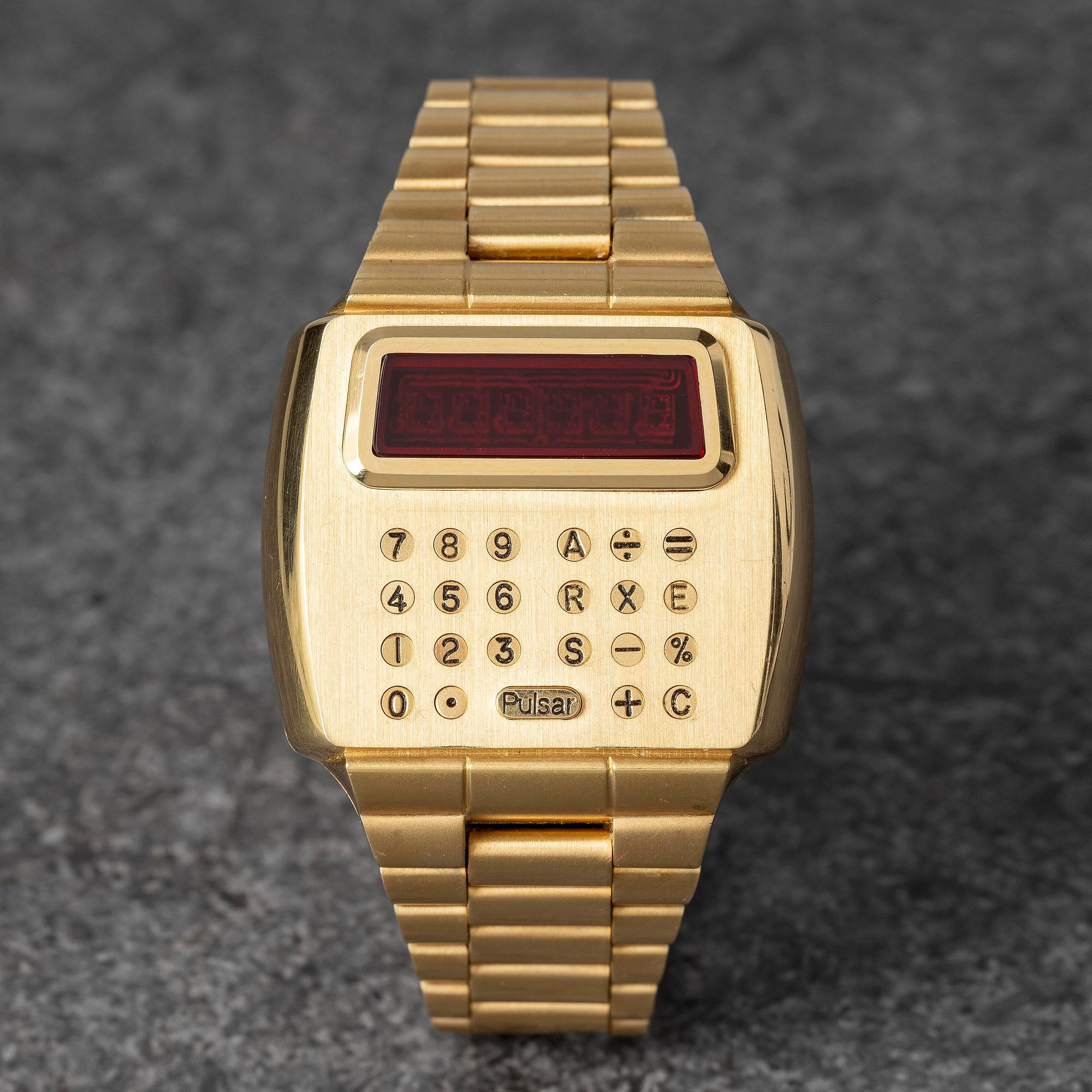
Pulsar Calculator Watch (1975):
In 1975, the most coveted watch in the USA was neither a Patek Philippe nor a Rolex, but an electronic calculator with a blood-red LED display.
Today, one could say it was the first luxury smartwatch in history, costing more than a gold Rolex and becoming an object of desire for many — including President Ford.
More Expensive Than a Legend
When the 18-karat gold version of the Pulsar Calculator Watch debuted on the market, its price was staggering: $3,950.
To fully grasp the absurdity, consider the prices of the time:
- Stainless steel Rolex Submariner: approx. $230 (if only one could turn back time...)
- Gold Rolex Submariner: approx. $2,000
The Pulsar was, remarkably, nearly twice as expensive as a gold Rolex. In today's terms, we're talking about the price of a car for some strange watch-like device that could only add, subtract, and glow red.
Hamilton's Strategy: Selling the Future, Not the Function
Behind the project was Hamilton Watch Company (operating under the Time Computer Inc. brand). The company made a brilliant marketing move — instead of electronics stores, the Pulsar landed in the most exclusive boutiques, with Tiffany & Co. at the forefront.
The advertising slogan was as audacious as it was effective: "For the man who has everything… until now."
Hamilton wasn't selling a tool for counting expenses or taxes. They were selling status at a time when no one yet used that term so freely. It was a pure promise of the future — in every sense — on your wrist.
The White House Affair
The Pulsar's prestige skyrocketed thanks to… Gerald Ford. In December 1975, the media reported that the US President wanted a gold Pulsar for Christmas. But then First Lady Betty Ford publicly declared the price "absurd" — with the emphasis squarely on the absurdity.
That refusal did more for the brand than a million-dollar ad campaign. If even the most powerful man in the USA had to think twice about buying one, the Pulsar must have become the "ultimate" symbol of luxury.
A Technological Beast (With a Stylus Included)
From today's perspective, the Pulsar was hopelessly impractical. Its buttons were so tiny they required a special stylus (included in the set), and its 15mm thickness meant it barely fit under a shirt cuff.
Energy efficiency? What does that even mean? Its LED display drained the battery so fast that the time only appeared when you pressed a button.
Yet it was something like a personal computer — ten years before the IBM PC. Its timekeeping accuracy of ±3 seconds per month was extraordinary for the era.
The Trap of Progress
The Pulsar's luxury was built on the exclusivity of technology — and technology has one flaw: it always gets cheaper. In 1977, Texas Instruments flooded the market with cheap LED chips. The price of the technology dropped dramatically, and with it, the Pulsar's aura of uniqueness. The era of "golden calculators" ended as quickly as it began, because luxury cannot tolerate mass production.
Apple Watch Edition: A Repeat Performance?
In 2015, Apple attempted to replicate this formula with the Edition model priced at $10,000–$17,000. The mechanism was the same: gold, fashion boutiques, aspirational marketing.
The difference is that Apple treated it as a one-time image experiment. They knew what Hamilton had to learn the hard way: electronics age faster than the gold encasing them.
Why This Is a Lesson for Us
The Pulsar story proves that luxury in watchmaking doesn't always stem from hundreds of gears and springs — it often, as I frequently emphasize, stems from narrative.
In 1975, the most coveted watch for a moment wasn't a mechanical masterpiece, but a silicon chip in a gold case. A reminder that the value of an object rarely lies in its function — it most often lies in what that object says about its owner.