WoW Investigations
The key turns a second time
WoW Reflection on Corum 2026. A reactivation that prefers to call itself continuity.
Grand Entrance
In May 2025, the Corum brand returned to Swiss hands. The buyout from Citychamp Watch & Jewellery Group, led by Haso Mehmedovic and a group of luxury sector investors, closed a twelve-year and, in my opinion, inglorious chapter of degradation for the brand under Chinese ownership, from the perspective of customers and collectors.
Less than a year later, in April 2026, Corum made a strong debut at Watches and Wonders Geneva.
For the first time in its history, with a collection of nineteen references and a production plan of "only" one and a half thousand pieces per year for now. And with a narrative that consistently avoids the word "return."
"It would be easy to say that Corum has returned, but that wouldn't be true, as Corum has been here continuously since 1955," Mehmedovic repeats in every interview. The statement is precise but also telling. It builds the foundation of the strategy called ReLoaded, which is not about starting something new, but about changing direction. This is an important rhetorical difference because reactivation implies a break. Continuity implies that nothing happened, only years passed under management that the new owners prefer to quickly forget.
In this text, we will examine three layers of this project. The product, meaning what actually made it into the 2026 catalog. The business, meaning how Mehmedovic is restructuring a brand that, over the last decade, has significantly lost customers, volume, and prestige, effectively squandering its achievements and history. And the criticism, meaning the differences between declarations and the operational reality of a company currently employing a dozen people in a headquarters designed for ten times that number.
Part One: Product
The 2026 collection is very sensibly organized around three pillars that anyone familiar with the brand's history would name if woken up at four in the morning.
So, we have three lines – Admiral, Golden Bridge, and Heritage.
Phew! The gaudy Bubble is not returning, and inventions like the absurdly large Tide, which were caricatures of the Admiral, or attempts to imitate Richard Mille for the less affluent, like the LABs, have also been relegated to the "Misconceived Ideas" folder.
Out of approximately two hundred and fifty items in the last Citychamp catalog, fortunately, a sufficient nineteen references remain, so we are looking at a reduction of over ninety percent. A completely justified reduction, we might add.
A decision of this scale leaves no room for ambivalence. Mehmedovic rightly chose the brand's icons that the haute horlogerie collector's market recognizes, at the expense of those that perhaps were intended to sell in Galeries Lafayette. But they didn't sell.
Admiral
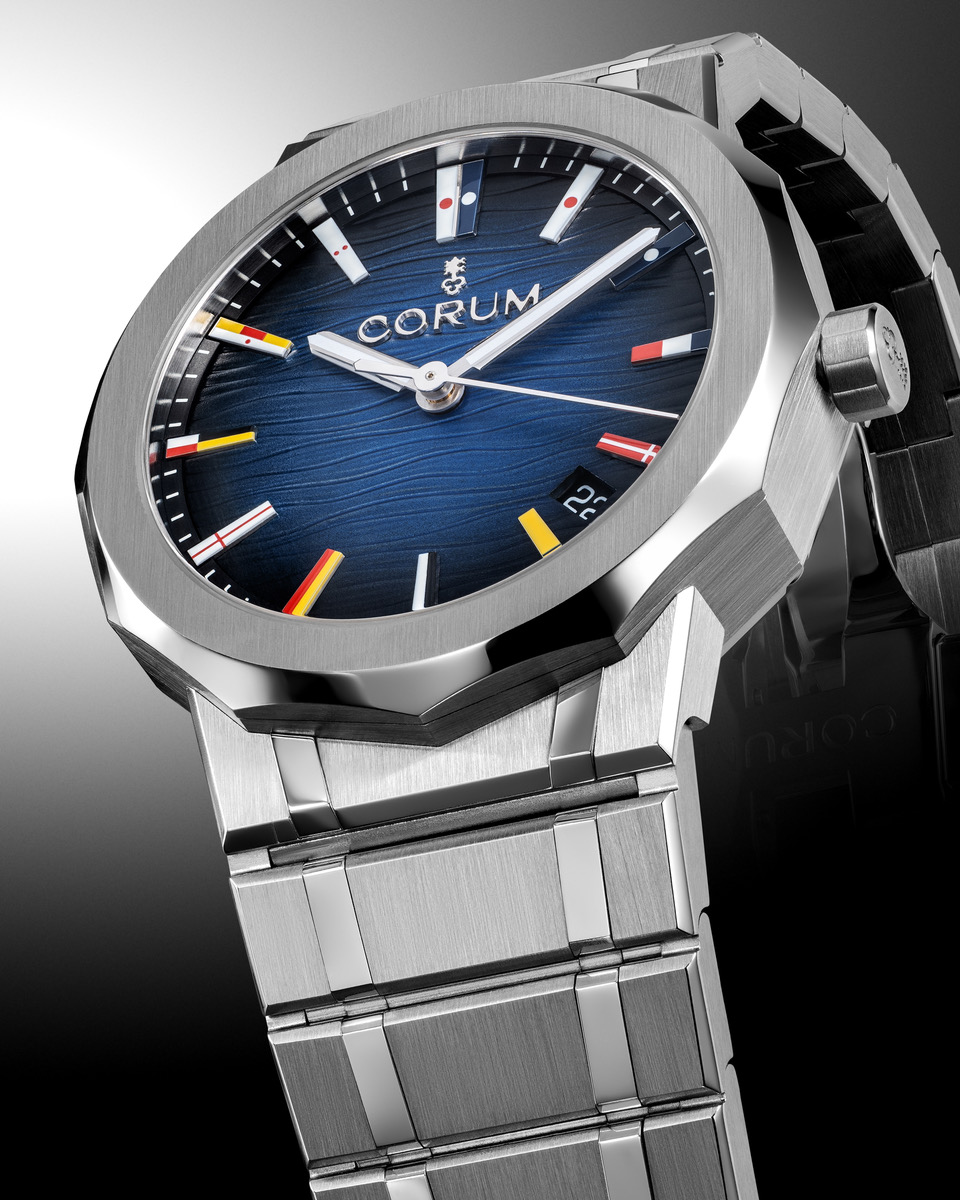
The line consists of eleven models in two very well-chosen sizes: thirty-six and thirty-nine millimeters. The thickness, or rather slimness, is 8.90 mm in both variants. The dodecagonal bezel is retained, but for the first time in the collection's history, the bracelet is fully integrated with the case, without traditional lugs. The change is structural, not cosmetic. The bracelet has five links, with the central link satin-finished, two inner links vertically polished, and two outer links satin-finished, plus a quick-release strap system without tools.
Trapezoidal indices, referencing maritime signal pennants from the IMS code. Sail-shaped hands. On the dials of the larger version, the pennants come in two variants: colored, consistent with the classic flag code from the 1980s, or monochromatic for the buyer who doesn't want to wear a maritime alphabet on their wrist. Water resistance is unfortunately only fifty meters.
Prices are a certain drawback, starting from 10,900 CHF for a steel model with a gradient blue dial, going up to 33,000 CHF for a rose gold piece on a rubber strap, and ending at 49,500 CHF for the titanium, skeletonized version with baguette diamonds, fully loaded.
The smaller version has five references in a similar price range, with options like diamonds on the bezel and mother-of-pearl dials, but without the most expensive version like its larger sibling.
In summary, I believe that from the perspective of appearance, movements, and the new bracelet, the whole line turned out excellently. On one hand, we have a beautiful reinterpretation of an icon with improvements that only added to its elegance; on the other hand, both better proportions of size and thickness, and much more practical details. If I had to nitpick, it should have 100 meters of water resistance and be slightly cheaper.
I will discuss the movements in a dedicated section, as they definitely deserve a separate paragraph.
Golden Bridge
The Golden Bridge is, on the one hand, a nearly half-century-old construction, and on the other, it still looks more radical and interesting than most "modern" industry releases. Therefore, the decision to leave the architecture created by Vincent Calabrese practically unchanged seems to be one of the smartest things Corum has done in years. There are movements that can be modernized. And there are those that are best left untouched. The Golden Bridge definitely belongs to the latter category.
A novelty is the Golden Bridge Sapphire Classic, with a tonneau case made entirely of transparent sapphire and with manual winding. The price range is from 22,000 to 50,600 CHF.
Heritage
The Coin received a sensible thirty-six-millimeter 18K yellow gold case and a dial made from an authentic fifty-dollar American Gold Eagle coin. Previous generations used the twenty-dollar Double Eagle.
This is a seemingly cosmetic change, but in practice, significant. The Coin watch was never just an ordinary watch, but rather an object balancing between numismatics, jewelry, and a demonstration of status. A larger denomination and a greater physical presence of the coin fit well with the attempt to restore Corum's position. The model's price is 49,000 CHF.
More about the phenomenon of coin watches can be found in the "Under the Loupe of WoW" section, although it's worth remembering that Corum wrote one of the most important chapters of this history.
The second model is the Heritage Golden Bridge Book, a reinterpretation of the 1996 design in the form of a miniature book. Inside, a manual caliber CO 157 operates, while under the opening cover, an engraved Hemingway quote about not thinking about things one doesn't possess is placed. This is one of those watches that are difficult to evaluate solely by technical categories. It resembles a small mechanical manifesto more than a classic luxury product. The price is 28,000 CHF.
Movements
The new Admiral line is powered by calibers CO231 and CO232, developed for Corum by Concepto Watch Factory. Seventy-two hours of power reserve, balance wheel at the twelve o'clock position, a tungsten rotor with the beautifully exposed key, which is the symbol of the CORUM brand. Satin-polished finish. In short, beauty in every detail, and fortunately, Corum's communication describes these movements as developed for the brand, meaning they do not mislead by calling them "in-house." Bravo for that.
The other calibers in the catalog, CO 113 in the Golden Bridge, CO 082 in the Heritage Coin, CO 157 in the Golden Book, are continuations from the previous period.
A final note is that all prices are net, which is a very significant difference compared to what one would pay, for example, in a European brand boutique outside Switzerland.
Part Two: Business
The ReLoaded strategy boils down to three parallel operations. Cutting the catalog by over ninety percent. Cutting the distribution network from approximately three hundred points to about seventy. Cutting the team to about fifteen people. All three moves are heading in one direction: a shift towards a boutique model, where a deficit of scale is to be transformed into a clearly perceived rarity.
The pricing has been significantly raised, and as I wrote earlier, I perceive this as a negative.
The starting price of the Admiral at 10,900 CHF positions the brand above Tudor, Oris, Longines, Frederique Constant, and Baume & Mercier, in direct competition with Chopard L.U.C, Zenith Defy Skyline, and the lower end of IWC or Rolex.
In the upper segment of the collection, at 33,000 CHF for a gold Admiral and 49,000 CHF for the Heritage Coin, Corum enters an area where the competition is named Vacheron Constantin, or the heavily armored Cartier Privé, as well as independents like Laurent Ferrier and Czapek. The break from the discount positioning of the Citychamp era is clear and consistent, the question is whether it will be well received by customers?
The three priority markets are the United States, Japan, and the Persian Gulf countries. Europe and China are relegated to the second tier.
What is quite clear is the lack of own boutiques and the lack of a direct-to-consumer sales strategy. There are also no officially announced ambassadors, and all communication is based solely on the CEO's persona and, in the background, a collective of artisans from La Chaux-de-Fonds. So, from a business perspective, it's clear they are retaining the entire margin, saving on advertising, PR, and other costly segments that are essential elements of other, competing brands.
New for 2026 is a digital certificate of authenticity on the blockchain with a biometric guarantee, an addition that clearly signals an attempt to introduce the brand into the technological language segment for significantly younger luxury buyers.
Initial industry reactions are cautiously positive.
Monochrome, in Xavier Markl's hands-on, wrote: "A venerable name returns to the scene with a more premium product strategy. We don't expect a revolution, but the new management has focused on a series of sensible strategic decisions."
Watchonista gives a clear critical voice to the Citychamp period and a favorable one to the new direction.
Watch Advice from Australia was the most enthusiastic, pointing to the titanium skeleton as a "favorite."
Fratello signaled a certain generational disconnect, as younger editorial members didn't quite understand why their slightly older colleagues were so excited.
The lack of hands-on reviews from Hodinkee, Watches by SJX, Worn & Wound, and Quill & Pad signals that in the premium watch press segment, which defines the standards for interpreting novelties, Corum 2026 did not generate the resonance expected for a project dubbed "the return of an icon."
There's also a lack of significant threads on Reddit r/Watches and WatchUseek. The hobbyist community remained strangely silent in the first weeks after the launch. This could be the result of a conscious positioning of the brand outside the enthusiast circuit, or it could simply be the effect of indifference. It's hard to distinguish at the moment.
Morgan Stanley and LuxeConsult, in their ninth annual report on the Top 50 Swiss brands published in February 2026, did not list Corum. The entry threshold for the ranking is approximately fifty million Swiss francs in annual revenue. Corum does not meet this threshold.
The reactivation, in terms of scale, is realistically absent from the main industry reports of the first half-year after the launch.
Part Three: Criticism
Here begins the part where the narrative and operation start to diverge slightly. In Corum ReLoaded's communication, there are at least four contradictions that the new management has not resolved, only rhetorically bypassed.
The "in-house" paradox
Mehmedovic declares a return to "one hundred percent in-house movements" and "full watchmaking autonomy." At the same time, calibers CO231 and CO232, the only new constructions in the 2026 collection, were developed jointly with Concepto Watch Factory under the direction of Valérien Jaquet. Concepto produces movements for many brands; it is an external supplier and an independent industrial entity. While the construction is exclusive to Corum, the architecture, design, and production are not. This is a non-trivial difference when we hear about a "manufacture."
In Mehmedovic's defense, it must be added that almost the entire Swiss mid-range watch market uses the same formula, and the line between "in-house" and "exclusive caliber" has been blurring significantly for two decades. But this does not change the fact that Corum's rhetoric suggests a manufacturing autonomy that the brand does not possess.
The long-term plan assumes gradual in-house movement production, but no timeline has been publicly communicated. In a few years, we will see whether the promise remains at a marketing level or moves to the execution stage.
The scale paradox
Corum's headquarters in La Chaux-de-Fonds, a glass building on Avenue du Technicum, was designed for approximately one hundred and fifty employees. It currently employs a dozen, but it is not a manufacture in the traditional sense.
It is a design and sales office with a prototyping laboratory. Declarations about a "great haute horlogerie brand" stand in stark disproportion to the actual staffing base.
Global positioning with such a small staff is only managed when some functions are outsourced. PR and narrative strategy are handled by Marine Lemonnier-Brennan and the agency 289 Consulting. The Admiral's design came from Emmanuel Gueit, former head of design at Audemars Piguet. The movements are from Concepto, and the dials from the neighboring Montremo manufacture.
Corum in 2026 is, for now, a network, not a company. An efficiently managed network of contractual specialists tied together by branding and an address in La Chaux-de-Fonds.
This is a legal and market-effective model, as many recognized independent brands operate in exactly the same way. The question is not whether it works, but whether the public buying a 33,000 CHF watch understands that they are buying a product assembled from components supplied by a network of subcontractors under one brand. In Corum's communication, this is not presented directly, and I fully understand why.
The "audacity" paradox
The word "audacity" appears very frequently in the brand's communication. Corum positions itself as "audacious," "rebellious," and "defying trends." Meanwhile, the new Admiral, though refined by Gueit, is aesthetically very safe and deeply rooted historically.
The integrated bracelet in a steel luxury case is the most numerous category of new products on the market in the last five years. Royal Oak, Nautilus, Alpine Eagle, Laureato, Polo S, Ingenieur, Czapek Antarctique – the list is long. The Admiral 2026 fits into this trend with only a slight accent of the dodecagonal bezel, and this accent is real and sufficient for the design to be recognized as Corum, but it is not "audacious" in the market sense. It is a well-executed response to a trend, strongly rooted in the brand's real history.
The real audacity in the 2026 collection lies where it is not present in the communication, namely in the decision to discontinue, for example, the Bubble line. The Bubble was a model that defined Corum in the 2000s, had cult status in the pop collector segment, and is still present on the secondary market, but its omission in the new catalog is a cool and calculated move. The Bubble does not fit the haute horlogerie narrative. It is too playful, too pop-art, and too obvious. Mehmedovic phased out this model, and that is a real strategic decision, but in the brand's communication, it does not function as an act of audacity, but as an absence. The Bubble is simply not mentioned.
The independence paradox
"Independence" is one of the most frequently repeated words. The brand is "independent of groups." Management is "independent of volume pressure." The strategy is "independent of trends." Meanwhile, the ownership structure, apart from Mehmedovic, has not been disclosed.
"A group of Swiss investors from the luxury and finance sector" is a formula that says nothing. In luxury, the investment horizon is usually five to seven years, after which an exit occurs. Do Corum's current partners have a ten-year, twenty-year horizon, or are they waiting for the brand to regain profitability to resell it? No one knows, and this question is not asked in interviews.
This is not to suggest bad faith. It is about the fact that "independence" in the current phase of the project is a declaration, not an operational fact. The buyout from Citychamp is a fact. The Swiss address and the group of investors are facts. The durability of this configuration will be decided over a period of several years, not in the launch year.
What does this imply?
The reactivation of Corum is a project with a very narrow margin for error. The decisions Mehmedovic has made are mostly sensible. The catalog reduction was inevitable, and the price increase was necessary if the brand was to escape this discount spiral. The choice of Admiral and Golden Bridge as identity carriers is rational, as these are two globally recognizable models. The collaboration with Gueit is a professional move, and the appearance at Watches and Wonders provided the exposure the brand desperately needed.
What Corum ReLoaded has managed to achieve in its initial period is to rebuild credibility with some of the industry press, introduce a structurally clear and competently executed product, and position the brand in a price segment where competition demands quality but not volume.
What it failed to achieve, in my opinion, is to generate broad resonance in the premium segment of the industry press, to be included in major reports, or to build a real discussion among hobbyists.
There are three real questions about the future of the project. The first is whether an annual production of one and a half thousand pieces with a catalog at these prices will generate sufficient cash flow to maintain distribution partners and the team in La Chaux-de-Fonds.
The second is whether the promise of gradual in-house movement production will be kept or remain at a marketing level.
The third and perhaps most important is whether investors will endure the horizon required for brand rebuilding at this level. Five years is a minimum, and seven is a more realistic scale.
In my opinion, ten years is the horizon within which it will be possible to assess whether ReLoaded was indeed a strategy of continuity or a transitional stage before another sale.
Mehmedovic, in an interview for Europa Star, used a phrase that remains the most accurate description of the situation: "The key is turning for the second time."
The key, meaning Corum's logo since 1955. The second time, meaning after a decade under Chinese ownership. The phrasing is precise but does not say that the key is starting something new; it merely states that it is turning in the same lock. Whether the lock will open for longer this time, we will see not in 2026, but in 2030.
The collection is well-designed, and the strategy is coherent. Communication is well-disciplined, and everything currently happening is at the level of declarations and initial references. The test will come when these first references start returning to the secondary market. Then we will see how the market values Corum without the aura of reactivation. Then we will see if the key truly opened a new chapter or merely turned again.
This is also enough to consider 2026 an important year for the brand. Whether it's enough for Corum to return to Morgan Stanley's Top 50 is another matter.
I sincerely root for the brand, both because of its history, its current collection, and the CEO's courage.
All images courtesy of Corum.