WoW Investigations
The Illusion of Simplicity
Such an inconspicuous spiral in a watch, yet so important, how much it costs, and why so few companies can produce it.
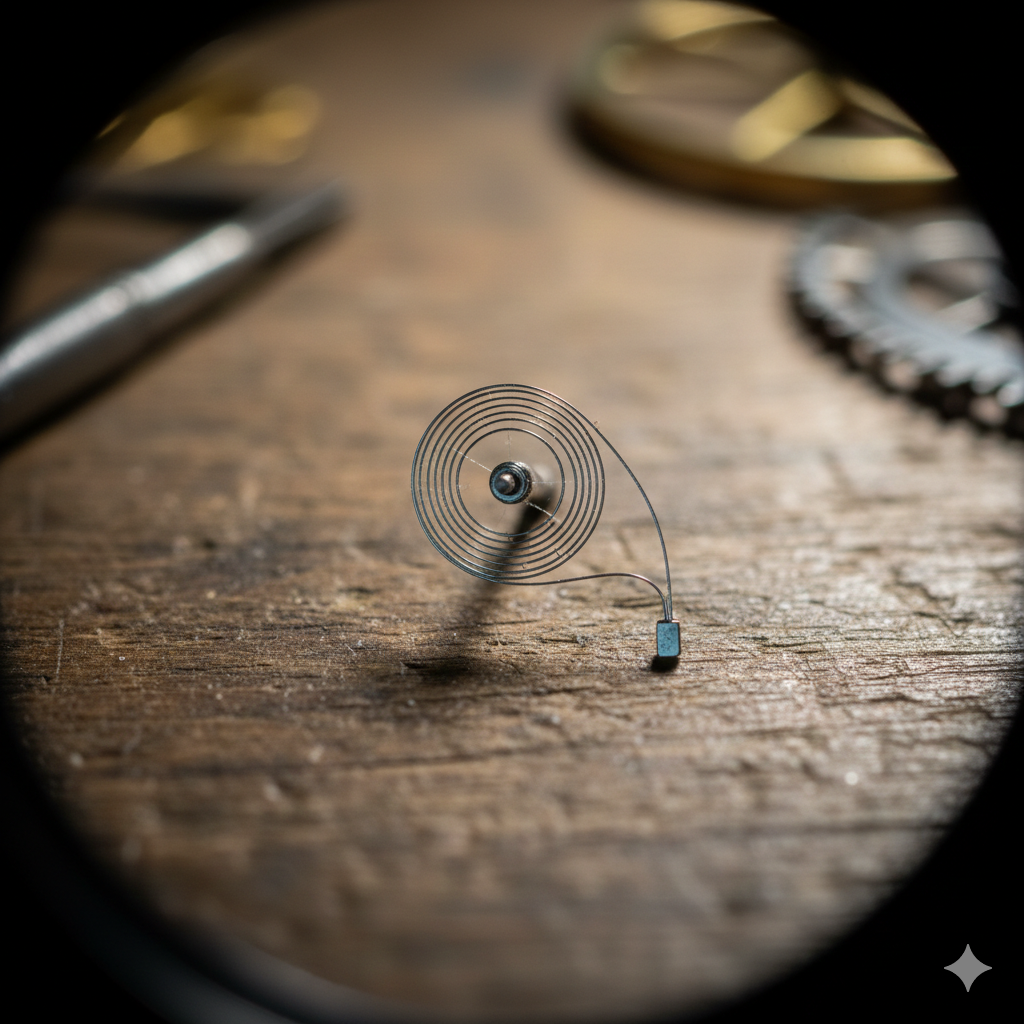
Why is the hairspring the most difficult element in watchmaking?
In a mechanical watch, everything seems logical. The mainspring, previously wound by the crown, drives the hour and minute gears, and the hands move. It's a system that can be drawn on a piece of paper and understood in a few minutes.
Of course, there are more parts, and also visual elements of the movement, beautiful bridges, half-bridges, blued screws, or ruby jewels set in the plates, all visible through a sapphire case back in a beautiful case.
Yet, the proper functioning of this entire structure is determined by a barely visible element that looks like a wire cut from a pen, coiled into a spiral. Nothing spectacular, just some little spring in the background.
The hairspring, also called the balance spring or spiral.
The most inconspicuous part of a watch, yet the most important and at the same time the most difficult to manufacture. So difficult that only a dozen companies in the world can make it.
1. Micrometers that weigh more than gold
The hairspring has a thickness measured in microns of metal strips. A difference of 0.1 micron, or one ten-thousandth of a millimeter, can generate a several-minute error in the watch's daily rate. A poorly made hairspring and the watch runs 5 minutes slow or fast per day. This is a tragedy, and no one would accept such a watch, not even for the price of a few sticks of butter.
A change in hairspring thickness of one thousandth of a millimeter is... 30 minutes a day!
Therefore, the hairspring cannot be "almost good."
It must be mathematically identical to the design.
This requires:
• controlled temperature and humidity,
• proprietary rolling mills and wire drawing machines,
• heat treatment with laboratory-level repeatability,
• selection and pairing with the balance in several categories.
And this cannot be bought in a machine shop; it has to be built.
2. A monopoly that defined the industry
After the quartz crisis, knowledge of hairspring production was consolidated. The company Nivarox-FAR, now part of the Swatch Group, became a supplier to most of the market.
It is estimated that for decades, over 90% of Swiss brands were dependent on a single source of regulators.
This meant one thing: true "in-house" ended where the hairspring began.
3. The elite of sovereignty
In-house hairspring production is not marketing. It is industrial sovereignty.
The exclusive club includes, among others:
• Rolex – Parachrom alloy (niobium + zirconium),
• Seiko – SPRON alloys developed since the 1940s,
• Patek Philippe – Spiromax (silicon),
• H. Moser & Cie. (Precision Engineering AG),
• Bovet Fleurier
• Nomos Glashütte – Swing system, and this is a very interesting example requiring separate discussion.
This is not a list of "pretty" brands; it's a list of brands that control the heart of the watch and can produce it themselves.
4. Nomos and seven years of silence
The history of Nomos is particularly interesting here.
In 2007, the brand began a project to create its own regulator module (balance wheel, staff, hairspring, etc.)
Seven years of research and over 11 million euros in investment, plus close cooperation with TU Dresden and the Fraunhofer Institute. That's the cost of this inconspicuous little spring, wheel, and a few other elements. The CEO of Nomos rightly called it their own "moon landing."
For a company employing several hundred people, this was an existential decision, but in 2014, the Swing System appeared.
For many, it was just "another in-house movement," but for the industry, it was a signal that the monopoly was not eternal.
5. Silicon and the future
Today, part of the market is moving towards silicon – it's photolithography, DRIE, ideal geometry, and silicon is anti-magnetic, requires no lubrication, and is repeatable.
But it is also very brittle and practically unserviceable in the traditional sense.
A metal hairspring can be corrected, but a silicon one can only be replaced. So what will last 100 years?
And who will be able to repair it?
6. Why it really matters
In the watch world, many things can be bought. A movement from a supplier and a case from a subcontractor. Design will be done by a creative agency. But this inconspicuous hairspring is the moment when a brand must decide whether it is a manufacturer or, to some extent, an assembly plant.
Therefore, "in-house" without its own regulator is often just a narrative, because a true manufacture begins where you control the oscillator, as it controls the time being measured.
The rest, however, is just the setting.