WoW Investigations
The Engineer and the King. Why Jaeger-LeCoultre Didn't Become Patek
One created over 1400 calibers. The other established a hierarchy of luxury. Why, in watchmaking, does the one who built more not always win?
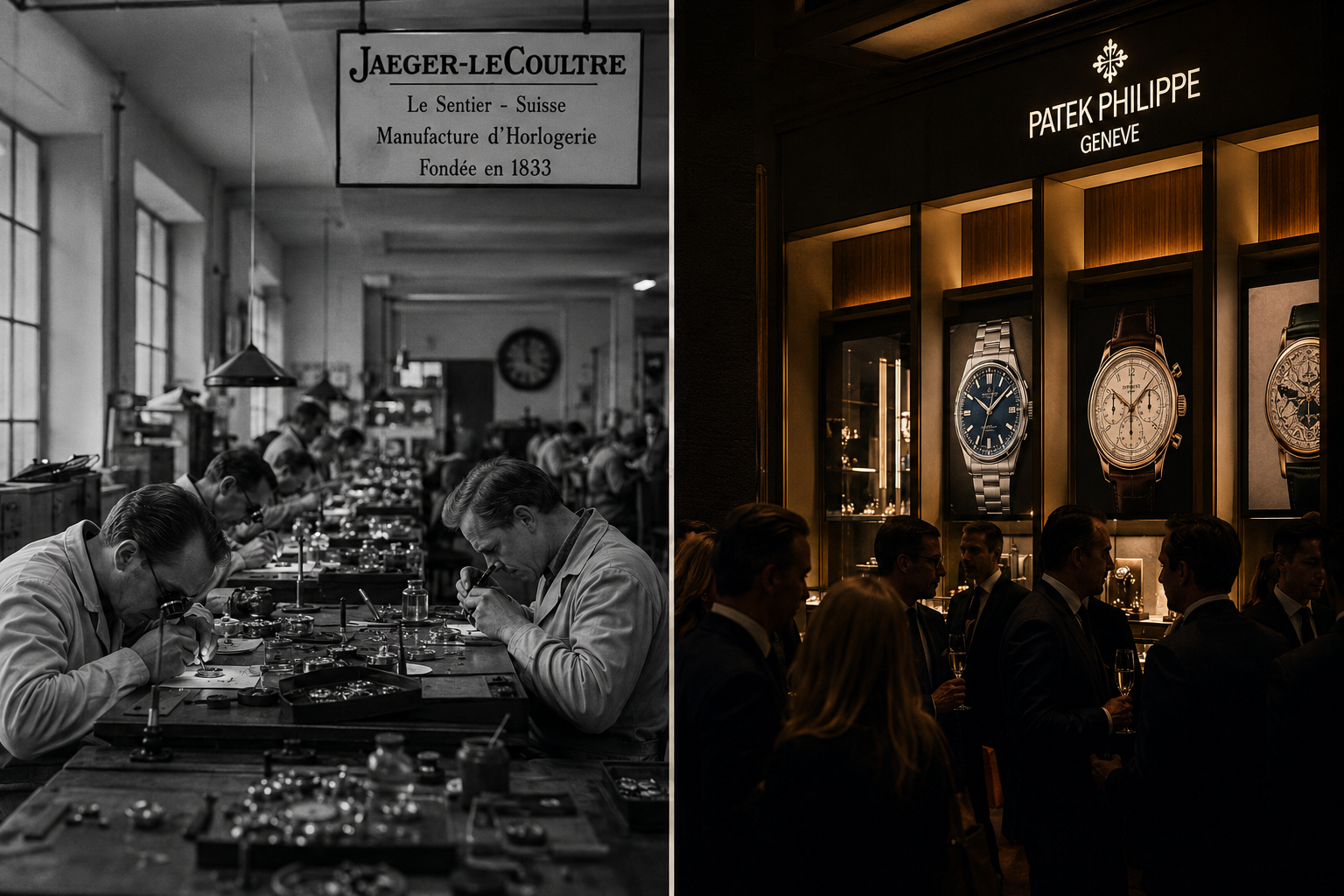
1:0 for Jaeger. Technical comparison
In the early 1990s, Patek Philippe remained a relatively low-volume manufacturer; today, it produces around 75,000 watches annually. Jaeger-LeCoultre, during the same period, operated on a much more industrial and higher-volume model.
Throughout its history, Jaeger-LeCoultre has created, according to the manufacture's official communication, over 1400 different calibers. It has filed over 430 patents. Among these, a significant portion consisted of grand complications, over 200 chiming movements, dozens of tourbillons, perpetual calendars, chronographs, as well as the thinnest hand-wound movement in history (caliber 145, 1.38 mm thick), calibers with an enormous degree of complication like the Gyrotourbillon or Hybris Mechanica, and the smallest mechanical caliber in the world. Caliber 101, introduced in 1929 and still produced today, measures 14 × 4.8 × 3.4 millimeters, weighs about one gram, and consists of 98 parts. It has held the miniaturization record continuously for almost a hundred years. It was with this caliber that Queen Elizabeth II wore a jewelry watch at her coronation in 1953.
As early as 1900, LeCoultre & Cie had 350 different constructions to its name, 128 of which featured a chronograph and 99 a repeater. In 1888, the manufacture employed 500 watchmakers, technicians, and artists, making it the largest integrated factory in the Vallée de Joux.
Patek Philippe, at the same time, produced significantly fewer of its own calibers, and from 1902 for the next thirty years, it bought most of its ébauches, or raw movements, precisely from LeCoultre.
In the category of wristwatches, however, a slight dominance of JLC is visible.
The first grand technical demonstration in wristwatch format was the Jaeger-LeCoultre Hybris Mechanica à Grande Sonnerie from 2009: 26 complications, over 1300 parts, caliber 182, recognized at its launch as the most complicated wristwatch in the world. Patek responded five years later, in 2014, for the brand's 175th anniversary, with the Grandmaster Chime Ref. 5175, featuring 20 complications and 1366 parts, produced in an edition of seven pieces. JLC also has the Reverso Hybris Mechanica à Triptyque from 2006 with 18 complications distributed across three dials, and the Hybris Artistica Mechanica Quadriptyque from 2021 with 11 astronomical complications on four dials. These constructions are in many dimensions at least as ambitious as Patek's counterparts, and in terms of the number of complications, even more elaborate.
Asymmetry in numbers is therefore not obvious. In calibers, JLC has more. In miniaturization records, JLC has more. In grand complication wristwatches, JLC was usually first or parallel. The only place where Patek undeniably wins in numbers is in 20th-century pocket watch super-complications, a format now defunct.
2:1 for Patek. Price and prestige hierarchy
Yet, it is Patek that dictates the hierarchy of prices and prestige.
The steel Grandmaster Chime Ref. 6300A "The Only One," sold at the Only Watch auction in 2019 for 31 million Swiss francs, set a record for the most expensive watch of all time. The Hybris Mechanica à Grande Sonnerie, although technically more ambitious in many dimensions, was valued at "only" 2.5 million dollars and did not generate a comparable cultural effect. The same technical segment, the same range of complications, a fifteen-fold difference in price, and an incomparable difference in media presence.
Just thirty years were enough for an average new Patek to cost multiples of a comparable JLC, and in the secondary market, this disparity is even more pronounced.
Specific pairs of similar models illustrate this scale very well. All prices are indicative, as of May 2026, according to Watchcharts market data and boutique offers.
Among dress watches, the Patek Calatrava 6119R in rose gold (hand-wound movement, 39 mm) costs around 34,700 euros in a boutique, and around 23,900 euros on the secondary market. The Jaeger-LeCoultre Master Ultra Thin Moon in rose gold, technically more ambitious in construction, costs around 19,000 CHF in a boutique, and drops to 5,500-6,300 CHF on the secondary market.
In sports watches, the disparity is dramatic. The steel Patek Nautilus 5711/1A, discontinued in 2021, had a list price of around 24,000 CHF at the time. In May 2026, it sells on the secondary market in the range of 79,000-126,000 CHF. Its successor, the Nautilus 5811/1G in white gold, costs around 82,000 dollars in a boutique and around 174,000 dollars on the secondary market (yes, I know it's gold, not steel).
The steel JLC Polaris Date, a sports watch in the same construction category, costs 8,300 CHF in a boutique, and drops to 5,500-7,100 CHF on the secondary market.
Patek today sells for three to ten times more than a comparable JLC in a boutique. On the secondary market, this disparity in some references exceeds fifteen times.
It is worth noting the nuance that the aforementioned Calatrava on the secondary market drops about 30% below its list price. The premium consistently occurs only in the Nautilus and Aquanaut (yes, I know I'm simplifying, but I don't want to overwhelm you with a barrage of comparisons). Patek as a brand does not retain value uniformly. It retains it where it has built a narrative of limited supply and the cult of a specific model.
This is not a technical difference, but a symbolic difference.
The question of why this happened is one of the most interesting questions in the history of watchmaking. And one of the least asked, because the answer is inconvenient for all market participants: for brands, for sellers, for owners, and for customers themselves.
What JLC did for watchmaking
The manufacture in Le Sentier, founded in 1833 by Antoine LeCoultre, has created so much throughout its history that only a handful of companies in the history of Swiss watchmaking can show a comparable constructive output.
Caliber 920, developed by JLC in the late 1960s, went into Audemars Piguet as the movement for the 1972 Royal Oak, into Patek Philippe as the base for reference 3700 Nautilus, and into Vacheron Constantin in the model 222. Three icons of the 1970s, three pillars of the so-called Holy Trinity, used a construction developed by a brand that was never invited into that trinity itself.
The Atmos, a clock powered by temperature differences, was one of the most original mechanical solutions of the 20th century and for decades served as Switzerland's official diplomatic gift. Incidentally, it can be considered a kind of perpetual motion machine (yes, I know, not from the perspective of pure physics, but for the user).
The Reverso from 1931, designed as a watch for polo players, is today one of the most recognizable shapes in the industry's history. Gyrotourbillon, Hybris Mechanica, Duomètre, these are constructions that in other brands would be the topic of a decade.
I therefore propose the thesis that JLC is the king of systemic watchmaking, and if I had to point to one company and say "take away all the logos and show only the movements," it is very likely that JLC would win.
Two crises, two responses
Both brands had a moment when their existence was genuinely threatened. The way they emerged from these moments says more about them than a catalog of their technical achievements.
Since 1872, Patek Philippe had a partner in Rio de Janeiro who changed the sales model of Swiss watches. The jeweler Gondolo & Labouriau, run by the Italian Carlo Gondolo and the Frenchman Paul Henrique Labouriau, built a network of exclusive collector clubs in Brazil known as the Gondolo Gang. Each club had 180 members, and membership required a commitment to purchase a specially designed Patek reference, signed as Chronometro Gondolo. In 1907, at least 54 such clubs operated in Brazil. At its peak, Gondolo & Labouriau accounted for about one-third of Patek Philippe's annual production.
The cooperation officially ended in 1927. Five years later, when the 1929 crash compounded the long-term decline of this seller, the Brazilian jeweler finally went bankrupt, and customers, including representatives of the Brazilian financial and political elite, began pawning and reporting lost Pateks to the police. Paul Labouriau died in February 1933.
It was then that Patek Philippe, deprived of one of its most important distribution channels and hit by the global crisis, stood on the brink of collapse.
In 1932, brothers Charles and Jean Stern, owners of Cadrans Stern Frères, previous dial suppliers for Patek, acquired the manufacture. They hired watchmaker Jean Pfister as head of the company and decided to focus on movement production, among other things by discontinuing supplies from LeCoultre. The delivery of the Graves Supercomplication in January 1933 for 60,000 francs helped stabilize the balance sheet. The Calatrava, introduced in the same year 1932, became the foundation of the new collection.
The Sterns' decision was not merely accounting, but visionary and marketing-driven. It was the foundation of the narrative that Patek has consistently built for ninety years. Henri Stern took the helm in 1958, Philippe Stern in 1993, Thierry Stern in 2009. Every current brand communication, every Generations campaign, every statement about caring for a watch for the next generation, has its origin in this rescue transaction of 1932. Patek not only rescued the company from the crisis but also the myth of family continuity and the myth of a watch passed from father to son.
This series of moves, not the watchmaking genius of Antoni Patek, is the true foundation of today's brand. With all due respect to our compatriot, who created a great watchmaker of kings, but in the pocket watch segment. The Sterns created the brand we know today.
Jaeger-LeCoultre had its critical moment in the second half of the 1970s. The quartz crisis hit the Vallée de Joux as painfully as the rest of the Swiss industry. JLC then operated within the SAPHIR group, the successor to the SAPIC holding company founded by the LeCoultre family in 1927, which since 1969 also included the Favre family, linking JLC with Favre-Leuba. The manufacture, despite its technical standing, found itself in a state requiring external rescue.
Rescue came from an unexpected quarter. Albert Keck, CEO of the German automotive group VDO Adolf Schindling AG, which produced speedometers and automotive instruments, led a project in the second half of the 1970s to build a European watch consortium to counter Japanese quartz. The coalition included the French group Matra with a mission to save the French watch industry, several smaller German brands, and the SAPHIR group. The broad European plan did not succeed, but in 1978, VDO acquired two Swiss manufactures: IWC, bought directly from the Homberger family, and JLC as part of the acquisition of SAPHIR.
Operational responsibility for both brands was given to 37-year-old engineer Günter Blümlein, who spoke fluent German and French and had previous experience at German Junghans. Throughout the 1980s, Blümlein consolidated JLC's ownership, as he bought back 20% of the shares from Swiss banks, 25% remaining after the split with Vacheron Constantin, and in 1986 sold 40% of SAPHIR to Audemars Piguet, which then used movements from JLC.
In 1990, together with Walter Lange, he rebuilt A. Lange & Söhne, and in 1991 he formalized the structure of Les Manufactures Horlogères as a vehicle for the three brands. After Mannesmann's acquisition by Vodafone in 1999 and the forced sale of non-automotive assets, Blümlein negotiated the transfer of LMH to Richemont in 2000. Unfortunately, he died a year later, in October 2001, at the age of 58.
The difference between the two crises is fundamental. Patek was rescued by a family that built an identity around this rescue that endures to this day. JLC was rescued by a manager who did the same for three brands simultaneously and whose name most JLC customers do not know. The Sterns are now part of the Patek story. Blümlein is a figure known only to a narrow circle of collectors, even though for late 20th-century watchmaking he probably did more than anyone else on the corporate side.
Both brands survived, but only one turned crisis into a story.
The mechanics of prestige
Patek won not because it made better watches. It won because it understood what luxury is as a system of signs and a phenomenon whose explanation should be sought in psychology, not in engineering.
An important element of prestige is consciously maintained limited supply. Patek could produce more. It doesn't. The waiting time for the Nautilus 5711 before its discontinuation was not a logistical error, but an instrument for managing desire. Unfortunately, JLC was never able to manage supply in this way, because Richemont's cost structure requires flow, not queues and rationed waiting lists. Significantly, Patek had this logic embedded in its business DNA for almost a century and a half. The Gondolo Gang of 1907, collector clubs circumventing the ban on gambling in Brazil by committing to purchase a specially designed Patek, was the ancestor of today's waiting list logic. The brand understood sales through exclusive membership when the rest of the industry simply sold watches.
Second is design consistency stretched over decades. The Calatrava today looks similar to the Calatrava of the 1930s. The Nautilus today looks similar to the Nautilus of 1976. The customer does not buy a product, they buy belonging to historical continuity, which fits well with the slogan of generational transmission. JLC has the Reverso, which fulfills this logic, but around the Reverso, dozens of collections have been built that dilute it.
Third is Philippe Stern's decision in the 1980s. When the Swiss watch industry was drowning under the onslaught of quartz, most historical brands moved downmarket, sought cheaper segments, accepted ETA, accepted mass production. Stern consciously chose the opposite direction. Patek not only did not lower its price positions but in the middle of the decade introduced the Calatrava 3919 and raised the bar for the classic collection. Caliber 89 from 1989, a watch with 33 complications created for the brand's 150th anniversary, was a demonstration that Patek did not intend to compete with the rest of the industry on the rest of the industry's terms. At the same time, JLC, under Blümlein's leadership, was doing something technically more ambitious and symbolically weaker. It developed calibers, supplied them to competitors, rebuilt the Reverso, introduced Master Control, but did not build a narrative about itself on the scale that Patek did.
Fourth is the relationship with the auction market. Patek has collaborated with auction houses for decades in a way that sustains the myth of value. Only Watch, Phillips, Christie's, and Sotheby's auctions regularly produce records for Patek references. JLC appears at auctions, but rarely as the star of the evening. The secondary market is not a neutral reflection of quality. The secondary market is part of marketing, but not of the brand, but of the entire ecosystem around it.
Fifth is the lack of an entry-level segment. Patek has no cheaper line. It has no sub-brand. It has no fashion collaborations. This is a boundary it does not cross. JLC has the Reverso Classic for several thousand euros and the Master Ultra Thin for several tens of thousands, but it also has collections reaching hundreds of thousands. This range, seemingly commercially beneficial, is also what prevents the construction of a homogeneous message of top-level prestige.
The engineer in a world of narratives
One could say that JLC behaved like a classic Swiss engineer. It built and solved construction problems. It assumed that the product would speak for itself.
Luxury doesn't work that way.
Luxury is a system of meanings in which the product is proof of belonging, not an end in itself. A Patek customer buys not only a movement but the right to participate in a specific story: of family continuity, of inheritance, of the peak of hierarchy, of belonging to a club that cannot be joined.
JLC never built such a story around itself. It tried, but too late and less consistently. Campaigns with actors, ambassadors, Hybris Mechanica as a manifesto, all of this was technically correct and culturally belated. Patek, during this time, spoke one sentence, in several languages, for several decades: you never actually own a Patek Philippe, you merely look after it for the next generation. This sentence does not sell a watch, but sells a concept of time into which the watch fits.
The list of losers
JLC is not alone in this story.
Eterna, a brand from Grenchen, created in 1948 a ball-bearing solution for wheels, which became the standard for modern automatic movements. Today's five-ball logo is a memento of an invention that changed the industry. In 1932, Eterna spun off its movement production division as ETA SA. From this division emerged the company that today produces most of the mechanical calibers on the Swiss market. Eterna itself as a brand exists today in limbo, passing through successive owners. The foundation of the entire Swiss watch mid-range bears its name, and its logo does not appear in any conversation about prestige.
Zenith developed the El Primero in 1969, one of the first automatic chronographs in history, operating at a frequency of 36,000 vph. During the quartz crisis, management ordered the destruction of machines and design documentation. Charles Vermot, an employee of the manufacture, hid them in the attic against orders. Thanks to this, the El Primero survived and returned to production in the 1980s, among other things as the base for the Rolex Daytona 16520 chronograph. Zenith today is a respected brand, but in the hierarchy of prestige, it is placed significantly below the Holy Trinity.
Jean Lassale in the 1970s built caliber 1200, one of the thinnest hand-wound movements in history, with a thickness of 1.2 millimeters. The construction proved so delicate that it was practically unserviceable. The brand disappeared, but the invention remained as a note in the history of technical extremes and a base for, among others, Piaget.
Each of these stories shows the same thing: that technical achievement does not build symbolic position. Symbolic position is built separately, consciously, over a long period, and through instruments that have no connection to mechanics.
What follows from this
The conclusion that follows from this is not: Patek is overrated. Patek Philippe makes excellent watches, its complications are technically correct, its finishing is top-notch, its strategy is consistent. Patek won fairly, according to the rules of a game it understood better than its competitors.
The conclusion is different. The luxury market does not reward technical quality alone. It rewards the ability to build a story in which technical quality is one of several elements, not the most important. A customer buying a six-figure watch buys primarily membership. The movement is a pretext.
JLC, Eterna, and Zenith were manufactures of engineers. Patek Philippe is a manufacture of engineers that also hired sociologists, marketers, and distribution strategists, and which already in the 19th century understood that luxury sells through clubs.
If the history of watches were written by watchmakers, it would look different. But the history of luxury is not written by watchmakers. It is written by distributors, auctioneers, shareholders, journalists, collectors, and customers who want to believe that their choice means more than just a purchase.
Patek's greatest achievement is not creating the best watch in the world. It is convincing the world that the question of the best watch should begin with its name.