WoW Investigations
THA, workshop of masterpieces.
The history of THA, a small workshop where, before creating their own brands, François-Paul Journe, Denis Flageollet, and Vianney Halter built constructions for Breguet and Cartier that transformed contemporary watchmaking.
History of Techniques Horlogères Appliquées
Before François-Paul Journe, Denis Flageollet, and Vianney Halter became symbols of contemporary independent watchmaking, they worked in a small atelier in Sainte-Croix.
There, constructions for Breguet and Cartier were created, but the names of their creators remained, as is often the case, off the dial. The history of Techniques Horlogères Appliquées is a story not only about mechanics but also about authorship, ambition, money, and the price of working in the shadow of major brands.
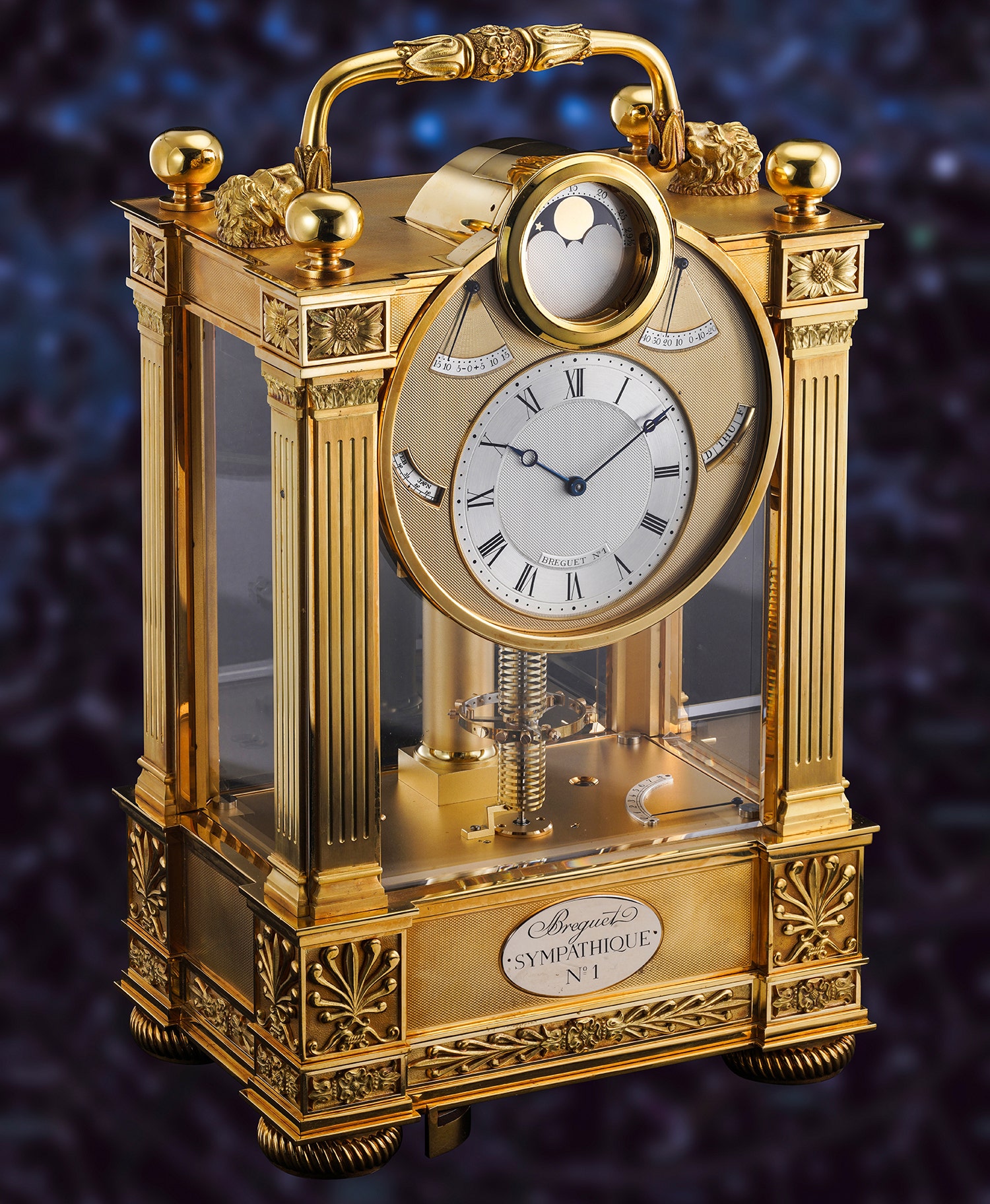
On May 10, 2025, at the Phillips auction house in Geneva, bidding was underway for one of the most extraordinary objects in contemporary watchmaking. The monumental Breguet Sympathique No. 1 from 1991, a table clock combined with a wristwatch "docked" within it, fetched a price of 5,505,000 Swiss francs including fees.
The buyer turned out to be François-Paul Journe, who, however, did not purchase the work of another watchmaker but bought back an object that he himself had designed over three decades earlier and on which he had worked with the team of Techniques Horlogères Appliquées, known as THA. The clock bore the name Breguet, not Journe. For its constructor, it was a material trace of a period when outstanding technical solutions were created in small, almost invisible and little-known workshops, while all the fame was taken by the brand commissioning the project.
Sympathique No. 1 was intended for the F.P. Journe museum. In a sense, it returned to its author and to its place in his home. At the same time, its auction history brought to mind the company without which contemporary independent watchmaking might look completely different.
This company was called Techniques Horlogères Appliquées.
Three clocks for Asprey
The history of THA did not begin with a formal act of incorporation, but with the solitary work of a young watchmaker in Paris.
François-Paul Journe was familiar with the concept of Abraham-Louis Breguet's Sympathique clocks from museums and collections. In the first half of the 1980s, he viewed historical examples thanks, among others, to John Asprey, owner of the famous London jewelry house. Asprey was not, as is sometimes stated, a co-owner of Breguet. The brand had belonged to Investcorp since 1987. Journe and Asprey had only briefly considered purchasing it earlier.
In 1987, Journe began building his own interpretation of the Sympathique for Asprey. The first clock received a case lined with pink coral. Soon, two more were created, made of jade and zoisite. They were not prototypes, but complete, functional, and salable objects, the execution of which took almost three years in total, and the value of the order Journe later estimated at around 800,000 French francs.
He made the movement himself. For large case elements, he used the help of a Parisian jewelry workshop with appropriate milling machines for brass. The success of the project, however, revealed a fundamental problem, as the construction was too complex for one person to safely accept and execute a larger order. Illness, an accident, or even simple overwork could halt everything and cause problems, contractual penalties, or even lead to the complete cancellation of the order.
Journe no longer wanted to remain a solitary craftsman fulfilling individual orders. He wanted to create an enterprise capable of transforming his ideas into small series. He was not yet thinking of a brand bearing his own name, but planned a specialized back-office for other companies.
Who really founded THA?
THA began operations in September 1989 in Sainte-Croix, a town in the canton of Vaud associated since the 19th century with music boxes, automatons, singing birds, and artistic mechanics. The choice of location was not accidental, as specialists with competencies that could not be found in an ordinary watch factory operated in the area.
However, precisely determining the founding composition is not as simple as the stories of the "great trio" Journe, Flageollet, and Halter, repeated in industry publications, suggest.
Denis Flageollet recalled that THA was founded by François-Paul Journe, Dominique Mouret, Simon Bull, and himself. Vianney Halter was to join later, as did Thomas Baumgartner, future co-creator of Urwerk. Journe presents the genesis of the company somewhat differently: he says that he founded THA and became its director, while Pascal Courteault was responsible for administration and management. His story also features Mouret, Flageollet, Bull, and a circle of friends and local craftsmen who helped launch the workshop.
Without registration documents, one should not arbitrarily assign formal founder titles to everyone, but one thing is certain: Journe was the initiator of the venture, Flageollet organized the technical and production facilities, Dominique Mouret knew the community of mechanics and conservators of Sainte-Croix, and Courteault handled the business side of the operation. Halter joined the already operating workshop.
This is an important distinction. The popular narrative created a romantic community of three future masters out of THA. The reality was a bit more complicated, as there was an originator, constructors, conservators, an administrator, automaton specialists, suppliers, and people capable of translating a single movement into repeatable production.
THA was not just a club of brilliant friends but a small but solidly operating enterprise.
Breguet places an order
The breakthrough came during the Basel fair in 1990. Journe presented the third clock made for Asprey and was looking for new orders for the then-young THA. He met Osvaldo Patrizzi, founder of the Antiquorum auction house, who was preparing a major auction "The Art of Breguet" and needed an object to attract collectors' attention. On the same day, Journe spoke with François Bodet, who headed Breguet.
The result was a contract for twenty contemporary Sympathique clocks, including nineteen in gilded brass cases and the first, unique, and exceptional piece made of gold. Breguet, however, considered No. 1 too expensive and did not buy it back from THA. The clock remained the property of the workshop and was then put up for auction at Antiquorum on April 14, 1991, where it sold for 1,546,250 Swiss francs.
It was the first contemporary Sympathique interacting with a wristwatch. When the watch was placed in a special receptacle, the table clock's movement wound it, set the time, and corrected its operation. The clock's construction had an eight-day power reserve, a constant force device renewing energy every five seconds, a chronometer escapement, and a balance wheel working with two cylindrical hairsprings made of gold. The clock also indicated a full calendar, moon phases, temperature, and equation of time.
Not all technical descriptions encountered today are reliable. For example, there is no basis to attribute to the team the casting of brass around an Invar core, and the English term "detent escapement" should not be translated as a resting escapement. In this case, it refers to a chronometer escapement.
Whose Sympathique was it, actually?
A particular problem of authorship arose around No. 1. Phillips presented the object as Journe's work created with the participation of THA, and in other publications, the names of Journe, Flageollet, and Mouret, sometimes also Halter, appear together. Journe himself states unequivocally that the entire architecture of the movement was his work, and the documentation provided to THA resulted from experiences gained during the execution of the three earlier clocks for Asprey.
At the same time, this does not mean that No. 1 was created alone at his Parisian table. Journe lists Denis Flageollet, Pierre-André Grimm, and Vianney Halter as people directly working on the clock. Halter, among other things, made elements of the chronometer escapement. According to Journe, his contribution was smaller than Flageollet's and Grimm's, but undeniably important. Journe taught the team how to work with gold hairsprings and provided his own drawings so that THA could develop full production documentation.
The fairest approach is therefore to separate three things.
The idea, the architecture of the movement, and previous experiences belonged primarily to Journe. The industrialization of the construction, its preparation for serial production, and the production itself were the work of THA, as physical execution required the competencies of many people.
A factory of others' dreams
THA's operating model met the needs of the industry at the turn of the 1980s and 1990s. Mechanical watchmaking was regaining importance, but many large brands, after the quartz crisis, no longer had teams capable of independently developing the most demanding constructions. They therefore used external specialists. Renaud & Papi played a similar role at the time, becoming famous as a back-office for grand complications, and only later became financially linked with Audemars Piguet.
THA carried out projects for companies such as Breguet and Cartier. Flageollet mentioned clocks and watches from the Mystery line, prepared for Cartier. Other sources also mention cooperation with Audemars Piguet, Girard-Perregaux, and Jaquet Droz, although confidentiality applied to many projects, and their exact authorship remains difficult to determine without access to unavailable agreements.
In this system, success had a peculiar form. The better the workshop performed its task, the less visible it was. The name Breguet or Cartier was on the dial. The client bought the history of a grand house, not the history of the constructors from Sainte-Croix.
For a time, such a model gave creators access to capital, facilities, and technical challenges that they could not finance independently. Over time, however, it revealed its own limitation, where an outstanding constructor as an individual could develop and execute an extraordinary movement, yet remain an anonymous supplier.
Diverging paths
Vianney Halter left THA around 1992. He then worked for Franck Muller, and in 1994, he founded Janvier SA in Sainte-Croix, named after the eighteenth-century watchmaker Antide Janvier. The company also carried out commissions for other brands but allowed Halter to gradually develop his own design language, and his Antiqua from 1998 showed that a grand complication does not have to look like a variation on a nineteenth-century pocket watch. Today, Vianney is making a grand return, for example, with the new Bulgari watch.
Journe left THA in 1994. According to his account, he was practically pushed out of the company after Pascal Courteault increased its capital, reducing Journe's share. This is one side's version and should be presented as such. It is known, however, that Journe retained shares, which were only settled after THA was sold to Bucherer in 2007. Bucherer itself was absorbed as part of Rolex's acquisition and formally liquidated, as I wrote in the study titled "Why Rolex had to kill Carl F. Bucherer."
After leaving, he began to develop his own projects. In 1999, the F.P. Journe brand debuted with the motto Invenit et Fecit, "invented and made." There is no proof that the formula was intended as a direct jab at THA. However, it is hard not to notice its significance in the life story of a man who for years created solutions sold under the names of other companies.
Denis Flageollet remained at THA the longest and left only in 2001, and in April 2002, together with David Zanetta, he founded De Bethune. He explained his departure by the increasing number of committees, procedures, meetings, and administration, and the focus of large brands on profitability at the expense of the essence, i.e., creation. THA gave him experience not only in designing calibers but also in production management, qualification, and certification of small series. Without this schooling, it is difficult to imagine the later De Bethune manufacture.
WoW – Watcher of Watches interviews with Denis Flageollet and Vianney Halter are available in the WoWywiady section. In them, both return to the value of independence, their own creative language, and decisions that are not made solely on the basis of marketing calculations.
Cartier and caliber 045MC
The second major chapter of THA's legacy was the monopusher chronograph developed for Cartier.
In the late 1990s, Cartier was developing the Collection Privée Cartier Paris, a program that revived the brand's historical forms and combined them with ambitious movements. THA proposed recreating the Tortue Monopoussoir, a watch referencing a rare Cartier chronograph from the late 1920s.
Thus, the hand-wound caliber 045MC was created. Phillips attributes its development to Denis Flageollet and François-Paul Journe. In later auction catalogs, Vianney Halter's name sometimes appears. However, Flageollet himself says he does not remember his involvement and believes that Halter left THA before work on the chronograph began. The honest answer is therefore that the 045MC was created at THA, its main authors were most likely Flageollet and Journe, while Halter's involvement has not been sufficiently confirmed, which does not mean it was absent.
The movement was about 25.6 mm in diameter, had 22 jewels, and operated at a frequency of 21,600 vibrations per hour. The chronograph was controlled by a column wheel, and its activation was handled by a rocking pinion. This solution, patented in the 19th century by Édouard Heuer, allowed for limiting the jump of the seconds hand when starting the stopwatch and reducing the load on the basic going train. All chronograph functions were operated by a single pusher integrated with the crown, topped with a sapphire cabochon.
The Tortue Monopoussoir appeared in the Collection Privée Cartier Paris in 1999, although the CPCP program itself began a year earlier. Versions were created in various gold types, including references 2356 and 2396, later also the larger 2762, and the rectangular Tank Monopoussoir 2846. Production was small, but exact numbers, apart from some limited editions, were not disclosed by Cartier.
Today, these watches are sought after not only as examples of the renaissance of Cartier's historical design. Collectors now know that beneath the decorated bridges lies a fragment of the shared history of people who would soon after build De Bethune and F.P. Journe.
One caliber or a family of related constructions?
Another story has grown around the 045MC, claiming that the movement was transferred from THA to Jaquet, later La Joux-Perret, and then found its way almost unchanged into watches by De Bethune, Ulysse Nardin, Franck Muller, and Angelus.
The reality is less orderly.
Jaquet produced a monopusher chronograph designed by Journe, used by Franck Muller and Girard-Perregaux, among others. According to a contemporary study by SJX, this construction was only loosely related to the 045MC. Its later development became the La Joux-Perret caliber A5000, currently used by Angelus.
Flageollet used a similar architecture in the first De Bethune chronographs, DB1 and DB8, but he himself emphasized that it was not exactly the same movement. Instead of drawing a straight line of inheritance for one caliber, it is better to speak of a family of constructions originating from the same environment and using similar solutions.
This distinction is also important today, as technical kinship does not imply identity, and a common architecture does not prove the transfer of the same rights, tools, or documentation.
From independent atelier to Bucherer
After the departure of its most famous creators, THA did not cease to exist, and the workshop continued its operations and collaborated with Carl F. Bucherer for over ten years. On July 1, 2007, Bucherer Watches acquired THA. The official statement from the Federation of the Swiss Watch Industry reported that the Sainte-Croix facility would be responsible for the development, technical research, and production of movements, collaborating with the assembly unit in Lengnau.
A year later, the CFB A1000 with a peripheral automatic winding system was shown. This was not the first peripheral rotor in history. Such solutions had been patented and produced earlier, for example, by Patek Philippe. The achievement of the Bucherer team was to bring the construction to reliable large-scale production, but would this have been possible without THA?
In 2015, Carl F. Bucherer began consolidating its production activities in Lengnau. Some Sainte-Croix employees were laid off, others transferred. However, this does not mean that all traces of activity in that town disappeared immediately. The report from the inauguration of the expanded manufacture in Lengnau in June 2016 still mentioned a laboratory in Sainte-Croix. It is safest to say that the production center and main competencies were moved to Lengnau, while the exact fate of the remaining research activities in Sainte-Croix requires further documentation.
Rolex and the end of the brand
In August 2023, Rolex announced the acquisition of the Bucherer group. The transaction included the retail network and the Carl F. Bucherer brand belonging to the group.
In February 2025, Swiss media revealed the decision to discontinue the watchmaking operations of Carl F. Bucherer. According to reports, the matter concerned about one hundred employees, some of whom were offered jobs within Rolex's structure.
History thus came full circle. The workshop, founded by people who wanted to create an independent back-office for the most demanding projects, was eventually incorporated into a larger manufacture, then, along with it, became part of the Rolex group, and the brand leveraging its heritage was destined for discontinuation.
This was not a simple march from craftsmanship to a global empire. Rather, it was the gradual dissolution of a small workshop within successive organizational structures.
The most enduring and important product of THA turned out to be its people
The significance of THA cannot be reduced to the Sympathique, the 045MC, or the peripheral rotor. The most important result of the company's activity was the people who learned there to combine the restoration of old movements, individual prototyping, teamwork, and the requirements of small-series production.
Journe built a brand based on clear authorship and the Invenit et Fecit formula, which today belongs to the top of its league. Flageollet, with De Bethune, created a laboratory of materials, chronometry, and a new language of form, and Halter showed that a complicated watch can be not only a time-measuring instrument but also an entire mechanical world. Thomas Baumgartner later co-founded Urwerk.
Their paths were different, but the THA experience left a common lesson: that invention, execution, and brand do not have to belong to the same person or company. Someone else can have the idea, someone else can prepare the documentation, someone else can make the parts, and yet someone else can place their name on the dial.
For years, the luxury industry benefited from this opacity. Today, the collector's market is trying to reverse it. The value of old Cartier watches is increasing, partly because their buyers are discovering the names of constructors who previously remained outside the advertising. Sympathique No. 1 achieved a multi-million price also because, after years, it was recognized as part of Journe's history, and not exclusively Breguet's.
This does not mean that all the merits of great brands should now be attributed to a few famous independent watchmakers. That would only be a reversal of the same oversimplification. THA operated as a team. It needed constructors, prototypers, watchmakers, automaton specialists, administrators, suppliers, and companies willing to pay for risky projects.
That is why its history is so important. It shows that watchmaking rarely arises as marketing later tells it. Behind one name on the dial can stand an entire network of people, agreements, disputes, and invisible work.
And sometimes you have to wait thirty-four years and pay 5.505 million francs for the constructor's name to return to a work that was part of his own history from the beginning.
Photos - Phillips