WoW Investigations
Swatch Royal Pop, or hard cash for soft promises
Swatch will earn more from Royal Pop than the entire group generated in 2025, and Audemars Piguet gets a hypothesis. A strategic analysis of the most talked-about collaboration.
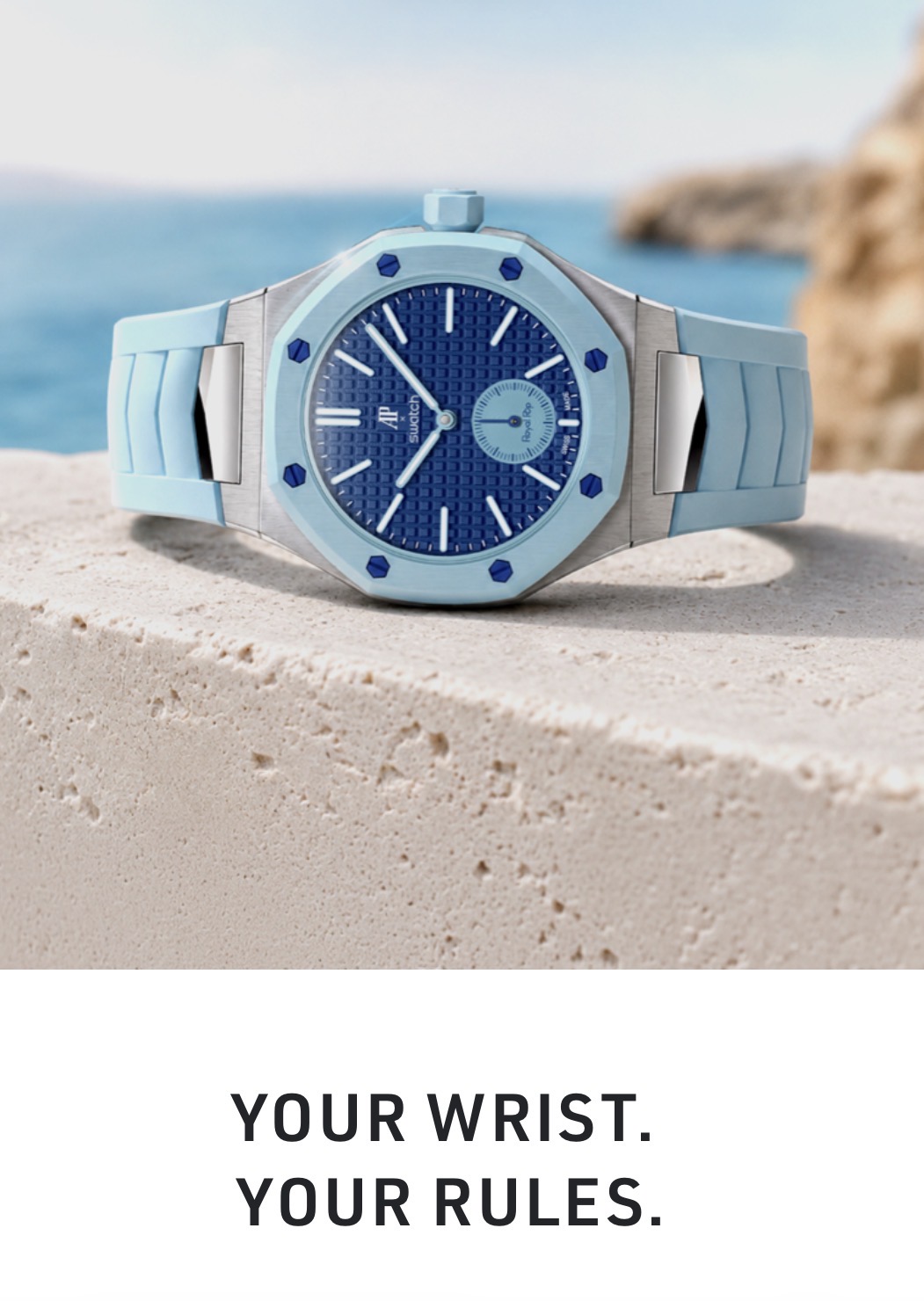
Royal Pop was predictable for the attentive
On June 18, 2024, the Swatch Group filed a trademark application in Switzerland for "Royal Pop" in class 14, covering watches and jewelry. This signal was unambiguous, as "Royal" led directly to Royal Oak, and "Pop" to Swatch's 1980s archive, meaning modular watches worn as clips or accessories.
WIPO registration number 7,613,928.
AP's silence was very telling, although major media outlets did not adequately report this fact, and yet Audemars Piguet has for years pursued a restrictive policy of protecting its trademarks. It filed lawsuits over the octagon in Japan (lost in 2024) and in the US TTAB (lost in 2025). And here, a competitor publicly registers a name that is a direct reference to Royal Oak, and AP does not object or issue a statement.
Swatch's registration of the name was the first sign that the project existed, and AP's silence was a strong indication that both parties had already reached an agreement. François-Henry Bennahmias, CEO of AP from 2012–2023, was himself a long-time collector of Swatches. In 2022, he publicly called the MoonSwatch "a great idea that does not affect the integrity of Omega" (Luxury Tribune). AP's collaboration with Marvel was the first practical test of its opening strategy.
Ilaria Resta took over AP in 2023 and continued this line, declaring the goal of increasing the share of women among customers from 20 to 45 percent by 2030.
An anecdote circulated by CNN, Helvetus, Wristbuddys, Stuff, and a dozen other media outlets claims that in September 2023, AP's official account commented on a Swatch post about the Scuba Fifty Fathoms with the words "when do we launch?". But all publications date from May 2026. On Reddit, in the Audemars Piguet, Swatch, and other communities, between September 2023 and May 2026, there is not a single mention. Johnny Brayson of Gear Patrol was the only one to honestly write that there is no way to verify whether the comment is three years old or if someone fabricated it last week. The industry repeats a story that no one has verified. I tried to find this entry, but there is no hard evidence or source.
In subsequent months, signals were misinterpreted, speculating that a plastic Royal Oak for the wrist would be created for $300. All later "leaks" or AI mockups were constructed under this assumption. Meanwhile, the project went in a different direction, towards a pocket format and modularity, in line with the history of Swatch Pop.
AP did not want a cheap Royal Oak for the wrist, but a product that could not be confused with a wrist Royal Oak.
Why it was created now
Swatch Group ended 2025 with revenues of CHF 6.28 billion, net profit of CHF 25 million, and an operating margin of 2.1 percent. These are results that cannot be saved by another Tissot PRX.
The Swatch brand fell by 15 percent year-on-year, Omega by 8 percent to CHF 2.2 billion and from second to fifth position in the Morgan Stanley and LuxeConsult ranking, Longines by 18 percent. This incidentally contradicts the thesis that the MoonSwatch and Blancpain × Swatch collaborations brought all parties the long-term benefits they expected.
In this context, Royal Pop appears. RBC Capital Markets, as of May 13, assumes sales of 3 million units at an average price of CHF 350, revenues of CHF 1.05 billion, and CHF 390 million EBIT for Swatch in 2026–2029 with a 50/50 profit split between SG and AP.
This means that one product line, planned 23 months in advance, is expected to generate more operating profit in its full cycle than the entire Swatch Group generated in 2025.
This is no longer just another collaboration, but a project that significantly impacts results.
With one caveat: the customer buying a Royal Pop is potentially the same customer who could have bought a MoonSwatch or two other regular Swatches. Part of this "gigantic success" may be a shift in sales within the Swatch Group portfolio, not new demand. The first honest test will only appear in the H2 2026 results; if the group's revenue growth in the second half of the year exceeds the value of Royal Pop itself, the new demand hypothesis will hold. If not, the hype only masked rotation.
What this product is meant to be for AP
Audemars Piguet generates approximately CHF 2.6 billion in annual revenue with a production of about 53,000 watches and an average transaction price above CHF 51,000. According to industry estimates, about 88 percent of these sales are based on the Royal Oak line in various variants. AP is practically a monoculture of one model line.
For Swatch, Royal Pop is an experiment by one of sixteen brands. For AP, it is touching its own business core, but touching it asymmetrically. If Royal Pop strengthens the myth of Royal Oak, AP will not earn extra from it. The Royal Oak is already impossible to buy, the waiting list reaches 36 months, and demand has exceeded the manufacture's production capacity for years. The strengthened myth will mainly translate into the prices of used Royal Oaks on Chrono24, where AP earns not a cent.
If, on the other hand, Royal Pop begins to pauperize the RO, then AP undermines the foundation on which 88 percent of its revenue is based. There is no third scenario good for AP.
What AP gets for this risk
Reuters reports, citing the Swatch Group itself, that within 48 hours of its launch, Royal Pop generated 11 billion social media impressions and millions of clicks on the brand's website. Global headlines in Bloomberg, Reuters, CNN, Financial Times, Fox, Yahoo, Blick, plus every serious watch media outlet and most lifestyle ones. Scenes of queues in New York, Milan, London, Tokyo, and Singapore, including the use of pepper spray at Roosevelt Field Mall and police interventions, entered mainstream news on a scale that AP has not achieved with any single event in its 150-year history.
This is a paradox worth naming. Audemars Piguet has not engaged in traditional commercial advertising for decades. No outdoor campaigns, no prime-time TV, minimal presence in non-industry press. All of AP's communication is based on art sponsorship, controlled presence in collector circles, AP House as curated spaces. A brand that consciously does not buy attention received, in 48 hours, exposure valued by the industry at tens of millions of dollars in advertising equivalent. Hayek told GQ Middle East it was a "win-win." From AP's perspective, the brand value itself increased by something that cannot be calculated with a traditional ROI model, but also cannot be ignored.
However, this exposure is uncontrollable. AP did not choose which photos would go mainstream. It did not choose the chaotic scenes that Müller called an "image disaster." It does not control the narrative of "Royal Broke," "Royal Swoak," "Ferrari x Kia." Advertising you didn't order is advertising you can't stop when it starts going in the wrong direction. AP bet that the sum of 11 billion impressions is beneficial for brand value despite the noise on the image side. This is just a hypothesis, and besides, buzz is not the same as fame.
What the market did
The aftermarket had months to prepare. Helvetus tracked the trademark filing earlier and within 24 hours of the launch, released a dedicated collection of case adapters and straps. Delugs launched Project WristPop, a line converting the pocket watch into a wrist watch. Wristbuddys announced dedicated straps for each of the eight models, Royal Pop Lab and Royal Pop Straps launched separate platforms offering metal bracelets, AP BROKE listed adapters on a waiting list. On MakerWorld, Cults3D, and Printables, STL files for such appeared within 48 hours of the launch.
Even Golden Concept offers adaptive bracelets for Royal Pop for 399 euros.
The market said: okay, thank you for the watch, we will make it what we really wanted, which is a cheap Royal Oak for the wrist.
Flippers, meanwhile, did what they always do: set up tents on the street and posted offers on forums.
Five questions for which there are no answers today
First question. Will the pop-cultural halo effect transfer to the Royal Oak for longer than a few quarters, as was the case with Omega after the MoonSwatch.
Second. In the second half of 2026, will AP House sales change the demographic structure of customers, will the promised women and people under 35 arrive.
Third. Will the "one-off" survive the temptation of a second color line, a second format, a new limited edition.
Fourth. Did AP, an independent, private, family-controlled manufacture, really need Swatch to achieve rejuvenation, or did it succumb to the temptation of scale that its own distribution structure did not provide.
Fifth and most important. Does AP plan a significant increase in Royal Oak production to capture the demand that Royal Pop will generate? Without this decision, the entire rejuvenation strategy falls flat. AP will educate a million new aspirational customers for watches that it physically cannot sell.
Royal Pop provides AP with buzz that it cannot convert into sales as long as its own production is a bottleneck. This is the most serious risk, which few adequately notice. Will the aspirational customer promoted by Royal Pop buy a CODE 11.59 in a few years?
Image: Golden Concept campaign, May 2026