WoW Investigations
Surgeon or butcher? And why not every modification is a heresy
Artisans de Genève under the magnifying glass: when personalization stops being tuning and starts being a dialogue with mechanics.
After the "iced out" article, several people privately approached me with polemical questions, arguing that not every intervention on a watch is barbarism. There are many companies recognized as "tuning" watches, and it doesn't have to be some anonymous craftsman with a home workshop.
Artisans de Genève immediately came to mind. This is because they clearly modify Rolexes, they are well-known, they stir emotions, and there have been several heated discussions about them.
For me personally, this is a moment where one needs to seriously reflect and draw a clear distinction, because if we throw everything into one bag, we will be as superficial as those who drill cases for diamonds because "it will shine beautifully and richly."
There is a huge difference between a butcher and a surgeon. Both, it is true, use sharp tools, but one must operate with extreme care and delicacy, with full responsibility for life, while the other can chop as they please, as long as they stick to the rules of their trade. But the intention, knowledge, and effect are completely different.
And it is in this difference that Artisans de Genève resides.
First, something uncomfortable
Rolex is an industry, and I say this without a hint of irony, as someone who fully appreciates the brand and its achievements, capabilities, and watches.
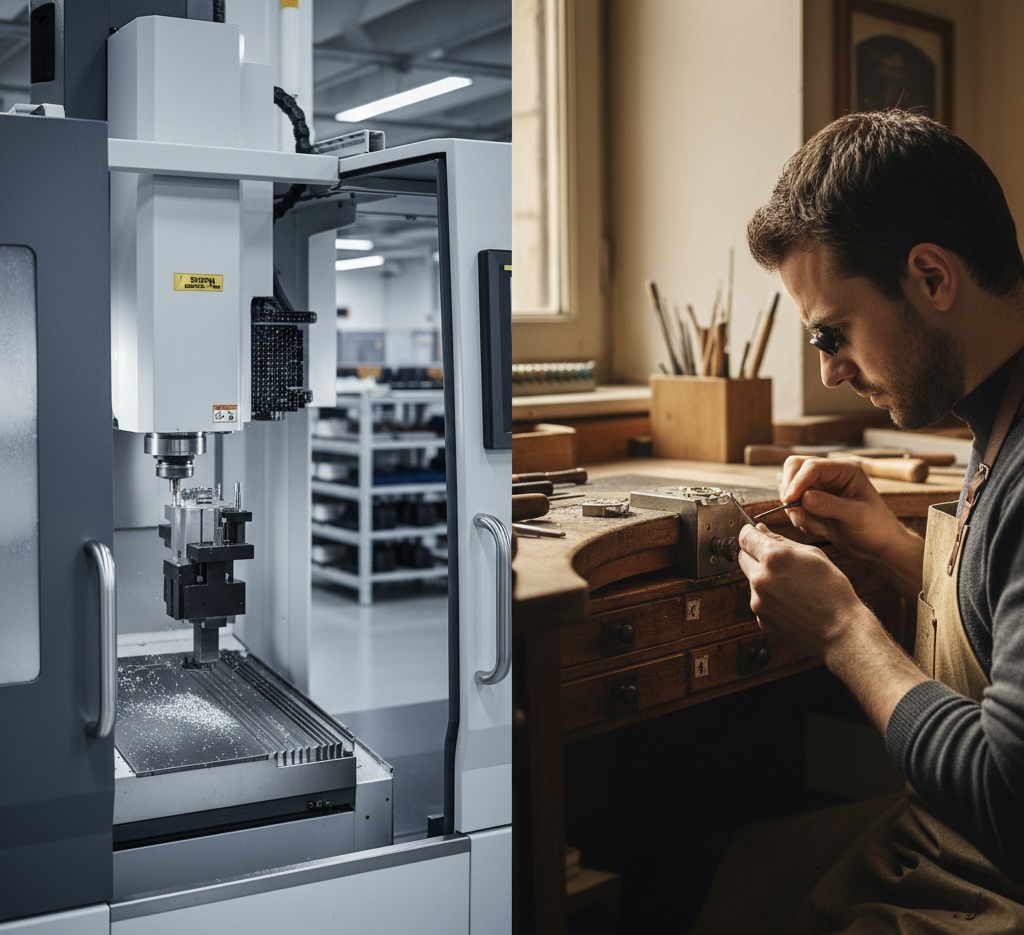
It is one of the best-organized, most automated production structures in the entire industry. Robots polishing cases. CNC machines cutting bridges. Processes designed so that each piece is almost identical to the previous one. It is one of the most well-structured companies in terms of modern production in the world, possessing almost cosmic technologies and machines. Of course, this does not mean that there is no manual human labor, which we associate with traditional Swiss manufactures, but it is a minority of the entire production process.
And this is not a flaw, but one of the reasons for their success.
So, we don't pretend that a serial Daytona is a hand-finished masterpiece in the spirit of an 18th-century manufacture, when it is a perfect industrial product. Repeatable, predictable, but safe, a great iconic watch with a long waiting list. And for the vast majority of customers, this is perfectly sufficient.
Except that luxury, the true kind for the ultra-demanding and not just Instagram, always had something more than perfect repeatability.
What they do in Carouge
Artisans de Genève does not buy watches, modify them, and sell them as a "new reference." They work exclusively on a watch that belongs to the client. This is not a legal detail but a fundamental aspect of their philosophy, a part of the company's DNA.
They don't "improve" a Rolex. They disassemble it down to the last screw, hand-finishing most components, and then reassemble it according to a design agreed upon with the client, which often involves very significant changes from the base reference.
If anyone has seen their skeletonized caliber 4130 under a loupe, they know it's not marketing. The bridges are hand-skeletonized and chamfered with a micro-file. Black polishing is often done for hours until the metal behaves like a mirror that absorbs light.
This is a level of work that simply doesn't exist in serial production because there's no room for it in the schedule or budget; it's neither necessary nor marketable.
Rolex has to produce a proverbial million watches a year, while Artisans can afford months of work on a single one.
These are two completely different worlds.
What convinces me the most is one thing
They set their own boundaries and do not work on vintage watches. They do not touch old references, which are historical documents, collector's items, and they respect this museum-worthy value. They accept watches younger than five years because they do not want to destroy history. They want to work on a contemporary industrial product whose modification will not disrupt its history.
For me, this is important because it shows that not only profit matters, but also respect for collectors, because it's easy to be a rebel at the expense of the past. It's harder to be a rebel who knows where to stop.
Does it make technical sense?
Yes, absolutely, if we're talking about the level of finishing.
A factory Rolex movement is solid, durable, and designed for reliability. But it's not a fetish of hand-finishing, and it doesn't have the celebration of detail you find in independent masters or companies like Lange & Söhne.
Artisans can elevate this level significantly, and it's not "more color." It's more handwork.
And finances?
I won't pretend this is a safe investment, as such a modified Rolex ceases to be classic from a purist's perspective. The secondary market is much narrower, and liquidity is lower. This is not a watch you buy to sell for a profit in three years.
But Artisans' projects now operate in a separate category. They don't compete with a serial Submariner. They compete among themselves. They are rare, have a story, and bear the owner's name.
This is not mainstream. This is a niche. A conscious one.
For example:
The Pearl Project (Patek Philippe 5711): An extreme challenge. Full skeletonization of the caliber 26-330 SC, chamfering of edges, and the application of black polish (mirror polishing) on the balance bridge. This is a level of finishing that places AdG in the same league as A. Lange & Söhne or Philippe Dufour.
The Lefty Project (John McEnroe): An engineering masterpiece. Rotating the movement 180 degrees to move the crown to the left side, which required a complete "deconstruction" of the Submariner.
L’Heure Solitaire (Gigi Buffon): Radical minimalism. Removal of the date display and two hands. Only one ("mono-sphere") remained, and the movement was converted to manual winding. Asceticism for a legend.
Paul Watson: An original moon phase module (28 parts) was added to the base caliber 3135, integrated with the date mechanism. The aventurine dial and hand-carved silver moons are a tribute to marine navigation.
Records that change the rules of the game
Modifications usually drastically reduce the value of a watch. AdG is the only exception that breaks this rule.
Absolute Ruby: A "one-of-one" project valued at nearly 555,000 USD. The development of the red sapphire dial alone took 2 years, and the search for 36 perfect "loupe-clean" rubies lasted over a year.
La Montoya: In the secondary market, these models fetch between 95,000 and 280,000 USD. This is the "Pinnacle of Modding" – an investment in uniqueness that breaks records at auctions.
Dispute with the giant and the TIMELAB seal
For years, AdG was a thorn in Rolex's side. However, a landmark ruling by the Swiss Supreme Court in 2024 defined a new freedom of craftsmanship, stating that an owner has every right to personalize their property.
To distance themselves from accusations of "amateur tuning," AdG is one of the few to submit its work to tests at TIMELAB. Each piece undergoes 26 checks for water resistance and precision, exceeding ISO standards. Although you lose the manufacturer's warranty, you receive a 7-year international AdG warranty and an official certificate from a state institution.
Foundations of mastery: The operational architecture of Artisans de Genève
Artisans de Genève (AdG) is a boutique public limited company (SA) based in Geneva, which operates more like an 18th-century manufacture than a modern production facility. At the heart of the workshop is a team of approximately 12 elite master watchmakers, each with a minimum of 15 years of experience working for the most prestigious watch companies in the world. The entire process of transforming a single watch involves a total of 26 specialists (the "52 hands"), passing through seven specialized departments: from the design office and artists, to material engineers and client advisors. The workshop possesses unique skills on a global scale for hand-skeletonizing using hair saws and files, which allows for achieving sharp internal angles inaccessible to CNC machines. Their technical capabilities enable them to work with extremely difficult materials, such as Namibian meteorites, Murano glass, tungsten, or forged carbon. Although the company does not publish official financial reports (data is confidential), and its share capital is 280,000 CHF, the scale of its success is evidenced by the cost of its services: from 30,000 to over 50,000 CHF for the modification alone, with limited capacity allowing for order fulfillment in an 8 to 12-month cycle.
Where I stand and what I think.
In most cases, I would leave the watch in its factory condition, because I like the fact that something was designed once and well. But on the other hand, I won't pretend that serial perfection exhausts the topic of luxury.
In a world where you see dozens of identical watches at every airport, the need for individualization is natural. Some do it with diamonds. Others with craftsmanship.
There is a fine line between a butcher and a surgeon because both intervene in the body of the watch.
The difference is whether the operation leaves a scar or a new quality.