WoW Investigations
SEIKO Sets the Pace: Why the Metronome is More of a Tool Watch Than Most.
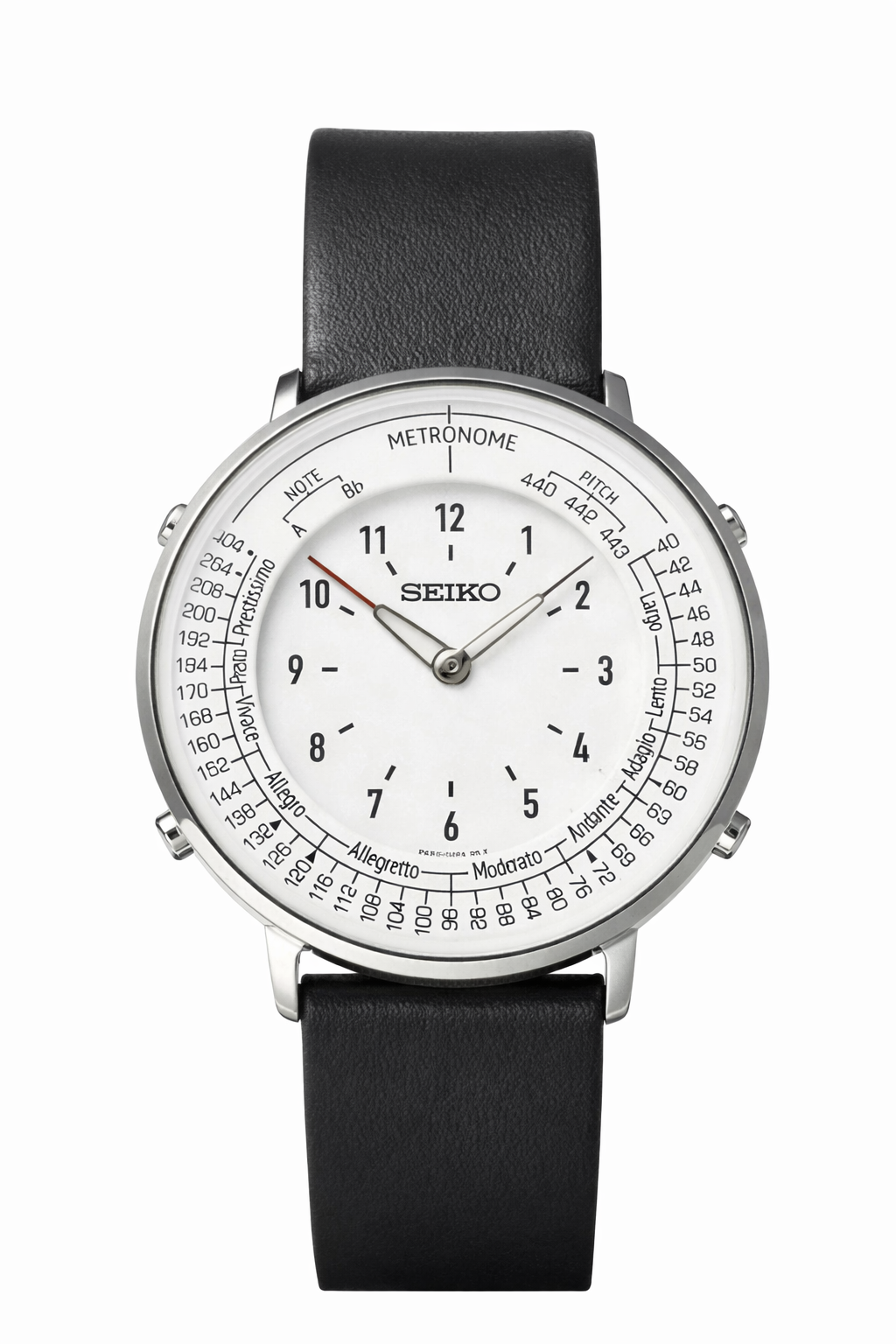
Seiko Metronome SMW is a true tool watch and a timepiece that gives rhythm to time.
Abuse of Definition
In the world of watches, the word "instrument" is often overused.
The Rolex Submariner is a "diver's instrument," although 99% of its examples have never seen depths greater than a hotel pool, hence the term "desk diver."
The IWC Big Pilot is an "aviator's tool," whose wearers more often gaze at the horizon from a business class window seat than from the cockpit.
And then something like the Seiko Metronome SMW appears, and suddenly the word "instrument" ceases to be a metaphor.
This is not a Seiko watch. And that is key.
The SMW series was not created within the structures of Seiko Watch Corporation but at Seiko Instruments Inc., and this is a fundamental difference, because SWC makes watches while SII makes electronic components, machine tools, printers, and... professional metronomes.
The SMW is not a "watch with a metronome function" but a full-fledged metronome packaged in a 36.5 mm case. And this difference is dramatic and palpable from the first press of a button.
Caliber PA50, a small rebel
At the heart of the series is the quartz caliber PA50, and this is not an ordinary quartz movement with an added buzzer, but a new dual-motor system designed for bidirectional operation.
A standard quartz movement operates in one direction, but this one must not only abruptly change direction but also oscillate the hand like a pendulum, generate a stable BPM signal, and emit reference tones of 440–443 Hz.
The best way to see how it works is in YouTube videos, but it's worth noting that when the metronome mode is activated, the hands instantly jump to the 10 and 2 o'clock positions, and the minute hand begins a rhythmic movement that is not just a "visual effect" but a physical simulation of a pendulum.
And that's why the watch has no seconds hand, as it would interfere with the metronome.
Legibility? Only if you're playing.
As a watch for telling time, it is perceived by users as moderate, as it has skeletonized hands that are quite similar to each other, despite a small red tip on the hour hand, and both are of similar length.
So a quick glance of "what time is it?" is not always comfortable.
However, in metronome mode, only one hand is active, and then everything makes sense, because this device was designed as if someone said:
"Time is a secondary function."
And this is a rare design honesty.
Bauhaus, but without nostalgia
The SMW006A model looks like a child of Max Bill and an engineer's calculator.
We see a white dial with thin indices and a rehaut with 41 BPM steps.
Interestingly, there are Italian markings: Largo, Moderato, or Allegro.
And all of this is functionalism in its purest form; there is no room for "heritage" and "since 1881" or any sentimental narrative.
Pure and useful information.
Locality as a filter (Japan domestic only)
The SMW debuted in 2022, not in watch boutiques, but in music stores.
In Japan, it costs the equivalent of about 140–185 USD; outside Japan, 200–300 USD.
The Fragment Design version? 1200–1500 USD, and in my opinion, this is the best proof that scarcity doesn't have to be artificial, and a watch doesn't have to be limited to be popular.
It's simply produced by a division that doesn't think in terms of hype. And that's why the hype appeared.
Fragment Design, or when an instrument becomes fashion
In 2026, Hiroshi Fujiwara introduced the PA50-00B0 version, with a completely different aesthetic. A double lightning bolt, a NATO strap, and an overall streetwear aesthetic.
And suddenly, boom! This metronome became a collector's item, which is an interesting sociological moment, as it was originally a typical tool for musicians and a quiet practice instrument.
Fragment transformed it into a cultural symbol.
Wouldn't an app be better?
"Why, when there's an app?" skeptics ask, and this is theoretically a valid argument. But only theoretically, because an app has notifications, and Instagram and other distractions run in the background. This watch has four physical buttons and doesn't vibrate, doesn't light up, and doesn't require background updates. It simply beats the rhythm, which in the digital age is a surprisingly analog experience.
The most important questions.
Is the Seiko Metronome a complication? Yes, if we define a complication as any function beyond time indication. But here we have something more; we have a watch that doesn't celebrate the past, doesn't build myths, doesn't pretend to be craftsmanship, and doesn't simulate luxury.
It simply works and does something that even the most expensive manufactures don't:
It sets the rhythm.
And the battery? When using the metronome daily for about 120 seconds at 120 BPM and using the reference tone function for about 20 seconds, it should last for about two years. In practice, frequent use of the metronome mode will significantly shorten this time, while using only the watch will allow the battery to last longer.
Paradox
In a world where a tourbillon is often just a marketing declaration of price,
a $200 metronome is a real working tool.
And perhaps that's why the SMW is one of the most honest watches of recent years, because it doesn't pretend to be more than it is. It is exactly what it claims to be.
An instrument.