WoW Investigations
Romain Jerome, when notoriety replaces the brand
Titanic, moon dust, Batman, and Pokémon. Romain Jerome managed to capture the attention of the entire watch world. Why wasn't this recognition enough for the brand to survive?
Titanic, moon dust, Pokémon, and 33 lost jobs. The story of a company that managed to make everyone talk about it, but failed to ensure its profitability.
It all started with a golf watch, which was supposed to be a groundbreaking and useful tool for players. Then came the Titanic, rust, moon dust, Batman, Super Mario, and Pokémon. Romain Jerome managed to turn almost any topic into a watch-related message, and for quite a few years, this was its greatest strength; marketing practically did itself. In time, it also became its problem.
Not because a watch cannot be fun, pop-cultural, or provocative. It can. But it's not enough for a brand to have more and more high-profile ideas that serve as agar for hordes of journalists, internet creators, or even just watch freaks sharing information on social media. Every product, including a watch, must be eagerly purchased, and at a price and in quantities that ensure profit. Unfortunately, it seems to me that many creators and entrepreneurs confuse dreams with reality. And they forget to answer a simple question: why should a client return to us specifically?
The watch that counted strokes
Romain Jerome was founded in 2004. The name came from the names of the founder's two sons, Alain Bajulaz. The initial direction was specific and grew out of a passion for golf, and watches for players were supposed to ensure success. The Golf Master Time counted holes, strokes, and the round score. This wasn't yet a watch trying to tell the story of the whole world, but it was meant to solve a specific problem and meet the expectations of golf enthusiasts.
However, the project did not gain sufficient market position. Specialization alone was not enough to build a brand capable of competing in the rather expensive segment of the watch market. The company needed an idea that would attract attention far beyond the golf course. In 2006, Yvan Arpa took the helm and radically changed direction. Golf disappeared, and in its place came the concept of "DNA of famous legends": watches containing materials linked to events and places known from history.
Titanic as material and story
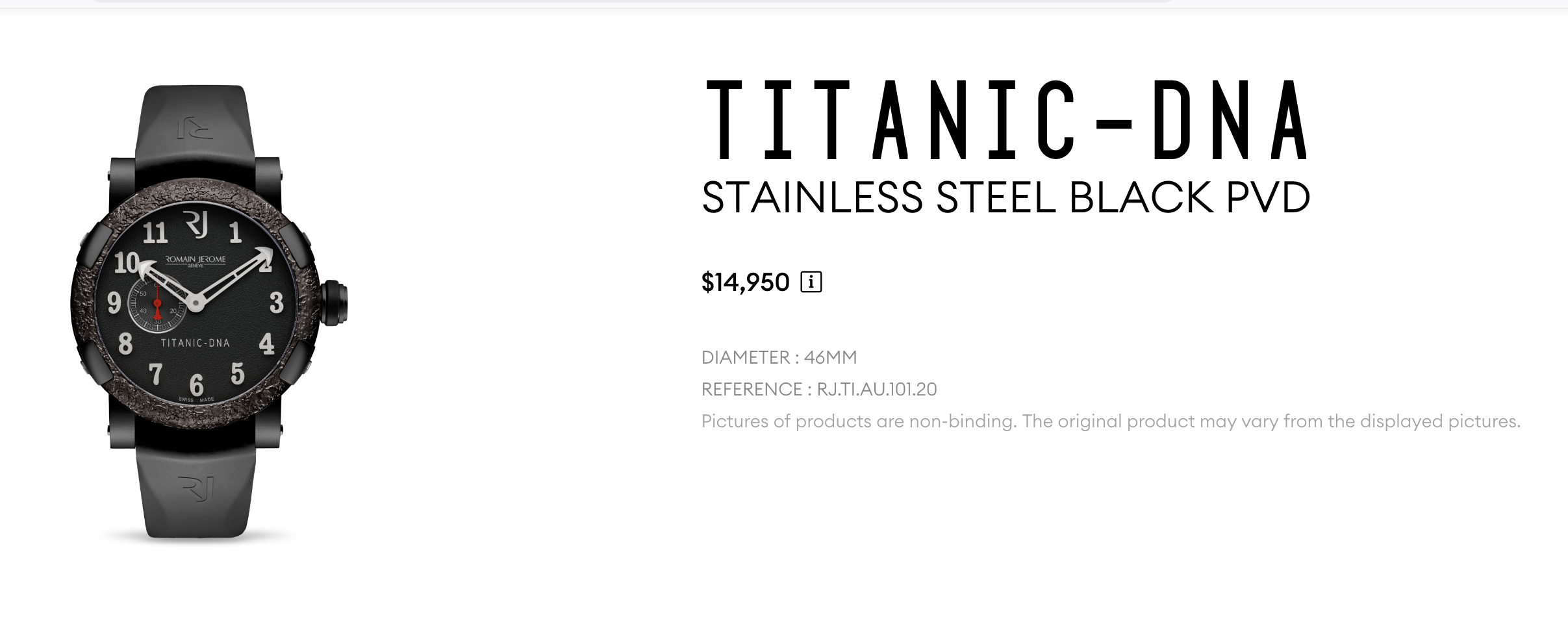
The most talked-about project became Titanic-DNA. The brand used steel associated with the Titanic wreck, of which it managed to acquire several kilograms, and the distinctive appearance of the cases referenced the corroded hull. It was an immediately understandable concept, and even someone unfamiliar with the movement or other nuances understood where the watch's theme came from.
This was an excellent answer to the problem of a young brand without centuries of tradition. Romain Jerome did not try to pretend it had centuries of history behind it. Instead, it placed a fragment of history into the case. One could consider this concept brilliant, exaggerated, or distasteful, but it was hard to mistake it for anything else.
This was where its strength and risk lay. The material was not a neutral raw material. The Titanic meant the death of over fifteen hundred people. The company spoke of memory and legend, but the very presence of tragedy in a luxury product raised the legitimate question of whether it was a tribute or already profiting from emotions? Publicity was certain, but publicity does not equal fame, and it was harder to build conviction around it that would last much longer than a campaign and the next launch.
Subsequent projects extended this logic to other areas: volcanoes, space, fragments related to lunar missions. These were watches that communicated their theme even before the owner had a chance to check the time; sometimes this reached absolute extremes, as, for example, the Day & Night model with two tourbillons did not tell time!
This is an impressive paradox, but also a question about the limits of common sense: when is a complication a watchmaking solution, and when does it become an argument that a high price and exclusivity suffice for all the functions with which a watch is associated?
From artifacts to pop culture heroes
After Arpa's departure, the brand did not abandon its ambition to stand out. During Manuel Emch's tenure, who took over in 2010, collaborations with pop culture played an increasingly important role. The offerings included watches inspired by Batman, Hello Kitty, Super Mario, and Pokémon.
By the way, how do you explain to a client who spent a small fortune on a watch with Titanic DNA that they should now buy a Hello Kitty? Truly, these design "pivots" were desperate.
They should not be dismissed as mere gadgets, as Romain Jerome attempted to combine licensed characters with mechanical watchmaking, unusual cases, and limited series. Such a product could be attractive to a collector who isn't looking for a classic dress watch. In 2017, Emch stated that the company sold approximately 1200 watches in the previous year and was then "on the verge of profitability." He also indicated that 2014 brought the company some profit. However, in my opinion, these were accounting juggles and an attempt to sugarcoat reality with PR messages. Mathematics is brutal and does not tolerate inaccuracies; either you make money and have positive cash flow, or you mislead the media, which always ends eventually when there's no money to cover costs.
Thus, subsequent collections created an increasingly rich catalog of themes, but not necessarily an increasingly strong answer to the question of what the brand actually was. Its language stretched from material traces of disasters and historical events to game and comic book characters. This did not have to be contradictory by definition. However, it required a common denominator stronger than "things that will attract attention."
The difficult difference between a launch and a brand
Romain Jerome had something many young companies could envy: it could regularly generate interest. The brand was not invisible, and its watches appeared in the media, sparked discussions, and did not resemble the conservative designs of competitors. But media recognition is not the same as lasting advantage.
A launch can be built around the Titanic. The next around Batman. Yet another around Pokémon. Each of these themes can attract its own audience, but the audience does not always transition from one product to another. A fan of a watch with a historical artifact does not necessarily want to buy a model with a game character. A game fan is not necessarily a client ready to pay for a mechanical watch at the price of a luxury good.
This is the trap of a strategy based on successive strong stimuli: a company can grow in reach without growing as quickly in loyalty or sales volume. Publicity brings a client to the storefront, but only a consistent product, reliable service, and a brand promise determine whether the client buys and stays for longer.
The last chapter was written by the shareholder
In 2018, Marco Tedeschi took over management, and the brand began operating under the name RJ Watches. The new ARRAW collection was intended to streamline the offering and become its recognizable core. The development of RJ Studio was also announced. This was an attempt to give the project a more stable foundation.
There wasn't enough time to see if the plan would yield results. On February 27, 2020, the company announced that its main shareholder, Alliance Investment Group SA, would cease funding it. A bankruptcy petition was filed, and 33 employees lost their jobs. In December 2019, the investor was still said to be maintaining confidence in the company. For Tedeschi, the decision was sudden and surprising. The company's revenues were around 10 million Swiss francs, but RJ was still not profitable, and management enigmatically assumed it might achieve profitability in the coming years.
The COVID-19 pandemic appeared in headlines reporting the collapse, but the coincidence in time should not be confused with a proven cause. Romain Jerome declared bankruptcy at the end of February.
And this is where the most important lesson lies, which is not "focusing on profit is bad." A company without profit cannot sustain people, service, distribution, or production. But the ambition for growth, as well as the push for breakeven, does not go hand in hand with financial resilience, and brand development depends on successive capital injections from a single investor. When the investor cuts funding, even the most impressive catalog does not give the company time to save itself.
The lesson is that publicity alone is not enough if watches are not eagerly purchased and their value on the secondary market does not drop by 3/4. The lesson is that it's not enough for a company and its watches to be talked about; they must sell in sufficient quantities and at an appropriate price, and the client must be satisfied even after purchase and have an appetite for more, rather than regretting what they fell for.
A watch can attract attention. A brand must retain it.
Romain Jerome did not fail because it tried to be different. Its distinctiveness was its asset. Nor did it fail because it used pop culture, as there are many examples of how successful collaborations can expand the market if they are part of a recognizable identity. In this case, the problem was that successive ideas too often had to carry the brand themselves.
The company's history shows that you can build a product that the entire watch world talks about, and still not build a business that can survive independently. You can sell a story about the Titanic and then have no answer to the question of what connects it to Pokémon. You can build recognition, but lack a sufficient customer base, predictable profitability, and independence from a shareholder's decisions.
Romain Jerome was, therefore, both a communication success and a business warning. Publicity opens doors but does not keep a company alive. For that, you need a product whose meaning lasts longer than a campaign, a brand that doesn't have to reinvent itself every time, and a financial model that doesn't disappear with a single transfer.