WoW Investigations
Richard Mille and the paradox of modern luxury
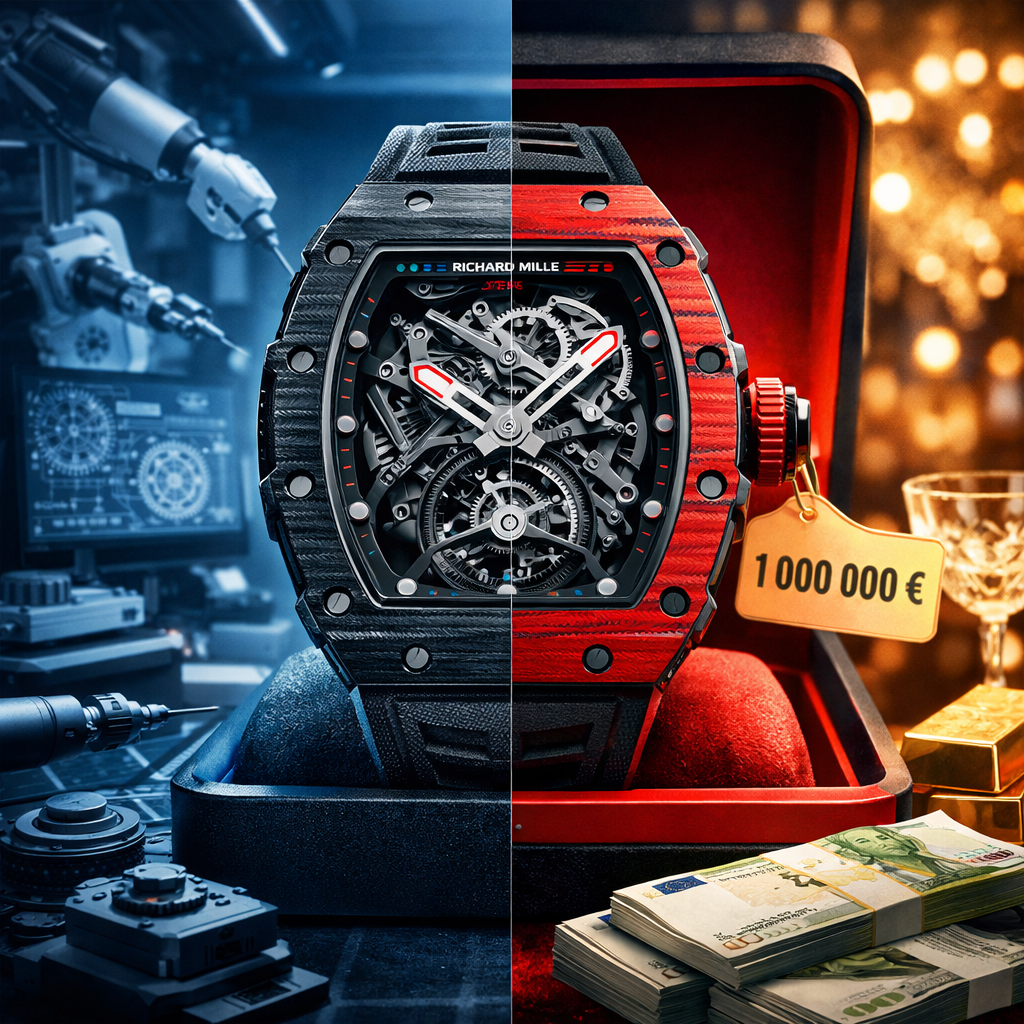
Is Richard Mille the pinnacle of watchmaking engineering, or the most expensive marketing experiment in the industry's history?
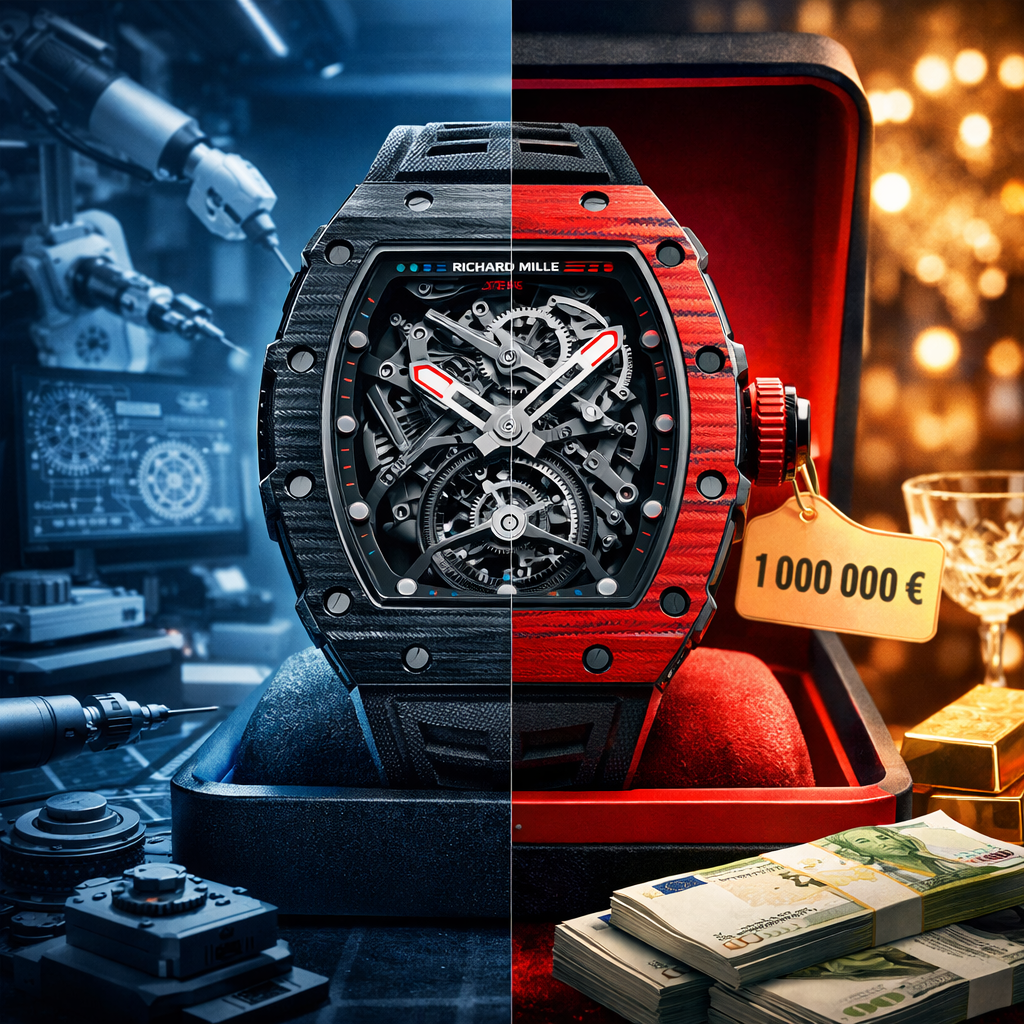
Are these watches "worth their price," or have they simply redefined value?
The Richard Mille brand ignites passionate debates and is, in essence, a debate about what luxury truly means today. At its core, two main currents clash. One argues that the brand is primarily built on hype, celebrities, and inflated prices for billionaires, while the other speaks of cosmic technology, otherworldly materials, and parameters unattainable by other companies. This is why the dispute over RM so rarely ends in agreement, because while one side views these watches as blasphemy against tradition, the other sees them as the most brilliant business model in the contemporary industry.
Both sides have some truth to their arguments, and I will attempt to examine this in more detail.
The problem is that Richard Mille no longer competes in the same category as classic haute horlogerie. It's not just "a different aesthetic" but an entirely different logic of value.
The Absurdity of Price.
The brand was conceived as a radical project. Richard Mille and Dominique Guenat didn't build another company based on 19th-century heritage, but a product designed to look and function like an engineering object from the era of Formula 1, aviation, and composite materials. The first RM 001 from 2001 didn't enter the market as a subtle alternative to Patek or Vacheron, but as a manifesto: a watch could be ostentatiously technical, skeletonized, lightweight, aggressive, and absurdly expensive from the start. This is well illustrated by an anecdote about a pricing error, where, on already printed materials, it turned out the watch had an extra zero. But the decision-makers decided to leave it as is. And it worked.
Today, price is the most recognizable distinguishing feature, as the most "accessible" models usually start around 80–100 thousand euros, most references cost 150–350 thousand euros, and in the case of the most advanced constructions, especially limited tourbillons or watches with sapphire cases, prices can reach 700 thousand euros, and sometimes even over a million euros.
Technology as the Main Narrative Axis.
What Richard Mille did best was to shift the focus from classic complications to material engineering and functional resistance. In traditional watchmaking, prestige is built through hand-finishing, movement architecture, complications, and stylistic continuity. RM added a different language: Carbon TPT, Quartz TPT, grade 5 titanium, sapphires, extreme weight reduction, shock resistance, and wrist ergonomics for sports activities. A symbolic summary of this philosophy is the RM 27-05 Rafael Nadal: 11.5 grams without the strap, resistance up to 14,000 G, and limited to 80 pieces. This is no longer just a sports watch with a tourbillon. It's a demonstration of technological dominance over the limitations of classical mechanics.
The aforementioned Carbon TPT, Quartz TPT, grade 5 titanium, and sapphire cases are not merely a stylistic experiment, but part of a perfectly designed technological narrative.
For example, Carbon TPT is made from hundreds of ultra-thin layers of carbon fiber arranged at different angles and hardened under high pressure. The result is simultaneously incredibly light, very rigid, and visually unique, as the material's structure resembles wood grain, making each case one-of-a-kind.
The Production Model in the Background.
One of the most frequently asked questions about Richard Mille is who actually produces these watches. In the world of luxury watchmaking, the word "manufacture" has become an almost magical incantation, suggesting an image of a closed, self-sufficient fortress where everything is created under one roof. The reality is much more complex, and Richard Mille is one of the most interesting examples of this complexity.
The brand's technological hub remains Les Breuleux in the Jura, where Guenat SA Montres Valgine, a company associated with Richard Mille's project from the beginning, operates. This is where structural design, movement architecture development, and final watch assembly take place. However, an industrial base has grown around this core, also including specialized production facilities such as ProArt, responsible for, among other things, titanium and composite processing, and the production of movement and case components.
At the same time, Richard Mille has always relied on collaboration with the industry's most advanced technological partners. The most complex mechanical constructions were developed with the participation of Audemars Piguet Renaud & Papi (APRP), one of the most prestigious design workshops in Swiss watchmaking, specializing in the most complicated calibers. In the case of some automatic movements, solutions developed by Vaucher Manufacture Fleurier, known for producing high-end movements for many brands, are also used.
An equally important partner is NTPT (North Thin Ply Technology), which is responsible for the development of composite materials such as Carbon TPT and Quartz TPT. It is thanks to this collaboration that Richard Mille introduced technologies previously used mainly in the aerospace industry, regatta yachts, and Formula 1 cars into watchmaking.
As a result, Richard Mille's production model resembles a system for integrating the most specialized technological competencies rather than a classic manufacture. So, in a world that still likes to tell stories about solitary master watchmakers at their benches, Richard Mille is more like a project built by a team of Formula 1 engineers.
Paradoxes.
This is where the first paradox arises. Purists are largely right when they say that Richard Mille often doesn't offer the kind of hand-finishing they would expect from a watch costing hundreds of thousands or millions. If someone grew up with the logic of Dufour, Voutilainen, Roth, or classic Pateks, they will look at RM and see the triumph of industrial aesthetics rather than the traditional beauty of a movement.
Unfortunately, the relentless market has been telling watch romantics something very inconvenient for several years: that the highest segment no longer rewards only tradition, but also selective rarity, recognition, and technological narrative. According to estimates by Morgan Stanley and LuxeConsult, Richard Mille sold approximately 5,950 watches in 2025, generating around 1.75 billion CHF with an average revenue of 294 thousand CHF per piece. At the same time, the four largest private brands, namely Rolex, Patek Philippe, Audemars Piguet, and Richard Mille, already controlled over half of the Swiss market in terms of value, and the segment above 50 thousand CHF accounted for 37% of export value with only 1.4% of the volume of units.
Richard Mille is not a fringe player or an exotic anomaly, but one of the most profitable models in the entire industry. And not because it produces a lot, but precisely because it produces extremely little and very effectively sells the idea that access is part of the product. In this sense, RM operates more like Hermès, Ferrari, or a private club than a classic manufacture in the old sense of the word. The boutique's primary function is not to sell, but to effectively filter clients.
The scarcity at Richard Mille is not solely a result of low production. It is also the result of precisely managed, global selective distribution. The brand's official network covers key centers of wealth and mobility from the USA and Western Europe to the Middle East and Asia, but its primary function is not mass sales, but control of access, relationships, and allocation. In this sense, a Richard Mille boutique does not function like a traditional watch store, but as an entry point to a closed system for distributing status.
The second pillar of this strategy is the so-called "friends of the brand." This is important because, at Richard Mille, an ambassador is not just the face of a campaign. They are meant to be proof of utility. Nadal playing with a tourbillon on the court is not just a celebrity in an advertisement, but a kind of technical argument. The same applies to the entire logic of collaboration with athletes, drivers, and artists. Even John Malkovich, associated with the brand since 2016 and with the RM 67-01, does not play the role of a classic red-carpet endorser here, but is meant to visually legitimize another facet of the brand: not brutal sport, but controlled, elite, and sophisticated modernity.
Richard Mille today primarily sells a position in a hierarchy recognizable to a very narrow group of people. Rolex has become too widely available and "cheap" a symbol of success, and Patek is decidedly too discreet, and thus less socially legible for many. Richard Mille, on the other hand, is immediately identifiable from several meters away and without conversation, as well as without the need to explain what is on one's wrist. In an era of hyper-luxury, a gigantic oversupply of money, and the incredibly rapid enrichment of relatively large groups, especially in countries with enormous social stratification, this is a huge advantage.
Risks.
This, of course, does not mean that RM is free from risks, because in my opinion, its strength is also its weakness. The brand's style is so aggressively rooted in the aesthetics of the 21st century that it is difficult to predict today how it will age. A classic Calatrava or an old Breguet may seem more boring, but they are much more resistant to changes in taste. Richard Mille largely thrives on the energy of its own era: sport, celebrity, performance, ostentatious "Dubai" luxury, and the need for conspicuous distinctiveness. If this aesthetic weakens, some models may lose their aura faster than their owners would care to admit. This is a real risk, even if the secondary market remains exceptionally strong for the brand today.
It should also be remembered that owning a watch of this brand also means entering a specific service system. Watches are serviced in a global network of workshops operating in Paris, London, Singapore, and Los Angeles, among other locations. In the case of the most complicated movements, work is sent back to Switzerland. Service costs, which can run into many thousands of dollars, are in practice part of the economics of owning such a watch, on the principle of "if you have a lot, pay a lot." And whether they will be serviceable for future generations, only time will tell.
Counterfeits.
One of the less elegant but inevitable consequences of Richard Mille's success is the scale of the counterfeit market. With watches reaching prices of several hundred thousand dollars, the temptation is obvious. In the case of this brand, however, there is another element: the aforementioned extraordinary recognizability of its form. The characteristic tonneau case and aggressive, skeletonized architecture make Richard Mille one of the few watches that can be recognized from several meters away, even by a novice watch enthusiast. However, the paradox is that the same feature that makes the watch an ideal status symbol also makes it an attractive target for counterfeiters.
Of course, a counterfeit remains a counterfeit, as both legally and morally it is simply theft of intellectual property. At the same time, however, it must be honestly admitted that in the case of Richard Mille, the line between authentic and imitation can be surprisingly difficult for the untrained eye to discern. Not because counterfeits technologically match the originals, but because the vast majority of people have never had the opportunity to see a real example up close. As a result, the reference point for evaluation becomes not the real object, but internet photos.
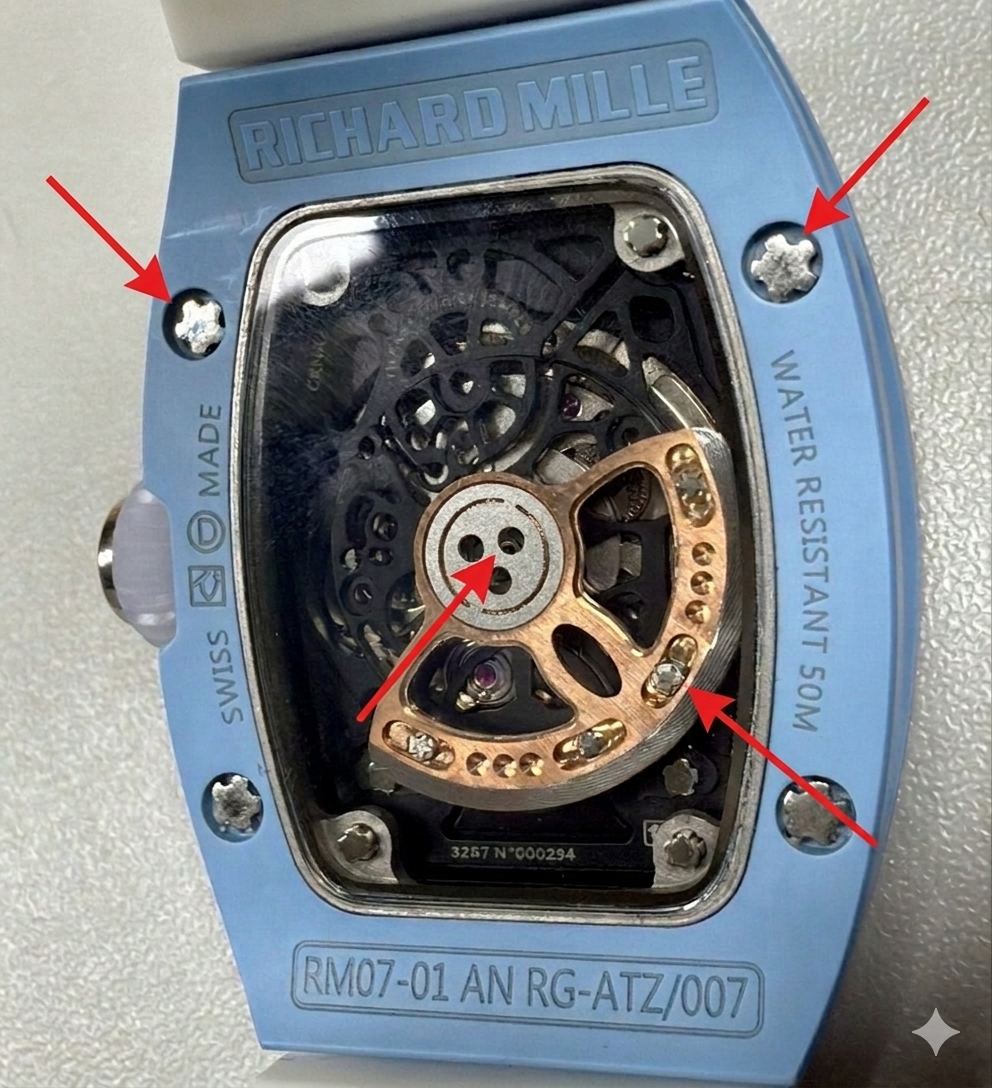
I once had the opportunity to experience this very concretely. A man contacted me claiming he had the opportunity to buy a Richard Mille at a "bargain" price. The story was classic: the watch was supposedly a family gift, someone urgently needed cash, and the price, though still high, was only 25% of the market value. At first glance, everything looked convincing. Only when he sent more detailed photos could one spot the small details betraying the forgery: minimal differences in screw finishing, a slightly different geometry, and deviations in the engravings. Things that ninety-nine percent of people would never notice.
And therein lies the paradox. Richard Mille is one of the most recognizable watches in the world, and at the same time one of the most difficult to verify for someone without experience with the product. As a result, counterfeits often function not because they are perfect, but because most observers lack a point of reference.
Revaluation.
Therefore, the question "is Richard Mille overvalued?" is essentially somewhat ill-posed, because it is definitely overvalued if measured by the standards of the traditional world, i.e., the amount of hand-finishing, historical achievements, discretion of form, and a typically horological definition of beauty. But it can be priced entirely rationally if one accepts that contemporary luxury today rewards something different: extreme selectivity, technological narrative, immediate status, and the ability to maintain value in the wealthiest segment of the market.
My heart is closer to the approach of a work of art than a work of money concentrated on the wrist, which looks good on Instagram surrounded by inflated women dancing in a champagne pool on the 99th floor with a view of the world's tallest building.
In the past, the pinnacle of luxury was supposed to be what was most laborious, subtle, and rooted in tradition, but today, the pinnacle of luxury is increasingly what is most limited, most visible, and most effective as a sign of belonging. And the most expensive.
Richard Mille, therefore, did not overturn the old definition of value, but did something worse.
It showed that for the market, it is no longer the only valid one.