WoW Investigations
Pathology of success and semantics of trust
About Patryk Vega, the film "Putin," and a non-factory Rolex as symbols of success narratives, manipulation, and investment risk.
The Pathology of Success and the Semantics of Trust
On Patryk Vega, the film Putin, and the watch that said too much
In the world of money, power, and ambition, nothing is accidental. Neither promises of 700% profits nor the way they are packaged. Sometimes, one detail, a watch, is enough to understand that something is amiss. The case of Patryk Vega, the film Putin, and a non-factory Rolex is a case study that can no longer be dismissed as an "unsuccessful film project."
From director to systemic visionary
For years, Patryk Vega built his position on an aesthetic of brutality and a "Western" flair: quick cuts, gritty police realism, a world presented as a permanent conflict. This style was consistent and, during the Pitbull series, was even effective.
The problem arose when the director decided to jump several rungs at once: from genre cinema to global recognition, and from the position of a creator to that of an investment guru.
The Putin project was not just meant to be a film. It was supposed to become a financial vehicle and proof that, thanks to allegedly unique knowledge and "new technologies," traditional market rules could be circumvented. In practice, it was a classic example of a principle known to every auditor: the weaker the foundations, the louder the story.
The architecture of promises
The declarations made in AIO Studios' promotional materials sounded like every investor's dream:
global distribution in 35 countries, a potential audience of 3.2 billion people, and a promised return of 435–700%.
These were not metaphors or journalistic shortcuts. These were concrete numbers whose sole function was to lull vigilance. The market, as always, brutally verified them.
Sales psychology instead of business
Investors' accounts form a coherent, almost textbook manipulative whole:
time pressure ("last chance"), personalization of the message ("I'm holding a pool for you"), and media legitimization (appearances on major stations, such as Telewizja Polsat).
However, what happened next is crucial. When the case went to court, the narrative changed dramatically:
"cinema is a risky business," "half of films don't break even."
This is true, but it was not the truth communicated to investors when capital was being raised. This contradiction is one of the strongest warning signs in the entire story.
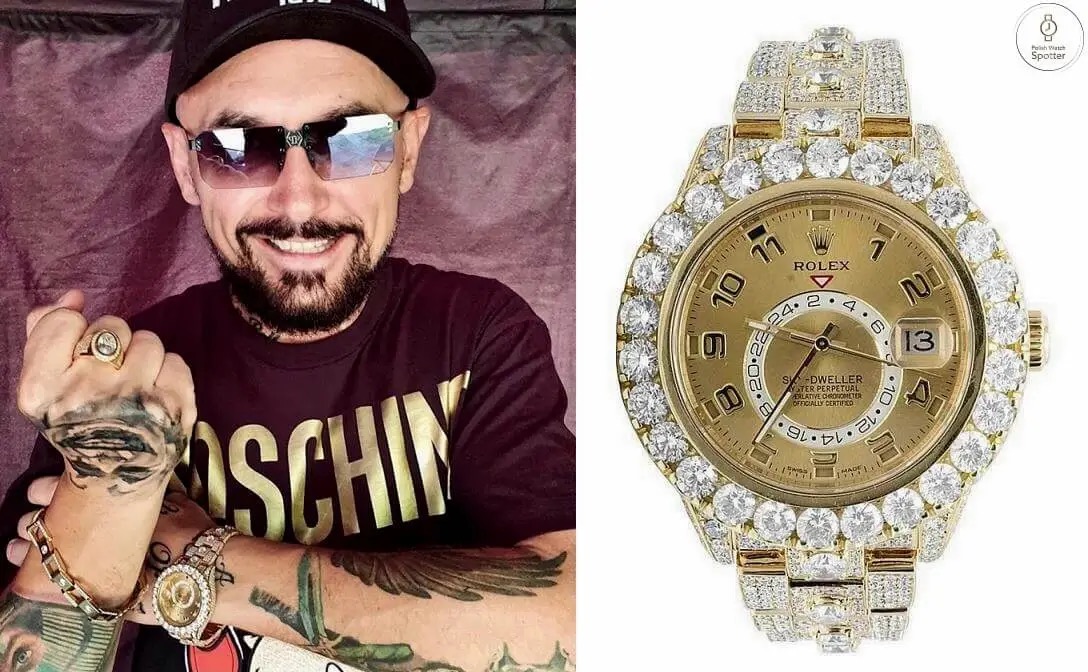
Rolex, or when a watch betrays its owner
In the world of luxury watches, details are merciless. An original Rolex, especially in versions studded with precious stones, is not only a celebrity watch but also a carrier of status and value provided we are talking about a factory configuration.
Any non-factory intervention, especially so-called "aftermarket" stones, added by unknown parties and of unknown quality, destroys the meaning of such a watch in every aspect. Moreover, such pseudo-jewellery modifications often irreversibly damage the structure of the case or bracelet.
Wearing such a watch sends very clear signals:
form over substance, questionable visual effect instead of real value, and the aesthetic of bling as a smokescreen. This is a language well-known from so-called high-risk profiles.
The analogy with the film Putin does not even need to be deepened. It's the same mechanism:
promises instead of certification, glitter instead of quality, narrative instead of market.