WoW Investigations
Patek Philippe off the wrist
50th Anniversary of the Nautilus and a Desk Clock – A Confluence of History in 2026
Why does this brand make desk clocks when the world only wants the Nautilus?
In the year the Nautilus celebrates its 50th anniversary, Patek Philippe does something that, at first glance, seems a bit odd. Instead of further hyping the icon and creating a dozen more variations of a model that sells itself, creating queues, waiting lists, and a secondary market, it once again showcases desk clocks.
And this isn't just a curiosity; it's a full-fledged element of its collection. So, this is a moment to pause and ask ourselves: does Patek truly live by the Nautilus, or does the Nautilus live by Patek?
A success that overshadowed everything
The Nautilus has become more than a watch; today, it's a kind of shorthand, a symbol, and a status instrument.
Gérald Genta's design, a steel case, sporty elegance, and unavailability that managed to create such an oddity as investment courses in watches! In our market, one celebrity leads the way, someone who doesn't know much about watches but is quite adept at marketing, which led a multitude of the unaware to fall for 5999 PLN, even on installments, for obvious hindsight analysis.
But returning to the point, the problem is that the Nautilus is just a fragment of this esteemed brand, and let's add that it's a rather negligible fragment in the entire portfolio. Because if you look at Patek Philippe honestly, its ambitions were never tied to one model, one line, or even one watch format.
Patek doesn't want to make "the best watches" but to control time as an idea and as an object, and that's why it returns to stationary clocks, in this desk clock iteration.
Before the Nautilus, there was the cabinet
As I've already written, desk clocks at Patek Philippe are not an addition to the collection but are its original form. It was in this segment that the most extreme constructions were created, commissioned for people like Packard or Graves. Where there were no limitations of the case, ergonomics, or wearing comfort.
Where the only limitations were imagination and budget, and from this perspective, a wristwatch is a compromise, a desk clock is not.
Engineering without alibi
A contemporary example of this thinking is the Patek Philippe Ref. 27000M-001, shown exactly a year ago.
At the heart of this clock is a newly developed, hand-wound movement with a 31-day power reserve. In addition, there are nine patented solutions that are not there just to look good in marketing materials, but to solve a real problem: the stability of the movement's operation throughout its entire period. An accuracy of about one second per day in such a device is a sufficient argument.
Seven years of work and over 900 components.
time displayed on a separate sub-dial
perpetual calendar
moon phases
day, month
week number
day/night indication
leap year cycle
925 sterling silver, Grand Feu enamel on a guilloché pattern, plus American walnut wood and a winding key that is a small work of art in itself (photos via Fratello)
This is not a product designed for the market, but it is a grand (ambiguously grand) construction designed to prove that limitations are a choice, not a necessity, and while such a construction would be absurd in a wristwatch, on a desk it becomes beautifully logical.
2026 is the year the icon hits the desk
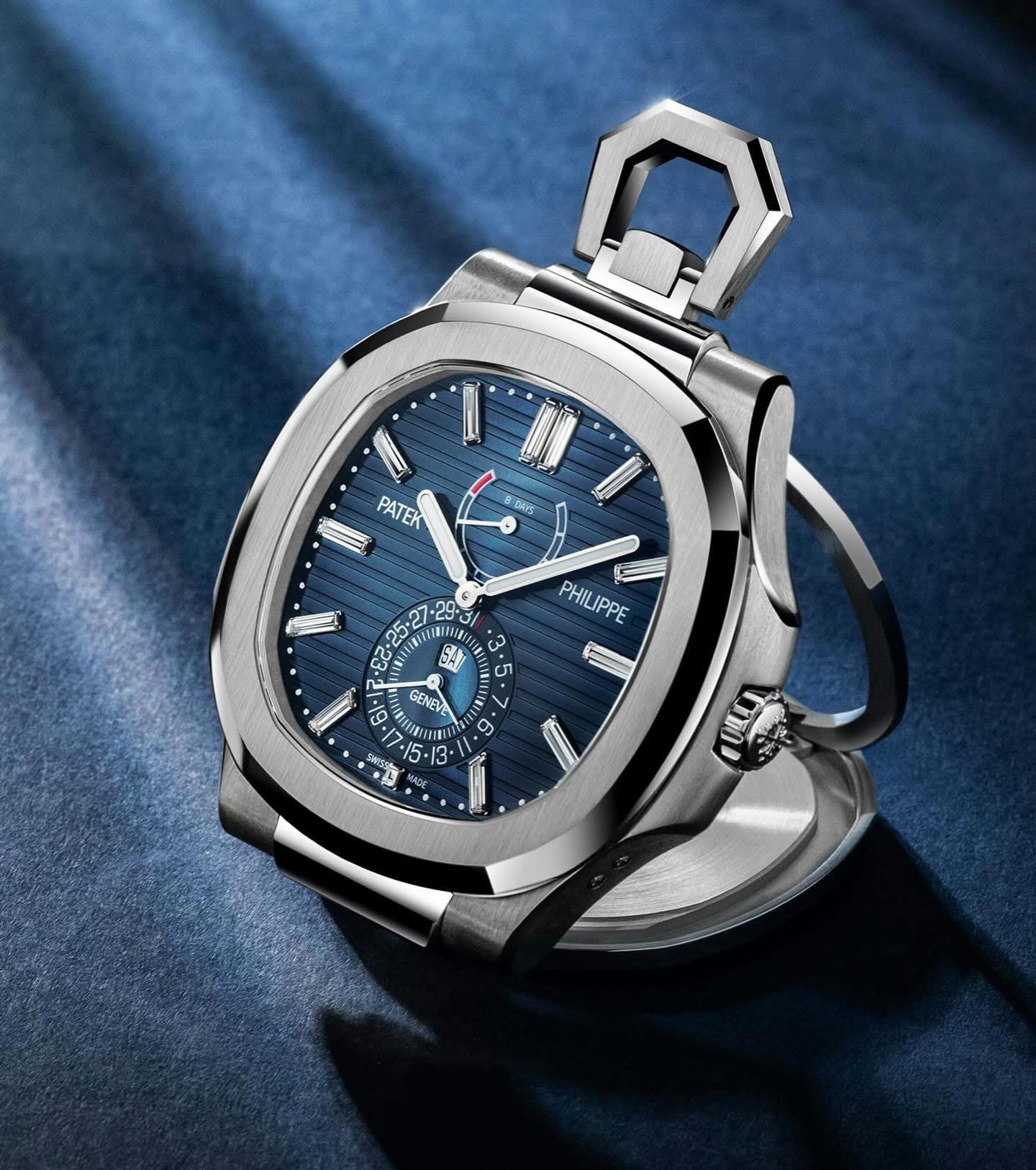
We have it! Patek Philippe Nautilus Ref. 958G-001.
The watch, which for half a century was a symbol of mobility and personal status, is enclosed in an object that, by definition, does not move, as it stands quietly in a prominent place, to be admired rather than to tell the time.
Patek successfully transferred all elements of the Nautilus – the shape, color, and texture of the dial, the indication functions, the hands, and even the case back, which serves as a stand – into a beautiful desk clock form.
And now, something I usually avoid, but must describe here: the technical specifications.
Technical Parameters
Case
material: 18k white gold (palladium alloy)
diameter: approx. 50.65 mm
thickness: approx. 13.5 mm
construction: hinged cover (serves as a support / stand)
form inspired by the classic Nautilus "porthole"
Dial
color: sunburst blue with horizontal embossing (classic Nautilus)
indices: baguette diamonds (~0.96 ct)
hands: white gold + luminescent material
Movement
caliber: 31-505 8J PS IRM CI J
winding: manual
number of parts: approx. 256
escapement: Pulsomax® (Silinvar)
Functions
hours, minutes
small seconds
date (pointer)
day of the week (aperture)
power reserve indicator
Power Reserve
8 days (192 hours) and a "9th day" as a reserve zone (red field)
Limitation and Price
limit: 100 pieces
list price: approx. 205,000 CHF
I have two remarks to add: first, I can't afford it, and second, for PP and such a model, it's cheap, so I don't think any client could simply order it unless they were a global star or a leader of a top-ten country.
The moment when a clock ceases to be a clock
And here, to the very end, to the point where this whole story ceases to be abstract.
One can talk about mechanics, history, as well as calibers and complications.
But one only needs to look at such an object to understand that all of this is just a superficial layer, and this is not just a clock. We can buy "just a clock" at Ikea, but this is an object that uses time as a pretext for its existence. Enamel, gold, reliefs, proportions, and everything here says one thing: function is secondary, and the movement is needed so that the whole is not "just" a decoration.
But it could just as well not be there, and the meaning of this object would not change.
The Nautilus says – I am an icon, and the desk Nautilus says – and I have no limitations.
Photo: Hodinkee
The clock as an object of power
A wristwatch is personal, but a desk clock is not, because it no longer belongs only to the user but also to the space where others are present.
It doesn't communicate style, or at least not exclusively style; it communicates position, and in this sense, it is closer to architecture than to watchmaking.
And that's why Patek never abandoned them, because they also communicate Patek's position, which will increasingly be "nibbled at" by, for example, Lange & Söhne.
Why now?
The 50th anniversary of the Nautilus is the perfect moment for such a move, because when you have a product that sells itself, you can afford to remind people that it doesn't define the brand. And given what I wrote above, "can" is perhaps not enough. You start to *have* to remind people that the king may be old, but it's not yet time for a new one to arrive.