WoW Investigations
Mediocrity at an exceptional price
MoonSwatch and Scuba Fifty Fathoms are examples of how an average product can be priced extraordinarily when selling a logo and emotion instead of technology and durability.
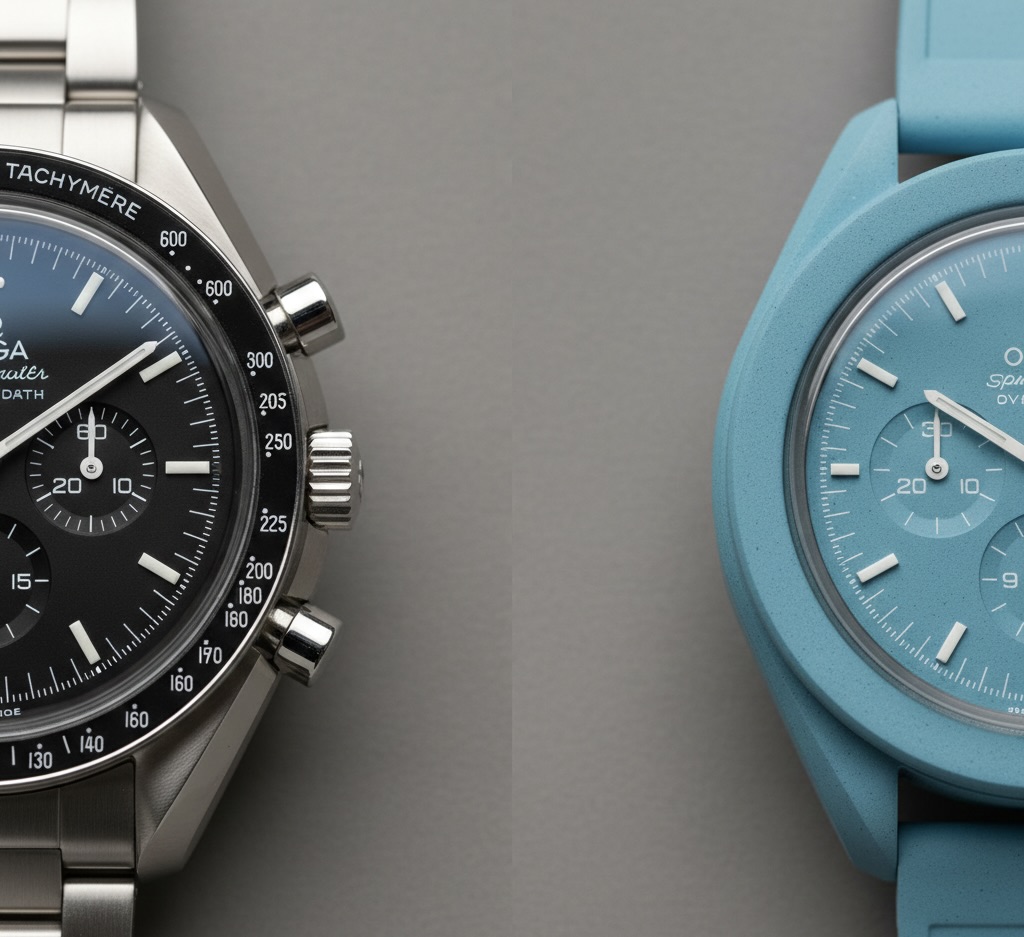
A Study of the Marketing Phenomena of MoonSwatch and Scuba Fifty Fathoms as an Ersatz for Omega and Blancpain
In the history of watchmaking, there are moments when technology doesn't change, but perception completely shifts. No new caliber emerges, no groundbreaking complication is created, no better material is developed. Something more subtle changes: the relationship between a product and its name. This change doesn't happen on its own; it is solely a product of marketing. If I could call anything a brilliant marketing shell, it would be the models described below.
The launches of MoonSwatch (2022) and Scuba Fifty Fathoms (2023) are precisely such moments. Not because they introduced new quality to watchmaking, but because they showed how far a brand can be separated from its realities and quality, and how effectively an inflated narrative alone can be priced.
1. Construction, or a Watch Without Aspirations for Durability
The MoonSwatch is equipped with an ETA G10 quartz movement.
The Scuba Fifty Fathoms features an automatic Sistem51 movement.
Neither movement was developed by Omega or Blancpain. They are Swatch products. Structurally mass-produced, designed for industrial repeatability and minimization of assembly costs, and commonly used across the entire model range of very inexpensive watches.
Something else is also crucial: the service philosophy.
The construction of the MoonSwatch practically limits repair possibilities.
The Sistem51, despite being mechanical, is modular and fully automatically assembled. The primary assumption in case of problems is replacement with a new movement, not repair or regulation.
In a traditional watch, even a very budget-friendly one, the movement is serviced, while at Swatch, it is replaced with a new one.
We have a good name for this: a disposable item. It strongly contradicts what the Swatch Group tries to convince us of – that these are cheaper, more fashionable models, but still Omega and Blancpain.
The truth, however, is painful: it's an expensive plastic disposable item.
2. Material with a Beautiful Name: Bioceramic as a New Wonder.
The cases are made of a material called bioceramic, a composite containing ceramic powder and a bio-sourced polymer, whose functional properties, however, place it closer to modern plastics than to technical ceramics used in premium watch segments. It is light, warm to the touch, and easy to color. At the same time, it is susceptible to scratches and irreparable in the classic sense of machining.
So, again, a disposable item.
What is not controversial in a watch costing a few hundred zlotys should not be used in a watch bearing the name Speedmaster from Omega or Fifty Fathoms from Blancpain.
3. Price as a Psychological Construct
In the price range of MoonSwatch and Scuba FF, one can find steel watches equipped with sapphire crystals, serviceable automatic movements, and classic case constructions.
The real problem lies mainly in the name, and the "price premium" results almost exclusively from the use of design similarity and branding of luxury brands. The product does not adopt their technology, their level of finishing, their standards of durability, or anything good that could genuinely justify the price or the use of the logo.
It adopts their myth, which is the opposite of the classic luxury model where the brand was a consequence of quality. Here, quality is a consequence of price, and price is only a consequence of the brand.
4. Hype and its Expiration
The first months of sales brought speculative price increases in the secondary market. Queues in front of boutiques became part of the marketing message. The project thus achieved its goal: it introduced "luxury brands" into mass discussion, created great market expectations, artificially sustained supply limitations, second-hand resale, and all other phenomena previously known from entirely different brands, e.g., Rolex.
However, the market quickly became saturated, and secondary prices stabilized. Emotion ceased to be scarce.
Then, the pure user-product relationship began to operate.
And this relationship is less spectacular, although the "magic" still works. Partially.
5. Final Observation
In the case of one of the variants called "Mission to Neptune," a problem of skin staining arose, as the pigment sometimes transferred to the wrist during use.
In a mass-produced watch costing a few dozen euros, such an event falls within some variant of tolerance, but an Omega x Swatch, which uses Speedmaster iconography and benefits from Omega's prestige, such an event shatters the myth of quality.
The model was temporarily withdrawn, and the material composition corrected.
But the bad taste remained, and the material called "bioceramic" behaved like what it largely is: colored plastic.
In addition, there are less spectacular but important elements such as:
– susceptibility of the crystals to scratches,
– quality of the straps often requiring immediate replacement,
– construction of the pushers in the MoonSwatch, which in some units raised doubts about durability, or cracking cases.
This is not a scam, but it is a sign of the times.
The MoonSwatch is not an Omega.
The Scuba Fifty Fathoms is not a Blancpain.
They are expensive Swatches that have learned to speak the language of legends.
And the market, at least for a while, accepts this proposition without major reservations.