WoW Investigations
Marriage Watch: Anatomy of the Phenomenon, Boundaries of Authenticity, and Real Value
A "pasówka" is neither a pure vintage nor a contemporary watch. It's a hybrid: a historical pocket watch movement in a new "body." Sometimes honest and excellently crafted, sometimes dangerously close to a scam. Below, I break down the topic into its constituent parts, without legends and without marketing.
What a "pasówka" really is
In the world of watches, there are objects that defy simple definitions. They are neither classic vintage nor contemporary production watches. They weren't created in a single manufacture, but they aren't always fakes either. In Poland, we colloquially call them "pasówki," while in Anglo-Saxon markets, they are known as marriage watches.
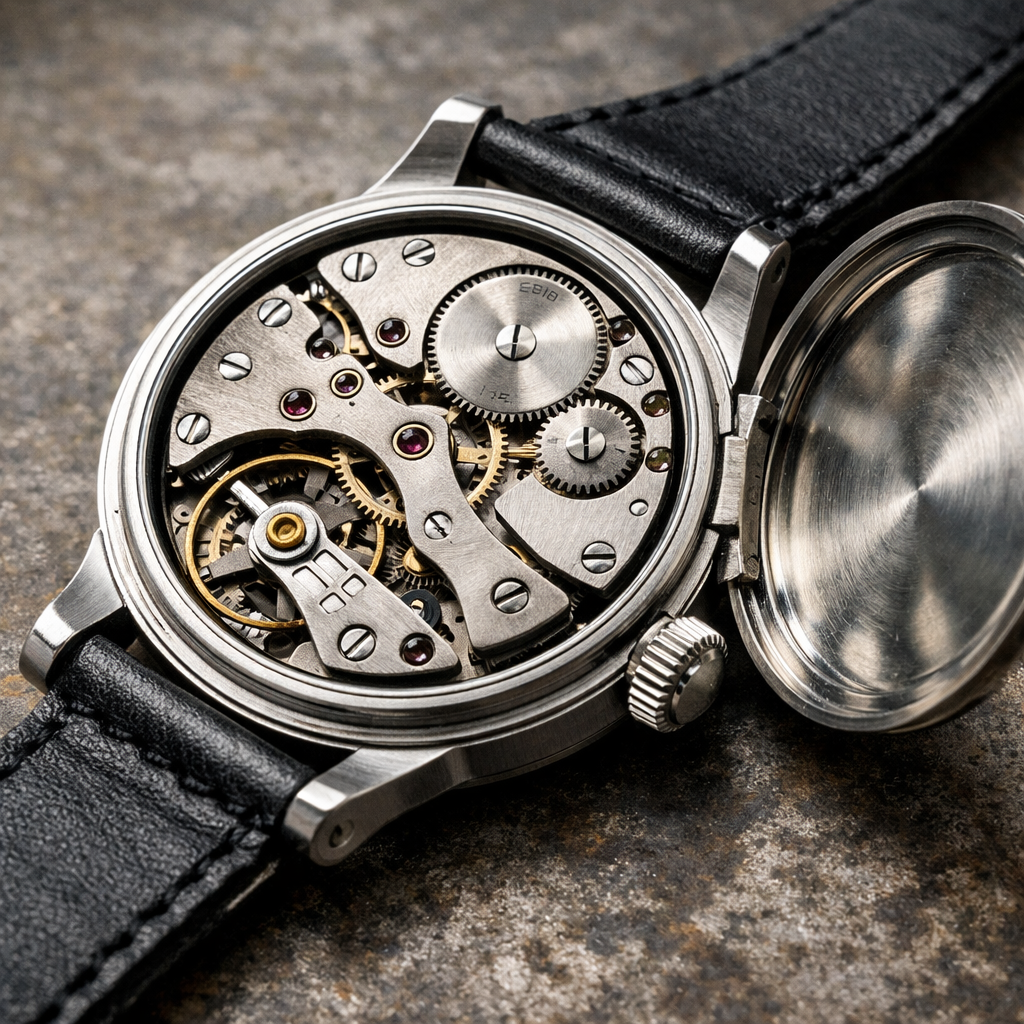
In the simplest terms, a "pasówka" is a wristwatch built around a movement from a pocket watch, housed in a new case. Sometimes the original dial and hands are also preserved, sometimes not, and this is where the complications begin.
A "pasówka" can be a legitimate way to save a historical movement, an honest author's project, a harmless assembly, or a plain fake or even a terrible creation that defies the above definitions. The difference lies not in the fact of conversion itself, but in the quality of workmanship, the creator's intention, and the way it is communicated.
Where "pasówki" came from
The phenomenon's origin was not fashion, but economics.
In the 20th century, especially during periods of crisis and sharp increases in gold prices, millions of pocket watches were stripped for their precious metal, and their cases melted down. The movements, often high-grade, were left "homeless."
They were too good to throw away, but useless in their original form. It was only the change in trends – the move away from small 34-36mm watches and a fascination with large, raw forms – that gave pocket watch movements a new life on the wrist.
The technical truth about "pasówki"
Movement orientation, or the detail that reveals everything
Pocket watches came in two basic construction layouts.
Lépine (open face) – crown at 12 o'clock, small seconds at 6.
When adapted to a wristwatch, this often results in the seconds hand at 9 o'clock. Technically correct, aesthetically quite debatable.
Savonnette (hunter) – crown at 3 o'clock, seconds at 6.
An ideal layout for conversion. That's why hunter-type movements are slightly more expensive and sought after.
This one detail often tells more about a "pasówka" than an entire auction description.
Case: a box or a construction
The cheapest "pasówki" are based on universal, mass-produced cases, often with a loose fit and plastic spacer rings. These solutions are functional in some way, but not durable, and worse, bad from the perspective of an often unaware user.
At the other extreme are cases designed for a specific movement, CNC milled or 3D printed with perfect support for the plate and bridges. At this point, a "pasówka" stops being just an assembly and starts to resemble a micro-manufacture, but one must always keep in mind all the limitations mentioned below.
The biggest problem: shock resistance
Most pocket watch movements do not have a shock-absorbing system. The lack of an "Incabloc" means that a fall onto a hard surface very often results in a broken balance staff, which is one of the most expensive and troublesome repairs in old movements.
Therefore, a "pasówka," despite its massive appearance, is not a "daily wear" watch, but one for conscious, careful use.
One should also remember about limited water and dust resistance. This is not the kind of watch that today's manufacturers accustom us to.
A "pasówka" is not the problem. The problem is a "pasówka" that pretends not to be one.
Four types: from rescue to fake
Type A – purist "pasówka"
Original movement, dial, and hands. Only the case is new.
This is a form of saving a historical movement, widely accepted by collectors – provided full transparency. The creator tries to preserve maximum originality with minimum intervention, and only what is necessary to convert a pocket watch into a wristwatch.
Type B – author's project
Historical movement, everything else designed from scratch, without the original brand's logo on the dial.
This is not a fake, but independent craftsmanship and full-fledged authorial creation. There are projects that are beautiful in form, but there are also those described as kitsch. I also know of projects made by talented craftsmen strictly to client requirements (decorated, painted dials) in cooperation with an artist, which are often not only unique but also very beautiful.
Type C – frankenwatch and painted dial
A mix of parts, repainted dials, fanciful logos, military narratives without factual basis.
Often with elements of Hitler's Germany, i.e., eagles, swastikas, etc. The goal is to deceive a potential buyer by creating the impression that they are buying a "historical" and, consequently, valuable watch. If it were honestly described, it would be half bad, but this is rarer than a four-leaf clover. If sold as original, which unfortunately is practically the rule, they become a fraud that unaware buyers still fall for.
Type D – fake
New dial with an applied trademark, new case, and the brand had nothing to do with this watch.
This is a violation of the law, regardless of whether the movement is original.
The movement can be historical. The lie is always contemporary.
Polish specificity: Molnija and DIY culture
Poland is one of the European centers of the "pasówka" market. The Molnija 3602 plays a key role here as a fairly solid, large movement that is a copy of the Cortébert 616.
For many enthusiasts, building their own "pasówka" on a Molnija was the first step into watchmaking. At the same time, it is a market where it is easiest to encounter products of borderline quality.
The debate has been going on for years: barbarism towards historical artifacts versus giving movements a second life. The truth, as usual, lies somewhere in the middle.
Does a "pasówka" make investment sense?
Usually not.
A "pasówka" rarely has a strong secondary market, and upon resale, often only the sum of the component parts remains, without the creator's margin.
Exceptions are recognized author's projects and purist "pasówki" with very good movements, in excellent condition, and with a clear history.
Purchase Checklist
Always inspect the movement: serial number, condition of screws, regulator.
Check the dial: fonts, proportions, mounting method.
Treat water resistance as fiction, and remember the technical limitations (lack of shock resistance or dust resistance, as well as limited accuracy).
Assume servicing and factor it into the price.
If the seller avoids answering, you already have your answer.
Instead of a summary
A "pasówka" is neither salvation nor a crime against history. It is a product of its era and can be a compromise between saving mechanics and contemporary taste. But unfortunately, in my experience, it is much more often not worth buying.
For some, it will be heresy. For others, the only chance to hear the slow, loud ticking of a 19th-century movement on their own wrist.
And as long as it doesn't pretend to be something it isn't, it has every right to exist, provided full informational transparency.