WoW Investigations
Jewel Wars: The Battle of the Jewels
How synthetic ruby jewels in a watch stopped serving a technical function and began creating value based on naivety.
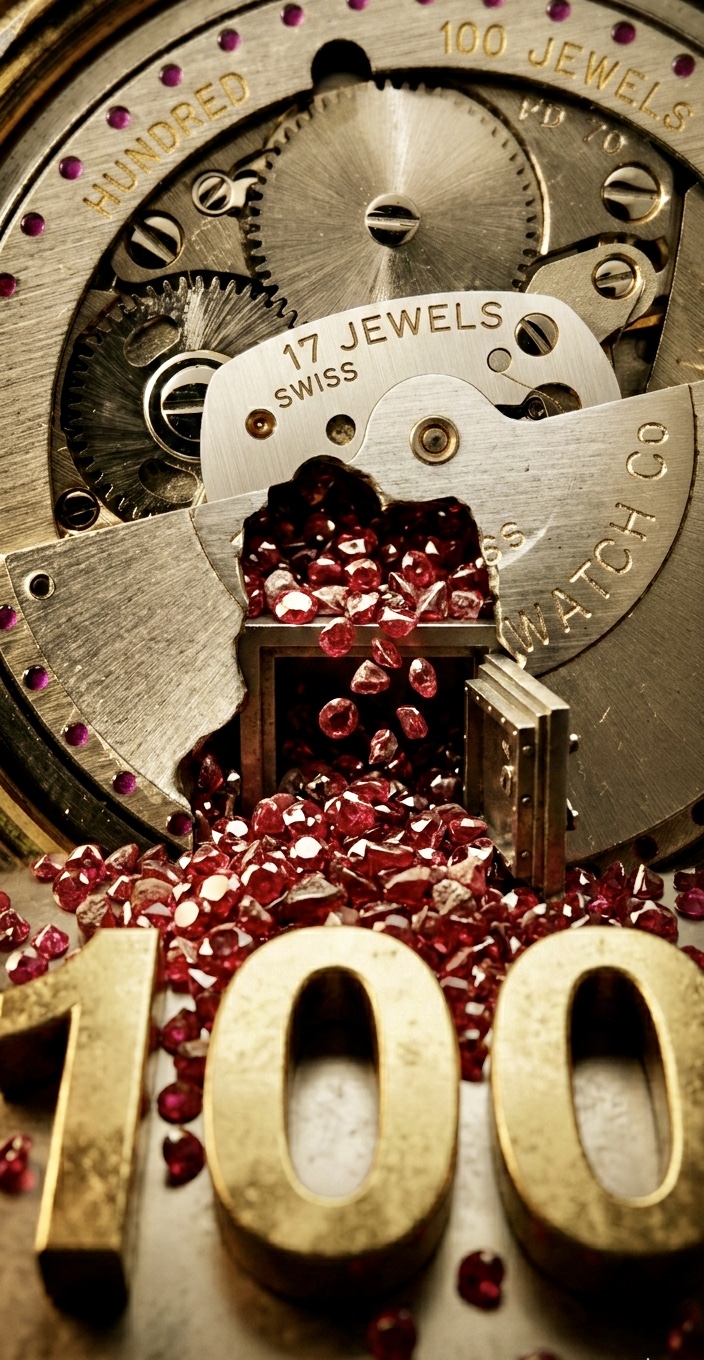
In the history of watchmaking, there have been and still are many different races. Some of them were quite sensible, such as the race for accuracy or the length of time between services. Others were aesthetic and engineering-driven, like the race for movement thinness or complications.
But there was also a race that today sounds like an industry joke, though its echoes persist even now.
It was a race for… the number of jewels.
In the 1950s and 1960s, the watch industry fell into a spiral that today we would call "metric hysteria." The number of so-called ruby jewels in a movement, a technical parameter with real significance, was transformed into a marketing fetish. The more jewels, the "better" the watch. Simple, understandable for every customer, and easy to sell.
Thus, the Jewel Wars were born.
1. Why Jewels Make Sense at All
Let's start by saying that jewels in a watch are not decorative, nor are they any real valuable addition, like diamonds or gold. They are factory-made, meaning synthetic, and their purpose is to minimize friction at specific points.
The pivots of the gear train wheels rotate in the plates and bridges. If metal worked directly against metal, wear would be rapid, and timekeeping stability dramatically lower. Synthetic ruby and sapphire jewels (hardness 9 on the Mohs scale) are ideal bearing materials: they minimize friction, stabilize wear, and improve durability (of course, lubrication at these points with special oil is crucial).
Therefore, over decades, reasonable standards have been developed:
7 jewels is the absolute minimum for the escapement to function.
15 to 17 jewels indicates a sensible quality for a manual-wind watch with three hands and a date complication.
21 to 25 jewels is typical for an automatic movement with additional bearings and cap jewels.
25 to 30 jewels are found in more complex constructions.
Above this number makes sense if a very large number of complications are involved (perpetual calendar, minute repeater, etc.).
Beyond this level, in a simple watch, further increasing the number of jewels yielded diminishing returns, and very often none at all.
And this is where our story begins.
2. The Moment When Technology Became a Label
The post-war consumer didn't understand balance amplitude, escapement geometry, or lubricant quality. But they understood numbers, so if one watch had 17 jewels and another had 21, the latter "had to be" better.
And manufacturers understood that if a competitor introduced and advertised 25 jewels, they would introduce 30. And since 30 sold well, why not 45? 60? 77? Or perhaps a magical 100?
The cost of a synthetic jewel was negligible, but the impression was enormous.
Thus, the ruby inflation of prestige was born.
3. Escalation: From Ambition Through Technology to Absurdity
At the peak of the 1960s, some manufacturers decided to cross the line of common sense.
The most famous example is the American Waltham "100 Jewels." The movement was based on a standard construction with about 17 functional jewels. To reach the magical number of 100, a ring of 83 additional rubies was added under the automatic winding rotor.
The visual effect was spectacular, but the technical effect was zero.
In watchmaking circles, this model is still cited today as a classic example of "bedazzling," which is the embellishment of a movement with elements that do not improve accuracy or durability and are completely unnecessary.
Were there companies that tried to justify this more ambitiously? Yes. Some constructions (e.g., Japanese Ricoh models with ball-bearing rotors) had real technical elements supporting a higher number of jewels. But even there, marketing clearly outpaced engineering. The line was crossed, and the war was in full swing.
4. Why Did It Work at All?
Because a number is objective, easily comparable, and simple to communicate. Every customer understands that 100 jewels is more than 25.
"100 jewels" sounds like a measurable parameter, and it sounds like something that can be compared to others. It even sounds like proof of excellence.
And humans love indicators that can easily measure, especially luxury and excellence. In reality, the number of jewels became a shorthand, a symbolic quality tag. The consumer didn't see the movement and didn't analyze the bridge construction, but they saw "100," and that was enough.
5. The Most Famous War Crimes.
The most famous is the aforementioned American Waltham, which, trying to regain its former market position, presented a model advertised as "100 Jewels."
Orient Grand Prix 100 as an ambition in Japanese style
Japanese Orient decided to show that it could play the same game, only more subtly. The Grand Prix 100 model from the mid-1960s was structurally much more refined than its American counterpart. It featured extensive jeweling, anti-shock solutions, and a dense movement architecture. Were one hundred jewels really necessary there? No. But was the movement good? Yes.
This is an important distinction. In the case of Orient, we were dealing not with pure decoration, but with technological ambition infused with strong marketing exaggeration. The number was still a message, just better packaged. Without the primitive insertion of jewels wherever there was space for their display.
Ricoh Dynamic 45 is a story where marketing tries to defend itself
Ricoh, also from Japan, advertised its forty-five jewel models as a technological breakthrough. The construction featured rotor bearing solutions utilizing ruby elements. Part of this number could be justified, but here too, the number became an end in itself. The watch was supposed to be "more advanced" because it had more jewels, even if the average user would not feel any difference.
Titoni, Clinton, and others, or endless wartime escalation
In the 1960s, models with 60, 70, and even over 100 jewels appeared. Titoni offered Airmastery with an impressive 77. There were reports of models signed with the number 110. At some point, it stopped being about function and started being about the record. According to the old rule, it doesn't matter what they say, as long as they don't twist the name.
6. Industry Reaction, or When Standards Enter as Peacekeeping Forces Imposing Peace Terms.
At some point, the situation became so grotesque that regulation was needed.
First, in Switzerland, the NIHS 94-10 standard appeared, which attempted to clarify the definition of functional jewels. The culmination was the international ISO 1112 standard (1974).
ISO clearly defined:
a functional jewel is one that genuinely stabilizes friction and reduces wear in the moving parts of the movement,
decorative jewels cannot be included in the official count,
marketing cannot use a number that does not correspond to functional reality.
7. Why the Jewel Wars Are Important Today
Because this was not a story about jewels, but it was a story about how a technical parameter can be transformed into a tool of marketing suggestion.
Aside from the fact that some still repeat like a mantra that a movement is better because it has more jewels, such marketing games of imposing narratives on customers continue unabated, only the form has changed.
Today, the role of these magical "100 jewels" is often played by:
the slogan "in-house" used out of context, often for movements that are only modified or made "by force" and are often functionally worse than popular ones.
narratives about "uninterrupted history for over 140 years, when only the name remained of the company, which the narrator bought for pennies and created a 'shell' that has nothing to do with the roots of its logo, either technically or generationally."
stories of non-existent but good-sounding "Graf von Zayten" brands that order cheaply from China, selling the magic of the name and place of registration, e.g., in Germany.
almost magical tales about a drop of old alcohol that turns a watch into a unique collectible and investment object.
limitations creating an illusion of rarity, but mass-produced in several thousand pieces per series, and the series stretch like long-running TV shows.
complex numbers that sound impressive but say little about real quality.
In the 1960s, rubies were sold; today, stories are sold.
8. Epilogue, or the Irony of History
The Jewel Wars ended almost simultaneously with the advent of the quartz revolution. Quartz watches, then ultra-precise, inexpensive, often with zero or minimal jewels, made the entire bidding war suddenly anachronistic.
Jewels ceased to be ammunition, and today "100 jewels" models are a collector's curiosity. Not because they are technically outstanding, but because they symbolize a moment when the industry crossed the line between engineering and illusion.
The Jewel Wars were not a war for quality, but a war of marketing departments for customer wallets.
Which, in another form, continues to this day.