WoW Investigations
Has Moser just turned towards smartwatches?
For the first time, Moser combines mechanics with a digital operating module, provoking the question of whether we are witnessing the birth of a new definition of haute horlogerie.

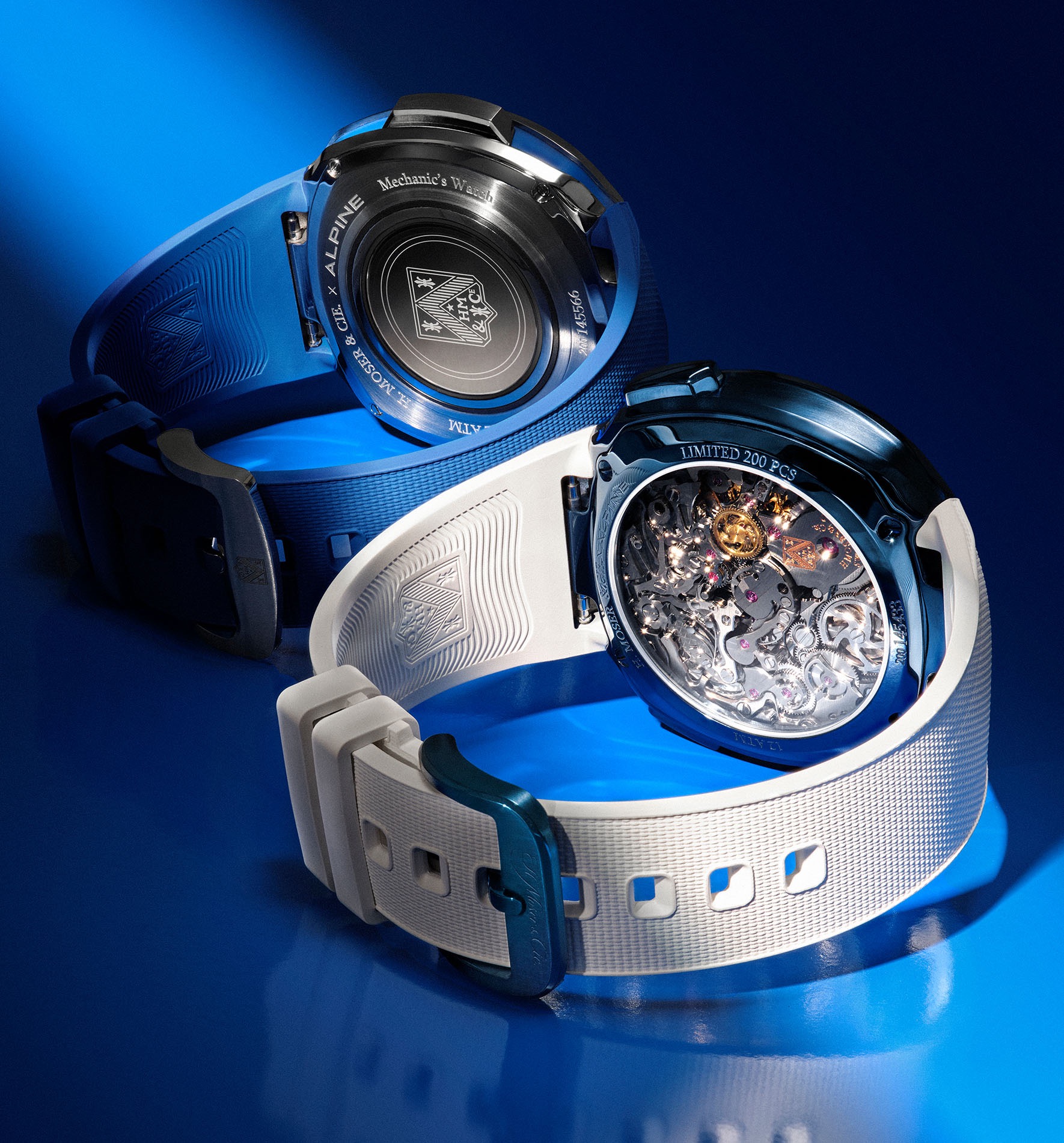
H. Moser & Cie. Streamliner Alpine Mechanics Edition
If someone had said a few years ago that Moser would release a watch that communicates with a phone, most would have considered it satire.
Meanwhile, the Streamliner Alpine Mechanics Edition is real and is neither a compromise nor a typical Moser marketing joke, but rather a kind of declaration.
The only question is, what kind?
I won't pretend here that I intend to dismantle this watch screw by screw, measure its thickness, or compare its mechanical values or technical-electronic specifications, because there are places that do it better, such as the portal Ch24.pl .
Pushing boundaries.
Something else interests me. I'm interested in the moment when a watch brand stops merely producing an object and starts pushing the mental boundaries of the entire industry.
And that's why the Streamliner Alpine Mechanics Edition is interesting to me.
Not because it has Bluetooth, and not because it displays messages from the Formula 1 paddock.
Not even because it was created in collaboration with the BWT Alpine Formula One Team, but in my opinion, the most important thing is that a brand like H. Moser & Cie. decided to enter the world of electronics at all, and did so not as a capitulation caused by, as it's nicely put in business, "the necessity of a pivot," but as an intelligent provocation, for which Moser is already known.
What's going on inside this watch?
If you look at this watch coolly, technically, without the marketing fog, we are dealing with a two-layer, almost philosophical construction in its architecture. Inside are two worlds that for the last fifty years have treated each other as enemies: a mechanical core and a digital operating module. Mechanics are responsible for time in the basic sense, i.e., there are hands, fumé, silence, and continuity. Electronics are responsible for time in an operational sense, displaying messages, synchronization, fractions of a second, and race context.
A coexistence that seemed impossible to reconcile in the world of Haute Horlogerie.
The most interesting thing is that these two worlds do not try to replace or eliminate each other, or even demonstrate the superiority of one over the other. They coexist.
This is the essence for me.
The small, domed dial is not a decoration for the screen, but an autonomous heart of the watch that works even when the digital module is dormant. Electronics do not drive the hands, nor does mechanics power the processor. This is not a hybrid in the mechanical sense; it is a hybrid in the ideological sense. Time as a foundation and time as information.
And this is where the breakthrough begins.
Because the world of high watchmaking has for decades built its identity in opposition to electronics. The quartz crisis was a trauma that taught the industry one thing: we will only survive if we are different from mass technology. Mechanics became not only a technical solution but a manifesto, and electronics was "that other world," fast, utilitarian, and disposable.
Another Moser blasphemy.
Moser does something that, from a purist's perspective, might look like blasphemy, and from a strategist's perspective, like a preemptive move. Moser clearly communicates that electronics do not have to be a threat if they do not try to pretend to be the "soul" of what was until now a mechanical watch.
In the Mechanics Edition, this digital module is a tool, not an identity. The display wakes up when needed and synchronizes only when truly necessary. In sleep mode, the watch does not scream, does not glow, does not pretend to be a gadget. It is a full-fledged watch, and only upon activation does it become an interface.
This is very "Moser-like."
This brand has been provoking the industry for years, sometimes with humor, sometimes with irony, sometimes brutally directly. Just recall their approach to "Swiss Made," their conceptual designs combining all elements of several watch icons into one, and also their play with minimalism. They like to challenge the obvious, and here they do the same, only more subtly.
Because if a watch can be both an autonomous timekeeper and a team communication tool, it ceases to be merely a collector's item. It becomes an element of infrastructure. It does not replace Formula 1 telemetry systems but integrates into their rhythm, simultaneously being such a personal and physical point of human contact with information, without losing its mechanical soul as an object beyond its function.
Is this a revolution?
This is not a technological revolution, because Bluetooth and low-power processors have existed for a long time. This is a mental revolution, because until now, a luxury mechanical watch was a demonstration of detachment from functionality in the technological sense. It showed that we can build something beautiful, complex, and superfluous in the age of atomic clocks and smartphones. And suddenly, a construction appears that says: we can remain beautiful and complex, and at the same time enter the world of real-time data, without losing face.
And that's what fascinates me most about this project.
photos - official brand website
Quo vadis?
I don't know if in five or ten years we will see more such constructions in the haute horlogerie segment, and whether this will permanently affect the industry in any way.
Perhaps the community will consider it an experiment, a curiosity, and a side, blind alley. Perhaps collectors will remain faithful to the pure, analog dogma. But the very fact that a brand with such a distinct identity as Moser decided to stand on both sides of the barricade is a signal to me that the mechanical watch no longer wants to be just a relic.
And that's why I don't treat the Streamliner Alpine Mechanics Edition as just another model in the catalog. I treat it as a question posed to the entire industry: can a luxury watch be both a manifesto of tradition and a tool of modernity, without losing its dignity?
For now, the answer is: Moser believes it can.
And frankly, I really like them for daring to find out.